Who Were the Early Believers?
Who Were the Early Believers?
Christians or Natsarim (Nazarenes)?
There is a long-standing assumption, often repeated by theological institutions and echoed from countless pulpits, that the earliest followers of the Messiah were known as Christians. Yet a closer examination of the historical record reveals a very different story, one shaped more by later Roman interpretation and the lying pen of scribes than by the reality of the first century.
For many, this realization is both startling and unsettling, as it calls into question long-held assumptions and inherited customs that find little support in Scripture. Yet such moments of tension often mark the threshold of deeper understanding. You are therefore invited to consider the following perspective, which carefully reexamines these traditions in the light of historical evidence and the testimony of Scripture, seeking not controversy, but clarity and truth.
The Emerging Christian
With this background in mind, it is necessary to trace the earliest appearances of the term “Christian” as it began to emerge in both Scripture and the wider Roman world. Though the word appears only a few times in the New Testament and never as a self-designated title of the earliest Messiah-followers, the historical record indicates that it functioned primarily as an external label, applied by observers to identify a distinct group. Before examining how this designation gradually separated from its original Hebraic framework, we must first establish where and how the term itself entered the historical record.
The first known ancient appearance of the word Christian (Greek Χριστιανός, Christianos) is in Acts 11:26, where it says that “the disciples were called Christians first in Antioch.”
Later in the same book, Acts 26:28, we find an even more striking instance when King Agrippa II says to Paul, “Do you think that in such a short time you can persuade me to become a Christian?” suggesting the term was known and used by outsiders in a recognizable way.
A third early biblical reference appears in 1 Peter 4:16, where believers are told not to be ashamed “if anyone suffers as a Christian.”
The earliest recorded non-biblical sources of the term “Christian” are as follows:
A.D. 56-120 The term “Christian” was used by Tacitus in describing Nero’s persecution. Annals, Tacitus on Jesus, Tacitus. Wikipedia
A.D. 69-122 Suetonius appears to refer to “Christians” when describing disturbances involving a group associated with “Chrestus” among Jews in Rome. Wikipedia
A.D. 61-113 Pliny the Younger mentions Christians as a distinct group when discussing how to handle legal cases involving them. Wikipedia
In contrast to the apparent evidence presented above, the commonly accepted narrative that Christianity originated with the first followers of the Messiah, the Christ, as the Anointed One, must be carefully reconsidered. The historical record instead points to a later designation, one that was deliberately promoted and overwritten by governing Roman scribes, gradually reshaping an external label into a formal religious identity severed from its original Hebraic and covenantal foundations.
Jerome Describes the Differences Between the Natsarim and Christians
Let’s consider the insights provided by Jerome, a significant figure in the early Roman Christian Church, as he contrasts the Natsarim, faithful followers of the Messiah, with the emerging Christian Church of Rome. The following passage comes from early church polemics, preserved in the writings associated with Epiphanius of Salamis and later referenced by Jerome in his book the Panarion 29.
It is important to note that when scholars speak of early church polemics, they are not referring to the Messiah’s original followers as portrayed in Scripture, but to the emerging institutional church within the Roman world, particularly from the late 2nd through the 4th centuries. During this period, orthodoxy was increasingly defined by opposition, as church authorities argued against groups they labeled “heretical.” Keep this distinction in mind, for it lies at the heart of this study: early (Roman) church polemics do not describe the biblical community of Messiah-followers, but rather a later Romanized framework that developed after the apostolic era.
“We shall now especially consider HERETICS who… call themselves Nazarenes [Natsarim]; they are mainly Jews and nothing else. They make use not only of the New Testament, but they also use in a way the Old Testament of the Jews; for they do not forbid the books of the [Torah] Law, the Prophets, and the Writings… so that they are approved of by the Jews, from whom the Nazarenes do not differ in anything, and they profess all the dogmas pertaining to the prescriptions of the [Torah] Law and to the customs of the Jews, except they believe in Messiah… They preach that there is but one god, and his son
Jesus[Yahusha]. But they are very learned in the Hebrew language; for they, like the Jews, read the whole [Torah] Law, then the Prophets. . .They differ from the Jews because they believe in Messiah, and from the Christians in that they are to this day bound to the Jewish rites, such as circumcision, the [lunar] Sabbath, and the other [lunar appointed] ceremonies.“ Jerome – Epiphanius; Panarion 29; translated from the Greek. (Jerome translated Greek Septuagint Bible into Latin language 1,615 years ago, he was an early Roman Christian Church father, here referring to the Nazarenes. Jerome was born 347 A.D. and died 420 A.D., which provides evidence that Christianity did not commence four centuries previous.)
Note: The bracketed terms [lunar] and [lunar appointed] in the quote above have been intentionally supplied by me to reflect the original scriptural and Temple-based meaning of the Sabbath and appointed times as governed by the heavenly lights (Genesis 1:14) and practiced throughout the Temple period. These clarifications are necessary because both later Roman Christianity and Rabbinic Judaism redefined sacred time and holy days through fixed weekly cycles and non-lunar frameworks that diverged from the original pattern set forth at Creation. The Nazarenes described above were not merely “Jewish” (Yahudim) in custom, but remained faithful to the Creator’s lunar-based rhythm of worship, including New Moon Days, lunar Sabbaths, and the lunar appointed Feast Days as originally ordained. Extensive scriptural, historical, and documentary evidence supporting this conclusion is presented throughout this work, and in the article titled The Lunar Sabbath’s Stunning Historical Evidence.
What this quotation exposes is a historical and theological fault line that is often hidden when the word “Christian” is casually defined as “Christ-follower.” As you know, fault lines are specific locations where earthquakes occur. In the same way, when this long-buried distinctive truth is brought to light, it has the potential to unsettle long-standing assumptions, shake inherited traditions, and force a serious reexamination of identity, authority, and allegiance within the Bible-believing community.
What This Profound Quote Reveals
Ironically, what these church fathers intended as a critique becomes, for us, a historical witness. They describe a group called the Nazarenes (Natsarim), whom they label “heretics,” yet they admit the following facts about them:
-
They were ethnically Jewish
-
They believed in one Alahim/Elohim
-
They believed Yahusha is the Messiah, not the Roman/Greek Jesus
-
They used both what we call the Old and New Testaments
-
They upheld Torah, Prophets, and Writings
-
They observed circumcision, the lunar Sabbath, Passover, and all the lunar appointed times
-
They read Scripture in Hebrew
- They all had Hebrew names
-
They lived indistinguishably from Jews except for their faith in Yahusha, the Messiah
This is not a marginal footnote. It is a clear description of what Messiah-followers looked like in the earliest centuries, contrasting greatly from Christians.
The Critical Distinction This Quote Makes
The most important sentence from the quote above is this one:
“They differ from the Jews because they believe in Messiah, and from the Christians, in that they are to this day bound to the Jewish rites…”
This tells us something profound:
-
In the 4th century, “Christian” already meant something distinct from the Torah Law-observant Messiah followers.
-
The term Christian had come to signify a Gentile identity redefined apart from Torah covenantal obedience, no longer describing a Hebrew Messiah-follower, but rather an adherent of a Roman-constructed understanding of Jesus Christ.
-
Therefore, “Christian” was not synonymous with Mashiach-follower in lived practice, and everyone at that time understood the difference.
Thus, when modern language equates:
Christian = follower of Christ,
an essential historical step is often omitted. The titles Christ and Christian were increasingly employed within the developing Roman Christian church, which deliberately distinguished itself from the original Messiah-followers by adopting a non-Hebrew identity and redefining faith apart from Torah observance. This linguistic and cultural shift marked not merely a change in terminology but the formation of a new religious trajectory that honored a fictitious Jesus Christ and a worship rhythm all their own.
This departure culminated in the establishment of Roman religious holidays, including Christmas, which takes its name and meaning from Rome’s reconstituted and fictitious “Christ,” an anointed figure shaped by imperial theology rather than the Messiah revealed in the Hebrew Scriptures.
Inception of Christianity
The development of what we now recognize as the “Christian” religion took shape between the 2nd and 4th centuries, primarily by the Greek-speaking Roman Emperors. Interestingly, its inception was marked by a notable departure from and, at times, hostility towards aspects central to the Yahudim (Jews) traditions. This includes the Torah Law and the observance of sacred New Moon Days, lunar Sabbaths, and appointed Feast Days, cherished attributes by the faithful followers of the Hebrew Messiah. Refer to the article “Constantine’s Creation of Jesus Christ” and “The Constantinian Creed, the Forgotten Foundation of All Christian Churches.“
Name and Title Swap
Historically:
-
Yahusha (Hebrew name) was the personal name of the anointed Messiah.
-
Mashiach (Hebrew title) was a functional designation, meaning Messiah, the anointed.
-
Iēsous Christos (Greek/Roman) is a Hellenized name with a Greek title. The word Christ, which was inserted in Scripture, is an epithet of the Messiah. Meaning the term Christ is a translation and replacement term, while Mashiach (Messiah) is the original Hebrew word meaning anointed.
-
Jesus Christ (Latin/English) became a fixed proper name. Mary never called her son Jesus because it did not exist until the 17th century A.D. There is no “J” in Hebrew. Later, the Romans inserted “Jesus” in the Bible as a replacement for our Messiah’s true name, Yahusha. Yahusha means Yah saves by way of the Lamb, identifying who saves and how.
That transition is precisely how the Roman church:
-
Moved from Hebraic meaning to a unique Roman institutional identity
-
Shifted from “Yahusha the Messiah”
to “Jesus Christ” a replacement.
What We Learned From This
Jerome’s observations shed light on the distinct characteristics of the Natsarim, who identified closely with Jewish traditions. Unlike the Christians of his time, these Natsarim believers maintained a deep connection to the Old Testament (Tanakh) Scriptures, including the Torah Law, Prophets, and Writings. Their adherence to Jewish customs and their belief in the one Alahim (God) and his son, Yahusha (Jesus), set them apart. Despite their faith in the Messiah, they remained committed to Jewish practices such as circumcision, the lunar Sabbath, Passover, and all the other Feast Days and Temple ceremonies.
What becomes evident through Jerome’s words is the unique identity of the early Natsarim believers as authentic followers of the Messiah. Their unwavering commitment to both Yahusha haMashiach and the TORAH LAW, in line with the teachings of the Hebrew Scriptures, distinguished them from the Christians of their time. This distinction highlights the tension between the emergence of the Roman Christian religion along with the much later development of her Protestant daughters, in contrast to the steadfast faith of the Natsarim, who continued in Torah belief and lunar Temple practice, honoring the lunar Sabbath and New Moon Days, and faithfully keeping all the lunar appointed Feast Days, including Passover on the fourteenth day counted from the spring New Moon.
It’s intriguing to see how historical narratives unravel, revealing the complexities of religious identity and doctrine. The contrast between the Natsarim and the Christians underscores the disparity of truth within their beliefs and practices. It was the governing role of the Roman “Christian” religion to depart from and have nothing to do with the Scripture’s Torah Law instructions of either the Jews or the Natsarim (Quartodecimen), the true followers of the Messiah.
Lying Pen of Scribes
The Shift in Time Measurement
Let’s journey back to Julius Caesar’s time (45 BCE), when he introduced significant changes to the Roman calendar 200 to 400 years before the creation of Christianity. His decision transitioned the calendar from being astro-luni-solar to astro-solar, effectively sidelining the moon’s role in time measurement. This paradigm shift, though innovative, altered the celestial ties referenced in Scriptures like Psalms 104:19, Psalms 89:37, Isaiah 66:23, and Ezekiel 46:1-3, disconnecting time from its previous lunar markers as outlined in Genesis 1:14, 16.
“In 46 B.C. Julius Caesar asked astronomer Sosigenes to suggest ways to improve the calendar. Acting on Sosigenes suggestions, Caesar ordered the Romans to disregard the moon in calculating their calendars.“ World Book Encyclopedia, Vol. 3, p. 28.
“Julius Caesar’s conquest of Egypt in the 1st century BC introduced this planetary week to the Roman Empire… Since the astrological and Jewish weeks were both seven days long, by the 1st century AD the day of Saturn had become identified with the Jewish Sabbath. After Christianity became the state religion, the Church integrated both cycles to produce our present week, used also by Jews and Muslims.” (Sarah Belle Dougherty in her book review of The Seven Day Circle: The History and Meaning of the Week by Eviatar Zerubavel, University of Chicago Press, Chicago and London, 1989. As published in Sunrise magazine, August/September 2003; copyright © 2003 Theosophical University Press)
This alteration not only redefined the length of years, months, weeks, and days but also introduced an eight-day week cycle, breaking away from the divine pattern. Consequently, when Emperor Constantine convened the Council of Nicaea four hundred years later, further adjustments were made to the Julian calendar, including reducing the week’s length from eight to seven days. However, the continuous cycling rhythm introduced by Julius Caesar persisted, evidence that it continued to be divorced from its lunar origins.
Discovering the Divine Time-Measuring Model
In Genesis 1:14-16, Leviticus 23, Isaiah 66:23, and Ezekiel 46:1-3, we encounter the Creator’s remarkable astro-luni-solar time-measuring model. This model not only synchronizes earthly worship rhythms with the Creator’s celestial throne but also reflects an eternal and unaltered design. It’s a testament to divine craftsmanship, designed to align earthly worship with the eternal rhythms of Yahuah Alahim.
From the construction of the wilderness Tabernacle through the destruction of the Second Temple, the sanctuary functioned as a divinely instituted system, designed to align Yahuah’s people with His prescribed order of worship, sacred time, and covenant faithfulness.
Because of the Jews’ (Yahudim) corporate decision to reject Yahusha as their Messiah and devise an elaborate plan to have Him judged and killed by Roman authority, their fate was sealed. They would no longer be His chosen people. They were destined to fall under Roman law and lose sight of the Creator’s Celestial timepiece, no longer bearing even one accurate unit of time measurement. They would no longer carry the divine oracles of truth as they are in Scripture.
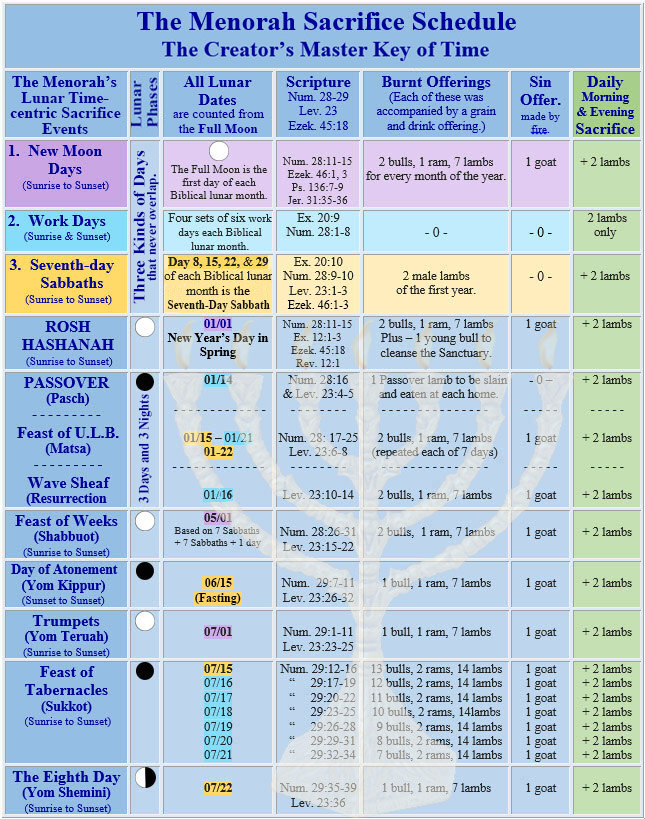
In addition, as humanity grappled with sin and rebellion, alternative time-measuring systems emerged. These gentile counterfeit systems lacked the potency to call worshippers to align their devotion with that of the Eternal Father and Son. For more on the Sacrifice Schedule, refer to: The Sacrifice Schedule, the Master Key of Time.
Navigating Historical Paradoxes
When we step back and trace the long arc of history, we discover that the calendar systems familiar to us today did not emerge in a vacuum. For more than three centuries, the Roman Empire operated on an eight-day weekly cycle. When Rome later adopted a seven-day cycle, the change did not represent a return to the Scriptural pattern; rather, it was a political and cultural shift shaped by forces demonstratively removed from the Genesis narrative. Today, if one desired the Roman week to mirror the Creator’s original rhythm, its historical foundation makes such alignment impossible.
Added to this is the deeper motive behind Rome’s reforms. These adjustments were not simply administrative conveniences; they were part of a broader effort to redefine identity and distance the empire from ancient Jewish practices. In the process, even the Jews living under Roman dominance saw their sacred markers of worship, the New Moons, the lunar Sabbaths, and the lunar appointed Feast Days gradually displaced. Under mounting pressure, they eventually conceded their sacred and ordained calendar, yielding it to a solar-based system that bore no resemblance to the pattern established at Creation.
With this in view, it becomes unmistakably clear that the modern Roman Gregorian calendar, with its uninterrupted cycling of days, cannot be seamlessly synchronized with the ordered week of Genesis. Its very structure carries a history and purpose that place it outside the Creator’s time-keeping design.
Revealing the True Significance
Despite the Romans’ emphasis on Easter Sunday as a replacement for Passover, it’s crucial to recognize that this holiday could never fully capture the essence of the true Messiah or its REMEDY for SIN as preordained in the Plan of Salvation outlined in the Torah. The fixed placement of lunar appointed Feast Days underscores the profound significance of each observance, offering a pathway to deeper spiritual understanding and connection with our Eternal Father’s divine plan to restore mankind back to His righteous standard.
Roman Inquisition
In reflecting on history, we encounter a somber chapter in time referred to as the Roman Inquisition, spanning from the fourth century CE to the 16th century CE. During this period, many Natsarim (Quartodecimen) faced persecution and even lost their lives for holding steadfast to their beliefs, deemed heretical by the emerging Roman Catholic Church.
It’s heartrending to consider the struggles faced by these early Messiah followers who refused to conform to the dogma imposed by the emerging Roman Christian Church. They bravely stood firm, resisting pressure to renounce their adherence to the Torah Law and embrace the newly formulated doctrines of Christianity. Among the contested beliefs was the observance of the time-centric astro-luni-solar calendar outlined in the Tanakh, with its sacred New Moons, lunar weeks, and Sabbaths. Additionally, the cherished Kadosh Feast Days, integral to the prophecies of the Messiah, were abolished under this coercive regime.
In the midst of this tumultuous period, a pervasive falsehood took hold, that the Feast Days and the Torah Law had ceased to hold relevance after the crucifixion. However, it’s essential to recognize that the decrees of Constantine and his Creed ultimately led to the abandonment of the Torah/Tanakh Law rather than the teachings of Paul or the Messiah. Also, as we learned in the first portion of this article, between the 2nd and the 4th century, “Christian” already meant something distinct from the Torah Law-observant Messiah followers. The term Christian had come to represent a Gentile, law-detached identity, not a Hebrew Messiah follower, but a Roman-crafted Jesus Christ follower. Therefore, “Christian” was not synonymous with Mashiach (Messiah) follower in lived practice.
As we reflect on these historical events, let’s honor the resilience of those who remained faithful to their Messiah and His time-honored Torah Law truth, despite facing persecution. Their courage serves as a reminder of the importance of staying true to the divine prescription, even in the face of adversity.
Unraveling the Truth
Embracing the Call of the Natsarim
In the midst of confusion and discord, there echoes a clarion call. The Eternal Father and Son extend a vital and enduring invitation, offering a pathway of escape for those who seek truth amidst the shadows of deception. This invitation resonates with hope, beckoning all who yearn for authenticity and restoration to come and find solace in the pure, life-giving waters of divine wisdom. Can you sense the tender whisper of guidance amidst the world’s confusion?
“Now the great city [seat of power] was divided into three parts, and the cities of the nations fell. And great Babylon was remembered before Yahuah Alahim, to give her the cup of the wine of the fierceness of His wrath. Revelation 16:19
“And on her forehead a name was written: MYSTERY, BABYLON THE GREAT, THE MOTHER OF HARLOTS AND OF THE ABOMINATIONS OF THE EARTH.” Revelation 17:5
“And I saw one of his heads as it were wounded to death; and his deadly wound was healed: and ALL THE WORLD WONDERED AFTER THE BEAST.” Revelation 13:3
“And he cried mightily with a loud voice, saying, “Babylon the great is fallen, is fallen, and has become a dwelling place of demons, a prison for every foul spirit, and a cage for every unclean and hated bird!” Revelation 18:2
“And I heard another voice from heaven saying, “COME OUT OF HER, MY PEOPLE, LEST YOU SHARE IN HER SINS, AND LEST YOU RECEIVE OF HER PLAGUES!” Revelation 18:4
“But the path of the righteous is as the shining LIGHT that shines more and more unto the perfect day. The way of the wicked is as darkness: they know not at what they stumble.” Mashali (Proverbs) 4:18
“Every good gift and every perfect gift is from above, and comes down from the FATHER OF LIGHTS, with whom there is no variation or shadow of a turning orbit [full sun, full stars, full moon].” YAHcob (James) 1:17
“So teach us to number our days that we may gain a heart of wisdom.” Tehilim (Psalms) 90:12
“It shall be established FOREVER like the MOON, even like the FAITHFUL WITNESS in the sky.” Psalms 89:37
“He ordained the MOON for SEASONS [#4150 – mo’edim – lunar appointed times]; the brilliant rays of the SUN reveal and endue it, making known its entrance [in the east].” Psalms 104:19 [This explains what governs the time-element of “SEASONS and/or FEAST DAYS” in both Genesis 1:14 and Leviticus 23:2-4.]
“Thus declares the Almighty YAHUAH, “the GATE of the courtyard interior facing the EAST shall be SHUT six days for work, and in the day of the SABBATH it shall be thrown open wide, and in the day of the NEW MOON it shall be thrown open wide. But come unto the exalted one, by way of the porch of the temple gate without, and stand beside the doorpost of the gate and observe the Kohenim’s (Priest’s) symbolic first and last burnt offering and symbolic Aleph and Tav peace offering. And you shall prostrate in worship upon the threshold of the open GATE, coming and going at any time, but the GATE shall not be shut until sunset.” And so WORSHIPED the people of the land at the entrance way of the same GATE, in the SABBATHS and in the NEW MOON DAYS, before the face of YAHUAH.” Ezekiel 46:1-3
Revelation paints a vivid picture of a world divided, where Babylon, the great, the epitome of falsehood and corruption, is confronted with the wrath of divine justice. Yet, amidst the chaos, a voice resounds from heaven, urging humanity to break free from the shackles of deceit and embrace the path of righteousness and YHUH’s (Yahuah’s) full light of truth.
The Scriptures, from Proverbs to Revelation, offer profound insights into the essence of truth and righteousness. Each verse serves as a beacon of guidance, illuminating the way forward for those who seek to align their lives with the eternal principles of light and wisdom.
If you’ve found yourself adrift in the sea of confusion, you’re not alone. Revelation 13:3 speaks of a pervasive deception that has ensnared “ALL THE WORLD,” leading many astray from the divine truth encoded within the celestial rhythms ordained by the Creator. By design, our Creator’s unique and purpose-driven lunar time-measuring model has been unceremoniously replaced by the Roman Christian counterfeit solar calendar. Well camouflaged, it is a time-measuring system so sinister as to cause its followers to be eternally lost. Those lacking “eyes to see or ears to hear” the still, small voice of Yahusha, their Messiah, calling them to return, will utterly miss out on the time-centric PROMISE from the beginning of the GLORIOUS PLAN TO SAVE MANKIND FROM ETERNAL RUIN.
The Distinction Between the Wise and Foolish Virgins
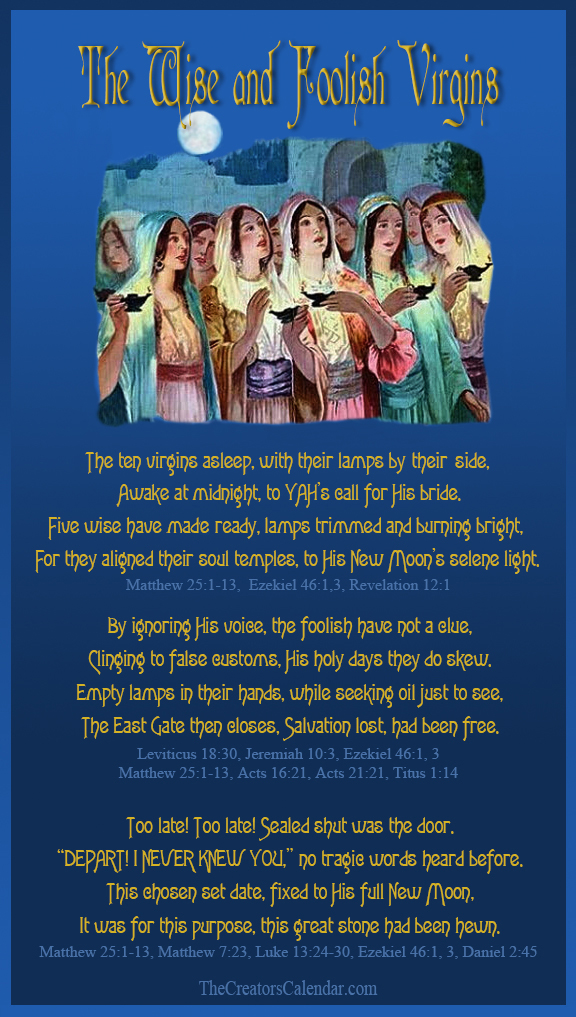
At the very end of time, the final testing truth is the restoration of our Creator’s original and authentic calendar. In the parable, both groups professed loyalty, both waited for the same Master, and both believed they were prepared. Yet when the hour of revelation arrived, their responses to this test of “TIME” exposed the quiet realities of their hearts. The wise received the unfolding light with humility, allowing obedience to shape their steps when truth called them higher. The foolish, though outwardly similar, hesitated to surrender long-held paradigms of worship and the popular solar calendar rhythm and were unrepentant and not prepared when the Bridegroom appeared.
In this way, the parable becomes a mirror for us: not all who wait for Him will embrace the light He restores. Only those whose hunger for truth rises above the desire for acceptance among worldly peers and the ease of long-standing but false paradigms will stand ready when the Bridegroom appears.
So Who Were the Early Believers?
Christians or Natsarim (Quartodecimen)?
The Final Call and Test
Our entrance through the East Gate is signaled by one sacred witness alone, the Kadosh Full New Moon, the very marker honored by the ancient Natsarim (Quartodecemin) and restored today to those who seek to walk as the Messiah walked.
This brings us back to the central question: Who were the Early Believers? Were they Christians as later tradition claims, or were they Natsarim (Quartodecimen) believers who faithfully guarded the Creator’s time-keeping system and the lunar-appointed Feast Days of Scripture, that outlined the Plan of Salvation and remedy for sin as laid out from the beginning? Both Scripture and History overwhelmingly affirm the latter. The earliest followers aligned their worship with the lunar calendar established at Creation, a pattern that Rome later abandoned and replaced.
All who claim allegiance to the Messiah yet disregard His still, small voice calling them to return and order their soul-temples according to His preordained, time-centered lunar calendar will never fully experience what it means to “follow the Lamb whithersoever He goes” (Revelation 14:4), for this path is inseparable from the Tabernacle’s time-governed sacrificial rhythm revealed only through the lunar model. Without this alignment, one cannot enter by the appointed doorway of salvation.
Now is the appointed time for a transformative return to the rediscovery of the very truths the early Natsarim cherished and for which many endured suffering and exile. It is a call to synchronize our lives with the Eternal’s sacred timepiece, to honor His lunar-appointed Feast Days, and to embrace the Bridal Covenant by which He distinguishes and tests His remnant.
Please understand that you are not alone. All the World has wondered after the Beast. We are not left without a compass. Let us respond with humility and resolve, for only by restoring the divine union of correct TIME and EVENT do we truly walk in the footsteps of the Messiah and accept His remedy for sinners. May this journey of rediscovery lead us to the true threshold of salvation and usher us into the radiant embrace of eternity.
Constantine’s Creation of Jesus Christ
Evidence the Full Moon Announces Lunar Months
Mounting Evidence for the Lunar Sabbath
The Sacrifice Schedule, The Master Key of Time
Kerrie L. French
www.TheCreatorsCalendar.com
TheCreatorsCalendar29.5@gmail.com