The Fourth Day of Creation
The Fourth Day of Creation
The Introduction of Earth’s Sun, Moon, and Stars
Have you ever paused to consider what truly transpired regarding the development of TIME on Earth between the first and fourth days of Creation? How were the cycles of each day established before the sun, moon, and stars were brought into existence, aligned, and set in motion? If this question has seldom been explored, you are warmly invited to consider the following narrative as a long-overlooked but ever-present missing link, one that has been obscured, overwritten, and largely unaccounted for in traditional explanations.
It is the purpose of this article to carefully examine this foundational issue as it is presented in Genesis chapter 1. To assist in this inquiry and to gain a fuller perspective, additional books of Scripture are brought into view, functioning much like a GPS, helping to locate and confirm vital elements of TIME that extend beyond Genesis alone. Through this broader scriptural witness, the missing pieces of the puzzle begin to emerge, and a remarkable picture, previously hidden, comes into clear focus. Together, these testimonies resonate as a harmonious symphony, declaring that TIME’S truths did not originate with the earth, but have existed in eternity past, from which earth’s time-measuring model was lovingly synchronized. All of this stands as the awe-inspiring work of our compassionate Eternal Father, Yahuah Alahim, and His only begotten Son, Yahusha HaMashiach, the Messiah.
Why Does Mankind Insist that Earth’s Creation Was the Commencement of Time?
It is easy to assume that the subject of TIME was long ago settled and maintained by those who preceded us, by the Rabbinical or Karaite Jews, the Roman church fathers, Protestant denominational reformers, scholars, and even presumed modern prophets, leaving little or nothing yet to be examined or rediscovered. Such an assumption, however, deserves careful reconsideration. When history is examined alongside Scripture, a different picture emerges, one that reveals how both the Romans and Jews played instrumental roles in altering the Creator’s established units of time, in direct opposition to the recorded standard. This sobering reality echoes the prophetic warning revealed in Daniel: “And he shall think to change times and laws” (Daniel 7:25).
Daniel 12:4 informs us that at the “time of the end, many shall run to and fro, and knowledge shall be increased.” While this passage is often understood as a reference to mass transit, global travel, or the rapid advance of modern technology, such interpretations do not fully exhaust its meaning. A closer consideration suggests that the emphasis may rest less on physical movement and more on the unprecedented expansion of tools that facilitate the pursuit of knowledge itself. In particular, the rise of computer-based resources that aid in the study of Scripture has dramatically accelerated access to original languages, historical records, and comparative texts. Through these instruments, human understanding is being enlarged in ways previous generations could scarcely imagine, serving to illuminate Yahuah Alahim’s end-time revelation of truth with greater clarity and depth.
The Computer Age and the Restoration of Sacred Time
Today, subjects may be gathered, cross-referenced, and studied within moments that only fifty or one hundred years ago would have required days, years, or even a lifetime of labor. In this light, it seems plausible that the greatest unveiling of truth arrives near the end of time as a form of discernment, a refining test that distinguishes the wheat from the tares and the sheep from the goats.
Truth has never yet been fully restored, nor sacred time fully understood, apart from that approaching reality when the Ruach ha Kadosh—the power, presence, promise, and provision of Yahuah—declares it through His still, small voice. Only those who have eyes to see and ears to hear, and who respond to truth with faithful action, will receive its reward.
In addressing this matter, it becomes evident that humanity has characteristically been myopic and self-focused. We often forget that the Eternal Father has existed from eternity past, abides in the present, and will continue into eternity future. As a result, we frequently lack the conceptual framework necessary to perceive that the earth and its rhythms of time were created to align seamlessly with His already-existing time-measuring order, rather than the reverse. In other words, Earth’s system of time was designed to reflect and mirror Yahuah Alahim’s preexisting, harmonious universe.
Would it not follow, then, that such a design would naturally include six days appointed for labor and a seventh day set apart for rest? Even beyond this, the east–west continuum of sacred time reveals further dimensions that have largely gone unconsidered, including the essential role of the New Moon.
These observations suggest that important elements of truth remain yet to be rediscovered and restored. Therefore, this article seeks to draw together the Scriptural principles associated with the fourth day of Creation, restoring another foundational stone in the original Creator’s Calendar and His dynamic design for the first week of earth’s history.
In the Beginning: Genesis 1 and the Sabbath, is there a relation to the New Moon?
The following statement is from the Biblical Research Institute of the Seventh-day Adventist Church – specifically, its chief officer at the time, Angel Rodriguez:
“The origin of earth’s Scriptural Sabbath definitely finds its birth in the creation week. It was instituted by God three days following the creation of the trinity of LIGHTS (sun, moon, and stars) according to (Gen. 1:14; 2:2), and not the seventh day after the first day of the month. It was to function independent of the month on a specific sequence of days unconnected from the moon and the sun, but uniquely grounded in God’s power to rule over time. The seventhness of the Sabbath is related to the passing of time, from the beginning of God’s creating activity on planet earth to its close. This is indeed a unique divine act, a fragmentation of time in a sequence of seven days exclusively fixed and governed by God Himself.” Angel Rodriguez, Biblical Research Institute of the Seventh-day Adventist Church, circa 2008.
Kerrie French’s Rebuttal and Response
In contrast to the statement above, no passage in all of Scripture presents the week as possessing an independent or self-contained time sequence, entirely divorced from the sun, moon, or stars, and especially from the lunar phases. On the contrary, Genesis 1:14 explicitly identifies the heavenly lights as SIGNS appointed for the regulation of sacred time. This designation alone establishes that the Sabbath was intended to be signaled and governed by the very lights placed in the shamayim (heavens), namely the sun, moon, and stars. To suggest otherwise is to stand in tension with the foundational evidence that the Creator Himself established for all time-measuring.
It is therefore striking that a scholar of Angel Rodriguez’s standing would assert that the seventh-day Sabbath, as defined in Genesis, was designed to function without reference to the beginning of the month, or even the beginning of the year, Rosh HaShanah. Such a position illustrates the profound influence that long-held traditions can exert, even upon well-trained theologians. Institutional loyalty often requires adherence to inherited interpretive frameworks, yet Scripture repeatedly calls the Creator’s faithful people to test every assumption against His revealed order.
In contrast to the claim that the Sabbath is detached from monthly or yearly cycles, Yahuah Alahim instructed Moses and Aaron with unmistakable clarity to count forward from the New Moon, the first New Moon of the year, to establish Passover on the fourteenth day (Exodus 12:1–3).
“The NEW MOON, ‘this one’ is the beginning (Rosh) of the LUNAR MONTHS. It is FIRST IN ORDER according to the LUNAR MONTHS for the revolution of a year (HaShanah). You shall keep and teach this to all the congregation of Israel saying, “in the tenth of the LUNAR MONTH, do the following: And you shall reserve and keep every man a lamb for each household of the father, a lamb for each house. . . And you shall keep it up until the fourteenth day of the same LUNAR MONTH. . .” (Click on this link to view the Hebrew word study on this verse in Exodus 12:1-3)
By extension, and without exception in the Scriptural record, the day immediately following Passover, the fourteenth day of the lunar month, is the seventh-day Sabbath, occurring on the fifteenth. This pattern is evident at the first Passover, throughout the entire forty years of wilderness wandering, and remains consistent at the time of the Messiah. Most significantly, it was on Passover, the fourteenth day, that Yahusha HaMashiach fulfilled prophecy by laying down His life, after which He rested in the tomb on the Sabbath, the fifteenth day of the lunar month. Thus, Passover consistently marks the sixth day of the lunar week, followed by the seventh-day Sabbath, confirming a Sabbath firmly anchored within the lunar framework established at Creation.
The Sabbath’s Consistent Lunar Dates
Remarkably, in every instance throughout Scripture where a calendar date can be associated with the seventh-day Sabbath, that day consistently falls on the eighth, fifteenth, twenty-second, and twenty-ninth days of the lunar month. In other words, each Sabbath identified in Scripture is methodically counted forward from the same New Moon, revealing a stable and repeating pattern rather than an arbitrary sequence.
Further support for this framework is found in passages such as Isaiah 66:22–23, Ezekiel 46:1–3, and Leviticus 23, which together demonstrate that Yahuah Alahim Himself employed the New Moon from the very beginning as a foundational marker of sacred time. The practice of commencing both the year and the month with the New Moon presents a far more cohesive and elegant model for the ordering of time than the assumption that the day preceding Creation’s first day was merely the seventh day of an unbroken weekly cycle. Such an assumption effectively severs the Sabbath from the very LIGHTS the Creator appointed as SIGNS and MO’EDIM (H#4150 – lunar appointed time) for time-measuring, a separation Scripture does not support. Refer to the article, Sabbath’s Consistent Lunar Monthly Dates.
“He ordained the MOON for “
seasons” (H#4150 – mo’edim – מועדים)…”
Psalms 104:19
- In the first chapter of Genesis the foundation is laid for all time units according to the lights in the heavens for Signs,
Seasons, Days, and Years. Discover the evidence that “Seasons” is a replacement term for the Hebrew word “Mo’edim, which means lunar appointed time. Mo’edim and the Missing Key Puzzle Piece.- Three months in a row depicts that each month began with the New Moon, placing all the Sabbaths on the 8th, 15th, 22nd, and 29th of the lunar month. Exodus 12, 16, 19. Refer to article, “Three Months in a Row, The Exodus, The Manna, and the Mountain.”
- Spring and Fall Feast days are placed according the count from the New Moon and their nearness to the seventh-day Sabbath. Leviticus 23:5-6, 34-35; Numbers 29:12-39.
- Two annual Feast days and their respective high Sabbath Challenge. Refer to article, Passover to Tabernacles Calendar Challenge. Leviticus 23:5-6, 34, 35; Numbers 29:12-39.
- Dedication of priesthood of Aaron and his sons. Exodus 40:2, 17; Leviticus 8, 9.
- The time of Solomon. 2 Chronicles 7:8-10.
- The time of Esther. Esther 9:18.
- King Hezekiah’s reform. Refer to article, Ten Degrees To and Fro on the Sundial. 2 Chronicles 29:17.
- Three kinds of days that never overlap. Refer to article, Worship at the East Gate. Ezekiel 46:1.
- The 24 prophetic Kohen (Priestly) courses. 1 Chronicles 9:25 and 2 Chronicles 23:8
- Birth of the Messiah – Refer to article, Our Messiah’s True Prophetic Birthday Luke 1-2
- Healing the blind man on the Sabbath, the 22nd of the Seventh Month. John 8:2, John 9:6 compared to Leviticus 23:35-36.
- Time of the Crucifixion. Refer to article, From the Sixth to the Ninth Hour. Mark 15:42; John 19:31; Leviticus 23:6-7, 11, 15; John 19:42.
- Time of the Resurrection “Sign of Jonah.” Refer to article, Three Days and Three Nights. Matthew 20:1; Matthew 28:1; Mark 16:1-2; Luke 24:1; John 20:1.
In the final analysis, history shows that influential leaders within religious institutions have often sought to preserve established paradigms in the name of unity and institutional stability. Such efforts, while frequently well-intentioned, can also serve to protect organizational structures and financial continuity, sometimes at the expense of continued truth-seeking. In these moments, truth risks being subordinated to peaceful conformity and the maintenance of efficient religious systems. Yet Scripture consistently reminds us that these priorities stand in tension with the teachings and example of our soon-returning Messiah, who never sacrificed truth for convenience, nor righteousness for institutional security.
Time Before Alterations Began
The following two verses identify that our Creator graciously shared “His own Sabbath,” which exists in eternity past, present, and future, with humankind:
“The seventh day is the Sabbath of Yahuah your Alahim/Elohim.” Exodus 20:10
“Moreover, also I gave them My Sabbaths to be a sign between me and them that they might know that I am Yahuah that sanctifies them.” Ezekiel 20:12
These texts affirm that the Sabbath did not originate with humanity, but with Yahuah Himself. It was extended to mankind so that Earth’s inhabitants might remain in harmony with the worship rhythms that existed before the creation of the Earth. In this way, humanity was invited to join the angels and any unfallen worlds in assembling before the Creator on His pre-appointed New Moon Days and Sabbath Days. Beyond sharing His Sabbaths, Yahuah also imparted to the earth the rhythm of His lunar months and astro-luni-solar years, patterned after heaven’s own New Moon–based order of time.
Thus, time on earth was synchronized with Yahuah Alahim’s throne room from the very first week of its existence. This foundational truth is frequently misunderstood. The fact that the seventh day of earth’s history was aligned harmoniously with the Creator’s eternal timekeeping provides a consistent framework for understanding all subsequent days. This is illustrated by the first three numbered days of Creation in Genesis 1, which are carefully marked by the boundary phrase “evening and morning” before the sun, moon, and stars were appointed or fully set into their governing roles.
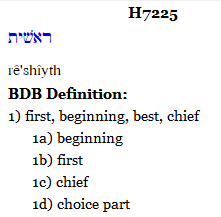
The sun, moon, and stars were designed not only to provide light, time, and heat, but also to bear the unmistakable signature of the Creator, declaring His majesty. Each day of Earth’s Creation unfolded upon a workday of the Eternal Father, a cycle of time that has always existed in eternity past. These six workdays were positioned between two sacred and set-apart days. While it is often assumed that both were seventh-day Sabbaths, this cannot be the case, since the ancient Hebrew year, month, week, and calendar dates were all anchored to and counted from the New Moon Days. Therefore, when Genesis opens with the words “In the beginning” (בראשית), it is possible to locate that moment precisely within the year, lunar month, lunar week, and even by its corresponding lunar phase.
This alignment may be compared to identifying the beginning of time on a clock, when both hands point straight up at twelve. Likewise, the first day of the ancient Hebrew year was also the first day of the lunar month. The four lunar weeks began on the following day. This was the Creator’s design. Because New Year’s Day coincided with the New Moon Day, Yahuah set it apart as a day of rest, designated for corporate worship by all His created beings. Many have not considered that Scripture recognizes more than one category of sacred day within each lunar month. Amos 8:5 points to this reality, as does the article When Will the New Moon and Sabbath Be Past?
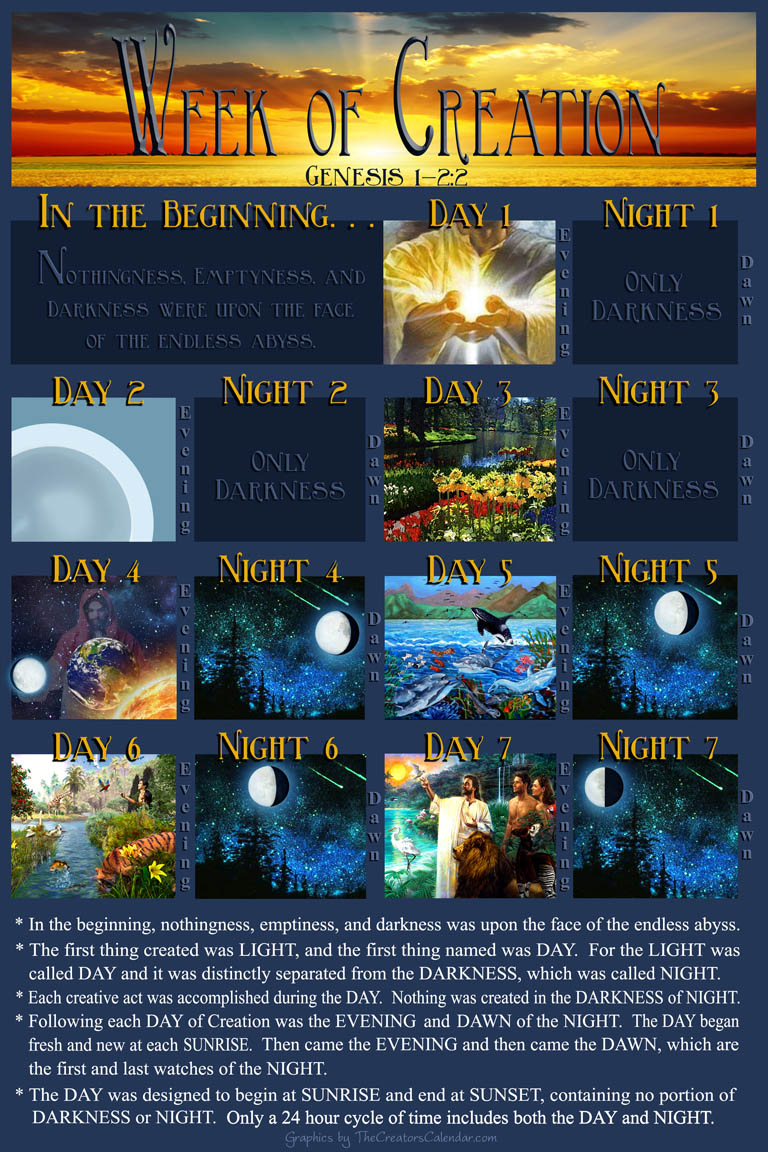
As a result, the work of earth’s Creation began on the following day, the first day of His workweek, after the New Moon Day had passed. This day was both the first workday and the second day of the twenty-nine or thirty-day lunar month. The accompanying calendar illustration demonstrates how the Creator designed this rhythm to function in perfect harmony.
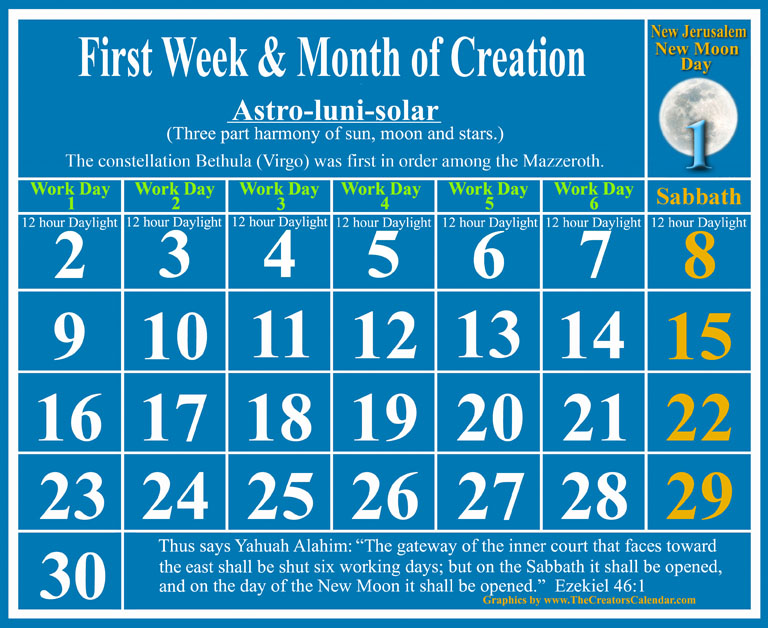
As a result, Scripture reveals that there are never more than six consecutive days in which the Eternal Father is engaged in creative work, whether upon the earth or in any other realm. This pattern is plainly evident in Genesis 1 and finds direct confirmation in Exodus 20:10, where the seventh day is identified as the Sabbath belonging to Yahuah Alahim.
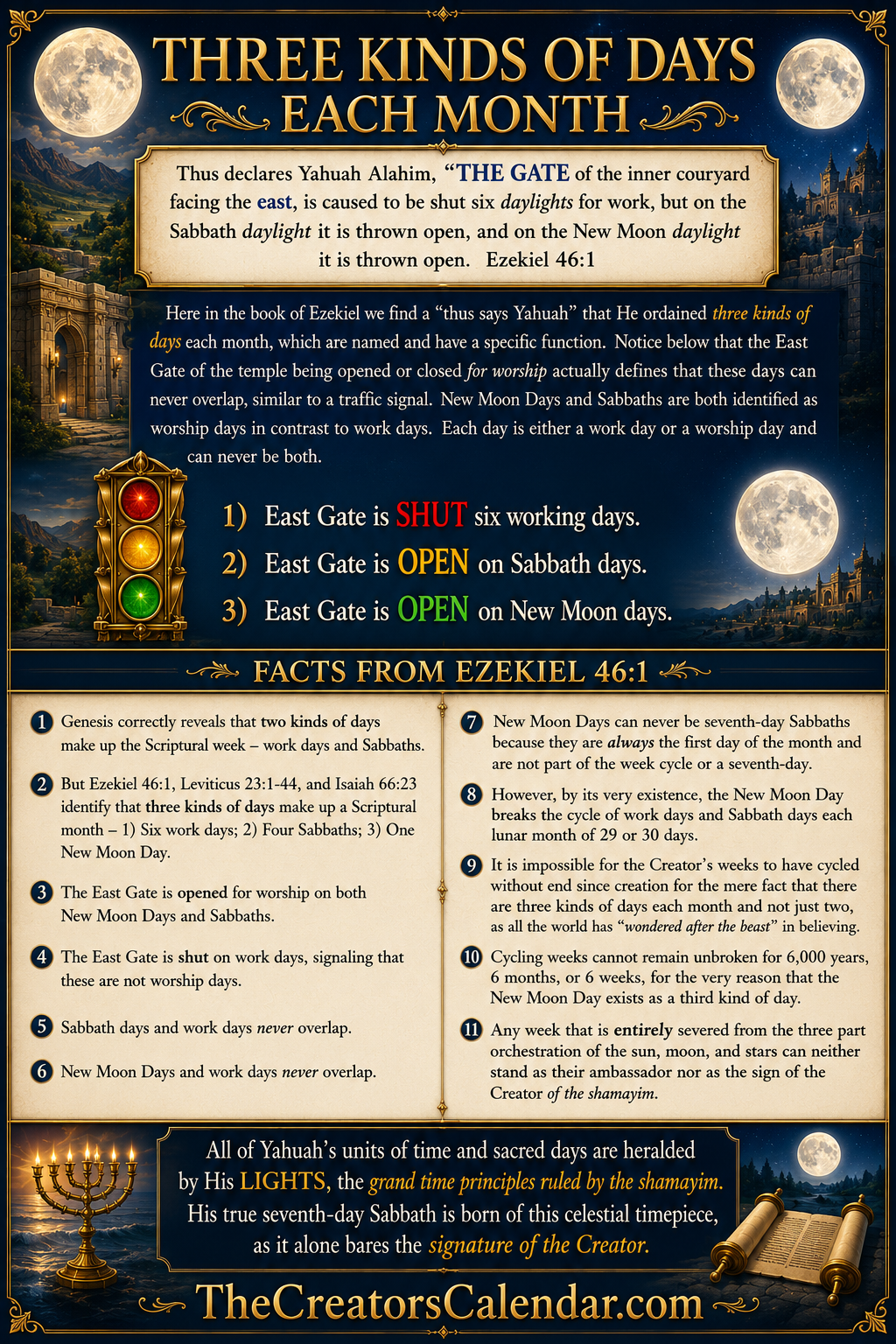
It is understandable why many assume that the first week of Creation was sandwiched between two seventh-day Sabbaths. Such an assumption reflects the widespread belief that the modern Roman continuous weekly cycle has existed unchanged from antiquity and stands in harmony with Scripture. Yet when this traditional view is carefully examined in the light of Leviticus 23, Ezekiel 46:1–3, and Isaiah 66:22–23, its foundation begins to erode. These passages clearly establish the New Moon Day as a Scriptural reality and a sacred appointment. Moreover, the New Moon serves as the divinely ordained starting point that must be included in any serious attempt to trace sacred time from Creation through the crucifixion into the present age. When this element is restored to the framework, it becomes evident that the New Moon Day constitutes a distinct category of sacred time, one that necessarily interrupts the uninterrupted cycling of weeks within each lunar month.
Earth’s Umbilical Cord
It is a serious oversight to dismiss the explicit language of the Creation account concerning the fourth day, when the sun, moon, and stars were created. Yet this aspect of the narrative is often minimized as interpreters attempt to reconcile Scripture with traditional views that recognize only solar-based time-measuring. Such efforts, though frequently well-intentioned, overlook the clear criteria outlined in Genesis 1:14–19. The only explanation that both honors the text and resolves the longstanding debate surrounding the lunar week is the recognition that the first three days of Creation were sustained by the Eternal Time of Yahuah Alahim Himself, extending directly from His throne room. These days were, as it were, suspended from eternity, awaiting their earthly synchronization.
Earth’s sun, moon, and stars were not required for Yahuah Alahim, His Son, the divine messengers, or any other created worlds to know when to assemble for worship on the sacred seventh-day Sabbath. How could this be? Because the heavenly systems of sacred time were already fully established, operating in complete unity and harmony long before the earth was formed.
Indeed, the fact that Earth’s sun, moon, and stars were not created until the fourth day stands as one of the most compelling testimonies of all. It declares not only to earth’s inhabitants, but also to other created beings and worlds, that humanity was fashioned to exist in perfect alignment with the broader family of creation. Earth was not given a unique or isolated worship rhythm, but was graciously brought into the same sacred cadence already observed by the sons and daughters of Yahuah Alahim. The delayed creation of Earth’s luminaries thus served as a profound sign of inclusion within this universal order.
This reality may be illustrated by the birth of a newborn child. Though the child enters the world as a distinct individual, it remains fully sustained by its mother until the umbilical cord is cut. Similarly, “in the beginning,” the earth emerged as a new and distinct creation during the first three days, yet it remained entirely dependent upon the Creator’s eternal passage of time. That dependence continued until the pivotal moment of the fourth day, when the proverbial umbilical cord was severed. This marked the creation and installation of Earth’s lights in the shamayim (heavens). On that day, the sun, moon, and stars were made, asah (H6213), to fashion, appoint, ordain, and institute earth’s localized system of time-measuring.
When this evidence is carefully considered, it becomes apparent that the Creator’s grand accord, designed to preserve harmony between Himself and His creation, has been fractured on earth. This rupture occurred as sacred time was gradually altered through human-devised calendar systems over the course of millennia, under the influence of rebellion against the Creator’s original order. As Scripture warns, such distortions do not arise in a vacuum, but reflect a deeper conflict between truth and deception, order and confusion, harmony and discord.
Boundary Markers for Creation
While our Creator is omnipotent, Scripture affirms that there are certain things He does not do. Chief among these is that He does not lie. Closely related to this truth is another principle of great importance for understanding His appointed calendar rhythms: Yahuah Alahim does not act in contradiction to His own sanctified order. This has a direct bearing on the timing of Creation itself. Specifically, the moon, described as “His faithful witness in the sky” (Psalm 89:37), could not have been created on the New Moon Day, the day preceding the first day of Earth’s Creation. Such an act would be inconsistent with the nature and purpose of that day.
The New Moon Day is presented in Scripture as a sacred and set-apart time of worship unto Yahuah, not a common workday. As Ezekiel 46:3 indicates, both the New Moon Day and the seventh-day Sabbath are occasions on which the Creator receives worship from all His faithful created beings. Yahuah is consistent and unchanging; He does not violate the sanctity (kadosh) of His appointed assemblies. To suggest that the Creator engaged in acts of creation on a day He Himself designated for rest and worship would place Him at odds with His own declared order, something Scripture does not support.
The accompanying calendar illustration helps clarify what occurred during the Creation week. On the full New Moon Day (represented in blue), the Creator was not engaged in creative labor related to the earth, but was resting and receiving worship from the entire host of messengers and unfallen creations. The six subsequent workdays are clearly identified (shown in green). Taken together, the Scriptural evidence indicates that the first day of Earth’s Creation corresponded to the second day of the lunar month and year. These foundational truths regarding time and order were soon to be entrusted to Adam and Havah (Eve), forming part of the sacred knowledge shared with humanity at the dawn of history.
The Fourth Day of the Creation Week
It is difficult for the human mind to grasp that, from the Creator’s perspective, time was already in motion even as Earth’s own experience of time had only just begun. Yet Scripture consistently reveals that the eighth day of the lunar month on earth (shown in gold) marked the first seventh-day Sabbath of the Creator’s year and lunar month. This was not a newly invented rest, but the continuation of Yahuah’s eternal rhythm of lunar months and seventh-day Sabbaths, spanning past, present, and future. On this sacred occasion, He again rested and received worship from all His creation, but now, for the first time, earth’s inhabitants were graciously included in one of the Creator’s corporate days of rest and worship. In this way, the Sabbath functioned as His preordained SIGN of universal unity, drawing all faithful creation into a shared celestial rhythm of sacred time.
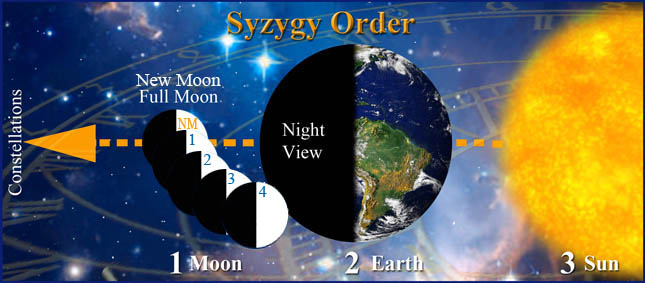
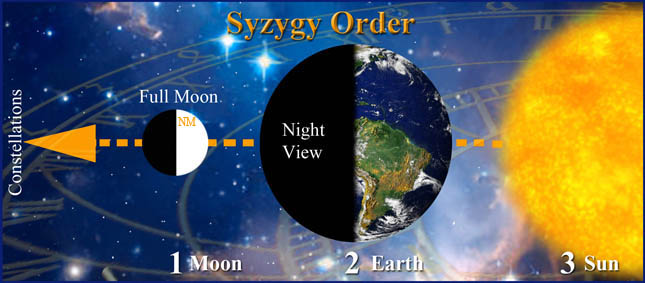
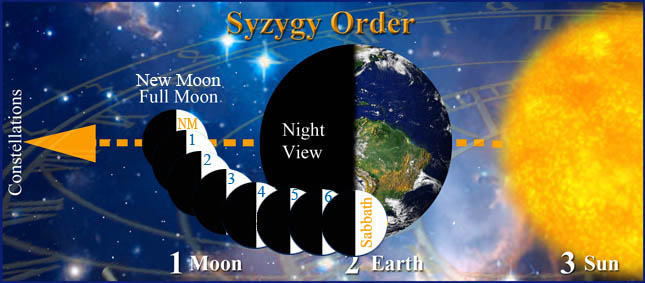
Through this divine ordering, all created beings were aligned according to Yahuah’s celestial time-measuring pattern, with the sun, moon, and stars carefully set and numbered in relation to the earth according to their proper syzygy, that is, the alignment of three or more celestial bodies such as the sun, earth, moon, and starry constellations. This alignment was not incidental, but essential to the governance of sacred time.
The order of syzygy defines which lunar phase qualifies as the true New Moon, as outlined in Genesis 1:16: first the sun, then the earth, followed by the moon, with the stars as witnesses. Only this configuration identifies the lunar phase that stands in opposition to the sun and is appointed to rule the night. The sole lunar phase that fulfills this condition, rising at sunset in direct opposition to the sun, is the full moon. In this role, the full moon rules the night in partnership with a designated starry constellation throughout the entirety of a lunation, that is, a complete lunar month. When the next full New Moon appears, it clearly marks the transition from one lunar month to the next, whether the year contains twelve or thirteen months. No alternative lunar arrangement satisfies all the Scriptural criteria governing years, lunar months, weeks, and the twenty-nine or thirty days that compose them.
Synchronizing Earth’s Clock/Calendar
The creation of the sun, moon, and stars on the fourth day of the Creation week stands as one of the most profound and dramatic SIGNS given to humanity. It testifies to a singular and essential truth: Earth’s experience of TIME was never intended to operate independently from the time continuum of Yahuah Alahim’s seat of authority. Rather, earth’s time was established in direct dependence upon His eternal order, suspended, as it were, from the very portals of His throne and synchronized with His eternal passage of time.
Just as the Tree of the Knowledge of Good and Evil was placed in the garden fully mature and bearing fruit on the third day, so all of creation came into existence complete and fully formed, bearing the appearance of age. Nothing was created in a state of infancy, whether seed, egg, or child. In the same manner, the celestial bodies were created on the fourth day and set immediately into precise and advanced positions within the shamayim (heavens). The moon’s phase and placement at that moment reflected not only the passage of the first three recorded days of Creation, but also the New Moon Day that preceded them, bearing silent witness to the sequence already established.
Accordingly, the beginning of earth’s first year, lunar month, lunar week, and lunar day was set with exactness, much like the hands of a clock, in alignment with Yahuah’s seat of power and His full New Moon. Earth was never designed to function within an autonomous time-measuring system detached from the Creator or from the broader universe He governs. This alignment represents a critical yet often overlooked piece of the Genesis narrative, without which the account of the first week remains incomplete.
Nevertheless, many have asserted that the New Moon Day occurred on the fourth day of Creation, largely because they continue to interpret Scripture through the lens of the Roman continuous weekly cycle, a system that permits the New Moon to fall on any day of the modern Gregorian month. In contrast, Yahuah’s time-measuring model consistently establishes the New Moon Day as the first day of the lunar month, with the first seventh-day Sabbath occurring on the eighth day. The New Moon thus governs the count for years, months, weeks, and days, while working in perfect harmony with the sun and stars to signal all lesser units of time. Only when this New Moon framework is restored does the Genesis account fully harmonize with the remainder of Scripture.
The Syzygy alignment above depicts New Year’s Day, the first New Moon of the year.
This illustration above depicts the placement of the moon on the 4th day of Creation, as it would appear showing the passing of the sacred New Moon Day, followed by each of the work days of creation.
This illustration depicts the placement of the moon for the four days after it was created. No creative works were performed on the New Moon Day, but commenced on the first work day. But the New Moon Day still marked the first day of the year and month, which causes the seventh-day Sabbath to also be the 8th day of the lunar month and year.
Earth’s sun, moon, and stars were neither created nor set into their governing positions until the fourth day of the Creation week. This deliberate ordering stands as an enduring testimony that time on earth was patterned after, and synchronized with, the eternal time of the Most High, Yahuah Alahim, as it proceeds from His seat of authority. Earth’s timekeeping was thus established as a gracious gift, designed for the benefit of creation. Yet, as with all divine provisions, its blessings are fully realized by those who willingly align themselves with its ordained principles.
Testimony of Two Witnesses
If the account in Genesis 1 were the sole record given to humanity for the measurement of time, then a variety of competing calendar models might reasonably be entertained. Yet this is not the case. Scripture provides a far broader and more consistent witness. On sound authority, we find that not only did the New Moon Day exist, but it is referenced more than twice as often in Scripture as the seventh-day Sabbath. Both were instituted by the same Creator, who rested on the Sabbath and who likewise designated the New Moon as a sacred day of worship. The New Moon was preordained as the beginning of His years, months, weeks, and days, from which all other sacred appointments were to be reckoned, including subsequent New Moon Days, lunar Sabbaths, and the appointed Feast Days.
Indeed, references to the New Moon appear over three hundred times throughout Scripture, compared with approximately one hundred fifty references to the seventh-day Sabbath. This raises an important and sobering question: where today is a time-reckoning system that preserves worship on New Moon Days alongside lunar seventh-day Sabbaths? Is it possible that the entire world has unknowingly accepted a comprehensive alteration of sacred time itself? History shows that the calendar framework now widely assumed to be normative was shaped by Roman authority and later reinforced through religious endorsement, first by ecclesiastical power, then by Rabbinical leadership, and later by well-meaning reformers and pastors. Yet the mere longevity or widespread acceptance of a system does not establish its truth. Scripture remains the final authority, regardless of how firmly tradition has been institutionalized.
 Such discoveries are not uncovered casually, nor through adherence to inherited assumptions. They emerge only through humble submission to the Eternal Father and a willingness to reexamine long-held beliefs in the light of His Word. When one entrusts Yahuah Alahim to lead into all truth, rather than relying upon the traditions and commandments of men who have departed from it, clarity begins to unfold (Titus 1:14).
“Thus declares the Almighty Yahuah, ‘the GATE of the courtyard interior facing the EAST shall be SHUT six days for work, and in the day of the SABBATH it shall be thrown open wide, and in the day of the NEW MOON it shall be thrown open wide. But come unto the exalted one, by way of the porch of the temple gate from without, and stand beside the doorpost of the gate and observe the Kohenim’s (Priests) symbolic Aleph and Tav burnt offering and symbolic Aleph and Tav peace offering. And you shall prostrate in worship upon the threshold of the open gate, coming and going at any time, but the gate shall not be shut until sunset.” And thus worshiped the people of the land at the entrance way of the same gate in the SABBATHS and in the NEW MOON DAYS before the face of Yahuah.'” YAHchezq’EL (Ezekiel) 46:1-3 Link to Hebrew Word Study — Worship at the East Gate
“Assuredly, according to the shamayim (starry abode), the New Moons, and the earth: The New Moon that I appointed and set in this ORDER remains firmly the chief corner [stone],” declares Yahuah. “Wherefore, it establishes and confirms your name along with your children. And it shall come to pass according to its abundance— New Moon by New Moon you shall keep; and according to its abundance— Sabbath by Sabbath you shall keep. And I shall lead all flesh to prostrate in worship, according to this chief corner [stone],” declares Yahuah. YashaYAHU (Isaiah) 66:22-23 The Creator’s Calendar Restored Hebrew Text. Link to Hebrew Word Study — New Moon by New Moon You Shall Keep
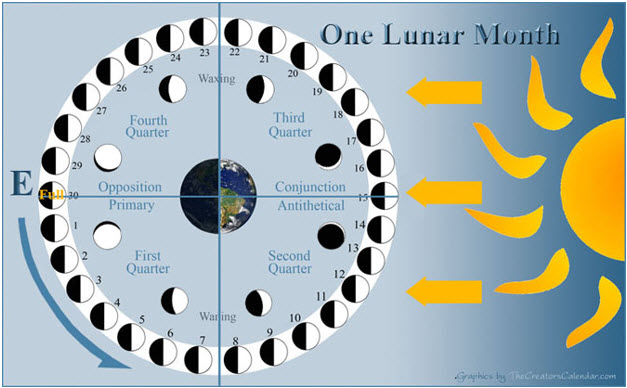
There is no avoiding the profound significance the Eternal Father assigns to His sacred New Moon Days and lunar seventh-day Sabbaths. The New Moon Day marks the harmonious commencement of each lunar month, while the moon itself delineates each successive day through its distinct lunar phases, counting from day one through day twenty-nine or thirty. Remarkably, this same cycle initiates the count of four lunar weeks, each culminating in a seventh-day Sabbath, while simultaneously regulating twelve months within a standard year and the addition of a thirteenth month at regular intervals every two or three years.
This system never drifts out of alignment with the Creator’s design. Through the established nineteen-year cycle, the lunar reckoning repeatedly returns the calendar into precise harmony with the solar year. In this way, every unit within the Creator’s original time-measuring model functions as an integrated division of a greater whole, each component reinforcing the coherence of the system. Attempts to locate the Creator’s true Sabbaths by any alternative method require the abandonment of this divinely established framework. Only by disconnecting sacred time from the LIGHTS appointed for time-measuring can the Sabbaths be made to appear within a continuous, unbroken cycle foreign to Scripture.
The Fourth Day of Creation from the Book of Jubilees
Notice the level of detail with which the fourth day of Creation is described. Beyond identifying the sun, moon, and stars as instruments for time-measuring, the Scriptural witness elsewhere expands this framework to include Sabbaths, months, Sabbaths of years, Jubilees, and the full cycle of appointed seasons. This broader scope invites thoughtful reflection. Could it suggest that aspects of sacred time were later minimized, altered, or omitted in subsequent interpretations of Scripture? If so, one must also ask who would have stood to benefit from such changes, and what motivations might have driven them.
History indicates that those who held authority over Scriptural transmission and interpretation, while simultaneously adopting Roman solar-based time-measuring, would have had both the access and incentive to reshape how sacred time was understood. Such considerations do not demand suspicion, but they do call for careful examination. When Scripture is allowed to interpret itself across its full breadth, the original design of the Creator’s calendar emerges with greater clarity and coherence.
8 …And on the fourth day He created the sun and the moon and the stars, and set them in the firmament of the heaven, to give light upon all the Earth, and to rule over the day and the night, and divide the
9 light from the darkness. And YAHUAH Alahim appointed the sun [these, the sun, moon, and stars] to be a great signs on the Earth for days and
10 for Sabbaths and for [lunar] months and for feasts [(mo’edim) lunar appointed days] and years, and for Sabbaths of years and for jubilees, and for all seasons of the years. And it [together these] divide the light from the darkness for prosperity, that all things may prosper which shoot and grow on the Earth. These three kinds [of celestial lights, astro-luni-solar] He made on the fourth day. Book of Jubilees 2:8-10.
Those with a Seventh-day Adventist Background
For readers with Seventh-day Adventist roots, it is noteworthy to consider an earlier Adventist perspective as expressed by Ellen White, who described suns, stars, and celestial systems revolving around the seat of Yahuah’s authority. Such imagery naturally invites thoughtful inquiry. Does this portrayal suggest that time itself in the heavens operates according to the same celestial markers later established on earth? Might it indicate that early Adventist thought once entertained the idea that earth’s luminaries were patterned after the timekeeping order of the Creator’s own throne?
If so, it follows that these celestial bodies were intentionally appointed to govern earth’s sacred worship assemblies, drawing creation into rhythm with its loving Maker and Sustainer. In this light, the Creator’s system of sacred time would function much like synchronized watches, calling His many created beings to assemble before Him on His appointed and set-apart days.
Yet, despite the richness of this imagery, there is little evidence that Ellen White herself fully grasped its implications. In practice, she continued to observe only the prevailing Roman-based time-measuring system, without questioning its underlying calendar structure. This contrast between expressed vision and lived application serves as a reminder that insight may be articulated without being fully understood, and that even well-respected voices remain subject to the limitations of inherited tradition.
With undimmed vision they gaze upon the glory of creation: suns and stars and systems, all in their appointed order circling the throne of Deity. Great Controversy, p. 677.
Conclusion
Humanity has been deeply honored by our loving Eternal Father, who entrusted us with the same time-measuring system governed by the sun, moon, and stars, fully synchronized with the heavenly courts above. In this design, nothing essential differs between heaven and earth. There are no wall calendars in the New Yarushalom assigning worship times before the Eternal’s throne; rather, all unfallen worlds, in their perfection, naturally operate within the same celestial rhythm. Each possesses its own suns, moons, and stars, all functioning in harmonious unity to synchronize the worship of the Creator across His vast dominion. Earth itself was designed as a central gear within this grand clock-calendar, the most intricate and elegant timepiece ever conceived. Its luminaries move upon unseen gears, serving as the great hands of time, visibly marking sacred moments along the east–west continuum.
This magnificent celestial mechanism stands as a continual testimony that the Creator not only exists but is present, attentive, and lovingly involved in the affairs of humanity. Thus, when Scripture proclaims that His only begotten Son, Yahusha haMashiach, would come, and indeed did come, as the Lamb slain to remove confessed sin and restore the repentant, it affirms that this redemptive act occurred exactly on time. Prophecy unfolds with precision according to the Torah-appointed Feast Days, which together reveal salvation’s timing and purpose. These appointed times form the divinely ordained framework through which the Messiah accomplished the only remedy for sin, ministering in the temple not made with human hands.
Might it be that through human rebellion and spiritual blindness, multiple competing calendar systems have arisen, each rooted in differing principles, leading many to observe sacred times they do not fully understand? Scripture cautions that such confusion is not without consequence. Therefore, may our compassionate Creator, both Father and Son, extend mercy to us all as we seek to rediscover and restore His kadosh (sacred) timepiece.
Regardless of which replacement time-measuring system one inherited through upbringing, religious tradition, or institutional authority, Scripture warns that deception has been widespread: “All the world wondered after the beast.” Yet, through the enduring love of our Creator, a call is now being issued to all who desire obedience. This is an end-time invitation to return to alignment with His preordained full New Moon and astro-luni-solar calendar, by which His true Sabbaths and prophetic Feast Days may be properly identified. These appointed times form a unified whole, with Passover standing foremost as the seal of Yahuah, offering deliverance, hope beyond the grave, and protection from receiving the mark of the beast.
Yahuah Alahim is calling His faithful followers to restore His original calendar, that their very soul-temples may be synchronized in preparation for His soon return. Until time itself is complete, each passing moment remains an opportunity for repentance, realignment, and restoration.
“There are two ways to be fooled.
One is to believe what isn’t true;
The other is to refuse to accept what is true.
Yet the TRUTH is found in what holds the greatest
weight of evidence.”
Summary of Evidence
- Twelve Scriptural stories indicate that the seventh-day Sabbaths fell consistently on the 8th, 15th, 22nd, and 29th lunar dates. The Sabbath’s Consistent Lunar Month Dates.
- Earth’s time system is a synchronized COPY of the time model at the throne of Yahuah Alahim and is not the original.
- The Creator can’t create the full New Moon on New Moon Day.
- Our Creator can only create during six workdays.
- Our Creator must always REST on New Moon days and seventh-day Sabbaths because they were set apart as Kadosh (holy). (Ezekiel 46:1-3)
- In addition to the Sabbath, our Creator shared His full New Moon with humanity.
- The New Moon Day is mentioned more than twice as often in Scripture as the seventh-day Sabbath. 349 New Moon References in Scripture.
- The New Moon Day is identified as the most sacred day of worship of our CREATOR. Isaiah 66:22-23; Ezekiel 46:1-3
- Earth was designed as the centerpiece gear in the grandest clock/calendar ever conceived by man. Its sun, moon, and stars operate on invisible gears as the great HANDS OF TIME and were designed to be fully visible to all the world when they are ruling along the east-west time-measuring continuum.
- Earth’s first week and month were set and hung from YAHUAH Alahim’s throne room clock/calendar.
- Seventh-day Adventists once believed and taught that “Through all eternity, the saints will witness the suns, stars, and systems circling the throne of deity.” Great Controversy, p. 677.
- Yahuah Alahim is calling His betrothed Bride, His obedient followers, to restore His original calendar so that they may synchronize their soul temples in preparation for His soon return. The Bridal Covenant of Promise, Assurance, and Restoration.
The following short video highlights several interesting insights regarding the days of Creation. Why was the Moon Created on the 4th Day?