Three Historical Periods of the Jewish Calendar
Three Historical Periods
of the Jewish Calendar
 by Kerrie L. French
Introduction
Most of the world today organizes life around the familiar Sunday-through-Saturday week. Work, school, shopping, appointments, and worship are all arranged within its continuously repeating seven-day cycle. For many Christians, Sunday has traditionally been set apart for worship, while Jews and some Christian communities observe Saturday as the seventh-day Sabbath.
Because this calendar structure has surrounded most of us from birth, we naturally tend to assume that it has always existed and functioned in essentially the same way. Rarely are we given reason to ask how the modern week developed, whether earlier societies measured weeks differently, or how the calendar familiar to us compares with the timekeeping patterns described in Scripture.
Yet these are important questions for anyone seeking to understand the biblical New Moon, Sabbath, and appointed Feast Days. If Scripture identifies particular days for worship, then the method by which those days are located becomes part of the inquiry. Rather than beginning with the assumption that our inherited calendar must be correct, this study invites the reader to examine the biblical and historical evidence and consider where it leads.
Purpose of this Article
The purpose of this article is to examine the historical development of the Jewish calendar and compare its changing methods of time-reckoning with the calendar principles presented in Scripture. Central to this study is the proposition that the original biblical calendar was established at Creation through the appointed functions of the sun, moon, and stars, and that this same celestial framework continued through the time of Abraham, Moses, and ultimately Yahusha haMashiach.
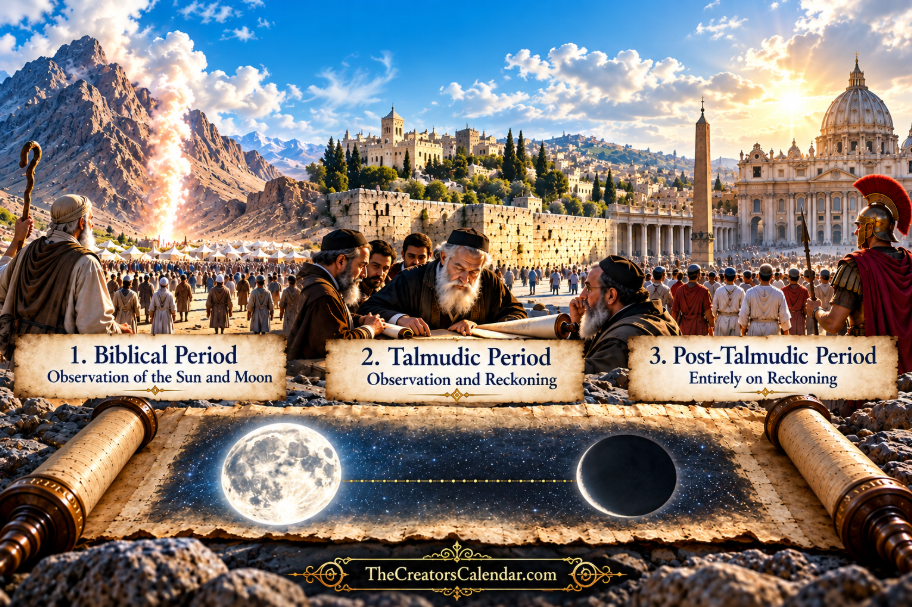
Yet history reveals that Jewish calendrical practice has not remained unchanged. Sources describing its development identify three distinct historical periods: the Biblical, the Talmudic, and the Post-Talmudic, each reflecting a different approach to determining sacred time. This article will examine those transitions, together with periods of captivity, political pressure, calculation, and religious development that influenced how New Moons, Sabbaths, months, years, and Feast Days came to be reckoned.
The question, then, is not simply whether the Jewish calendar changed, but what changed, when it changed, and whether those changes remained consistent with the Scriptural standard and pattern of time measurement. If the methods used to determine the year, month, week, day, Sabbath, and appointed Feast Days changed over time, it becomes reasonable to ask whether the worship calendar familiar to us today still reflects the original biblical model.
This investigation therefore invites the reader to consider the historical record alongside Scripture. Daniel 7:25 contains the sobering prophecy that an earthly power would seek to “change times and laws.” Whether the historical calendar developments examined below bear upon that prophecy is a question worthy of careful consideration rather than assumption.
With that purpose in mind, we will begin with the historical testimony concerning the three periods of the Jewish calendar, and then examine each period in greater detail.
Setting the Stage
The historical framework for this study is summarized in the following statement from the Jewish Encyclopedia:
“The history of the “Jewish calendar” may be divided into three periods—the Biblical, the Talmudic, and the Post-Talmudic. 1) The first rested purely on the observation of the sun and the moon, 2) the second on observation and reckoning, 3) the third entirely on reckoning.” Jewish Encyclopedia, “History of the Calendar,” by Joseph Jacobs, Cyrus Adler, 1906, Vol. 3, p. 498.
#1. Biblical Period of Jewish Calendar History (19th c. BCE – 4th c. BCE)
The Biblical Period provides the starting point for understanding the calendar presented in Scripture. Rather than beginning with later rabbinical calculations or Roman civil timekeeping, this study begins with the heavenly LIGHTS established by Yahuah Alahim at Creation and follows their appointed function through the biblical record.
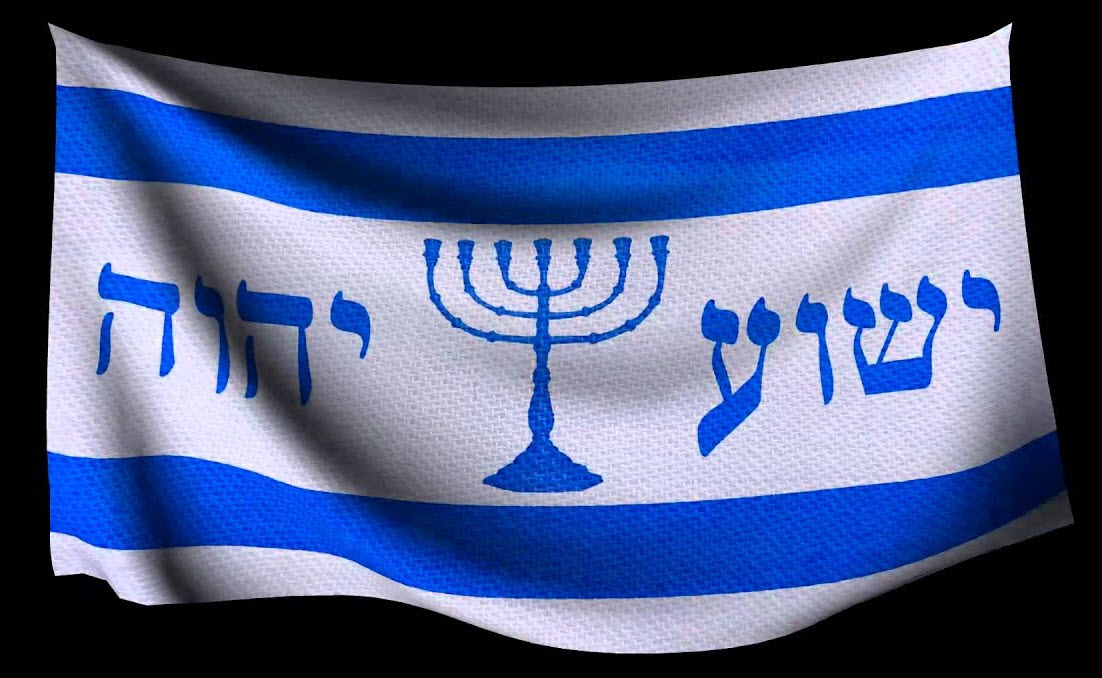
Israel’s original flag with their sacred symbol illustrating obedience to the Alahim of Abraham, Isaac and Jacob, and the correct astro-lunar calendar.
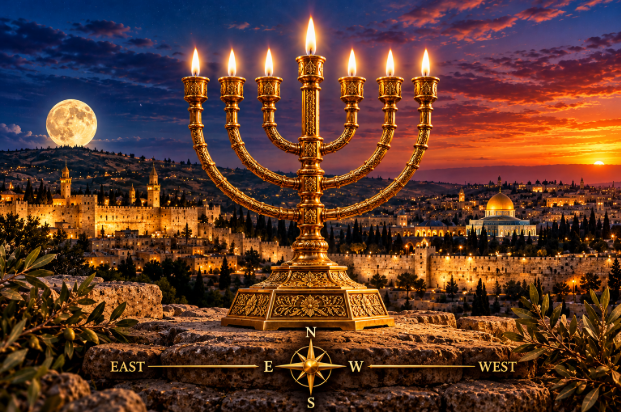
The seven-branched Menorah stands among the most ancient and enduring symbols associated with Yasharal (Israel) and its worship. Established according to the divine Sanctuary pattern given to Moses, the Menorah occupied a sacred place in Israel’s worship and later became a prominent Jewish symbol in archaeological remains, religious art, and representations associated with the Temple. IMJ Within the framework of this study, its seven lamps also beautifully correspond with the seven Kadosh Feast Days and their prophetic relationship to the Plan of Salvation. Thus, the original seven-branched Menorah provides an important visual witness to the Sanctuary pattern that preceded the later symbols and traditions considered in the following periods.
From the beginning, the promise of redemption was woven into the biblical story. Following the entrance of sin, Adam and Eve were given the promise of a coming Deliverer. That promise continued through the covenant with Abraham, through whose seed the promised Messiah would ultimately come. Yahusha haMashiach, the Atoning Lamb, would provide the way for mankind to be reconciled and restored to the Father.
Within this redemptive framework, TIME and EVENT are inseparably connected. Scripture identifies Yahuah’s appointed TIMES as mo’edim (H#4150) and His sacred or prophetic assemblies as miqra (H#4744). The annual Feast Days later given through Moses would provide a prophetic pattern of the Plan of Salvation, each appointed event occurring within its designated time.
The biblical record also reveals periods when Israel departed from Yahuah’s instructions and experienced captivity among surrounding nations. These periods become important to our investigation because political displacement and foreign influence provide part of the historical setting in which Israel’s calendar practices must be considered.
Before examining those later developments, however, we must first establish the biblical foundation for measuring TIME itself. That foundation begins where Scripture begins, with the LIGHTS placed in the heavens at Creation. Discover additional info on the Biblical Period of Jewish History.
The Biblical Evidence
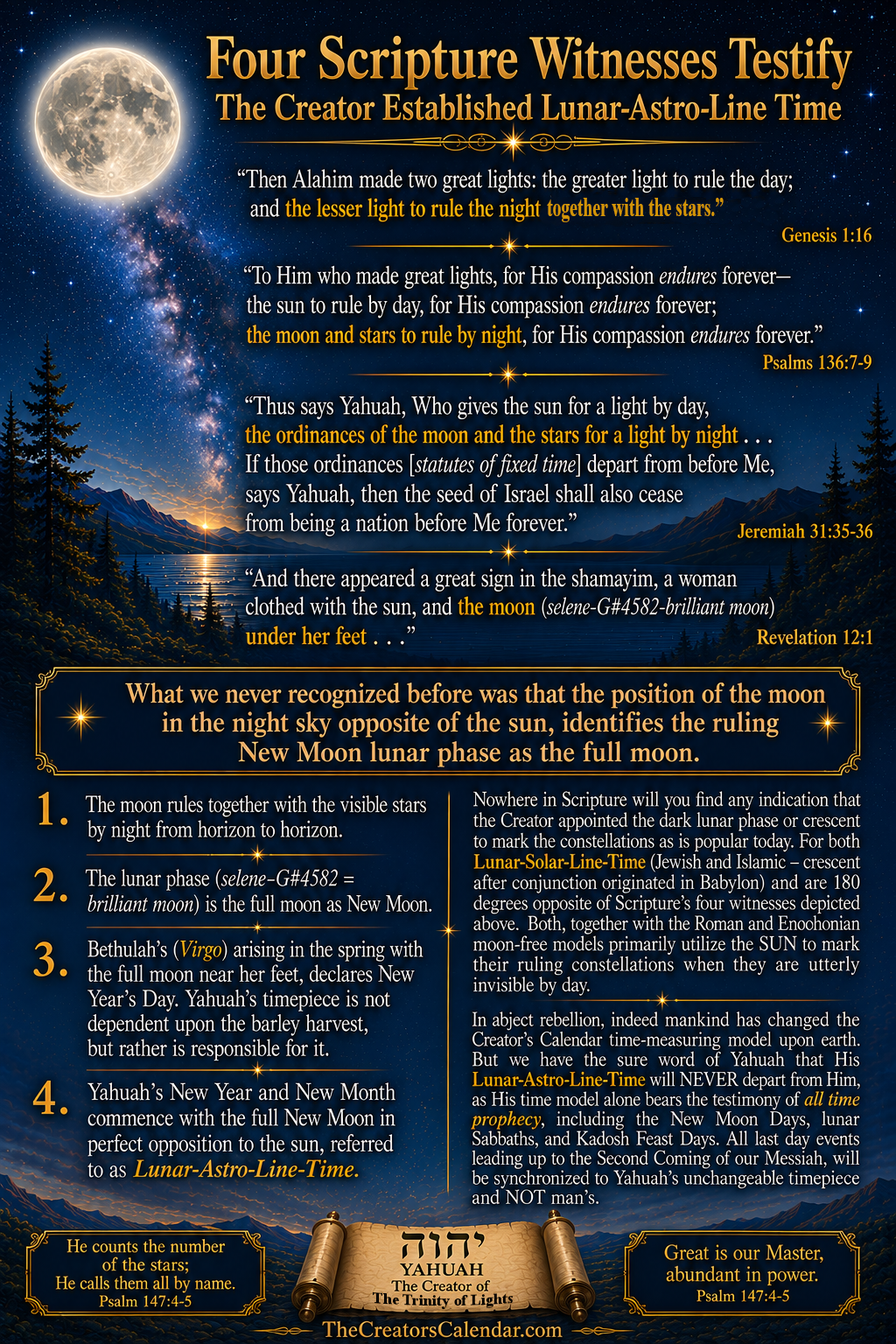
Any investigation into the biblical calendar should begin at Creation, where Scripture first identifies the heavenly LIGHTS and describes their purpose in measuring TIME:
“And Alahim [God] said, “Let there be LIGHTS in the firmament of the heavens to divide the day from the night; and let them be for SIGNS [#226-oth= remembrances with a distinguishing mark]; SEASONS [#4150-mo’edim = lunar appointed times]; DAYS [#3117 – yom = 12 hour days followed by the four watches of night]; and YEARS [#8141 – shanah = lunar years]...” Genesis 1:14
Scripture then identifies the two great LIGHTS and their respective governing functions:
“Then Alahim made two great LIGHTS: The greater LIGHT (Sun) to rule the day, and the lesser LIGHT (the Moon) to rule the night with the stars He made the stars also.” Genesis 1:16
The Moon and the Appointed TIMES
King David provides another important piece of this biblical framework:
“He ordained (H#6213 asah) the MOON (H#3394 Yareach) for
SEASONS(H#4150 – mo’ed – meaning: lunar appointed times)…” Psalms 104:19
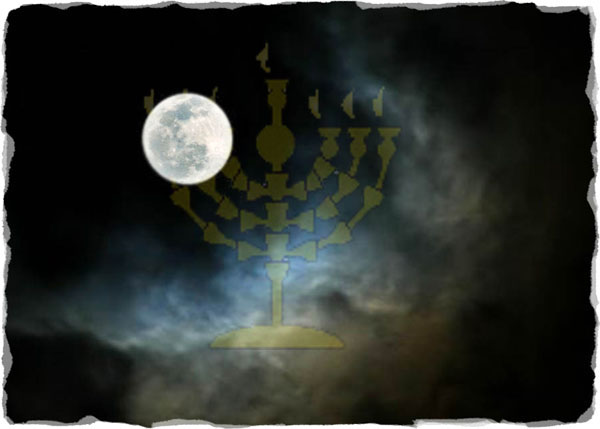
Psalm 104:19 directly associates the MOON with the mo’edim, the appointed TIMES. This connection becomes particularly significant when compared with Genesis 1:14, where the heavenly LIGHTS are appointed for mo’edim, and Leviticus 23, where the same Hebrew term is used for Yahuah’s appointed worship assemblies.
Within the framework presented in this study, these passages establish an important principle: the biblical appointed TIMES cannot be separated from the heavenly timekeepers Yahuah ordained to regulate them. The sun, moon, and stars therefore provide more than illumination; together they form the visible celestial framework through which biblical TIME is reckoned.
There is another important consideration. At the time described in Genesis 1:14, sin had not yet entered the world and the annual Feast Days associated with the later Plan of Salvation had not yet been given through Moses. Yet the heavenly LIGHTS had already been appointed for mo’edim. This study therefore asks what appointed TIMES were operating from Creation before the annual Feast system was introduced.
The evidence presented throughout TheCreatorsCalendar.com identifies the New Moon Day and seventh-day Sabbath as foundational elements of that original worship rhythm. The annual lunar-appointed Feast Days given later through Moses would then expand this pattern, prophetically illustrating the Remedy for Sin and the Plan of Salvation ultimately fulfilled through Yahusha haMashiach.
The Lunar Sabbath Question
If the moon was ordained for the mo’edim, an important question naturally follows: Does Scripture include the seventh-day Sabbath among Yahuah’s appointed TIMES?
Leviticus 23 is particularly significant because the chapter introduces Yahuah’s mo’edim before describing the seventh-day Sabbath and then proceeding to the annual Feast Days. In other words, the Sabbath does not appear as an unrelated subject inserted into the chapter; it stands at the beginning of the sequence of sacred assemblies presented there.
Note: The following is an expanded study rendering in which key Hebrew terms and their interpretive meanings have been supplied for clarity. Readers are encouraged to compare the passage with the Hebrew text and standard Bible translations.
From Leviticus 23 we read:
- And declared Yahuah unto Moses, saying,
- Speak unto the children of Yasharal, and command them concerning the specific lunar appointed dates [H#4150 mo’edim] of Yahuah, which shall proclaim My set-apart (Holy) rehearsal assemblies [H#4744 miqra – feasts]. These are themselves My specific lunar appointed dates
[H#4150 mo’edim]: (Note this requires a colon)- Six days from sunrise to sunset you shall do your work, but in the daylight of the seventh it is the Sabbath-rest to observe the covenant, a set-apart (Holy) rehearsal assembly event [H#4744 miqra] in which you shall do no work, for it is the Sabbath unto Yahuah in all your dwellings.
- These are the specific lunar appointed dates [H#4150 mo’edim] of Yahuah, the set-apart (Holy) rehearsal assemblies [H#4744 miqra], which you shall proclaim as SIGNS [of prophetic events to be fulfilled by the Messiah alone] at their specific lunar appointed dates [H#4150 mo’edim]:
- In the lunar month [H#2320 chodesh], the first one of the year, in the fourteenth day counted from the New Moon [H#2320 chodesh], between [H#996 beyn] the evenings [plural twilights] [H#6153 ereb], is the PASSOVER of Yahuah. Leviticus 23:1-5 and beyond…
For a more detailed Hebrew Interlinear Word Study, click HERE.
The sequence is noteworthy. Leviticus 23 first identifies the subject as Yahuah’s mo’edim, then immediately presents the six working days followed by the seventh-day Sabbath, and only afterward introduces Passover and the remaining annual appointments. Within the interpretation advanced in this study, this ordering supports the conclusion that the weekly Sabbath belongs within the same appointed-time framework governed by the heavenly LIGHTS.
This does not, by itself, establish every detail of a lunar Sabbath calendar. It does, however, provide an important Scriptural foundation for asking whether the Sabbath was originally reckoned independently of the moon or whether its weekly rhythm was historically connected to the lunar month.
Historical Witnesses to a Lunar Week
Scripture remains the governing authority for this study. Historical sources cannot establish biblical doctrine, but they can provide valuable evidence concerning how ancient calendars and weekly cycles have been understood by historians, encyclopedists, and other researchers. The following statements are therefore presented as historical witnesses, to be considered alongside the Scriptural evidence rather than in place of it.
“It shall be established FOREVER like the MOON, even like the trustworthy WITNESS in the sky.” Tehilim (Psalms) 89:37
“The [early] Hebrews employed lunar seven-day weeks, which ended with special observances on the seventh day, but none the less were tied to the moon’s course.” Rest Days, Hutton Webster, p. 254-255
“The weeks do not continue in a regular cycle regardless of the moon. Each [lunar] month has four weeks, beginning with the New Moon. I have no doubt that this was the old Hebrew system.” Babylonian Menologies and the Semitic Calendars, p. 89.
“The months of the year were lunar, and began with the new moon.” The Universal Jewish Encyclopedia, “Calendar,” p. 631.
“In the time of the earliest prophets, the New Moon stood in the same line with another lunar observance, the Sabbath. Ezekiel, who curiously enough frequently dates his prophecies on the New Moon . . . describes the gate of the inner court of the (new) temple looking eastward as kept shut for the six working days, but opened on the Sabbath and the New Moon.” Scribner’s Dictionary of the Bible,(1898 edit), p. 521.
“…Shabbat [weekly Sabbath] originally arose from the lunar cycle, containing four weeks ending in Sabbath, plus one or two additional…days per [lunar] month. The Universal Jewish Encyclopedia: An Authorative and Popular Presentation of Jews and Judaism Since the Earliest Times. Volume 10 Cohen, Simon (1943 p 482-483.). Week. In Landman, Isaac.
“And then the moon, ever punctual to mark the times, [as] an everlasting sign: It is the moon that signals the Feasts (H#4150 – mo’ed [lunar] appointed times), a luminary that wanes after being full. The month derives its name from hers. She waxes wonderfully in her phases, a banner of the hosts on high, shining in the vault of heaven [the shamayim].” Ecclesiasticus 43:6-8, c.a. 19-180 B.C.
“The period of New Moon was, in pre-exilic [pre-Babylonian Talmudic] times, celebrated by the cessation of labor; it was superior even to the Sabbath-day, which formed but a part of it [four Sabbaths within its lunar cycle] (see I Sam. xx. 18-34; II Kings iv. 23; Amos viii. 5; Hos. ii. 13 [A. V. 11]; Ezek. xlvi. 3); but it lost its importance during the Exile and was observed mainly as the determining factor of the calendar with its festivals…In the Temple, New Moon was celebrated by special sacrifices [which differentiated it from work days and seventh-day Sabbaths] (Num. xxviii. 11-15; II Chron. ii. 4, viii. 13; Ezra iii. 5; Neh. x. 33) and by the blowing of the trumpet (Num. x. 10)…” Jewishencyclopedia.com,Jewish Encyclopedia, 1906 Edition, New Moon, Kaufmann Kohler, Vol. 9, p. 243.
“With the development of the importance of the Sabbath as a day of consecration and the emphasis laid upon the significant number seven, the week became more and more divorced from its lunar connection…” The Universal Jewish Encyclopaedia, Vol. X, “Week,” p. 482.
“…the week of seven days was connected with the lunar month, of which it is, approximately, a fourth…” The Jewish Encyclopedia, “Week”
“… A month in law, is a lunar month… unless otherwise expressed… In legal proceedings, the word ‘months,’ means lunar months…” Stroud’s Judicial Dictionary (of Great Britain), 1903 Edition, p. 1221.
“…The Hebrew Sabbath (i.e. Creation Sabbath) was originally a Sabbathon…it was celebrated at intervals of seven days, corresponding with the changes in the moon’s phases…” Encyclopaedia Biblica, 1899, p. 4180.
#2. Talmudic Period of Jewish Calendar History (500 BCE – 505 CE)
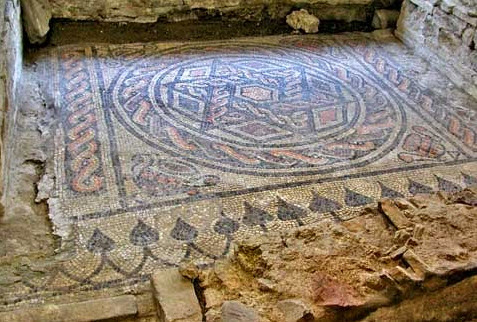
The Menorah candlestick symbol of Yasharal (Israel) was replaced with the Hexagram, declared by the rabbis as the Star of David.
The second period identified in our historical framework is the Talmudic Period, an era of significant transition in Jewish religious life and calendrical practice. During these centuries, Israel experienced foreign domination, the rise of influential religious schools, the destruction of the Second Temple, dispersion, and the increasing development of rabbinical interpretation and tradition.
These developments are particularly important to a study of the calendar because the method of determining sacred TIME was also undergoing change. As the Jewish Encyclopedia quotation at the beginning of this article states, the Biblical Period rested upon observation of the sun and moon, while the Talmudic Period came to depend upon a combination of “observation and reckoning.” The transition was therefore not merely theological or political; it also affected the manner in which the Jewish community determined its sacred calendar.
During this broad historical period, the teachings and discussions that would eventually form the Mishnah and Gemara, together comprising the Talmud, became increasingly influential in Jewish religious life. Rabbinical interpretation came to address a wide range of subjects, including religious law, ethics, customs, Feast observance, and calendrical reckoning.
From the perspective of this study, an important distinction must therefore be maintained between the written Torah itself and the later body of rabbinical interpretation surrounding it. Where the two appear to differ concerning the measurement of sacred TIME, this article will continue to use Scripture as the governing standard.
More info on the Talmudic Period of Jewish History.
The Evidence for the Talmudic Period
The following historical sources provide a window into this period of transition. Of particular interest are the changing influence of the Pharisaic and rabbinical traditions, the developing separation between Christianity and Jewish practice, the controversy surrounding the timing of Passover, and the increasing pressure to separate Christian observance from the Jewish calendar.
The Passover Controversy and the Council of Nicaea
One of the most consequential developments during this period concerned the dating of Passover and the Christian Paschal observance. Historical sources reveal that early believers were not united in their method of determining the annual commemoration of Messiah’s death and resurrection. Some communities continued to observe the fourteenth day of the lunar month in connection with the biblical Passover, while others increasingly favored a Sunday observance independent of the Jewish calendrical determination.
This disagreement, commonly associated with the Quartodeciman controversy, was more than a dispute over a single Feast Day. It reflected a growing division over whether Christian worship should remain connected to the Jewish calculation of Passover or develop an independent method of reckoning sacred time.
By the fourth century, this separation became particularly visible in connection with the Council of Nicaea. The historical quotations that follow document the controversy and illustrate the growing determination within the Roman Church to establish its Paschal observance independently of the Jewish calendar.
“Pharisaism became Talmudism… [but] the spirit of the ancient Pharisee survives unaltered. When the Jew… studies the Talmud, he is actually repeating the arguments used in the Palestinian academies…The spirit of the [Pharisees’] doctrine has remained quick and vital.” Louis Finklestein, The Pharisees: The Sociological Background of their Faith, [Jewish Publication Society of America], Vol. 4, p. 1332.“With the destruction of the Temple (A.D. 70)the Sadducees disappeared altogether, leaving the regulation of all Jewish affairs in the hands of the Pharisees. Henceforth, Jewish life was regulated by the Pharisees; the whole history of Judaism was reconstructed from the Pharisaic point of view, and a new aspect was given to the Sanhedrin of the past. A new chain of tradition supplanted the older priestly tradition (Abot 1:1). Pharisaism shaped the character of Judaism and the life and thought of the Jew for all the future.” “Pharisees,” The Jewish Encyclopedia, Vol 9, [1901-1906 ed.], p. 666.“At the Council of Nice [Nicaea] the last thread was snapped which connected Christianity to its parent stock [Romanism detached from the Jews and by extension severed itself from the Messiah and the Torah Law]. The festival of Easter had up till now been celebrated for the most part at the same time as the Jewish Passover, and indeed upon the days calculated and fixed by the Synhedrion [Sanhedrin] in Judea for its celebration; but in the future, its observance was to be rendered altogether independent of the Jewish calendar, ‘For it is unbecoming beyond measure that on this holiest of festivals we should follow the customs of the Jews. Henceforward, let us have nothing in common with this odious people; our Savior has shown us another path. It would indeed be absurd if the Jews were able to boast that we are not in a position to celebrate the Passover without the aid of their rules.’These remarks are attributed to Emperor Constantine… [and became] the guiding principle of the Church, which was now to decide the fate of the Jews [and their original time-measuring system].'” Heinrich Graetz, History of the Jews, Vol. II, pp. 563-564.
“We shall now especially consider heretics, who… call themselves Nazarenes [Natsarim – early followers of Messiah]; they are mainly Jews and nothing else. They make use not only of the New Testament, but they also use in a way the Old Testament of the Jews; for they do not forbid the books of the [TORAH] Law, the Prophets, and the Writings…so that they are approved of by the Jews, from whom the Nazarenes do not differ in anything, and they profess all the dogmas pertaining to the prescriptions of the [TORAH] Law and to the customs of the Jews, except they [also] believe in Messiah…They preach that there is but one god, and his son Jesus [Yahusha]. But they are very learned in the Hebrew language; for they, like the Jews, read the whole [TORAH] Law, then the Prophets…They differ from the Jews because they believe in Messiah, and from the Christians, in that they are to this day bound to the Jewish rites, such as circumcision, the Sabbath, and the other ceremonies.” Jerome – Epiphanius; Panarion 29; translated from the Greek.“The question relating to the observance of Easter [Passover], which was agitated in the time of Anicetus and Poly carp, and afterward in that of Victor, was still undecided. It was one of the principal reasons for convoking the Council of Nicaea, being the most important subject to be considered after the Arian controversy. It appears that the churches of Syria and Mesopotamia continued to follow the custom of the Jews, and celebrated Easter on the fourteenth day of the moon, whether falling on Sunday or not.” A Historical View of the Council of Nice [4th century A.D.], p. 22, translated by Isaac Boyle, D.D. New York: Thomas N. Staintford, 637 Broadway, 1856.“There was a considerable discussion raised about this time, in consequence of a difference of opinion respecting the observance of the paschal [Passover] season. The churches of all Asia, guided by a remoter tradition, supposed that they ought to keep the fourteenth day of the moon for the festival of the Savior’s Passover, in which day the Jews were commanded to kill the paschal lamb; and it was incumbent on them, at all times, to make an end of the fast on this day, on whatever day of the [Roman] week it should happen to fall.” The Ecclesiastical History of Eusebius Pamphilus, Bishop of Caesarea, in Palestine [4th century A.D.], translated by Christian Frederick Cruse, D.D., Tenth Edition, Chapter 23, p. 207. 1850.“But notwithstanding the decision of the council [of Nicaea] there were some Quartodecimens, as they were termed; who remained pertinaciously attached to the celebration of Easter [meaning Passover] on the fourteenth of the moon and among others the Audeans, schismatics of Mesopotamia. They found fault with the council, reproachfully remarking, that this was the first time that the ancient tradition [of properly locating Passover by the moon], through compliance for Constantine, had been departed from.” A Historical View of the Council of Nicea [4th century A.D.], p. 23, translated by Isaac Boyle, D.D. New York: Thomas N. Staintford, 637 Broadway, 1856.“The moon was the beneficent… [herald] of the shepherds in the region and climate where ancient Israel had its ancestral home. Hence the many traces of lunar institutions in even the latest Israelitish cult and its phraseology… The Sabbath, as marking the end of the week, reveals its lunar origin; the phases of the moon having taught the shepherds, whose weal or woe depends so largely upon the benevolence or malevolence of the night season, to divide the period elapsing between two new moons into four equal groups (weeks), the last day of each…Indications are not wanting that at first the New Moon festival was not counted among the seven days of the week (see Week);but after… New Moon days… a new cycle of four weeks began... Later, the week and the Sabbath became fixed [according to the Babylonian/Roman continuous weekly cycle]; and this gradually resulted in taking away from the New Moon festival its popular importance.”Jewish Encyclopedia.com, the unedited full-text of the 1906 Jewish Encyclopedia, “Festivals,” Pastoral Feasts, Emil Hirsch, Vol. 5, p. 376.“The decline of the eight-day week coincided with the expansion of Rome… The astrological and Christian [planetary – Sunday – Saturday] seven-day weeks that had just been [re] introduced into Rome were also becoming increasingly popular. There is evidence indicating that the Roman eight-day week and those two [differing] seven-day cycles were used simultaneously for some time. However, the coexistence of two weekly rhythms that were entirely out of phase with one another obviously could not be sustained for long. One of them clearly had to give way. As we all know, it was the eight-day week that soon disappeared from the pages of history forever.” Eviatar Zerubavel, The Seven-day Circle, p. 46.
Zerubavel’s discussion concerns the transition from Rome’s eight-day cycle to competing seven-day weekly systems rather than specifically documenting the disappearance of the Hebrew lunar week. Nevertheless, his account demonstrates an important historical point: the continuously cycling seven-day week familiar to us today was not the only weekly structure operating in the ancient world. When considered alongside the preceding evidence concerning the lunar week, it provides useful historical context for understanding how differing systems of weekly reckoning could coexist and eventually give way to a dominant continuous cycle.
Taken together, these sources preserve evidence of a significant calendrical dispute. The question was not merely what to call the observance, but how its date should be determined. One method remained tied to the fourteenth day of the lunar month, while the developing ecclesiastical practice sought a Paschal observance associated with Sunday and increasingly independent of Jewish calendrical reckoning.
For the purposes of this study, this distinction is particularly important. It demonstrates that the relationship between lunar dates and the continuously cycling Roman week was not simply assumed to be interchangeable. The historical record itself preserves evidence of disagreement over which system should govern the timing of sacred observance.
Divine Intervention for the Messiah’s Prophetic Appointed Times
At this point, a reasonable question arises: If competing calendar systems and methods of reckoning sacred time were already developing, how can we know that the appointed TIMES surrounding the life, death, and resurrection of Yahusha haMashiach remained intact?
This question becomes especially important when considered within the larger Plan of Salvation. Scripture presents the coming of Messiah as occurring according to divine appointment rather than historical accident. Paul writes that “when the fullness of the time had come, Alahim sent forth His Son” (Galatians 4:4). From this perspective, the Father who established the appointed TIMES was also fully able to preserve the prophetic timing necessary for their fulfillment.
The life and ministry of Yahusha therefore provide an important point of reference in this calendar investigation. His birth, ministry, death, resurrection, and continuing priestly work were not isolated events, but belonged to the larger redemptive pattern established beforehand in Scripture. Within the framework presented in this study, the annual Feast Days functioned as prophetic rehearsals, pointing forward to the saving work that Messiah alone would accomplish.
This means that TIME and EVENT must remain connected. Passover could not prophetically identify Messiah’s sacrificial death if its appointed time were irrelevant. Likewise, the remaining Feast Days derive their prophetic significance not merely from the events they portray, but from their placement within Yahuah’s appointed order. The calendar therefore serves as the framework upon which these prophetic rehearsals and their fulfillments can be examined.
Even amid periods of political upheaval, religious controversy, and competing methods of calendrical reckoning, this study proposes that Yahuah preserved the necessary witnesses to His original timekeeping system. The question before us is therefore not whether human beings ever altered calendars, for history plainly records calendrical development, but whether sufficient biblical, historical, and celestial evidence remains to identify the pattern established by the Creator.
Calendar Wars in the Time of the Messiah
The discovery and study of the Dead Sea Scrolls has added an important dimension to our understanding of Jewish calendrical diversity during the centuries surrounding the First Coming of Yahusha haMashiach. Numerous calendrical texts were preserved among the scrolls, demonstrating that the reckoning of sacred TIME was an important concern within the Qumran community. Scholars have also examined the extent to which differing calendars contributed to disputes over the proper timing of Sabbaths, Feast Days, priestly service, and other sacred observances.
The importance of these calendrical texts lies in what they reveal about the religious world surrounding the time of Messiah. There was not a single, universally accepted method of reckoning sacred TIME among all Jewish communities, creating chaos. Competing calendar systems could place Sabbaths, Feast Days, and priestly service on different dates, making the calendar itself a matter of serious religious concern. This diversity provides an important historical setting for the question at the heart of this study: Which method of reckoning sacred TIME remained faithful to the pattern established in Scripture?
The Dead Sea Scrolls do not, by themselves, establish the calendar model presented in this study. They do, however, demonstrate that calendrical disagreement existed in the centuries surrounding the First Coming of Yahusha. The biblical pattern must therefore be identified by returning to the Scriptural witnesses themselves and comparing them with the historical and celestial evidence that remains.
#3. Post-Talmudic Period of Jewish Calendar History (505 CE – Present Day)
The third period identified in our historical framework is the Post-Talmudic Period, extending from the centuries following the completion of the Talmud to the present day. By this stage, Jewish calendrical practice had moved increasingly away from direct observation of the heavenly LIGHTS toward a system governed by established rules and mathematical calculation.
This represents the third stage described in the Jewish Encyclopedia quotation with which we began: the Biblical Period rested upon observation of the sun and moon, the Talmudic Period upon “observation and reckoning,” and the Post-Talmudic Period “entirely on reckoning.” The progression is significant because the method used to identify sacred TIME had fundamentally changed.
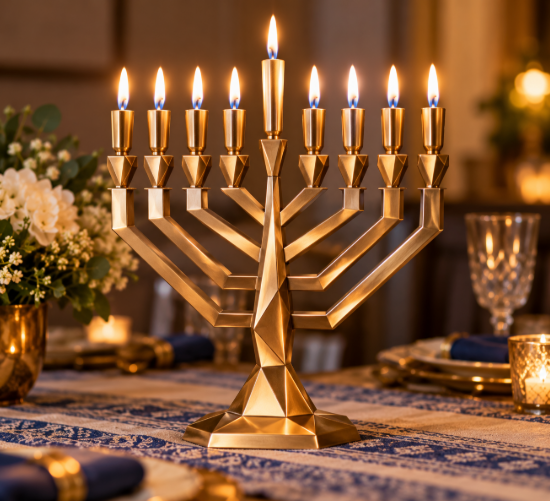
Another distinction that emerged in later Jewish tradition concerns the Menorah. The original seven-branched Menorah belonged to the Sanctuary pattern given to Moses and, within the framework of this study, reflects the seven Kadosh Feast Days and their prophetic relationship to the Plan of Salvation. The later nine-branched Hanukkah lamp arose from a different historical setting and commemorates events associated with Hanukkah rather than the seven annual Feast Days. While it holds an important place in later Jewish tradition, it should therefore be distinguished from the original seven-branched Menorah when examining the biblical Sanctuary pattern and its prophetic relationship to sacred TIME.

Zionist’s Star of Moloch
A related symbolic development occurred during this Post-Talmudic Period. The six-pointed hexagram now commonly known as the Magen David, or Star of David, is not identified in Scripture or the Talmud as the symbol of Yasharal. Its documented development as a specifically Jewish communal emblem occurred much later, becoming increasingly associated with Jewish communities during the medieval and early-modern periods. This stands in contrast to the seven-branched Menorah, whose biblical origin reaches directly back to the Sanctuary pattern given to Moses.
As Jewish communities became increasingly dispersed, rabbinical authorities faced the practical challenge of maintaining a common calendar across great distances. Over time, calculation provided a means of establishing months, years, and Feast Days without requiring every community to depend upon direct local observation. From a historical perspective, this development offered consistency and predictability. From the perspective of this study, however, it also raises an important biblical question: Can a calculated calendar remain equivalent to a calendar whose appointed TIMES were originally determined by the observable heavenly LIGHTS?
This question becomes especially important when considering the New Moon, because the beginning of the lunar month establishes the dates that follow. In the later calculated Jewish calendar, the beginning of the month came to be associated with the molad, a mathematically calculated mean lunar conjunction, rather than being established solely through direct observation of a visible lunar marker. Thus, the dark conjunction phase became incorporated into the reckoning of the month’s beginning, even though Scripture nowhere explicitly identifies the invisible dark conjunction as the New Moon or instructs Yahuah’s people to use it as the celestial marker for beginning the month.
This distinction has far-reaching consequences. If the lunar phase or method used to determine New Moon Day is changed, then every sacred date reckoned from that beginning may also be affected, including the Sabbaths and annual Feast Days. The transition from observation to calculation therefore represents more than a change in calendrical technique; it changes the foundation from which the sacred month itself is reckoned. More info on the Post-Talmudic period of Jewish history.
Rabbinical Authority and Majority Rule
As the Post-Talmudic Period developed, the role of rabbinical authority became increasingly important in preserving and interpreting Jewish religious practice. The Geonim, who led the great Jewish academies of Babylonia, exercised considerable influence during the early centuries of this period. Later scholars, including Moses Maimonides (Rambam), would likewise have a profound and lasting influence upon Jewish law, tradition, and calendrical understanding.
This development raises an important question for the present study: What happens when the interpretation of religious authorities becomes the accepted standard for determining sacred TIME? The issue is not whether generations of rabbis were sincere or learned, but whether any later interpretive tradition should be permitted to override the instructions and celestial principles established in Scripture.
Within rabbinical Judaism, the principle of deciding matters according to recognized legal authority and, in certain contexts, the majority became an important part of the interpretive process. Yet from the perspective advanced in this article, truth is not established by the number of people who accept a particular interpretation. The ultimate question must remain whether that interpretation can be demonstrated from Scripture.
This distinction becomes particularly important when considering the calendar. A method may become ancient, widely accepted, carefully calculated, and deeply embedded within religious tradition, yet those qualities alone do not establish that it represents the original biblical method. For those seeking restoration, the appropriate question is therefore not simply, “What has traditionally been observed?” but also, “What pattern do the Scriptures themselves reveal?”
This does not require dismissing Jewish historical sources or rabbinical scholarship. On the contrary, they can provide invaluable testimony concerning the development of Jewish calendrical practice. But within this study, they remain historical witnesses rather than the final authority, because Scripture itself provides the standard by which the Creator’s appointed TIMES are being examined.
The Evidence
The transition from observation to a calculated calendar did not occur in a historical vacuum. Jewish communities were living under considerable political pressure, and maintaining a unified calendar across increasingly scattered communities presented genuine practical difficulties. These circumstances are important to acknowledge, because they help us understand why a fixed system of calculation could have appeared both necessary and beneficial. At the same time, the historical reasons for adopting a new method cannot determine whether that method remained faithful to the biblical pattern. That question must be answered by comparing the resulting calendar with the celestial principles and appointed TIMES established in Scripture.
“In AD 351-352 Roman persecution flared and the Jews revolted. They were soon crushed. Many Jewish towns were destroyed and decrees issued against the local authorities and against Judaism. The privileges of the head of the Sanhedrin and the freedoms of the Sanhedrin itself were curtailed. Roman pressure to conform “Jewish” TIME to Roman TIME had reached crisis level. ibid
Under this pressure Hillel II agreed to limit the functions of the head of the Sanhedrin, as well as the Sanhedrin itself, with respect to proclaiming the New Moon, setting festival dates, and employing intercalation [adhering to the 13th lunar month]. With the decline of the Jewish power-base in Israel, the Jewish community in Babylon had been rising in influence to fill the vacuum. Hillel II published details informing all Jews of the methods of the [new] calculated calendar developed in Babylon. From that time on the Sanhedrin in Judea ceased to function or to maintain calendar experts. Hillel II is thus given the credit for the present fixed Rabbinical calendar, but in reality it originated in BABYLON and was just the starting point of the development of the Rabbinical calendar in use today.” Encyclopedia Judaica, s.v. “Hillel.”
“The persecutions under Constantius finally decided the patriarch, Hillel II. (330-365), to publish rules for the computation of the calendar, which had hitherto been regarded as a secret science. The political difficulties attendant upon the meetings of the Sanhedrin became so numerous in this period, and the consequent uncertainty of the feast-days was so great, that R. Huna b. Abin made known the following secret of the calendar to Raba in Babylonia: ‘Whenever it becomes apparent that the winter will last till the 16th of Nisan, make the year a leap-year without hesitation.’ Ibid
This unselfish promulgation of the calendar, though it destroyed the hold of the patriarchs on the scattered Judeans, fixed the celebration of the Jewish feasts upon the same day everywhere. Later Jewish writers agree that the calendar was fixed by Hillel II… 359 C.E… Saadia afterward formulated calendar rules, after having disputed the correctness of the calendar established by the Karaites. That there is a slight error in the Jewish calendar, due to inaccuracies in the length of both the lunar and the solar years upon which it is based, has been asserted by a number of writers.” Jewish Encyclopedia.com, the unedited full-text of the 1906 Jewish Encyclopedia, “History of the Calendar,” “Post-Talmudic Period,” by Joseph Jacobs, Cyrus Adler, Vol. 3, p. 500.
These accounts describe an important turning point. A calendar that had once depended upon observation and proclamation increasingly became capable of functioning through predetermined rules and calculation. This provided Jewish communities separated by great distances with a common means of identifying months and Feast Days. Yet for the purposes of this study, the central issue is not whether the calculated system was practical, but whether its rules could alter the placement of days that Scripture identifies as divinely appointed.
“The FOUR RULES OF POSTPONEMENTS allow the [new Roman] seven-day week to cycle without interruption, while corrections by way of DELAYS are imposed upon the day of the New Moons [mo’edim]. This system proactively DELAYS the Feast Days by one to two days.” Explanatory Supplement to the Astronomical Almanac – U.S. Naval Observatory, Edited by P. Kenneth Seidelmann, p. 586.
From Observation to Postponement
This is where the historical investigation becomes deeply personal for the worshiper. If the New Moon establishes the beginning of the lunar month, and the Sabbaths and annual Feast Days are reckoned from that beginning, then both the lunar phase chosen to identify the month’s beginning and any rules that postpone that beginning become critically important. A change at the beginning affects the sacred dates reckoned from it. For those seeking to worship according to the Creator’s original pattern, identifying the correct New Moon and allowing that celestial marker to establish the month therefore becomes essential.
This brings us back to the three historical periods with which this study began. The progression described by the Jewish Encyclopedia moves from observation, to observation and reckoning, and finally to a system operating entirely by reckoning. What began as a calendar identified through the observable movements of the sun and moon had, over time, become a calculated system capable of adjusting the placement of particular sacred dates.
From the perspective of this study, this distinction is crucial. If Yahuah appointed the heavenly LIGHTS to identify His mo’edim, then the central question is not whether a calculated calendar is orderly, sophisticated, or convenient. The question is whether humanly established rules should be permitted to postpone an appointed TIME beyond the celestial marker by which that TIME was originally established.
This is where the historical investigation becomes deeply personal for the worshiper. If the New Moon establishes the beginning of the lunar month, and the Sabbaths and annual Feast Days are reckoned from that beginning, then changing the placement of the month’s beginning can affect the sacred dates that follow. For those seeking to worship according to the Creator’s original pattern, identifying the correct beginning of the month therefore becomes essential.
The Transition From the Lunar Week to the Continuous Week
The fixed calendar involved more than the method used to determine months and annual Feast Days. Historical writers have also examined a more fundamental question: Was the ancient seventh-day Sabbath originally reckoned within the lunar month, or did it always belong to an uninterrupted seven-day cycle like the week familiar to us today?
The following historical sources are significant because they describe an earlier lunar week and a later transition to the continuously cycling seven-day week. While these writers do not themselves establish the biblical calendar, their observations provide historical testimony that can be compared with the Scriptural evidence already presented.
“The changes in the calendric position of the weekly religious rest day have been few from pre-historic times to the present day. The Sabbath which came down to the Jews from pre-historic [prior to Moses] times was the seventh day of the lunar week. The lunar week and the lunar month gave the simplest form of time division to early man…Moon and month meant the same thing. The division of the month into four weeks of seven days . . . and the weekly division begun again at the time of the next new moon. The change from the lunar week to the seven-day week running continuously through the year, while a momentous change, was unrecorded. The use of two styles of weeks seems to have existed together, and the more modern seven-day week slowly, but finally, supplanted its ancient but inexact competitor. The lunar week was simple and serviceable…When the continuous seven-day week was generally accepted, then it was linked with the past, as we now date events before Christ by a scale unknown to the people and historians of those times… The lunar Sabbath was succeeded by the seven-day weekly Sabbath without confusion, and the mention of the Sabbath in Exodus 31:13 and elsewhere, may be taken to refer to the lunar day.” Sunday the World’s Rest Day, “The Sabbath, the Day Which Divine Love Established and Human Love Must Preserve,” Theodore Gilman, p. 479. Published for the New York Sabbath Committee, Doubleday, Page and Company, New York, 1916.
Writing in the same 1916 volume, Samuel W. Gamble identified several difficulties that arise when later calendar assumptions are applied retrospectively to the biblical text.
“Several customs which prevailed during the age between the Exodus of the Israelites and the resurrection of Christ had so completely changed by the seventeenth Christian century that the translators of the “Authorized Version” of the English Bible were not able to perceive some important truths taught in the Greek version of the Old Testament and the Greek New Testament. Unseen truth would not be clearly translated into the English Bible. The student, who of necessity was limited in his studies to the English version would not be able to see more truth than was expressed in the English version. . .ibid
Second – Since the Jews for more than sixteen centuries have been observing a Saturday Sabbath, and since Christians have been for more than eighteen centuries having a fixed Sunday Sabbath, it is only reasonable to expect most Sabbath writers to try and interpret all Bible Sabbath teachings on the theory of fixed septenary cycles. But the noted Rabbi Hirsch believes and teaches that “The old (Jewish) Sabbath had no connection with a fixed [cycling] week.” ibid
Third – The passing out of sight of the old Bible lunar calendar and the now almost universal effort to interpret the Bible upon the basis of solar calendars . . . ibid
Sixth – . . . Because of the failure to note the above mentioned difficulties it has become quite difficult so to write or teach as to be clearly understood about the Scriptural Sabbaths.” Sunday the World’s Rest Day, The Sabbath-The Lord’s Day, by Rev. Samuel W. Gamble, D.D. p. 81-82. Published for the New York Sabbath Committee, Doubleday, Page and Company, New York, 1916.
“…the Jewish festivals being regulated solely by the moon, may fall on any day of the [modern Roman continuous cycling] week.”Oxford English Dictionary, 1971 Edition, Vol. 2, Pentecost.
Taken together, these historical observations illustrate an important distinction between lunar dates and a continuously cycling week. A Feast fixed to a particular lunar date can fall on different days of a continuous weekly cycle precisely because the two systems are reckoned independently.
Within the calendar model examined in this study, however, the New Moon establishes the beginning of the lunar month, from which the monthly sequence of working days and Sabbaths is reckoned. The transition from a lunar week to a continuous week therefore represents far more than a change in calendar terminology. It represents a fundamentally different method of locating the seventh-day Sabbath.
A continuously cycling seven-day week will certainly produce a seventh day every seven days, but that alone does not make it the Creator’s ordained seventh-day Sabbath. If the cycle is disconnected from the Creator’s appointed beginning of the lunar monthly count, its seventh day cannot identify the Sabbath established by that original pattern. Counting seven days is not enough. The count must begin from the point in TIME ordained by the Creator.
Inherited Assumptions About the Calendar
Most of us inherit our understanding of the calendar long before we ever think to investigate it. The Sunday-through-Saturday week is so deeply woven into everyday life that it can easily appear to be an unbroken and self-evident continuation of biblical time. Jews, Christians, and others may therefore assume that the weekly cycle familiar today has preserved the original sequence of days from antiquity without interruption.
Yet the historical evidence presented in this study gives us reason to examine that assumption more carefully. If methods of reckoning months and weeks changed over time, and if lunar and continuous weekly cycles once existed alongside one another, then the antiquity of a present tradition alone cannot establish its continuity with the calendar described in Scripture.
This does not mean that those who observe Saturday or Sunday have deliberately rejected the Creator’s calendar. Most are simply worshiping according to the calendar they inherited from their families, religious communities, and cultures. The purpose of examining these assumptions is not to question anyone’s sincerity, but to ask whether our inherited practices can withstand careful comparison with Scripture and history.
Several understandable considerations may make this question difficult to revisit:
Confidence in the inherited calendar. Many naturally assume that the calendar used for worship today has remained synchronized with the biblical pattern for years, months, weeks, days, Sabbaths, and Feast Days. Because this system has been received and practiced for generations, its continuity with biblical TIME is rarely questioned.
Trust in religious leadership. Others reasonably depend upon rabbis, pastors, theologians, scholars, or denominational leaders whom they trust to have carefully examined these questions.
Confidence in historical continuity. Some find it difficult to imagine that an entire religious community could gradually lose or alter the original method of identifying sacred TIME, particularly the seventh-day Sabbath.
The personal cost of reconsideration. Discovering that one’s established worship schedule might differ from the pattern presented in Scripture could require difficult changes involving family, congregation, employment, and long-held traditions.
The strength of familiar tradition. Religious practices are often deeply connected with family, fellowship, community, and personal identity. For this reason, reconsidering an inherited calendar can involve much more than simply changing a date on the calendar.
These considerations are understandable, but none of them can finally determine what is true. Sincerity, antiquity, popularity, and tradition are not substitutes for evidence. If Yahuah established His appointed TIMES through the heavenly LIGHTS, then the appropriate response is to return patiently to Scripture, examine the historical record, and allow the evidence to speak for itself.
The Karaite Question of Sabbath Continuity
The question of an unbroken weekly cycle is not confined to those who advocate a lunar calendar. A particularly interesting acknowledgment appears in Karaite Jewish material concerning the historical continuity of the Saturday Sabbath. Rather than assuming that the present weekly cycle can be traced without question to Creation, the following statement recognizes the limits of what can actually be demonstrated historically:
“Through all the trials and tribulations that humanity has experienced over the past 5,000 years, we have no proof whatsoever that our current Saturday is the actual seven-day “anniversary” of the original Shabbath of Creation.” http://www.karaiteinsights.com/article/shabbat.html
This statement does not, by itself, establish a lunar Sabbath calendar, nor does it demonstrate which calendar model is correct. What it does establish is something more limited but important: the identification of today’s Saturday with the seventh day of Creation cannot be demonstrated merely by appealing to an assumed uninterrupted historical succession. The starting point of the count must still be established.
That distinction matters. A continuously repeating seven-day cycle can identify every seventh day within its own system, but unless the starting point of that cycle can be established, the cycle itself cannot prove that its seventh day is the same seventh day ordained by the Creator. This brings us again to the central question of this study: What biblical markers did Yahuah provide for locating His appointed TIME?
Within the framework presented throughout this article, the answer must ultimately be sought not in inherited weekday names or tradition alone, but in the Scriptural pattern of the heavenly LIGHTS, the New Moon, the monthly count, and the appointed Sabbaths and Feast Days.
So Why Does It Matter?
The calendar matters because, throughout Scripture, TIME and EVENT are joined together in the Plan of Salvation. Yahuah did not merely promise that an Atoning Lamb would come through the seed of Abraham; He also established appointed TIMES through which the work of redemption would be rehearsed and ultimately fulfilled. The annual Feast Days therefore present more than commemorative occasions. Within the framework of this study, they form a prophetic sequence pointing to the saving work of Yahusha haMashiach.
This is why the question of sacred TIME reaches beyond the mechanics of a calendar. If Yahuah appointed particular TIMES for particular prophetic EVENTS, then identifying those appointments correctly becomes part of understanding the pattern He established. The calendar does not provide salvation, but it provides the Scriptural framework within which the Plan of Salvation is revealed, rehearsed, and fulfilled.
“But when the fullness of the time had come, Alahim (God) sent forth His Son, born of a woman, born under the [Torah] Law, to redeem those who were under the [Torah] Law, that we might receive the adoption as sons. Galatians 4:4-5
Torah and grace are not enemies. Torah identifies the divine standard and reveals sin, while grace provides the remedy that the sinner cannot provide for himself. Grace does not make sin meaningless, nor does it erase the divine standard by which sin is recognized. Rather, the saving work of Yahusha demonstrates both the seriousness of sin and the immeasurable grace of Yahuah in providing the remedy. Within the Plan of Salvation, Torah reveals our need, while grace reveals Yahuah’s provision through Yahusha haMashiach.
The Plan of Salvation’s GPS Coordinates

The Plan of Salvation may be pictured as a set of divine GPS coordinates in which three elements work together: MESSIAH, TIME, and EVENT. Each contributes to identifying the prophetic pattern established in Scripture and ultimately fulfilled through Yahusha haMashiach.
MESSIAH identifies the One who accomplishes the saving work. TIME identifies Yahuah’s appointed moments, measured according to the heavenly LIGHTS He established for signs, seasons, days, and years. EVENT identifies the prophetic acts portrayed through the Sanctuary services and annual Feast Days, each pointing forward to a specific aspect of Messiah’s redemptive work.
These three elements come together beautifully in the Sanctuary pattern. Its daily, weekly, monthly, and annual services provided a continuing visual lesson of the Plan of Salvation. The Feast Days were not merely dates to remember; they were prophetic rehearsals, occurring at appointed TIMES and portraying EVENTS that would find their fulfillment in Messiah.
In this sense, TIME does not save us, nor does correctly identifying a calendar provide salvation. Yahusha alone is the Savior. Yet TIME matters because Yahuah deliberately placed the prophetic EVENTS of salvation within His appointed order. Just as the location coordinates on a GPS help identify a particular destination, the convergence of MESSIAH, TIME, and EVENT helps identify the prophetic pattern established by Yahuah.
When one of these coordinates is altered, the prophetic pattern is distorted. A different TIME changes the placement of the appointed EVENTS. A different TIME and EVENT can ultimately point to a different Messiah rather than the One who fulfills the prophetic pattern established in Scripture. As a result, the prophetic meaning being portrayed is altered. For this reason, preserving the Scriptural relationship between MESSIAH, TIME, and EVENT is essential to recognizing the prophetic architecture of the Plan of Salvation as Yahuah established it.

A Question of Identity
If MESSIAH, TIME, and EVENT are the divine GPS coordinates of the Plan of Salvation, what happens when we test the Messiah presented by popular Roman Christianity against those coordinates?
Is the “Jesus Christ” commonly portrayed today the same Hebrew Messiah revealed in Scripture, who lived within the Torah, honored His Father’s appointed TIMES, fulfilled the prophetic Feast EVENTS at their appointed moments, and bore the Hebrew identity and prophetic credentials established beforehand in the Word?
Or has another portrait of Messiah emerged, separated from the Hebrew Scriptures, the Torah, the Sanctuary pattern, and the appointed TIMES that authenticate His identity?
If TIME and EVENT help identify the true MESSIAH, then this question cannot be dismissed as merely a matter of names or religious tradition. The Messiah of Scripture must be identifiable by the prophetic coordinates Scripture itself provides.
The Roman Calendar Changes that Affected the Jews
The Roman calendar underwent significant development over the centuries, eventually producing the Julian and later Gregorian systems familiar to much of the world today. Of particular importance to this study is the growing separation between Christian religious observance and Jewish practices associated with the Torah, including Passover, New Moons, Sabbaths, and Feast Days.
By the fourth century, this separation was expressed not merely in calendrical practice but also in religious language directed against continued participation in Jewish observances. The following profession of faith provides a striking historical example because it specifically names Feasts, New Moons, Sabbaths, and other observances among the practices being renounced.
Constantine’s Christian Creed
“I renounce all customs, rites, legalisms, unleavened breads and sacrifices of lambs of the Hebrews, and all the other Feasts of the Hebrews, sacrifices, prayers, aspirations, purifications, sanctifications, and propitiations, and fasts and New Moons, and Sabbaths, and superstitions, and hymns and chants, and observances, and synagogues. Absolutely everything Jewish, every [Torah] Law, rite and custom and if afterwards I shall wish to deny and return to Jewish superstition, or shall be found eating with Jews, or feasting with them, or secretly conversing and condemning the Christian religion instead of openly confuting them and condemning their vain faith, then let the trembling of Cain and the leprosy of Gehazi cleave to me, as well as the legal punishments to which I acknowledge myself liable. And may I be an anathema in the world to come, and may my soul be set down with Satan and the devils.” Profession of Faith, from the Church of Constantinople, Stefano Assemani, Acta Sanctorium Martyrum Orientalium at Occidentalium, Vol. 1, Rome 1748, page 105.
For more on this subject refer to article The Constantinian Creed.
For more historic calendar quotes refer to The Lunar Sabbath’s Stunning Historical Evidence.
Whatever conclusions one draws from this profession of faith, its language provides clear evidence of an intentional religious separation from practices identified as Jewish. Particularly significant for this calendar study is the explicit rejection of New Moons, Sabbaths, and Feast observances. These were not incidental customs, but recurring elements of the biblical worship calendar examined throughout this article.
This raises an important question: Can the continuously cycling week of the later Roman calendar simply be assumed to preserve the same weekly arrangement established in the biblical calendar?
The evidence presented in this study leads to a clear conclusion: the continuously cycling week of the Roman calendar cannot be identified with the weekly arrangement established by the Creator’s calendar. Although the Roman system produces a seventh day every seven days, its continuous cycle operates independently of the New Moon and the lunar month. Therefore, within the calendar framework demonstrated in this study, its seventh day cannot identify Yahuah’s ordained seventh-day Sabbath. The Creator’s Sabbath must be located according to the timekeeping pattern He established, beginning with His appointed New Moon and continuing through the monthly sequence of working days and Sabbaths.
The Wake-up Call
The historical evidence presented throughout this study brings us to a deeply personal question: If the calendar systems inherited by the modern world differ from the timekeeping pattern established in Scripture, how should the sincere worshiper respond? The purpose of uncovering these changes is not merely to accumulate historical information. It is to invite each of us to return to the biblical foundations of sacred TIME and examine whether our own worship remains aligned with the appointments established by Yahuah.
Both Roman and Jewish calendar systems were reshaped over the centuries through a series of historical and calendrical changes, although by different processes and under different circumstances. As this study has documented, methods of identifying months, weeks, Sabbaths, and Feast Days changed as direct observation gave way to calculation, the dark conjunction became incorporated into the reckoning of the lunar month’s beginning, postponement rules were introduced, and the continuously cycling week became dominant.
The evidence presented in this study demonstrates that the calendar familiar to us today does not preserve the timekeeping pattern established in Scripture. Its continuous week operates independently of the New Moon and lunar month and therefore cannot identify the Creator’s ordained Sabbaths and appointed TIMES according to their original pattern.
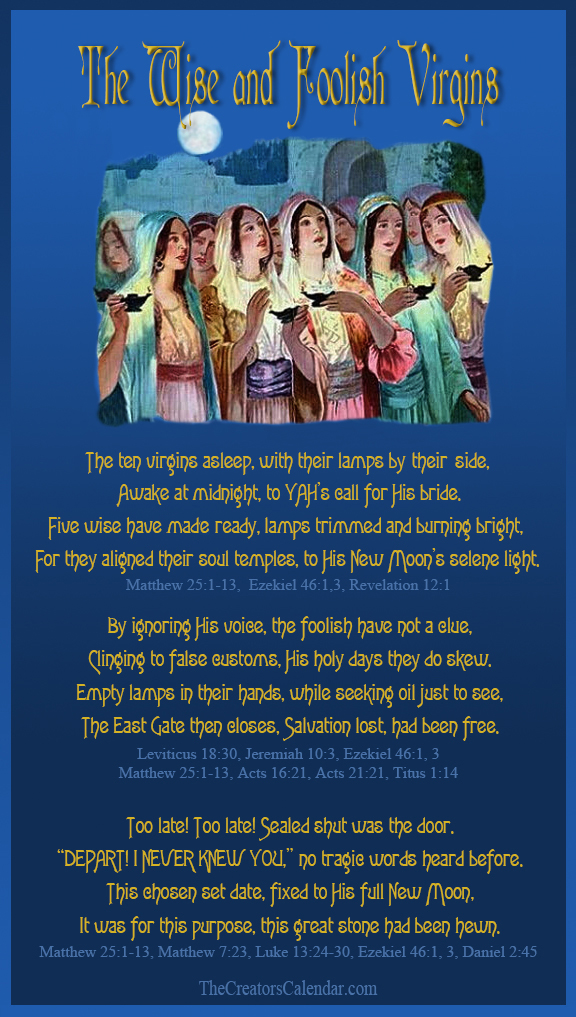
From beginning to end, this article presents a WAKE-UP CALL to those who desire to “follow the Lamb wherever He goes” and to be numbered among the five wise virgins portrayed in Matthew 25. Their lamps were trimmed and burning, supplied with the oil necessary to meet the Bridegroom when He came. The imagery is especially fitting here, because the restoration of sacred TIME is not merely an exercise in calendar calculation. It is a call to watch, prepare, and walk faithfully in the LIGHT Yahuah has provided, recognizing His appointed TIMES and preparing to meet the Bridegroom according to His prophetic pattern.
The seven-branched Menorah beautifully reinforces this theme. Established according to the divine pattern given to Moses, it belonged to the Sanctuary service and stood as a continual source of light within the sacred structure. Within the framework of this study, its seven lamps also invite consideration of the seven annual Feast Days and the prophetic Plan of Salvation they portray through Yahusha haMashiach. The Missing Key Puzzle Piece.
The historical evidence examined throughout this article ultimately brings us back to where the biblical calendar itself begins: the New Moon. If the beginning of the month is incorrectly identified, every date reckoned from that beginning is affected. Recovering the Creator’s appointed TIMES therefore begins with identifying the lunar marker He established to announce the beginning of each month.
The question is no longer simply whether calendar systems changed. The historical evidence demonstrates that they did. The question now becomes: What does Scripture reveal about the original New Moon and the sacred order that proceeds from it?
What Will You Do With the Evidence?
At some point, evidence calls for a response. If the calendar we have inherited does not preserve the timekeeping pattern established in Scripture, then simply recognizing that fact is not enough. Each of us must decide what we will do with what has been revealed.
Will we continue worshiping according to the calendar we inherited because it is familiar and convenient, or will we be willing to return to the pattern established by the Creator of the heavens and earth? Restoration may require us to reconsider traditions we have held for many years, but truth has always called the faithful beyond what is familiar and back to what is written.
The question is therefore deeply personal: What are you going to do with the evidence? Return to Scripture. Examine the Creator’s celestial witnesses for yourself. Test the inherited calendar against the pattern established in His Word. And if the evidence confirms that His appointed TIMES have been displaced by inherited traditions, then the final question becomes one only you can answer: Will you be willing to order your worship according to His TIME?
Suggested Further Study in this Order
- Three Months in a Row Part 1-4
- Amos Prophesied a Solar Eclipse to Occur at the Messiah’s Death
- The Sun was Darkened From the Sixth to the Ninth Hour