Three Months in a Row – At the Mountain – Part 3
Three Months-in-a-Row
Part Three
The Mountain
Introduction, The Third Month in a Row ~ Exodus 19:1-8
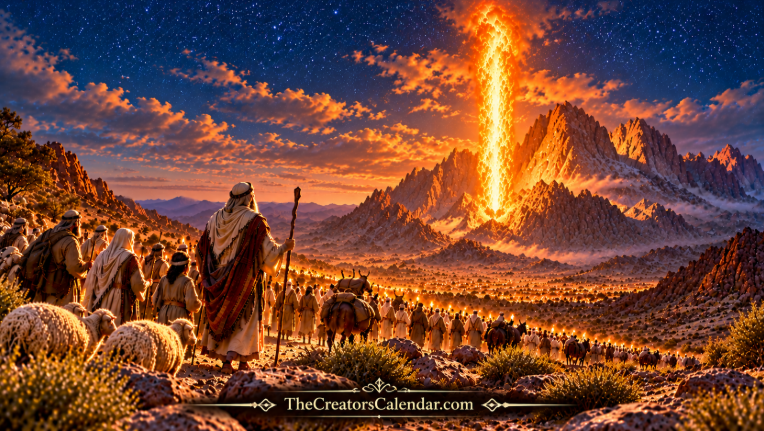
In the Third Month, Yahuah brought Israel to Mount Sinai, continuing the divinely ordered pattern of TIME established during the Exodus and confirmed through the manna. Within the chronology presented in this study, Israel arrived at the Mountain on the night of the 15th, guided by the pillar of fire. This remarkable timing provides another opportunity to examine the recurring lunar Sabbath pattern of the 8th, 15th, 22nd, and 29th.
Yet something even greater awaited Israel at Sinai. Yahuah had not merely called His people out of Egypt; He had called them unto Himself. Here, at the Mountain, the redeemed nation would hear His covenant invitation and be called to become a kingdom of Kohens (Priests) and a Kadosh (holy) nation. The restoration of sacred TIME was inseparably connected with His greater purpose of establishing a covenant relationship with His people.
Although the Wilderness Sanctuary would not be erected until the following year, Sinai would become the place where Yahuah revealed the divine pattern for its construction and appointed services. The calendar already restored to Israel would provide the framework for its Sabbaths, New Moons, sacrifices, and annual Feasts. Thus, the Third Month brings us to a pivotal moment when the restoration of TIME and the unfolding of Yahuah’s Plan of Salvation begin to converge.
Exodus 19:1-8
Three Months in a Row ~ Part 3“In the third month, when the children of Israel were gone forth out of the land of Egypt, the same day came they into the wilderness of Sinai. 2 For they were departed from Rephidim, and were come to the desert of Sinai, and had pitched in the wilderness; and there Israel camped before the mount.
3 And Moses went up unto Alahim, and Yahuah called unto him out of the mountain, saying, Thus shall you say to the house of Jacob, and tell the children of Israel; 4 You have seen what I did unto the Egyptians, and how I bore you on eagles’ wings, and brought you unto Myself.
5 Now, therefore, if you will obey My voice indeed, and keep My covenant, then you shall be a peculiar treasure unto Me above all people: for all the earth is Mine: 6 And you shall be unto Me a kingdom of Kohens (Priests) and a Kadosh (holy) nation. These are the words which you shall speak unto the children of Israel. 7 And Moses came and called for the elders of the people, and laid before their faces all these words which Yahuah commanded him. 8 And all the people answered together, and said, All that Yahuah has spoken we will do. And Moses returned the words of the people unto Yahuah.” Exodus 19:1-8 NKJV

Actual image of Mount Sinai. It is the blackened peak on the far left.
The Third Witness: Evidence from Mount Sinai
The arrival at Mount Sinai marks another significant milestone in Yahuah’s unfolding restoration of sacred TIME. Having witnessed His appointed order through the Exodus and the manna, we now turn to the Third Month, where another remarkable chronological connection emerges.
The expression “the same day” in Exodus 19:1 invites us to examine the Third Month with the same attention to TIME that we applied to the Exodus and the manna. Within the chronology presented in this study, it connects Israel’s arrival at Sinai with the 15th day of the First Month, when the nation departed from Egypt by night.
The historian Flavius Josephus also places Israel’s arrival at Mount Sinai within this three-month period:
“And going gradually on, he came to Mount Sinai, in three [lunar] months’ time after they were removed out of Egypt; at which mountain, as we have before related, the vision of the bush, and the other wonderful appearances, had happened.” Antiquities of the Jews, Flavius Josephus, Chapter 2, #5.
Yet Exodus 19 does not explicitly identify the 15th day of the Third Month as a seventh-day Sabbath. We must therefore ask an important question: Can the Third Month establish its Sabbath dates through independent Scriptural evidence, rather than merely assuming that its calendar corresponds with the preceding two months?
The answer, within the calendrical framework presented in this study, is found in an unexpected place: Yahuah’s Count to the Feast of Weeks, Shabuoth. Although its instructions were given for a later Sanctuary observance, the count provides a chronological overlay through which the weekly structure of the Third Month can be examined.

The Week According to Genesis
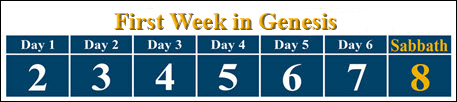
At Creation, Yahuah established the foundational pattern of six working days followed by the seventh-day Sabbath. This same six-plus-one pattern was demonstrated through the manna, when Israel gathered bread from the shamayim for six working days, while none fell on the seventh-day Sabbath.
Within the lunar calendar presented in this study, the six-working-days-plus-Sabbath pattern operates within a monthly framework established by the New Moon. To understand how this order is maintained, we must distinguish between the days that establish the month and those that make up its complete weekly cycles.
Therefore, the distinction is:
-
New Moon Day: Establishes the lunar month, but is not counted as a weekday.
-
Six working days: The days appointed for ordinary labor.
-
Seventh-day Sabbath: Completes the seven-day weekly cycle.
-
30th transition day (when present): Stands outside the weekly count.
This distinction becomes essential when examining Yahuah’s instruction to count “seven Sabbaths complete” for the Feast of Weeks, Shabuoth. Within this calendrical framework, each complete week consists of six working days followed by the seventh-day Sabbath, while New Moon Days and transition days retain their separate functions.
The Count to Shabuoth will now provide a means of examining whether this same weekly structure can be traced into the Third Month.
The Count to the Feast of Weeks
Yahuah’s appointed times provide a remarkable means of comparing Scriptural events across consecutive lunar months. Like transparent layers placed over the same calendar, the Exodus, the manna, and the Count to Shabuoth each provide chronological markers that can be examined for agreement.
An important distinction must first be understood. The Feast of Weeks was not yet an active Sanctuary observance when Israel arrived at Mount Sinai. The Wilderness Sanctuary would not be erected until the first day of the First Month of the following year (Exodus 40:17). Therefore, the Count to Shabuoth is not presented as something Israel was observing upon arriving at Sinai, but as a later instruction that can be applied retrospectively to examine the calendar of the Third Month.
The instructions are recorded in Leviticus 23:15-16, 21. Within the calendrical interpretation presented in this study, the count begins on the 16th day of the First Month, immediately following the Sabbath of the 15th. From that starting point, Yahuah instructed His people to count “seven Sabbaths complete.”
The following step-by-step examination traces the Count to Shabuoth from its beginning in the First Month through seven complete Sabbath weeks. As the calculation unfolds, we will discover how this count provides an additional chronological witness to the weekly structure of the Third Month.
The instructions upon which this count is based are found here:

Leviticus 23:15-16, 21
15 And you shall keep count from the day after the Sabbath, from the day that you brought as a sign the wave sheaf, seven Sabbaths shall be kept whole and complete. 16 Even FROM the day after the Sabbath of the seventh, you shall count out fifty [additional] days, and you shall present the NEW MOON OFFERING unto Yahuah…
21 And you shall proclaim and keep it according to the ”WAXED MIGHTY” on the selfsame day that the sacred and set-apart assembly occurs; for as all work, service and business employment shall NOT be done by you as a commandment of eternal perpetuity in all of your assemblies, and for all of your habitations. Leviticus 23:15-16, 21 The Creator’s Calendar New Restored Text
Step-by-Step Details
1. The Count Begins on the 16th of the First Month
Within the chronology established in Part 1, the 15th of the First Month was a seventh-day Sabbath. The following morning, the 16th, began the first working day of a new week and provides the starting point for the Count to Shabuoth.
2. Seven “Sabbaths Complete” Establish Seven Full Weeks
Leviticus 23:15 instructs that seven Sabbaths shall be complete. Each complete week consists of six working days followed by the seventh-day Sabbath.
Seven complete weeks therefore contain 49 weekdays. Within the lunar-calendar interpretation presented here, New Moon Days and any 30th transition days stand outside those weekly cycles, preserving the six-plus-one pattern.
3. The First Seven Weeks Reach the Third Month
The answer becomes clearer when we consider the relationship between the date of Israel’s arrival, recorded in Exodus 19:1, and the Scriptural reckoning of a complete day. Within the chronology presented here, these details help explain how Israel could have reached the Mountain on the 15th without traveling during the daylight hours of the Sabbath.
4. The 8th Establishes the Remaining Sabbaths of the Third Month
Once the 8th is identified as a seventh-day Sabbath, the remaining Sabbaths follow at seven-day intervals:
8th — 15th — 22nd — 29th
Within this calendrical framework, the Third Month therefore displays the same recurring Sabbath dates identified in the First and Second Months.
5. The Count Continues for Fifty Additional Days
The Creator’s Calendar New Restored Text renders Leviticus 23:16:
“Even FROM the day after the Sabbath of the seventh, you shall count out fifty [additional] days…”
According to this interpretation, the Count to Shabuoth does not conclude with the first seven complete weeks. Fifty additional days are counted from the day following the seventh Sabbath, extending the calendrical calculation beyond the Third Month.
The first portion contains 49 counted weekdays. The second consists of fifty additional counted days, understood here as seven more complete weeks plus one additional day. Together, these portions produce 99 counted weekdays, while New Moon Days and transition days remain outside the weekly count.
Within this model, the extended count reaches the full New Moon Day of the Fifth Month.
6. “New” or “New Moon”? Chadash and Chodesh
An important part of this interpretation concerns the Hebrew wording of Leviticus 23:16.
The Creator’s Calendar New Restored Text distinguishes between chadash (חדש, Strong’s H2319), commonly translated “new,” and chodesh (חדש, Strong’s H2320), associated with the lunar month or New Moon.
Within this restored-text analysis, the grammatical form is understood to identify the New Moon rather than merely a new offering. This interpretation connects the destination of the extended count with a specific lunar-calendar marker.
7. The Offering Language Provides Another Key
The restored-text interpretation also understands the offering terminology in Leviticus 23:16 differently from conventional translations, which commonly refer to a new grain or meat offering.
Within the analysis presented here, the instruction is understood as directing the count toward a New Moon offering unto Yahuah. If this interpretation is correct, the extended count identifies not merely a numbered day but an appointed New Moon.
8. “Waxed Mighty” and the Sacred Assembly
The Creator’s Calendar New Restored Text renders the language of Leviticus 23:21 in connection with what is described as the “waxed mighty.”
Within this interpretation, the expression identifies the fully illuminated moon, providing an additional connection between the Feast of Weeks and the full New Moon.
Thus, the Count to Shabuoth is understood to unite two calendrical elements: the recurring complete Sabbath weeks and the lunar months established by the full New Moon.
What began as a count of seven complete Sabbaths becomes, through the extended calculation presented here, a chronological overlay reaching from the First Month into the Fifth Month.
For a fuller examination of the Hebrew wording and the extended calculation, refer to the article The Count to Shabuoth.
Arriving at Mount Sinai on the Night of the 15th
Having identified the 15th of the Third Month as a seventh-day Sabbath within the calendrical framework presented in this study, an important question arises: How could Israel have traveled to Mount Sinai and established its encampment without violating Yahuah’s sacred Sabbath?
The answer becomes clearer when we consider the relationship between the date of Israel’s arrival, recorded in Exodus 19:1, and the Scriptural reckoning of a complete day. Within the chronology presented here, these details help explain how Israel could have reached the Mountain on the 15th without traveling during the daylight hours of the Sabbath.
Throughout this study, the day is understood to begin at sunrise and continue until the following sunrise. Within this reckoning, the night following the daylight hours of the 15th remains part of that same calendar date.
Israel’s movements were directed by Yahuah Himself, who provided both cloud and fire to guide His people:
“And Yahuah went before them by day in a pillar of a cloud, to lead them the WAY; and by night in a pillar of fire, to give them light; to go by day and night.” Exodus 13:21
Within the chronology presented here, Israel could therefore have remained at rest throughout the Sabbath daylight hours of the 15th, departing afterward and arriving at Mount Sinai during the night, before sunrise introduced the 16th. This interpretation allows the arrival date understood from Exodus 19:1 to harmonize with the Sabbath pattern established through the Count to Shabuoth.
The parallel with the First Month is especially significant:
“On the fifteenth day of the first month; on the morrow after the Passover the children of Israel went out with an high hand in the sight of all the Egyptians.” Numbers 33:3
In the First Month, Israel departed Egypt on the night of the 15th, following the Sabbath daylight hours. Two months later, within the chronology presented in this study, Israel arrived at Mount Sinai on the night of the 15th, likewise following the Sabbath daylight hours.
The journey from Egypt to Sinai was therefore marked by two extraordinary events understood to have occurred on the same lunar date, with the manna testimony standing between them as the Second Month witness.
Moses later described Yahuah’s faithful guidance through the wilderness:
“Who went in the way before you to search out a place to pitch your tents, to show you the way you should go, in the fire by night and in the cloud by day?” Deuteronomy 1:33 NKJV
The significance of Israel’s arrival extends beyond the calendar. Yahuah had brought His people to the Mountain where He would reveal Himself, establish His covenant, and prepare them for the Sanctuary system that would unite sacred TIME with the appointed events of His Plan of Salvation.
Thus, the Exodus, the manna, and the arrival at Sinai stand as three consecutive monthly witnesses to the same divinely appointed order of TIME.
Three Months: One Recurring Pattern
The chronological evidence from the Exodus, the manna, and Mount Sinai can now be viewed together. Each month presents a different event and a distinct Scriptural witness, yet within the calendrical framework developed in this study, all three reveal the same recurring pattern of sacred TIME.
First Month: The Exodus
The Passover chronology and Israel’s departure from Egypt establish the First Month witness, identifying the 15th as a seventh-day Sabbath within the interpretation presented in Part 1.

The Second Month: The Manna
The manna provides a second witness through six working days of provision, the double portion on the sixth day, and the absence of manna on the seventh-day Sabbath.

Third Month: Mount Sinai
The later Count to Shabuoth provides a chronological overlay reaching into the Third Month, identifying the 8th as a Sabbath and establishing the recurring weekly pattern surrounding Israel’s arrival at Sinai.
Viewed separately, these accounts concern deliverance, daily provision, and covenant preparation. Viewed together, their chronological markers align within the lunar-calendar interpretation presented throughout this study.
Three months in a row. Three Scriptural witnesses. All in one recurring pattern of sacred TIME.
The New Moon: The Foundation Established at Creation
The three consecutive monthly witnesses reveal an essential principle: the recurring Sabbath dates are understood within a calendar whose foundation is established by the New Moon. Within the calendrical framework presented in this study, New Moon Day marks the beginning of each lunar month and stands apart from the six working days and the seventh-day Sabbath.
This distinction is not presented as an adjustment introduced during the Exodus. Its foundation is traced to Creation, when Yahuah established the heavenly lights to govern the measurement of TIME.
“And Alahim said, Let there be lights in the firmament of the shamayim to divide the day from the night; and let them be for signs, and for seasons, and for days, and years.” Genesis 1:14
The Hebrew word translated “seasons” is mo’edim, referring to appointed times. Scripture further identifies the moon’s relationship to these appointments:
“He appointed the moon for seasons [mo’edim]: the sun knoweth his going down.” Psalm 104:19
Within the Scriptural interpretation developed throughout this study, these passages establish the heavenly foundation for Yahuah’s appointed times. The New Moon identifies the beginning of the lunar month, while the recurring Sabbaths occupy their prescribed positions within that month. The calendar is therefore understood as an expression of the Creator’s design rather than a system established by human tradition.
This relationship between New Moons, Sabbaths, and worship extends beyond Israel’s wilderness experience. Isaiah describes their continuing significance in a prophetic picture of worship before Yahuah:
“Assuredly, according to the order of the shamayim (starry abode), the New Moons, and the earth: The New Moon that I appointed and set in order remain firmly the chief corner [stone],” declares Yahuah. “Wherefore, it establishes and confirms your name along with your children.” And it shall come to pass according to its abundance, New Moon by New Moon you shall keep, and according to its abundance, Sabbath by Sabbath you shall keep. And I shall lead all flesh to prostrate in worship, according to this chief corner [stone],” declares Yahuah. Isaiah 66:22-23, The Creator’s Calendar New Restored Text
Within this restored-text interpretation, Isaiah presents the New Moon and Sabbath together as continuing appointments of worship. What began at Creation, was restored to Israel, and was demonstrated through three consecutive months is understood to remain part of Yahuah’s enduring order of sacred TIME.
The New Moon establishes the month. The Sabbath completes its weeks. Together, they testify to the Creator who appointed them.
The Mountain Was Only the Beginning
Israel’s arrival at Mount Sinai was not the culmination of Yahuah’s restoration of sacred TIME. It was preparation for something far greater.
At Sinai, Yahuah called His redeemed people into covenant relationship with Himself and revealed the divine pattern for the Wilderness Sanctuary. Yet the Sanctuary would not be erected until the first day of the First Month of the following year:
“And it came to pass in the first month in the second year, on the first day of the month, that the tabernacle was reared up.” Exodus 40:17
The Sanctuary: A TIME-and-EVENT Model
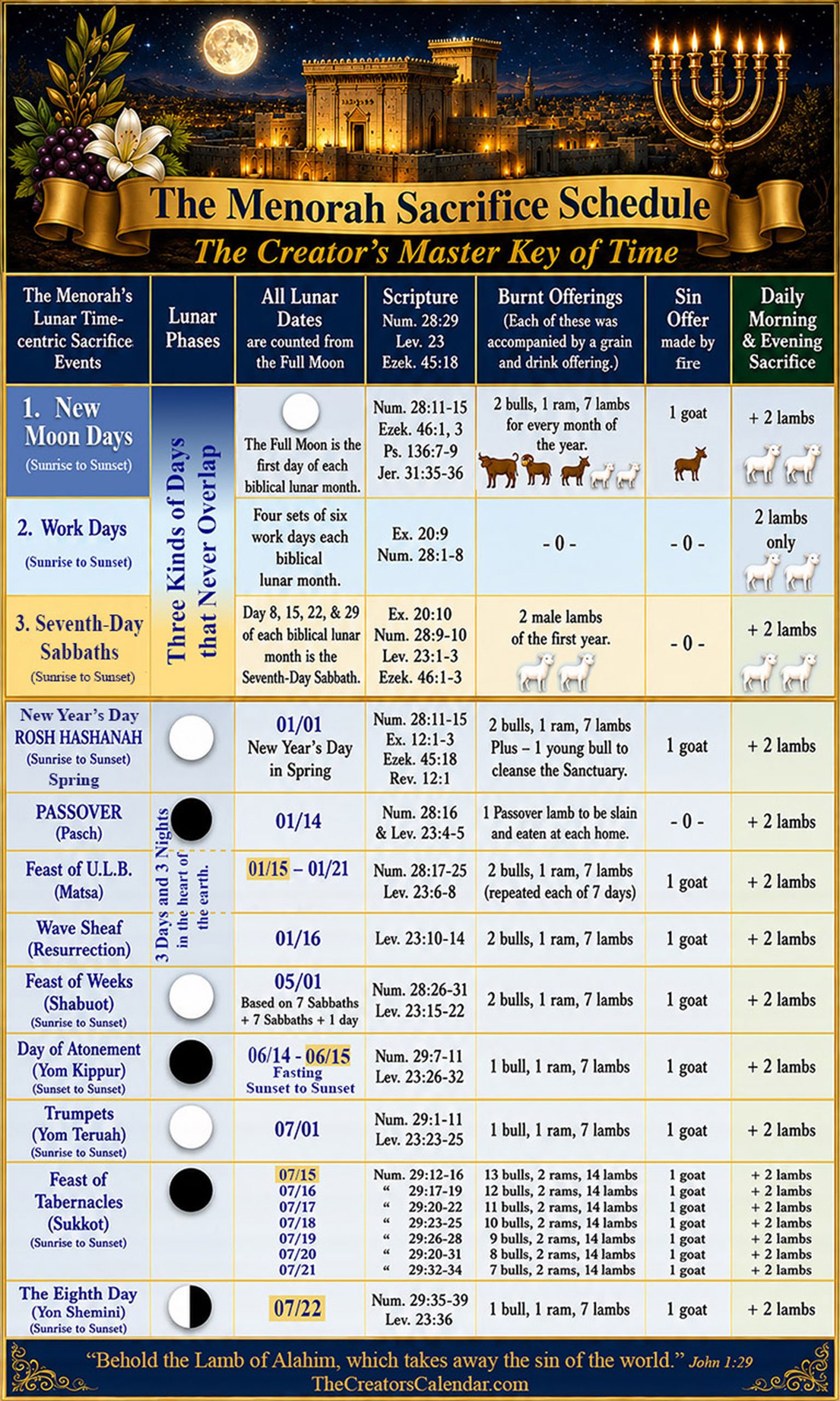
The Sanctuary was more than a sacred structure containing holy objects. Its sacrifices, priesthood, and appointed services formed a divinely ordered teaching system in which TIME and EVENT were inseparably connected.
The daily offerings followed the morning and evening cycle. The seventh-day Sabbath had its appointed sacrifices. New Moon offerings marked the beginning of each lunar month, while the annual Feasts occurred on their prescribed dates.
Each observance had its appointed place, demonstrating that the Sanctuary’s services were organized according to the calendar Yahuah had established.
Three Kinds of Day
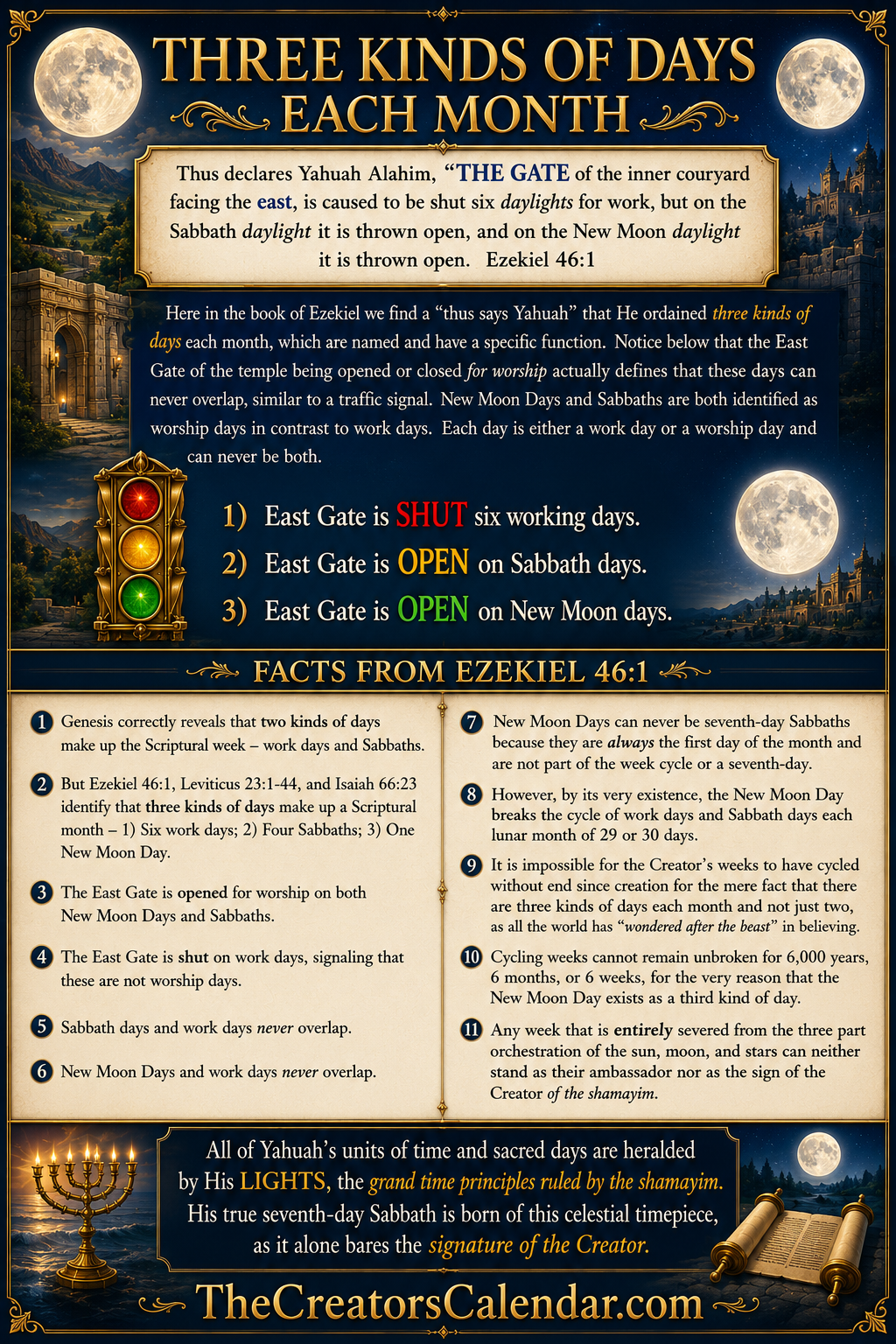
Within the calendrical framework presented in this study, the Sanctuary’s appointed services help illustrate three distinct kinds of days:
-
New Moon Days: Establish the beginning of each lunar month and carry their own appointed observances.
-
Working Days: The six days appointed for ordinary labor within each complete week.
-
Seventh-day Sabbaths: The sacred rest days that complete each weekly cycle and carry their own appointed services.
When a 30th transition day occurs, it stands outside the six-working-days-plus-Sabbath count, preceding the next New Moon Day.
This distinction is essential to the relationship between TIME and EVENT. The calendar identifies the kind of day, while the Sanctuary establishes the sacred observances appointed for that day.
TIME and EVENT Point Forward
Yet the Sanctuary’s purpose reached far beyond identifying appointed days and sacrifices. Its priesthood, offerings, veil, Kadosh haKadoshim, Mercy Seat, and annual Feasts formed a prophetic teaching system revealing Yahuah’s Plan of Salvation.
Each appointed EVENT pointed toward a greater fulfillment through Yahusha haMashiach, whose ministry brings meaning to the Sanctuary’s sacred symbols and services. The calendar provided the framework of TIME, while the Sanctuary revealed the redemptive EVENTS associated with Yahuah’s covenant promises.
The Mountain was therefore not the conclusion of Israel’s journey into restored TIME. It was the place where the people who had been delivered from Egypt were prepared to understand the greater purpose of their deliverance.
Yahuah first taught His people WHEN to worship. Through the Sanctuary, He revealed the EVENTS that would unfold within His appointed TIME, leading ultimately to the fulfillment of His Plan of Salvation through Yahusha haMashiach.
Third Month Conclusion
|
Part 3 The Mountain |