Constantine and the Week
Constantine and the Week
Daniel 7:25
1. A Civil Power Would Change Times and Laws
“And he shall speak great words against the Most High, and shall wear out the saints of the Most High, and think to change times and laws…” Daniel 7:25
Could one man, empowered by empire and ambition, truly alter the divinely ordained fabric of time?
Daniel foretold the rise of a power that would “think to change times and laws.” This prophecy does not imply that any earthly ruler could alter the movements of the sun, moon, and stars, for the heavens remain obedient to the Creator’s command. Rather, it points to an attempted change in mankind’s reckoning of sacred time, a counterfeit system by which the appointed worship rhythm of Yahuah would be obscured, replaced, and eventually accepted by much of the world.
To understand Constantine’s role in this change, we must first go back nearly four centuries before him to Julius Caesar. Constantine did not begin Rome’s departure from lunar timekeeping. He built upon it. Julius Caesar removed the moon from Roman civil time. Constantine later used that already solarized framework to legislate a continuous planetary week and elevate the “venerable day of the Sun” as the weekly rest day of the Roman Empire.
2. Julius Caesar Removed the Moon from Roman Time
Nearly four centuries before Constantine, Roman time-measuring had already begun to detach itself from the lunar cycles that had defined sacred time since Creation. This shift was advanced under Julius Caesar, whose calendar reform removed the moon as the governing measure for years, months, weeks, and days, replacing the Creator’s luni-solar rhythm with a solar-based Roman system.
“In the mid-1st century B.C., Julius Cæsar [Roman Emperor] invited Sosigenes, an Alexandrian [Egypt] astronomer, to advise him about the reform of the calendar, and Sosigenes decided that the only practical step was to abandon the lunar calendar altogether. Months must be arranged on a seasonal basis, and a tropical [solar] year used, as in the Egyptian calendar.” Encyclopedia Britannica, The Julian Calendar, Paragraph 1. https://www.britannica.com/science/calendar/The-Western-calendar-and-calendar-reforms
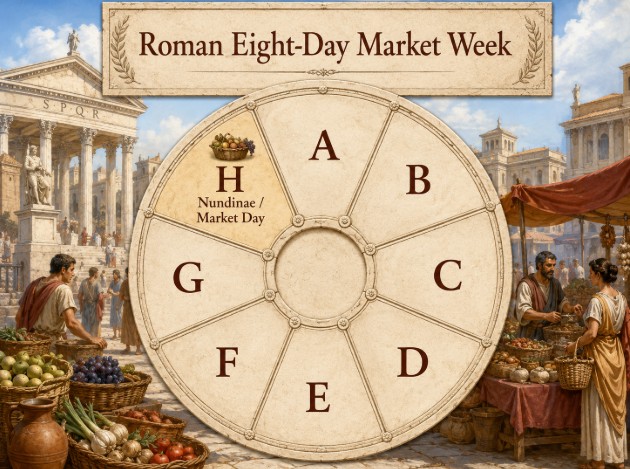
Along with Rome’s departure from lunar-based reckoning, Julius Caesar’s reform prepared the way for a radically different weekly model. Instead of a seven-day week cycling four times within each lunar month, he designed an eight-day market week that cycled continuously, without interruption from the New Moon Day. This created a week entirely detached from the lunar phases. It allowed Roman time to move forward in an unbroken civil cycle rather than according to the Creator’s appointed celestial rhythm. This calendar remained in use for approximately three centuries and was enforced upon the captive Jews since A.D. 70, who were unable to locate the true Sabbath any longer.
“The decline of the [Roman Julian] eight-day week coincided with the expansion of Rome… The astrological and Christian [planetary Sun. – Sat.] seven-day weeks that had just been [re] introduced into Rome were also becoming increasingly popular. There is evidence indicating that the Roman eight-day week and those two seven-day cycles were used simultaneously for some time. However, the coexistence of two weekly rhythms that were entirely out of phase with one another obviously could not be sustained for long. One of them clearly had to give way. As we all know, it was the eight-day week that soon disappeared from the pages of history forever [along with the original lunar seven-day week].” Eviatar Zerubavel, The Seven-day Circle, p. 46.
3. From the Eight-Day Roman Cycle to the Seven-Day Planetary Week
Rome’s departure from the Creator’s lunar time-measuring system did not arrive in one single step. It unfolded in stages. Julius Caesar’s reform first severed Roman civil time from the moon by removing the lunar phases as the governing measure for years, months, weeks, and days. But Rome’s weekly structure would continue to develop until it finally settled into the seven-day planetary cycle inherited by the modern world.
Before the Roman planetary week was fixed into the order now commonly recognized, Rome utilized an eight-day market cycle. This cycle was civil in nature and was not governed by the New Moon, nor by the lunar phases that had marked the Scriptural rhythm of sacred time. In contrast to the Creator’s weeks, which were counted within the lunar month from one New Moon to the next, Rome’s civil cycle moved forward independently, without any interruption from New Moon Day.
This distinction is important. The Creator’s calendar recognizes the New Moon as the starting point from which the days of the month are counted. Its weeks are therefore anchored to the lunar month and divided by the moon’s appointed phases. Rome’s developing calendar system, however, detached the count of time from that heavenly witness. Once the moon was removed from the calendar’s governing structure, the way was prepared for a week that could cycle continuously according to human design.
Over time, Rome’s older eight-day civil rhythm gave way to the seven-day planetary week. Yet this new seven-day form was not a return to the Scriptural week. It was seven in number only, not seven according to the Torah’s method of reckoning. It was ordered by the planetary sequence of Rome, not by the New Moon, lunar phases, or the appointed lights established at Creation.
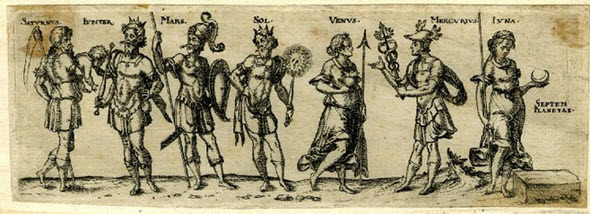 This planetary week also appears to have passed through more than one stage before becoming the familiar order later inherited through Christianized Rome. In earlier arrangements, Saturday, dies Saturni, held the first-day position. Only later, as the Romanized seven-day week was reordered and established, did Sunday, dies Solis, become day number one, causing Saturday, dies Saturni, to occupy the seventh-day position.
This is a critical point in the history of the Sabbath question. Saturday did not come to appear as the seventh day because Scripture identified it as such. It came to appear as the seventh day only after Rome’s planetary week was reordered with Sunday as the first day. From that point forward, Saturday carried the number seven within Rome’s week, but not because it had been preserved from Creation. It was the seventh day of a Roman planetary cycle, not the seventh day counted according to the Creator’s lunar calendar.
Thus, before Constantine gave the planetary week imperial force, the foundation had already been laid. The moon had been removed from Roman reckoning. The older eight-day cycle had given way to a seven-day planetary arrangement. And the days themselves were identified not by Scripture, but by the names of Rome’s planetary deities: Sun, Moon, Mars, Mercury, Jupiter, Venus, and Saturn.
By the time Constantine entered the stage of history, the issue was no longer merely civil timekeeping. Rome was now prepared to bind its planetary week to religious observance. The next step would be to elevate dies Solis, the day of the Sun, as the weekly rest day of the empire and to give this already moonless calendar rhythm the force of Roman law.
4. Constantine Legislated the Modern Planetary Week
Fast-forward nearly four centuries. By the time Constantine rose to imperial power, Rome already possessed a solar calendar detached from the lunar phases. What remained was to settle and enforce a weekly rhythm that would not return to the New Moon, nor to the lunar phases that had once governed the Scriptural count of weeks. Instead, Constantine’s reform elevated a seven-day planetary cycle, one that moved continuously and independently of the Creator’s lunar calendar.
This new Roman seven-day week was not a restoration of the Scriptural week. It was a counterfeit replacement. Although it returned to a seven-day structure, it did not return to the Creator’s model of weeks counted from one New Moon to the next. Rather, it was arranged according to the planetary order of Rome, passing through its own stages before the dust finally settled with Sunday, Dies Solis, as day number one, and Saturday, Dies Saturni, as day number seven.
This seven-day planetary week had already been shaped by Rome’s evolving calendar order; Constantine’s contribution was to give it imperial and religious force.
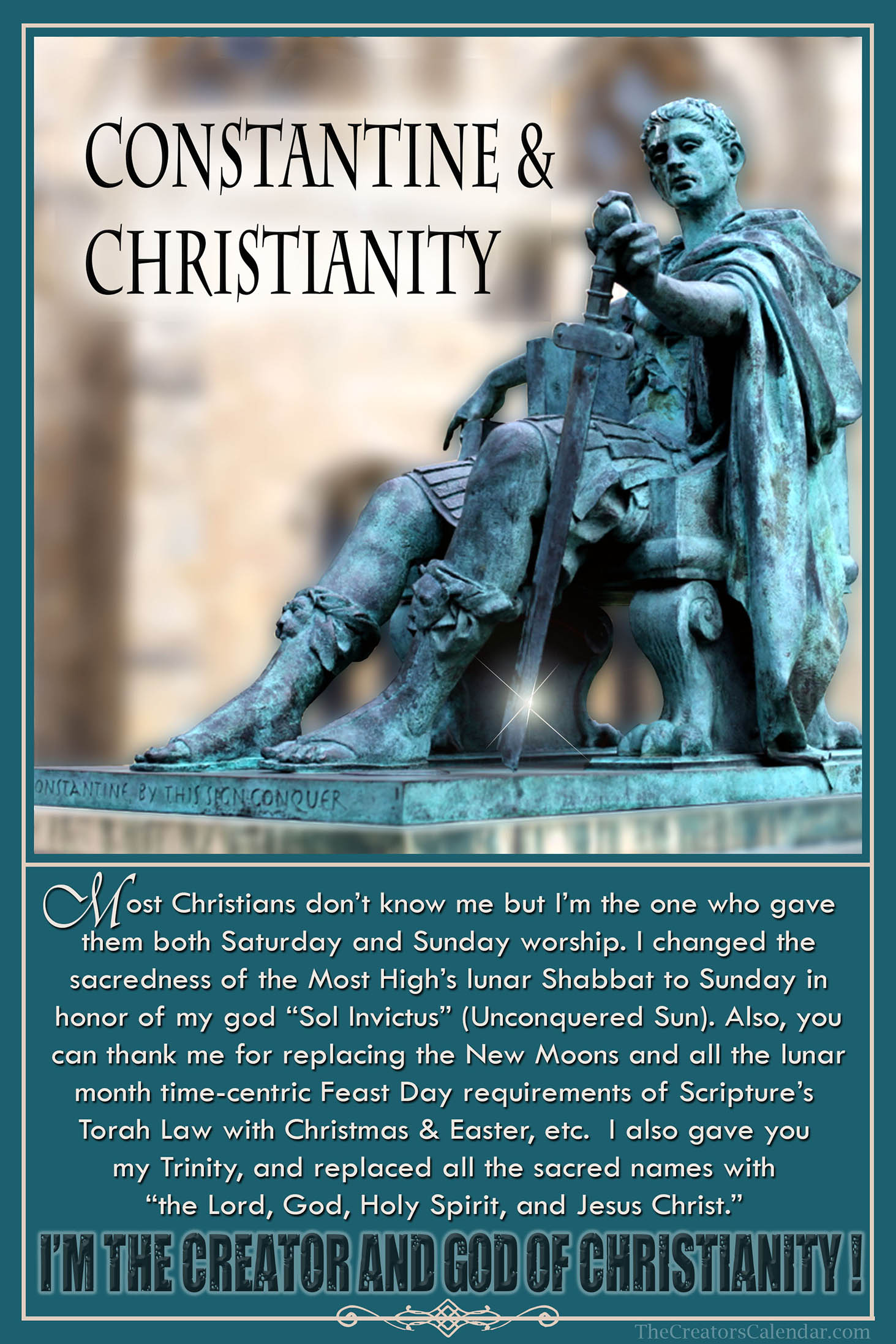
Constantine issued his famous Sunday legislation, honoring “the venerable day of the Sun” as the weekly rest day of the empire. This was not a minor civil adjustment. It gave official recognition to a weekly rhythm that was disconnected from the New Moons, lunar Sabbaths, and appointed times established in the Torah’s divine calendar.
In 321 A.D., Constantine, emperor of Rome…by civil enactments made “the venerable day of the Sun,” which day was then “notable for its veneration,” the weekly rest day of the empire…The enforcement of the weekly observance of Sunday gave official recognition to the [NEW] week of seven days and resulted in the introduction of it into the official civil calendar of Rome. The Romans passed that calendar down to us, and in it we have still the ancient planetary titles of the days of the week. Odom, op. cit., p. 243-244, emphasis supplied.
Thus, Constantine did not restore the biblical week. He legislated a Roman planetary week within a calendar system already divorced from the moon. Its rhythm was not counted from one New Moon to another, nor was it governed by the quarter phases of the lunar month. It cycled independently, without interruption, without lunar correction, and without regard to the Creator’s appointed lights.
This was a crucial turning point. Julius Caesar had removed the moon from Roman calendar reckoning. Constantine then advanced a seven-day planetary week that carried the appearance of biblical numbering while remaining severed from the biblical method of counting. Together, these reforms helped establish a time-measuring system that stood in direct contrast to the Scriptural model of sacred time.
5. Nicaea and the Separation from Passover
A few years later, in A.D. 325, the Council of Nicaea further advanced Rome’s separation from the Torah-based calendar. Here, the timing of the resurrection celebration was formally distanced from the Scriptural Passover framework and from the calendar of the Yahudim. This was not merely a disagreement over dates. It represented a growing determination to sever Roman Christianity from the lunar appointed times of the Hebrew Scriptures.
The biblical Passover was date-stamped on the 14th day of the first lunar month, counted from the New Moon. The Wave Sheaf Offering, connected to the resurrection pattern, belonged to the Torah’s appointed sequence. But Rome’s Easter system moved the focus away from the Creator’s lunar calendar and toward a new religious structure shaped by imperial and ecclesiastical authority.
Many other doctrines and traditions were strengthened or developed in this Romanized environment, including the growing elevation of Easter Sunday and the replacement of the Scriptural Passover pattern. What had once been anchored in the lunar appointed times of Yahuah was increasingly redefined through the calendar and theological framework of Rome. Ultimately, Easter was placed on the first Sunday, following the first full moon, after the Vernal Equinox.
6. The Constantinian Creed and the Rejection of Hebrew Time
The Constantinian Emperors achieved a significant milestone in the fourth century A.D. by eliminating the Torah (Law) and all things Jewish from their new Christian religion, and by creating a calendar standard based on the sun rather than the trinity of sun, moon, and stars. This afforded them the freedom to craft their own spurious sacred day on an entirely different time-measuring calendar model wholly divorced from the New Moon and lunar phases. It was this stunning impostor calendar model that was proactively proclaimed to ALL THE WORLD by the Roman Catholic mother Church and her daughter Protestant Christian churches alike.
Creed of Constantinople Church
“I renounce all customs, rites, legalisms, unleavened breads and sacrifices of lambs of the Hebrews, and all the other feasts of the Hebrews, sacrifices, prayers, aspirations, purifications, sanctifications, and propitiations, and fasts and New Moons, and Sabbaths, and superstitions, and hymns and chants, and observances, and synagogues…Absolutely everything Jewish, every Law, rite and custom and if afterwards I shall wish to deny and return to Jewish superstition, or shall be found eating with Jews, or feasting with them, or secretly conversing and condemning the Christian religion instead of openly confuting them and condemning their vain faith, then let the trembling of Cain and the leprosy of Gehazi cleave to me, as well as the legal punishments to which I acknowledge myself liable. And may I be an anathema in the world to come, and may my soul be set down with Satan and the devils.” Stefano Assemani, Acta Sanctorium Martyrum Orientalium at Occidentalium, Vol. 1, Rome 1748, page 105.
The Constantinian Creed overtly identifies that the foundation of Rome’s new Christian religion was proactively designed to have NO CONNECTION to anything taught in the Torah (Law) or the entire Old Testament Scriptures. This creed is evidence that neither Saturday nor Sunday was ever designed by Rome to accurately align with the original calendar model of the first week of Creation or anything after that, as presented in Scripture. Instead, with the creation of their new sacred EASTER HOLIDAY, they combined it with their newly ordered Sunday, causing it to appear that Rome’s continuous weekly cycle meets the Scriptural standard, with Sunday as the first day and Saturday as the seventh.
So the question is, was the sacredness of the authentic and original seventh-day Sabbath, as ordained by our Creator, ever changed from Saturday to Sunday? The answer is no. The evidence points to something far more serious: Saturday was never the Sabbath of Scripture, but only the seventh day of Rome’s reordered planetary week.
In this way, Rome’s “witty invention” becomes visible in stages. Julius Caesar removed the moon from Roman civil time. Constantine gave force to the continuous planetary week and exalted Dies Solis, the day of the Sun. Nicaea further separated the resurrection celebration from the Torah-based Passover rhythm. The Constantinian Creed then openly rejected the New Moons, Sabbaths, Feasts, and Hebrew foundations of worship.
Yet Rome did not change the heavens. It could only train the nations to follow another calendar. The sun, moon, and stars remained in their appointed courses, while mankind was led to reckon sacred time by imperial decree, ecclesiastical authority, and inherited tradition. The next historical witness, Canon 29 of Laodicea, reveals how deeply this shift affected the Sabbath question itself.
7. Council of Laodicea, Forty Years Later
Forty years later, in A.D. 363-364, under the rulership of Julian, the last Constantinian Emperor, the Council of Laodicea convened.
The popularized version of Canon 29 from the Council of Laodicea is central to Sabbatarian doctrine. Unrecognized by most, this Canon has been FALSELY translated, perpetuating “Sunday sacredness” as the first day and “Saturday” as the seventh day of the biblical week sequence:
“Christians shall not Judaize and be idle on Saturday, but shall work on that day; but the Lord’s Day [Sunday] they shall especially honor, and, as being Christians, shall, if possible, do no work on that day. If however, they are found Judaizing, they shall be shut out from Christ.” Council of Laodicea, Canon 29
8. The Shift from Sabbath to Saturday
The following evidence may come as a shock to many sincere Saturday Sabbath believers who have trusted the common English rendering of Canon 29 of the Council of Laodicea. For generations, this canon has often been presented as though it proves that the early Roman Church transferred sacredness from Saturday to Sunday. Yet a closer look at the Latin and Greek wording raises a far more serious question: Was Canon 29 truly addressing “Saturday,” or was that word supplied later by translators who assumed that the Sabbath of Scripture and the Roman day of Saturn were one and the same?
According to Karl J. von Hefele, Catholic Bishop and scholar, in his History of the Councils of the Church from the Original Documents, the wording of Canon 29 does not contain the Roman planetary term “Saturday,” or dies Saturni, in either the Greek or Latin text. Instead, the Latin uses Sabbato, and the Greek uses Sabbath terminology, terms that mean the same thing. This distinction is significant because Sabbato refers to the Sabbath, while dies Saturni refers to Saturn’s day, the name of a pagan entity within the Roman planetary week. These were never one and the same term, nor did they arise from the same calendar system.
Please do not accept this claim without examination. The reader is encouraged to do due diligence and compare the evidence personally. If the original wording says “Sabbath,” but the English translation supplies “Saturday,” then the translation has already interpreted the passage through a Roman calendar lens.
Here are two Latin versions of Canon 29:
“Quod non oportet Christianos Judaizere et otiare in Sabbato [Sabbath], sed operari in eodem die. Preferentes autem in veneratione Dominicum Diem [Sunday] si vacre voluerint, ut Christiani hoc faciat; quod si reperti fuerint Judaizere Anathema sint a Christo.” Council of Laodicea, Canon 29, Latin version.
“Christiani non oportet judaizare et otiare in Sabbato [Sabbath], sed operari in eodem die; Dominicum [Sunday] autem honorare, et, si possunt, in eo otiare, ut Christiani. Quod si reperti fuerint judaizantes, anathema sint a Christo.” Council of Laodicea, Canon 29, Latin version.
Here is the same Canon 29 in Greek:
“Οὐ δεῖ Χριστιανοὺς Ἰουδαΐζειν καὶ σαββατίζειν [Sabbath], ἀλλ᾽ ἐργάζεσθαι τῇ σαββάτῳ [Sabbath]· τὴν δὲ κυριακὴν προτιμῶντες, εἴπερ δύνανται, ἐν αὐτῇ μηδὲν ἐργάζεσθαι· εἰ δὲ Ἰουδαΐζοντες εὑρεθῶσιν, ἀνάθεμα ἔστωσαν τῷ Χριστῷ.” Council of Laodicea, Canon 29, Greek version.
A basic English rendering from Google Translate is somewhat different from the common English version often quoted, yet it maintains the term “Sabbath” and makes no reference to the Roman planetary god Saturn or to “Saturday”:
“He does not see Christians Judaizing and Sabbath-keeping, but working on the Sabbath; but preferring Sunday, as much as they can, they do not work on it at all; but if Judaizing is found, let them call Christ anathema.” Council of Laodicea, Canon 29, English version from Google Translate.
By contrast, here is the common English version often presented to Saturday-keeping believers:
“Christians shall not Judaize and be idle on “Saturday,” but shall work on that day; but the Lord’s Day [Sunday] they shall especially honor, and, as being Christians, shall, if possible, do no work on that day. If however, they are found Judaizing, they shall be shut out from Christ.” Council of Laodicea, Canon 29.
The issue is not small. The Latin and Greek wording refers to the Sabbath, while the common English version supplies the word “Saturday.” But during the period when the Julian calendar and Roman planetary week were being pressed upon early believers for religious purposes, Sabbato and dies Saturni were not identical terms arising from the same calendar model. Sabbato belonged to the language of the Sabbath, while dies Saturni belonged to the Roman planetary week. These represented two distinctly different time-measuring systems.
Only as the historical record has been obscured and overwritten through translation, under the pretext of shifting sacredness from Saturday to Sunday, has Saturday come to be mistakenly regarded as the seventh-day Sabbath of Scripture. In other words, the English word “Saturday” causes the reader to assume that the Sabbath being condemned in Canon 29 was the Roman day of Saturn. But the original wording does not say dies Saturni. It says Sabbato.
This distinction helps expose a much larger historical problem. The theory that Saturday was the original sacred Sabbath, later changed to Sunday, depends upon the assumption that the Scriptural Sabbath and Roman Saturday were already one and the same day. Yet if Canon 29 itself says “Sabbath” rather than “Saturday,” then the passage cannot honestly be used to prove that Saturday had always been the seventh-day Sabbath of Scripture.
9. Sabbato Is Not Dies Saturni
The heart of the matter rests upon a simple but far-reaching distinction: Sabbato is not dies Saturni. One belongs to the language of the Sabbath; the other belongs to the Roman planetary week. To translate Sabbato as “Saturday” is not merely to choose a modern English equivalent. It is to import a Roman calendar assumption into a text that never used the planetary name.
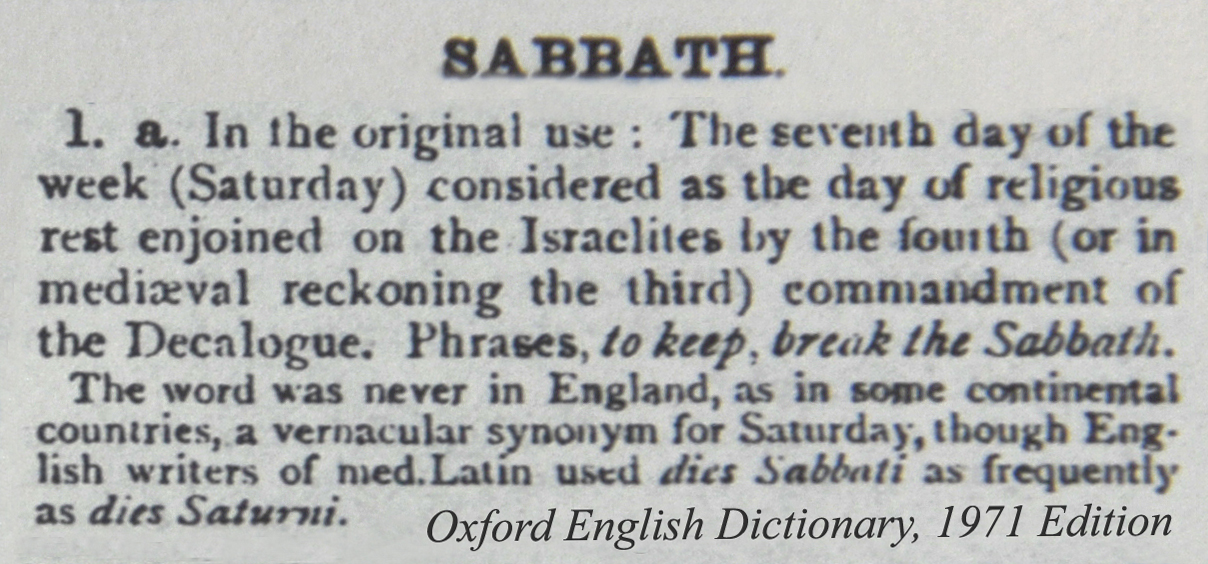
This distinction matters because the Sabbath of Scripture was not defined by Rome. It was not named after Saturn, nor was it governed by a continuous planetary week cycling independently of the New Moon. The Sabbath of Yahuah was established within the Creator’s own time-measuring system, where days, months, years, appointed times, and Sabbaths were reckoned by the lights placed in the heavens.
By contrast, dies Saturni belonged to Rome’s planetary week, named after pagan celestial deities: Sun, Moon, Mars, Mercury, Jupiter, Venus, and Saturn. This was not the language of Genesis, Exodus, Leviticus, or the prophets. It was the language of Rome.
Therefore, when Canon 29 uses Sabbato, the deeper question is not, “Why did Rome change Saturday to Sunday?” The deeper question is, “Why has Sabbath been translated as Saturday when the original wording did not say Saturn’s day?” That substitution quietly trains the reader to believe that the Sabbath being condemned was already the same as Roman Saturday.
Once “Sabbath” is replaced by “Saturday,” the entire historical narrative shifts. The reader is led to imagine that early believers were keeping Saturday as the seventh-day Sabbath and that Rome merely commanded them to transfer their rest to Sunday. But if the original issue involved Sabbath observance according to the Hebrew and lunar-rooted calendar, then Canon 29 reveals something far more consequential: Rome was not simply moving sacredness from one Roman weekday to another. Rome was condemning the older Sabbath rhythm itself.
Hutton Webster records the later Jewish association of Saturn with the Sabbath:
“These . . . eventually led Jewish rabbis to call Saturn ‘Shabbti,’ ‘the star of the Sabbath.’ It was not until the first century of our era, when the planetary week had become an established institution, that the Jewish Sabbath seems always to have corresponded to Saturn’s Day [Saturday].” Rest Days, Hutton Webster, p. 244.
This is why the wording matters. If the original term Sabbato was allowed to remain as “Sabbath,” Canon 29 becomes a window into the conflict between two time systems. But if it were to be changed to “Saturday,” that conflict goes away and disappears beneath the Roman calendar now assumed by nearly all the world.
The Torah never defines the Sabbath by the name of Saturn. The prophets never identify the appointed rest day by the Roman planetary week. Yahusha never taught His followers to locate the Sabbath by a calendar system severed from the New Moon. The question, then, is not whether Saturday or Sunday should be honored within Rome’s week. The deeper question is whether either day belongs to the Creator’s original Sabbath rhythm at all.
10. The Planetary Week and the Saturday Illusion
Once the distinction between Sabbato and dies Saturni is understood, the next question becomes unavoidable: How did Saturday come to be regarded as the seventh-day Sabbath of Scripture? The answer lies in the rise and enforcement of the Roman planetary week, a calendar structure wholly different from the Creator’s lunar appointed rhythm.
The planetary week did not arise from the Torah. Its days were named after celestial deities honored in the pagan Roman world: the Sun, the Moon, Mars, Mercury, Jupiter, Venus, and Saturn. This weekly cycle was not counted from the New Moon, nor was it divided by the lunar phases. It moved forward in an uninterrupted sequence, detached from the heavenly calendar markers Yahuah appointed at Creation.
Before this Roman system settled into the familiar order inherited today, Saturday, dies Saturni, was not consistently understood as the seventh day. In earlier planetary arrangements, Saturn’s day held the first-day position. Only later, as the Romanized seven-day week became established, was Sunday, dies Solis, elevated as day number one, causing Saturday, dies Saturni, to occupy the seventh-day position within the new planetary cycle.
This is the critical point. Saturday did not appear as “the seventh day” because Scripture identified it as such. It appeared to become the seventh day only after Rome’s planetary week was reordered and imposed as the governing weekly framework. Once Sunday was fixed as the first day of that cycle, Saturday automatically appeared as the seventh. But this was Roman numbering, not Torah reckoning.
Constantine’s Sunday legislation helped give this new order civil and religious force. By honoring “the venerable day of the Sun” as the weekly rest day of the empire, Rome gave official recognition to a weekly rhythm severed from the New Moon, lunar Sabbaths, and appointed Feast Days of Scripture. From that point forward, the planetary week increasingly became the accepted rhythm by which both civil life and religious observance were measured.
Rome then secured this new rhythm in the minds of believers by attaching the resurrection of the Messiah to Sunday, dies Solis, the day of the Sun. By doing this, Sunday could be presented not merely as a pagan planetary day, but as a Christianized memorial of the resurrection. Once Sunday was accepted as the weekly resurrection day, it naturally became day number one of the Roman Christian week, while Saturday appeared to become the seventh day by default.
But this entire arrangement rested upon Rome’s calendar framework, not upon the Old Testament Torah. The resurrection of Yahusha haMashiach was not originally anchored to a floating Roman weekday called Sunday. It was tied to the appointed sequence of Passover, Unleavened Bread, and the Wave Sheaf Offering, all measured by the lunar calendar of Scripture. The Messiah fulfilled the lunar appointed time, not a planetary day.
This is why the Easter question cannot be separated from the Sabbath question. Both depend upon the calendar by which sacred time is measured. When Rome placed Easter Sunday at the center of its new religious rhythm, it did more than establish a replacement festival. It reframed the weekly cycle itself. Sunday appeared sacred by association, and Saturday appeared ancient by placement.
Odom identifies the planetary week as paganism’s counterfeit of the biblical week:
“This planetary week was paganism’s counterfeit of the true biblical week instituted by the Creator in the beginning of earth’s history. In the counterfeit week employed in ancient paganism ‘the venerable day of the Sun’ was esteemed by the heathen above the other six days because it was regarded as sacred to the Sun, the chief of the planetary deities . . . Just as the true Sabbath is inseparably linked with the biblical week, so the false Sabbath of pagan origin needed a weekly cycle. Thus we have found that the planetary week of paganism is Sunday’s twin sister, and that the two counterfeit institutions were linked together …” Odom, op. cit., p. 243-244.
“The long-term effect was that ‘Easter Sunday’ entered [established the new] the Christian paradigm as ‘The Day of Christ’s Resurrection.’ The corollary to this realignment of time calculation was that the day preceding Easter Sunday, Saturday, became forever after the [perceived] ‘True [seventh-day] Bible Sabbath.’ This is the true significance of Constantine’s ‘Sunday law’ and it laid the foundation for the modern assumption that a continuous weekly cycle has always existed.” eLaine Vornholt & Laura Lee Vorholt-Jones, Calendar Fraud, “Biblical Calendar Outlawed.”
Thus, the Saturday illusion rests upon a hidden assumption: that the Roman planetary week is identical to the Scriptural week of Creation. Yet Scripture never identifies the Sabbath by the name of Saturn, never commands worship by the order of pagan planetary days, and never detaches the count of sacred time from the heavenly lights, counted from one New Moon to the next.
To those who no longer understood the Creator’s lunar calendar, Saturday appeared to be the ancient seventh day simply because it occupied the seventh position in Rome’s newest weekly cycle. But a position within a Roman planetary cycle is not the same as the seventh day counted according to Yahuah’s calendar. The number seven alone cannot sanctify a day if the count itself comes from a fraudulent time system.
When this is seen, the issue becomes much larger than Saturday versus Sunday. Both belong to the same contrived Roman planetary week. The deeper question is whether the faithful will continue measuring sacred time by Rome’s unbroken cycle, or return to the Creator’s timepiece, where the New Moon, lunar phases, lunar Sabbaths, and lunar appointed Feast Days testify together of Yahuah’s ordained worship rhythm.
In time, Easter Sunday was cemented as the memorial of the Messiah’s resurrection, while the preceding Saturday was recast in the Christian mind as the authentic seventh-day Sabbath. Constantine’s decree did more than enforce Sunday rest; it helped restructure sacred time and fostered the illusion that Rome’s weekly cycle had flowed without interruption from Creation.
In light of this evidence, the claim that sacredness was merely transferred from Saturday to Sunday must be reexamined. The deeper issue is not a transfer between two Roman weekdays, but the replacement of the Creator’s appointed calendar with Rome’s continuous planetary cycle.
11. Rome Could Only “Think” to Change Time
Daniel’s prophecy is precise. It does not say the beast power would successfully change the Creator’s times and laws in the heavens. It says he would “think to change times and laws.” This distinction is vital. No earthly ruler, no emperor, no council, and no religious institution has power to alter the courses of the sun, moon, and stars appointed by Yahuah at Creation.
The heavens did not submit to Julius Caesar. The moon did not cease its phases because Rome abandoned it. The New Moon did not stop announcing the beginning of the month because imperial calendars ignored it. The Sabbaths and appointed Feast Days did not vanish from the Creator’s order because Constantine legislated the venerable day of the Sun. Yahuah’s timepiece remained exactly where He placed it, written in the heavens for all who would look up and discern.
What Rome changed was not the divine order itself, but mankind’s allegiance to that order. By replacing the Creator’s lunar appointed rhythm with a solar calendar, a continuous planetary week, and a Sunday-centered resurrection festival, Rome trained the nations to reckon sacred time by imperial authority rather than by the lights of heaven. This is how the change became effective, not in the throne room of Yahuah, the Most High, but in the minds and habits of men.
This is the essence of the deception. The counterfeit does not need to move the moon from its course. It only needs to persuade the world that the moon no longer matters. It does not need to erase the New Moon from the sky. It only needs to erase it from worship. It does not need to destroy the Creator’s Sabbath. It only needs to replace the method by which people count to it.
Seen in this light, the Roman calendar system becomes a masterful illusion. It appears orderly. It appears ancient. It appears universally accepted. Yet its authority rests upon inherited tradition, imperial legislation, and religious enforcement, not upon the Torah, the Sanctuary, or the heavenly lights ordained in Genesis 1:14. It appears as something the wizard of Oz may have accomplished from behind his curtain.
Therefore, the call of Daniel 7:25 is not merely to identify a power that attempted to change time. It is to awaken us from the exposed assumption that man-made time has divine authority. Rome may have thought to change times and laws, but Yahuah’s appointed order remains unchanged. The question is whether His people will continue to follow the calendar that obscured His time, or return to the celestial rhythm He established from the beginning.
12. The Question Is No Longer Saturday or Sunday
When the evidence is allowed to stand in its proper order, the issue is no longer simply whether Saturday or Sunday should be honored. That question already assumes the authority of Rome’s planetary week. Both Saturday and Sunday belong to the same Roman calendar structure, the same continuous cycle, and the same system of timekeeping that was severed from the New Moon and lunar phases.
This is why the Sabbath controversy must be lifted out of the narrow debate between the sixth and seventh days of the Roman week. The deeper question is not whether the sacredness of Saturday was transferred to Sunday. The deeper question is whether Saturday was ever the seventh-day Sabbath of Scripture in the first place. If the Roman planetary week is not the Creator’s original week, then neither Saturday nor Sunday can resolve the question of sacred time.
The Torah does not define the Sabbath by Roman day names. It does not call the seventh day dies Saturni, nor does it identify the first day as dies Solis. Scripture presents a worship rhythm governed by the appointed lights of heaven, by New Moons, by Sabbaths, and by Feast Days measured according to Yahuah’s calendar. This is the foundation that must be restored before the Sabbath question can be answered correctly.
Rome’s genius was not merely in exalting Sunday. It was in persuading the world to accept the Roman week itself as though it were the original week of Creation. Once that assumption was accepted, Saturday appeared to be the ancient seventh day, and Sunday appeared to be its Christian replacement. But both conclusions depend upon the same counterfeit framework.
Therefore, the faithful seeker must be willing to ask a more searching question: Which time system is calling me to worship? Is it the Creator’s celestial calendar, established by the sun, moon, and stars from the beginning? Or is it Rome’s planetary week, legislated by empire, sanctified by tradition, and inherited by nearly all the world?
This is where the matter becomes deeply personal. The calendar we use for worship is not merely a tool for measuring days. It reveals whose authority we recognize in sacred time. If Yahuah Alahim appointed the lights in the heavens for signs, seasons [lunar appointed times], days, and years, then to return to His calendar is to return to His order, His rhythm, and His call to worship.
Neither Saturday nor Sunday nor the rhythm of their continuous weekly cycle are mentioned even once in Scripture.
13. The Inherited Assumption
All these years later, nearly the whole world has inherited Rome’s week without realizing it. This includes Catholics, Protestants, Jews, Seventh-day Adventists, the Worldwide Church of God, and other Sabbatarian groups. Revelation 13:3 declares that “all the world wondered after the beast,” and the reach of Rome’s calendar system shows how deeply this prophetic pattern has touched the nations.
This does not mean every sincere believer knowingly follows error. Rather, it means that many have been born into a calendar rhythm already accepted by the world around them. The tragedy is not that sincere souls have sought to honor Yahuah on the best day they knew, but that Rome’s planetary week has hidden the Creator’s appointed timepiece from view.
Once this is understood, Saturday can no longer be treated as the antidote to Sunday sacredness or the Mark of the Beast. Both days belong to the same contrived Roman weekly cycle. The true question is whether we will continue to measure worship by inherited tradition, or return to the calendar ordained by Yahuah through the lights of heaven.
14. The Real Antidote to Receiving the Mark of the Beast
If worshiping on Saturday is not the antidote to receiving the Mark of the Beast, as Seventh-day Adventists have long taught, then what is? This question deserves prayerful and careful examination, and it is addressed more fully in the following studies:
The Mark of the Beast or the Seal of Yahuah Alahim?
Weighed in the Balances and Found Wanting
The evidence presented in this article reveals that neither Saturday nor Sunday can provide the remedy, for both belong to the Roman planetary week and its continuous cycle, a rhythm unknown to the Torah’s lunar-appointed Sabbath structure. There is simply no record of the obedient Hebrew people maintaining an unbroken weekly cycle detached from the lights in the heavens. Rather, the Scriptural pattern ties years, months, weeks, Sabbaths, and Feast Days to Yahuah’s appointed lunar phases, from one New Moon to another and from one Sabbath to another. Isaiah 66:23.
Once this fuller picture is seen, each soul must make an informed decision. Will we continue following the inherited calendar rhythm of Rome, or will we return to the Creator’s astro-luni-solar calendar, the ancient timepiece that opens the way back to His appointed worship rhythm? The choice is not merely between Saturday and Sunday, but between the calendar constructs of men and the sacred order established by Yahuah from the beginning.
15. Returning to the Ancient Paths
If the history of Rome’s calendar reforms reveals anything, it is that the Creator’s time was never destroyed or changed by Him. It was displaced in the minds of men. The heavens continued their faithful witness. The New Moon continued to mark the beginning of the month. The moon continues to provide each day with its own unique lunar phase, and divide sacred time. The Sabbaths and lunar appointed Feast Days of Yahuah continued to stand in their ordained places, even while the nations were trained to follow another master.
This is why the call to return is not a call to novelty. It is not the invention of a new doctrine, nor the pursuit of something strange for its own sake. It is a return to the ancient paths, to the time-measuring system established at Creation, confirmed in the Torah, honored by the prophets, and fulfilled in the redemptive work of Yahusha haMashiach.
The Most High has never asked His people to worship according to confusion. He has given witnesses in the heavens, instructions in His Word, and prophetic warnings for the final generation. If the world has followed after the beast through a counterfeit system of time, then the call to come out of Babylon must include a return to the Creator’s lunar appointed worship rhythm.
This return requires humility. It asks us to lay down inherited assumptions and allow Scripture, history, and the heavenly lights to testify together. It asks whether we have been measuring sacred time by the calendar of Rome or by the calendar of Yahuah. It asks whether the day that calls us to worship is truly beaconed by the Creator’s appointed lights, or merely numbered by a planetary week inherited from empire.
Yet this return is not burdensome when the heart recognizes the voice of the Shepherd. Yahuah’s appointed times are not arbitrary commands. They are invitations. They are sacred appointments with the One who created, redeemed, and calls His people to walk in His ways. To return to His calendar is to return to His order, His rhythm, and His presence.
Therefore, let every sincere seeker prayerfully examine the evidence. Let the words Sabbato and dies Saturni be weighed honestly. Let Canon 29 be read as it was written, not as later assumptions have framed it. Let Daniel 7:25 be understood in the light of history. And let the heavens once again declare the glory of Yahuah’s lunar appointed time.
Rome may have legislated another rhythm, but Yahuah’s timepiece still shines above us. The question is whether we will continue to follow the calendar handed down by empire, or return to the ancient paths marked by the Creator Himself.
Lunar Sabbath’s Stunning Historical Evidence
Constantine’s Easter Controversy with the Messiah’s Obedient Quartodecimen
The Creed of the Constantinople Church – Foundation of All Christian Churches