349 New Moon References in Scripture
349 New Moon References
in Scripture
Introduction
The New/Renewed Moon holds a remarkably prominent place throughout Scripture. The Hebrew word family examined in this study, chodesh/chadash (H#2320, H#2319, and H#2318, חדשׁ), appears a combined 349 times, carrying the related meanings of new moon, renewed moon, month, monthly, the first day of the month, lunar month, renewal, and newness. Significantly, these terms never identify a solar month. Instead, they repeatedly direct our attention to the lunar framework woven throughout the biblical record.
This distinction is more important than it may first appear. From Genesis to Revelation, when Scripture identifies a month, it does so within a lunar framework, in which the month begins with its appointed New Moon phase. The New Moon therefore serves as far more than a beautiful celestial marker. It provides the essential starting point from which the sacred order of TIME can be reckoned.
From this appointed signal in the heavens, together with the stars by night, the biblical framework announces and orders the first day of the YEAR, the beginning of each MONTH, the count of WEEKS and DAYS, and the lunar-appointed FEAST DAYS. The New Moon thus stands at the threshold of the Creator’s time-measuring system, inviting us to look upward and rediscover the celestial rhythm by which His appointed TIMES are identified.
Identifying the New Moon
But identifying the biblical Chodesh as lunar raises another essential question: Which lunar phase marks New Moon Day and the beginning of the month?
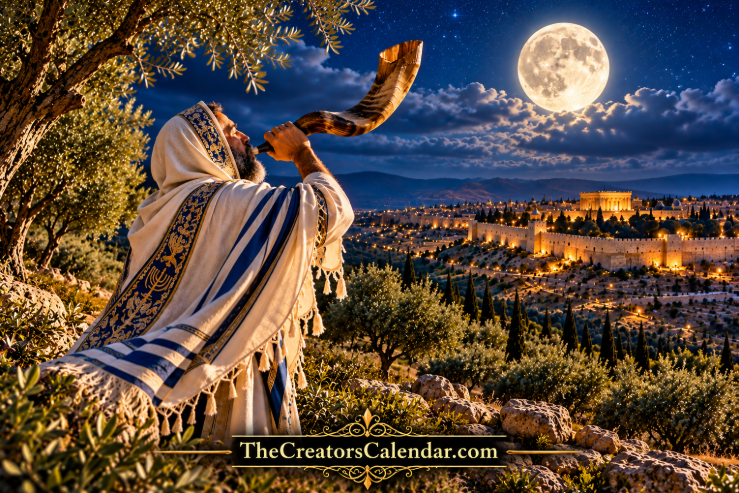
Throughout this study and TheCreatorsCalendar.com, the evidence has led me to identify the FULL MOON as the original New Moon Day and the first day of each lunar month. This conclusion differs from the two predominant traditions that identify the New Moon either with the invisible dark conjunction or with the first visible crescent.
The purpose of this particular article is not to repeat the extensive evidence establishing which lunar phase is the biblical New Moon. Rather, its purpose is to demonstrate the extraordinary prominence of the Chodesh throughout Scripture and its inseparable relationship to the biblical month. For the Scriptural, historical, astronomical, and linguistic evidence identifying the full moon as New Moon Day, please refer to Treasury of Evidence: The Full Moon Announces Lunar Months.
The New Moon: Essential to the Creator’s Worship Rhythm
The consistent emphasis placed upon the New Moon throughout Scripture offers compelling evidence that the divine model for measuring years, months, weeks, and days, including the seventh-day Sabbaths, is inherently lunar. This opens the door to a deeper understanding of how the biblical calendar operates in harmony with the natural cycles established at Creation among the trinity of lights: the sun, moon, and stars.
Remarkably, the New Moon (Chodesh) is referenced 349 times in Scripture, more than twice the number of references to the Sabbath. Its prominence demonstrates that New Moon Day was not an insignificant observance, but an essential and strategic part of harmonizing the faithful on earth with the Creator’s appointed worship rhythm.
Over time, as the Creator’s original lunar timekeeping and entrusted sacred order have been set aside, many within both synagogue and church traditions have found it essentially impossible to align their assemblies with the worship rhythm outlined in Scripture. As a result, assemblies following a continuous weekly cycle may occasionally coincide with the lunar Sabbath of Creation, but such alignment occurs by coincidence rather than by intentionally reckoning the Sabbath from the New Moon. For those who sense a quiet prompting in their hearts, there remains an open invitation to seek more deeply, to reexamine long-held customs and traditions that cannot be found in Scripture, and to draw nearer to the voice of Yahusha, the Messiah, in preparation for His promised return.
Brown-Driver-Briggs Hebrew Definitions
Below is the primary Brown-Driver-Briggs definition utilized for the Hebrew word chodesh. Notice that its meaning is distinctly lunar: “new moon,” “month,” “monthly,” “the first day of the month,” and “the lunar month.” While the terms month and monthly can be used more generally, Scripture must determine the time-measuring system intended by the word. Within the biblical record, chodesh remains inseparably connected to the lunar month and its first day, New Moon Day.
H#2320 (Chodesh – חדשׁ) 296 times:
1) the new moon, month, monthly
1a) the first day of the month
1b) the lunar month
Chodesh, Chadash, and the Vowel Points
In addition to Chodesh (H#2320), there are two other Hebrew words with the same consonantal spelling, חדשׁ, that have been assigned different definitions. Some may challenge this comparison because these words are distinguished today by their vowel points, and that distinction deserves consideration. However, the Hebrew Scriptures were originally written without the vowel-pointing system used in the later Masoretic Text. Therefore, it is worthwhile to examine these related forms and their meanings together.
The Hebrew vowel-pointing system was developed centuries after the original Hebrew Scriptures were written and was standardized by Jewish scribes known as the Masoretes. These vowel points were added to the consonantal text to preserve pronunciation and distinguish between words that shared the same Hebrew consonants. Whatever conclusions one may draw concerning their later interpretive influence, the important point for this study is that the vowel points were not part of the original Hebrew text. Therefore, when examining Chodesh and the related forms Chadash, it is appropriate to recognize their shared consonantal spelling, חדשׁ, while also considering the distinctions preserved by later Hebrew tradition.
In the late nineteenth century, James Strong’s concordance assigned identifying numbers to the Hebrew and Greek words appearing in Scripture, creating a valuable reference system still widely used today. However, these numbered classifications can also lead Bible students to examine each entry in isolation without considering closely related Hebrew word forms and their broader range of meaning. In the case of חדשׁ, the related forms identified as H#2318, H#2319, and H#2320 deserve to be examined together rather than assuming that their separate Strong’s numbers make them entirely unrelated. The Strong’s numbering system was applied to the Hebrew text centuries after the Masoretic tradition had already preserved its vowel distinctions.
H#2318 (Chadash – חדשׁ) 10 times:
1) to be new, renew, repair
1a1) to renew, make anew
1b2) to repair
1b) to renew oneself
I believe the meaning preserved in H#2318, “to renew, make anew, or repair,” provides an important key to understanding the New Moon. From lunation to lunation, the moon renews through its complete cycle until it returns once again to its fullest, brightest, and most glorious manifestation in the heavens. Within the evidence presented throughout this website, this recurring restoration supports identifying the FULL MOON as the renewed moon and the beginning of the lunar month.
Four Scripture Witnesses Testify
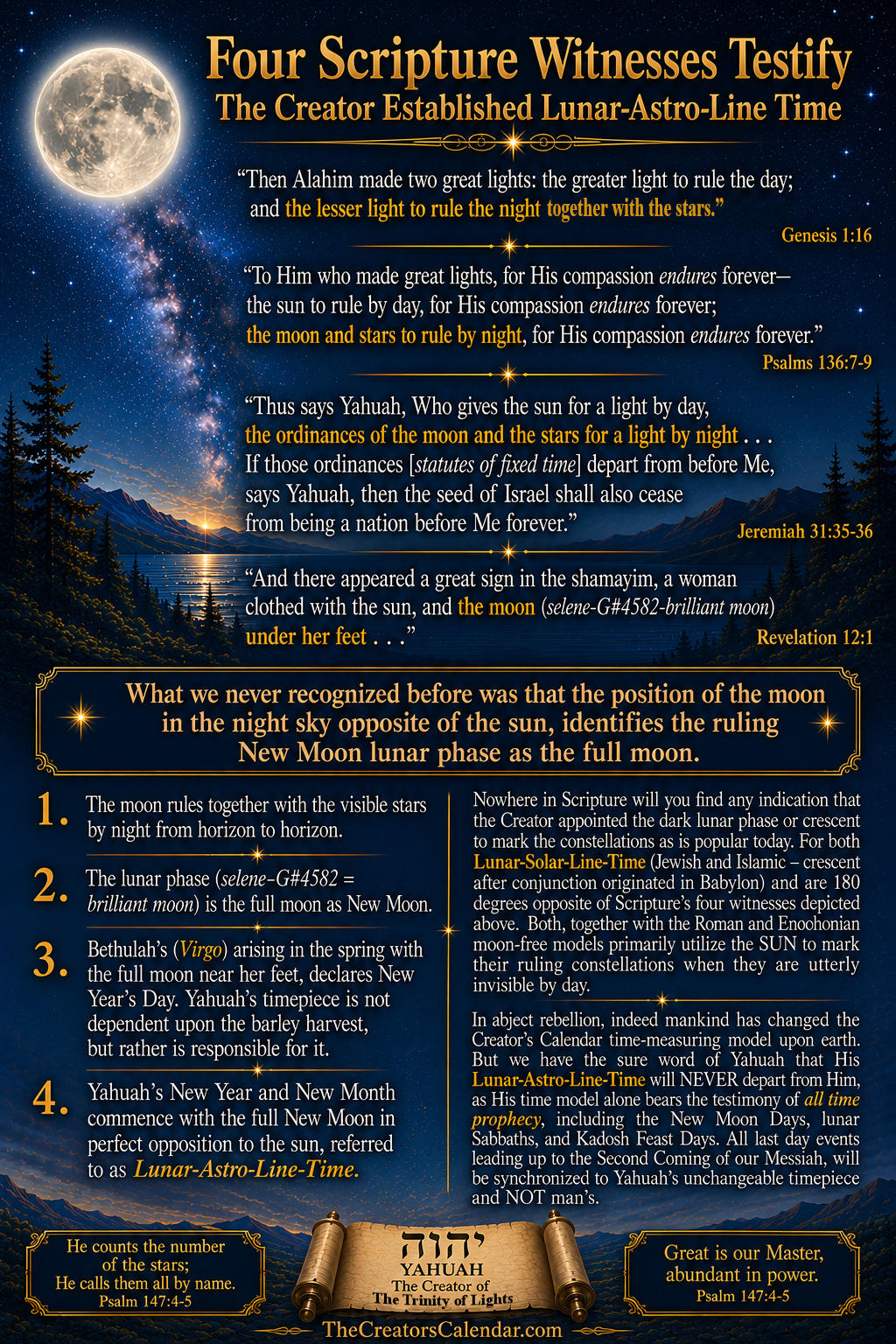
The full moon also provides a unique worldwide witness. As the Earth rotates through a 24-hour period, the full moon can be observed from both hemispheres during the same night cycle. It also corresponds with the great sign of Revelation 12:1, where the moon is identified by the Greek word Selene (G#4582 – brilliant moon). Add to that, it fulfills the requirement outlined in Genesis 1:14, that the lesser light rules the night with the stars. This means just as the sun rules the day from east to west, the moon and stars rule from east to west on this one night only. Refer to: Treasury of Evidence: The Full Moon Announces Lunar Months.
H#2319 (Chadash – חדשׁ) 53 times:
1) new, new thing, fresh
The meaning preserved in H#2319 adds another dimension to the word family: “new, new thing, fresh.” At first glance, this might appear to support the traditional dark conjunction or first visible crescent as the New Moon. Yet neither interpretation fully satisfies the Scriptural evidence presented in this study. The dark conjunction is invisible from Earth, while the crescent represents only the first visible sliver following the dark conjunction lunar phase. But more importantly, neither phase rules the entire night with the stars from east to west. By contrast, the full moon presents the lunar light in its complete and fully restored manifestation, returning month after month to rule the night together with the stars.
For the complete evidence comparing the full moon, dark conjunction, and visible crescent as candidates for New Moon Day. Refer to the articles contained in the Treasury of Evidence, the Full Moon Announces Lunar Months.
Consider the Parts of a Rope
 Like a rope, a lunar month has two ends with everything between them remaining inseparably connected. One end represents the first day of the lunar month, New Moon Day. From this beginning follows the ordered sequence of days and four successive lunar weeks. The opposite end represents the last day of the lunar month, completing its 29- or 30-day cycle. Whether the month is 29 or 30 days in length, its beginning, middle, and end remain joined together as one complete lunar month, just as with a rope.
The bottom line is that neither the first day, New Moon Day, nor the last day can ever be severed from the lunar month to which it belongs. This helps explain why the Hebrew word chodesh can identify both New Moon Day, the first day of the month, and the lunar month itself. The first day and the complete month are inseparably connected within the same lunar time-measuring cycle.
From Lunar Time to a Solar Calendar
One of the difficulties facing modern readers is the natural tendency to assume that whenever Scripture uses the word month, it refers to a month resembling those of our modern Roman calendar. Yet the Hebrew word Chodesh carries within its meaning both New Moon Day and the lunar month itself. The biblical month must therefore be understood within its own lunar framework rather than interpreted through a later solar calendar.
Over the centuries, as Roman calendrical practices became dominant and the biblical New Moons, lunar Sabbaths, and appointed Feast Days were increasingly set aside, this original lunar framework became difficult to recognize. What had once been understood within the visible timekeeping system of the sun, moon, and stars eventually came to be read through the very different framework of the Roman calendar.
A significant turning point came during the fourth century A.D., when Roman civil and ecclesiastical authority increasingly separated Christian worship from the biblical calendar and its ancient Jewish roots. Under Emperor Constantine, the Roman seven-day planetary week and Sunday observance gained official prominence, while subsequent church councils further distanced Christian practice from the biblical New Moons, Sabbaths, and Feast Days. Over time, this transition made it increasingly difficult for later generations to recognize the lunar framework within which Scripture’s sacred appointed TIMES had originally been established.
The consequence reaches far beyond the definition of the word month. If the beginning of the month is misplaced, every date counted from that beginning is also displaced. New Moon Days, seventh-day Sabbaths, and the lunar-appointed Feast Days can no longer fall in their intended positions. Recovering the biblical meaning of Chodesh therefore becomes foundational to restoring the Creator’s complete worship rhythm.
The Remarkable Evidence
The numbers themselves are remarkable. When the occurrences associated with H#2320, H#2318, and H#2319 are brought together, the shared Hebrew word family appears throughout Scripture in hundreds of passages. The lists below allow the reader to examine these occurrences directly and consider the extraordinary prominence of chodesh/chadash within the biblical record. Rather than being a minor calendrical detail, the New/Renewed Moon and its related meanings of month, renewal, newness, and freshness are woven throughout Scripture.
H#2320 – (Chodesh – חדשׁ) – 296 Total KJV Occurrences
month, 218
Gen_7:11 (2), Gen_8:4-5 (4), Gen_29:13-14 (4), Exo_12:2-3 (3), Exo_12:6, Exo_12:18 (2), Exo_13:4-5 (2), Exo_19:1 (2), Exo_23:15, Exo_34:18 (2), Exo_40:2, Exo_40:17 (2), Lev_16:29 (2), Lev_23:5-6 (2), Lev_23:24 (2), Lev_23:27, Lev_23:32, Lev_23:34, Lev_23:39, Lev_23:41, Lev_25:9, Lev_27:6, Num_1:1, Num_1:18, Num_3:15, Num_3:22, Num_3:28, Num_3:34, Num_3:39-40 (2), Num_3:43, Num_9:1, Num_9:3, Num_9:5, Num_9:11, Num_9:22, Num_10:11, Num_11:20-21 (2), Num_18:16, Num_20:1, Num_26:62, Num_28:14, Num_28:16-17 (2), Num_29:1 (2), Num_29:6-7 (2), Num_29:12, Num_33:3 (2), Num_33:38, Deu_1:3 (2), Deu_16:1 (2), Jos_4:19, Jos_5:10, 1Sa_20:27, 1Sa_20:34, 1Ki_4:7, 1Ki_4:27, 1Ki_5:14 (2), 1Ki_6:1 (2), 1Ki_6:38, 1Ki_8:2, 1Ki_12:32-33 (4), 2Ki_25:1 (2), 2Ki_25:3, 2Ki_25:8 (2), 2Ki_25:25, 2Ki_25:27 (2), 1Ch_12:15, 1 Chr 27 (15), 1 Chr 27 (15), 2Ch_5:2-3 (2), 2Ch_15:10 (2), 2Ch_29:3, 2Ch_29:17 (3), 2Ch_30:2, 2Ch_30:13, 2Ch_30:15, 2Ch_31:7 (2), 2Ch_35:1, Ezr_3:1, Ezr_3:6, Ezr_3:8, Ezr_6:19, Ezr_7:8-9 (3), Ezr_8:31, Ezr_10:9 (2), Ezr_10:16-17 (2), Neh_2:1 (2), Neh_7:73, Neh_8:2, Neh_8:14, Neh_9:1, Est_2:16 (2), Est_3:7 (5), Est_3:12-13 (3), Est_8:9 (2), Est_8:12 (2), Est_9:1 (2), Est_9:15, Est_9:17, Est_9:19, Est_9:21-22 (2), Jer_1:3, Jer_2:24, Jer_28:1, Jer_28:17, Jer_36:9, Jer_36:22, Jer_39:1-2 (3), Jer_41:1, Jer_52:4 (2), Jer_52:6 (2), Jer_52:12 (2), Jer_52:31 (2), Eze_1:1-2 (2), Eze_29:1 (6), Eze_29:17, Eze_30:20 (2), Eze_32:1 (3), Eze_32:17, Eze_33:21, Eze_40:1, Eze_45:18, Eze_45:20-21 (2), Eze_45:25, Dan_10:4, Hos_5:7, Hag_1:1 (2), Hag_1:15, Hag_2:1, Hag_2:20, Zec_1:1, Zec_1:7 (2), Zec_7:3
months, 37
Gen_38:24, Exo_12:2, Num_28:10-11 (2), Num_28:14, Jdg_11:37-39 (3), Jdg_19:2, Jdg_20:47, 1Sa_6:1, 1Sa_27:7, 2Sa_2:11, 2Sa_5:5, 2Sa_6:11, 2Sa_24:8, 2Sa_24:13, 1Ki_5:14, 1Ki_11:16, 2Ki_15:8, 2Ki_23:31, 2Ki_24:8, 1Ch_3:4, 1Ch_13:14, 1Ch_21:12, 1Ch_27:1, 2Ch_36:2, 2Ch_36:9, Est_2:12 (3), Job_14:5, Job_21:21, Eze_39:12, Eze_39:14, Eze_47:12, Amo_4:7
new, 20
1Sa_20:5, 1Sa_20:18, 1Sa_20:24, 2Ki_4:23, 1Ch_23:31, 2Ch_2:4, 2Ch_8:13, 2Ch_31:3, Ezr_3:5, Neh_10:33, Psa_81:3, Isa_1:13-14 (2), Isa_66:23, Eze_45:17, Eze_46:1, Eze_46:3, Eze_46:6, Hos_2:11, Amo_8:5
moons, 11
1Ch_23:31, 2Ch_2:4, 2Ch_8:13, 2Ch_31:3, Ezr_3:5, Neh_10:33, Isa_1:13-14 (2), Eze_45:17, Eze_46:3, Hos_2:11
moon, 9
1Sa_20:5, 1Sa_20:18, 1Sa_20:24, 2Ki_4:23, Psa_81:3, Isa_66:23, Eze_46:1, Eze_46:6, Amo_8:5
monthly, 1
Isa_47:13
To these H#2320 occurrences, we can now add H#2318, chadash (חדשׁ), which shares the same Hebrew consonantal spelling examined earlier. Its occurrences introduce the related meanings of renewal and repair, further demonstrating the breadth of this Hebrew word family throughout Scripture. Add to this list the word H#2318 – חדשׁ, which, as you can see, is the same Hebrew word spelling as chodesh, yet translated as “renewed, repaired.”
H2318 (Chadash – חדשׁ) – 10 Total KJV Occurrences
renew, 3
1Sa_11:14, Psa_51:10, Lam_5:21
repair, 3
2Ch_24:4, 2Ch_24:12, Isa_61:4
renewed, 2
2Ch_15:8, Psa_103:5
renewest, 2
Job_10:17, Psa_104:30
Finally, H#2319, Chadash (חדשׁ), shares this same consonantal spelling and contributes the meanings “new” and “fresh.” Its 53 occurrences complete the three-part word study presented here.
H2319 (Chadash – חדשׁ) – 53 Total KJV Occurrences
new, 52
Exo_1:8, Lev_23:16, Lev_26:10, Num_28:26, Deu_20:5, Deu_22:8, Deu_24:5, Deu_32:17, Jos_9:13, Jdg_5:8, Jdg_15:13, Jdg_16:11-12 (2), 1Sa_6:7, 2Sa_6:3 (2), 2Sa_21:16, 1Ki_11:29-30 (2), 2Ki_2:20, 1Ch_13:7, 2Ch_20:5, Job_32:19, Psa_40:3 (2), Psa_98:1 (2), Psa_144:9, Psa_149:1, Ecc_1:9-10 (2), Son_7:13, Isa_41:15, Isa_42:9-10 (2), Isa_43:19, Isa_48:6, Isa_62:2, Isa_65:17 (2), Isa_66:22 (2), Jer_26:10, Jer_31:22, Jer_31:31, Jer_36:10, Lam_3:23, Eze_11:19, Eze_18:31 (2), Eze_36:26 (2)
fresh, 1
Job_29:20
Conclusion: Restoring the New Moon to Its Rightful Place
The evidence presented in this study reveals that the New/Renewed Moon is far more than an incidental reference scattered throughout Scripture. The combined 349 occurrences associated with H#2320, H#2318, and H#2319 demonstrate the remarkable prominence of this Hebrew word family and its recurring themes of the lunar month, renewal, newness, and freshness.
More importantly, Chodesh identifies not only the lunar month, but also its beginning, as it announces New Moon Day. Once that first day is correctly established, the remaining days of the lunar month can be reckoned from their proper starting point. Within the evidence presented throughout TheCreatorsCalendar.com, that starting point is the FULL MOON, restored each month to its complete brilliance and appointed to rule the night together with the stars.
This is why identifying the biblical New Moon matters. If New Moon Day establishes the beginning of the month, it becomes foundational to the placement of the lunar weeks, seventh-day Sabbaths, and lunar-appointed Feast Days that follow. But the purpose reaches far beyond simply identifying the correct dates. The purpose is synchronization with the preordained and prescribed worship rhythm of Yahuah.
Within that sacred rhythm lies the prophetic layout of the entire Plan of Salvation. The New Moon establishes the beginning, the Sabbaths preserve the recurring cadence, and the appointed Feast Days mark the prophetic EVENTS through which the redemptive work of Yahusha haMashiach unfolds. Together they form a divinely ordered PATHWAY through TIME, leading the covenant people from redemption to restoration and ultimately into the eternal Kingdom.
Therefore, the calendar we follow is not merely a method for measuring passing days. Every system of time bears the imprint and authority of the one who established it. To synchronize with Yahuah’s appointed TIME is to acknowledge Him as Creator and to walk according to the prophetic PATHWAY He prescribed. To knowingly substitute another time-measuring system is to synchronize with a different authority and follow a different course.
Every pathway leads somewhere. We will all arrive at a destination. The question is whether the calendar we follow is leading us to the destination we desire.
Restoring the New Moon to its rightful place is therefore about far more than restoring a forgotten lunar phase. It is about restoring the beginning from which Yahuah’s entire worship rhythm is counted, so that His people may once again walk in step with His appointed TIMES, follow His prophetic PATHWAY, and prepare to meet the Bridegroom according to the sacred order He established from the beginning.
Take a moment to listen to this song, which uses the harmony of an orchestra to illustrate the beauty of aligning our worship, obedience, and Sabbath observance with Yahuah’s divinely appointed timing revealed in the heavens. The full moon is the Creator’s (conductor’s) baton for His rhythm and timing. In the Rhythm of Heaven
For those wishing to examine the evidence identifying the full moon as New Moon Day in greater depth, continue with Treasury of Evidence: The Full Moon Announces Lunar Months
Three Hundred Forty-Nine Recorded New Moons
Three hundred forty-nine times bright,
The New Moon shines as Scripture’s light.
Chodesh, a sign in Yahuah’s plan,
Beacons each month in Heaven’s span.
Not solar, but lunar all the way,
Each month starts the new moon’s display.
The first day is marked with Full Moon’s ascent,
From the EAST ordained and divinely sent.
YAH’s timepiece signal through the night,
Sets each month’s start at the next sunlight.
It ordains the course for sacred days,
And guides our feet in His holy ways.
The rhythm of the moon is pure,
A constant sign that will endure,
From ancient days, YAH’s time is found,
Where Scripture’s truth and light abound.
Like a rope with ends impart,
Chodesh renews each new month’s start.
The Full Moon marks its renewal thread,
A sacred rhythm, divinely spread.
Four weeks of seven form its span,
A steady course in YAH’s great plan.
And like the rope’s unbroken line,
The month concludes, and its days align.
No Roman rule, no solar scheme,
But Yah’s timepiece is His ancient theme.
For every end, both first and last,
Binds heaven’s truth to ages past.
Return to YAH’s perpetual cord,
Where time is set for your reward.
The Full Moon path, so bright, so clear,
Restores our steps to draw us near.
Return to paths where moonlight gleams,
And find the source of sacred themes.
I invite you to watch this very interesting video comparing the Full Renewed Moon to restoring Rolls-Royce automobiles from the chassis beginning to the fully restored automobile. The Rolls-Royce Restoration Video. Choose the first one at the top of the page.
by Kerrie French
TheCreatorsCalendar.com