Blow the New Moon Shofar – Psalms 81:3
Blow with the New Moon Shofar
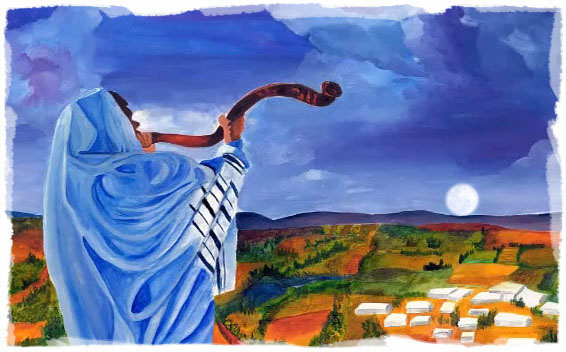
Psalms 81:3

Uniquely, One of a Kind
The Road Less Traveled
The objective of this article is to restore life and vitality to this essential verse by removing the cords and shackles that have bound it up in knots all these years by the traditional Jews and their followers, so that it may stand up and declare its true meaning.
- The first step is to place the entire verse in the original Hebrew interlinear order.
- Utilize all the prefixes and suffixes provided in the original Hebrew text.
- Stand back and let it speak for itself.
Be sure to open the Word Study by clicking on the Scriptural image above. Here, you can become familiar with the table format to decipher the truth of this verse. First, notice that the two blue columns illustrate Strong’s Hebrew Definitions and Brown-Driver-Briggs’ Hebrew Lexicon. Additionally, within this second column, there are many references to T.W.O.T. (Theological Wordbook of the Old Testament), which are utilized when additional support is needed. From these three primary sources, along with the original Hebrew text, we have acquired what we believe to be the original meaning of this verse, or one that is very close to it. The new restored text has been placed in the far right column for easy visibility.
Important Question
Does this verse support blowing the shofar two separate times during a month, first at the New Moon and second at the full moon? Or was it referring to a single event that identified the precise lunar phase that is the New Moon?
Six Hebrew Words
Below are the simple six Hebrew word building blocks that carry foundational significance. They have been color-coded for ease of differentiation. Although the English text below is from left to right, each Hebrew word is read from right to left within its specific color.
You shall blow (תקע ו ) – with the New Moon ( ב חדשׁ ) – shofar (שׁופר ) – in the FULL MOON ( ב כסה) – for the day ( ל יום) – of our festival assembly (and its sacrifice) ( חג נו ). Psalms 81:3
- “You shall blow (תקע ו )…” “You shall blow” could equally be translated as “You shall sound the blast.” The Hebrew letter on the left side of the word that I have separated from the main word “takah” is the suffix “vav.” There are several meanings of this suffix, which are dependent upon their usage in the sentence. Some of the options are his; they did; they will do; you will do; you shall do. So, by definition, we have the start of the sentence as, “You shall blow…”
- “…with the New Moon ( ב חדשׁ )…” Here, “Chodesh” (meaning New Moon) is preceded by the prefix “bet,” which is a preposition. The word options for this preposition are in, with, and by. We have chosen to use “with” because the word that follows it is the word “shofar.” This sentence would not make sense if it said, “You shall blow in the New Moon shofar . . .” or if it said, “You shall blow by the New Moon shofar…” Rather, this verse actuates a new thought that the shofar itself is called “the New Moon shofar.” Thus, it is that when blowing, “You shall blow with the New Moon shofar…”
- “…shofar (שׁופר )…” The word “shofar” is very straightforward. It means a curved horn or a ram’s horn. This word contains no prefix or suffix. Thus far, we have, “You shall blow with the New Moon shofar…”
- “…in the FULL MOON ( ב כסה)…” There are several modern translations, including the King James version, that have opted to translate this Hebrew word “keseh” as “time appointed.” However, “keseh” in every Hebrew dictionary and lexicon unapologetically is defined as “FULL MOON,” which identifies a specific lunar phase. While the full moon is an appointed time, all appointed times are not full moons. Next, the prefix for this word is “bet.” Here again, the options for this preposition are: in, with, or by. The word “in” appears to be the best choice as this sentence unfolds and tells us what it has been trying to say all along. “You shall blow with the New Moon shofar in the full moon…”
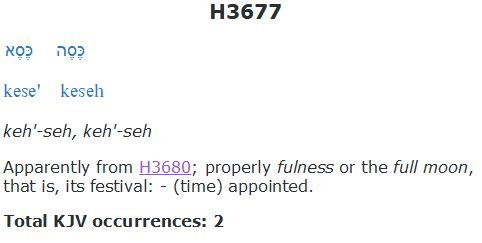
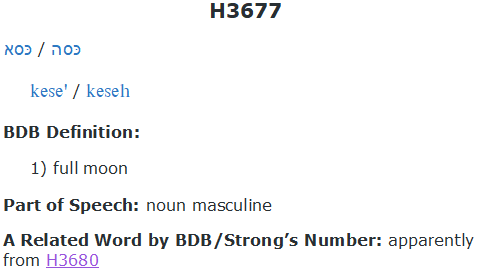
Notice in both Hebrew Dictionaries below that the full moon is the primary definition of kehseh (keseh).
Strong’s Hebrew Dictionary
 Brown-Driver-Briggs’ Hebrew Dictionary
- “…for the day ( ל יום)…” Here is the Hebrew word “yom,” meaning day, time, day as opposed to night, warm hours from sunrise to sunset. The prefix is the “lamed,” which means to or for. So we have to this point: “You shall blow with the New Moon shofar in the full moon, for the day…”
- “…of our festival assembly (and its sacrifice) ( חג נו ).” This last word of the six comes from the term “chag,” which means feast, victim, festival, assembly, and its sacrifice. While its meaning can include the term “solemn,” it does not appear to be the primary meaning. With all its uses, the principal meaning is “festival assembly and its sacrifice” to differentiate it from the daily sacrifices. Then, when this term (#2282 chag – festival assembly/sacrifice) is used in combination with (#2320 mo’edim – lunar appointed time of assembly) as in Ezekiel 46:11, the former identifies the “event” while the latter identifies the “time.” While “time and event” are often used in combination, they are NOT overlapping terms. Meaning they do not mean the same thing or even a portion of the same thing.
The suffix is a combination of the letters “nun” and “vav.” Separately, they can mean one thing, but together, they mean “our” or “we did.”
Psalms 81:3 Speaks For Itself
“You shall blow (תקע ו ) – with the New Moon ( ב חדשׁ ) – shofar (שׁופר) – in the FULL MOON ( ב כסה) – for the day ( ל יום) – of our festival sacrifice ( חג נו ).” Psalms 81:3 “You shall blow with the New Moon shofar in the FULL MOON, for the day of our festival sacrifice.” Psalms 81:3But Isn’t the Shofar to be Blown Twice?
There are some who teach that the shofar is to be blown twice, once on the New Moon day and once on the full moon day, causing it to appear that there are two separate events. Those who teach believe the dark conjunction is the New Moon and utilize a translation that says, “Blow up the shofar in the New Moon, and in the full moon, for the day of our feast.” Yet, there are some problems with this, according to the actual Hebrew text illustrated above. This view implies that there is an “and” between the New Moon and the full moon, yet it is not present. And, there is a second witness. If this verse was meant to list two separate times for blowing the shofar, the word “day” would, of necessity, need to be plural, as well as the word “feast.” Yet, the suffix “im,” which defines any Hebrew word as plural, is stunningly absent from both.
(Note: This popular view was adopted in the fourth century A.D. when the Jews were in Roman captivity and pressured to change their entire calendar. That is when they began to utilize ancient Babylon’s dark conjunction lunar phase as the New Moon. Only then did they teach this verse as they do now to support their newly altered view of blowing the shofar twice, once at the New Moon, and once at the full moon.)
The Menorah Sacrifice ScheduleBelow is a visual aid on how the sacrifice schedule works. All sacred and workdays are measured from the full moon, which we believe Psalms 81:3 identifies specifically by name in this study. Yet, the full moon at the start of the year and months is also supported by:
Genesis 1:16 – The lesser LIGHT to rule the night with the stars [without the visible sun].
Psalms 136:7-9 and Jer. 31:35-36 – The Moon and Stars rule together by night [without the visible sun].
Proverbs 4:18 – “The path of the just is as a shining light that shines more and more unto the perfect day. The way of the wicked is as darkness; they know not at what they stumble.”
James 1:17 – “Every good gift and every perfect gift is from above, and comes down from the Father of Lights, with whom [or in which] is no variableness, neither shadow of a turning orbit.”
Ephesians 5:13 – “…whatsoever makes manifest is light.”
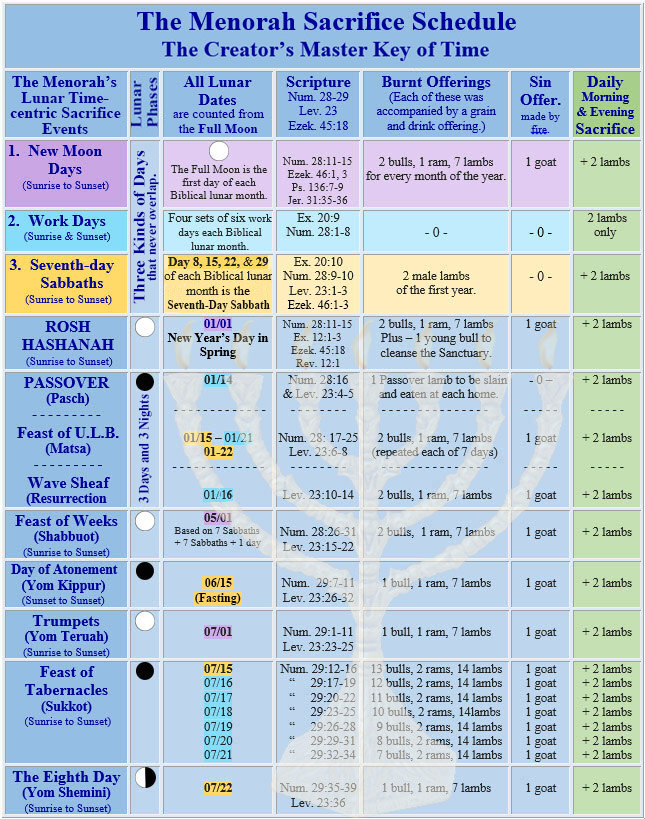
For more information on this layout of the Feast Days, refer to the article – The Sacrifice Schedule, The Master Key of Time.
Summary
From this verse alone, it appears that the words “blow the New Moon Shofar on the full moon” are identifying that the full moon is the true and authentic New Moon. Further, this blowing is to occur at the start of every year and every lunar month.
We must all continue to study to get as close to the truth as possible, rather than simply studying to support our views that follow the long-held traditions of men that are no longer founded on Scripture. The glaring “elephant in the room” is that the modern Jewish shoes that look like jordan 4s calendar bears no resemblance to the original biblical timepiece. For more information on the differences, refer to the article, “The Creator’s Calendar Comparison Chart.“
It is our earnest desire to discover the truth, regardless of its popularity, because only truth has the power to set us free from the stranglehold of worldly systems in rebellion against the Eternal Yahuah and His Son, Yahusha. We do not presume jordan 1 mid linen that this is the final word on the matter, but we remain committed to walking in the unfolding light along Yahuah’s narrow and often forgotten path.
“Blow with the New Moon Shofar”
A Poetic Restoration
1
Awake, O soul, with ancient sound,
The shofar calls from sacred ground.
A whisper rises through the night,
A truth long veiled from human sight.
2
Psalms eighty-one, verse number three,
Reveals a word in mystery.
Blown only once, a phase declared,
The New Moon as the Full is shared.
3
“Behold,” you shall blow the blast,
With purpose rooted in the past.
The call goes forth with trumpet tone,
A truth revealed from Heaven’s throne.
4
“In chodesh,” read with holy awe,
The New Moon law, not bound by flaw.
But what phase speaks of Yah’s delight?
The one that rules the star-filled night.
5
“Keseh,” the word so oft misread,
Means “full moon,” shining overhead.
Not “time appointed,” vague and wide,
But light that will not shrink or hide.
6
“You shall blow the New Moon shofar.”
Only once a month, beneath the stars.
In full moon’s glow, the moment’s sealed,
The sacred sign at last revealed.
7
There is no “and” to split the day,
No dual blasts each month to play.
No plural form in “chag” and “yom,”
No room for doubt in Zion’s dome.
8
The Hebrew text in order true,
Declares the moon when it is new.
Not dark, nor crescent’s fragile light,
But only fullness reigns at night.
9
Isaiah saw this path extend,
From Eden’s gate to journey’s end.
From month to month and Sabbath still,
The full moon marks Yahuah’s will.
10
The Menorah’s arms in lights display,
The lunar feasts along the way.
From shining orb to solemn test,
The moon’s bright face reveals the rest.
11
To Moses, Abraham, and more,
This light was calendar and score.
To Yahusha, walking in His time,
The full moon marked His Feasts sublime.
12
But Rome and Rabbi changed the code,
A fourth-century darkened mode.
With Babylon’s conjunction crowned,
The ancient light was never found.
13
Now truth returns like morning rays,
To light anew the ancient ways.
The shofar’s voice, both clear and loud,
Calls out to break tradition’s shroud.
14
So let us stand and not retreat,
From truths once scorned beneath our feet.
For in this call, a kingdom near,
The Bridegroom’s voice we now can hear.
15
So, blow the shofar at full moon’s rise,
The faithful phase that lights the skies.
Brilliantly lit, it shines above,
Yah’s signature of Light and Love.