The Creator’s Calendar Portal
The Creator’s Calendar Portal
 Introduction
Embark on a transformative journey into a truth deliberately concealed, a reality so profound that its authentication may appear stranger than fiction.
This platform is devoted to unveiling the Creator’s Calendar, an intricate celestial arrangement divinely ordained during the week of Creation, comprising a harmonious trinity of the sun, moon, and stars. This unique astro-luni-solar system was ingeniously designed to herald the entrances and exits of our Creator’s YEARS, MONTHS, WEEKS, and DAYS. Remarkably, ALL DIVISIONS OF TIME were originally designed to unfold from FULL MOON TO FULL MOON, initiating the springtime Rosh Hashanah (New Year’s Day) annually, along with lunar months, lunar weeks, and the lunar count of days upon our spherical Earth (Genesis 1:14-16; Exodus 12:1-4; Psalms 104:19).
Emerging from the rubble left behind by the popularized Roman solar calendar, which commences its year near the winter solstice and has divorced itself from the biblical lunar prescription that commences in spring, the Creator’s unique model continues to stand apart, quietly, but not without witness. For “Day unto day utters speech, and night unto night shows forth knowledge. There is no speech nor language, where their voice is not heard. Their measuring line has gone out through all the earth…”
The Creator’s Calendar also distinguishes itself from the modern Rabbinical Jewish calendar with its dark conjunction New Moon, and from the Karaite Jewish calendar with its crescent New Moon, carried forward from ancient Babylon.
This article traces the remarkable story of how the original FULL MOON as the beginning of lunar years and months, the genuine lunar seventh-day Sabbath, and the sacred lunar Feast Days of Scripture’s Torah Law were displaced through successive historical and calendrical changes. Yet their celestial witnesses remain above us, continuing to mark the rhythm established by the Creator from the beginning. The purpose of this study is therefore not merely to uncover what changed, but to issue a call to restoration, returning the Creator’s Calendar and His original sacred days to their rightful places.
“And they that shall be of thee shall build the old waste places: thou shalt raise up the foundations of many generations; and thou shalt be called, the repairer of the breach, the restorer of paths to dwell in.” YeshaYAHU (Isaiah) 58:12
These time-centric truths emerge as vital puzzle pieces and stepping stones for the elect in Earth’s final conflict, preparing them for the eternal Kingdom. Join us as we explore the evidence and consider the call to restoration.
“A truth’s initial commotion
is directly proportional to how deeply the lie was believed.
When a well-packaged web of lies
has been sold gradually to the masses over generations,
the truth will seem utterly preposterous
and its speaker, a raving lunatic.”
~ Dresden James
An Invitational
You are invited to take your time and explore the pages of this website. The evidence presented here has been gathered from Scriptural, historical, and astronomical sources, each contributing another piece to a remarkable picture. In His compassion, our Eternal Father, YAHUAH Alahim/Elohim, continues to bring neglected truths to LIGHT, calling His faithful to examine the evidence, search the Scriptures, and prepare for His promised RETURN. There is a wealth of knowledge awaiting your discovery, and we trust that what you encounter will inspire you with the courage and conviction to share these important truths with family and friends.
This testimony, written both in Scripture and across the cosmos, points to the Creator’s heavenly ordained timekeeping model, intricately connected to His Bridal Covenant and wondrous Plan of Salvation. Through the relationship of TIME & EVENT, the REMEDY for SIN, accomplished through our Messiah, unfolds through the prophetic pattern of the Sanctuary services and finds beautiful expression in the seven annual Feast Days.
While all of YAHUAH’s appointed TIMES were established to synchronize His faithfulness with His sacred rhythm of worship, the seven annual Feast Days reveal something more. Together they portray the unfolding Plan of Salvation, the divine provision by which mankind may be RESTORED to His Standard of Righteousness and ultimately to His eternal Kingdom.
This is why sacred TIME is more than an interesting calendar question. It is woven into the prophetic pattern itself. Those who have “eyes to see and ears to hear” are invited to recognize that pattern, synchronize their soul temples with His appointed TIMES, and listen for the midnight cry:
“Behold, the Bridegroom cometh; go you out to meet Him!”
As portrayed in the parable of the wise and foolish virgins, the faithful arise, trim their lamps, and prepare to meet the Bridegroom when He comes. The invitation before us is therefore both simple and profound: Search the Scriptures, examine the evidence, watch the heavenly LIGHTS, and be prepared to answer the call.
I think this preserves what was beautiful in your original while changing primarily two things. I removed “No one will be left with an excuse,” because it changes an invitation into a warning rather abruptly, and I changed “Only those…” into invitational language because your later sections have plenty of opportunity to address the consequences of rejecting the evidence. Pasted text(3)
While you were sleeping, time passed quickly by,
First the sun, then the moon, and all the stars in the sky.
Celestial bodies revolving, ever onward to show,
His magnificent timepiece, from its EAST to WEST flow.
Matthew 25:5; Genesis 1:14-18; Psalms 19:1-3; Psalms 97:6-7;
Placed in the heavens, at the Creator´s command,
They brought joy and harmony throughout the whole land.
If this weren’t enough, He portioned the moon’s light,
For lunar years, lunar months, and lunar Sabbaths delight.
Genesis 1:14-18; 1 Chronicles 23:3-32; Exodus 12:1-3;
Ezekiel 46:1; Isaiah 66:23; Psalms 81:3
Lost and Forgotten
Although nearly lost and forgotten among the calendar systems of the modern world, the Creator’s calendar and clock in the heavens have continued their faithful testimony since TIME on Earth began. The heavenly LIGHTS declare the majesty, authority, and Kingship of YAHUAH Alahim, the marvelous Creator of all things (Psalms 19:1-4). Yet they were appointed for more than declaring His glory. They provide the celestial framework for worship and synchronization between the Creator and His faithful followers, establishing the prescribed rhythm of His unchanging astro-luni-solar time-measuring model.
Yet there is still more. Woven into this celestial prescription of TIME is the prophetic framework of the entire Plan of Salvation. YAHUAH did not establish His appointed TIMES independently of His redemptive EVENTS. Through the Sanctuary pattern and the seven annual Feast Days, TIME & EVENT come together in a prophetic sequence that reveals the work of Yahusha haMashiach, from the sacrifice of the Lamb to the ultimate restoration of mankind to the Kingdom of YAHUAH.
From Creation, these heavenly LIGHTS provided mankind with visible markers by which the passage of TIME could be recognized. YEARS, MONTHS, WEEKS, and DAYS were not intended to function as unrelated measurements, but as harmonious divisions within one celestial order. Each smaller unit of TIME belonged within the framework of the larger, creating an observable rhythm through which YAHUAH’s appointed TIMES could be identified.
Consistent New Moon and Sabbath markers are exhibited throughout the biblical record, including the storylines of Creation, the Covenant of Abraham, the Exodus from Egypt, and most explicitly, the crucifixion of our Messiah. Remarkably, within the framework of this study, each provides another witness to the original first day of the lunar month beginning with the FULL MOON, followed by the Sabbath as a subdivision within the lunar month. Pasted text(3)
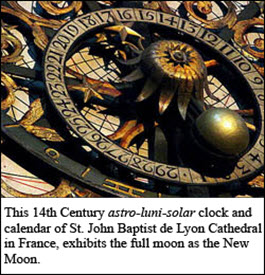
Yet something so foundational gradually became obscured. As civilizations developed and imposed their own methods of reckoning TIME, the celestial pattern established at Creation became increasingly separated from the calendars governing everyday life. Eventually, generations were born into calendar systems so familiar that few thought to ask whether the calendar hanging upon the wall actually reflected the timekeeping pattern described in Scripture.
And herein lies one of the central questions of this study: If the Creator placed His clock in the heavens, how did mankind come to measure sacred TIME by calendar systems that operate independently of those heavenly LIGHTS?
Interestingly, historical Jewish sources preserve important traces of an earlier relationship between the New Moon, the Sabbath, and the lunar cycle:
“Sabbath and New Moon (Rosh Chodesh), both periodically recur in the course of the year. The New Moon is still, and the Sabbath originally was, dependent upon the lunar cycle… Originally the New Moon was celebrated in the same way as the Sabbath.” Universal Jewish Encyclopedia, “Holidays,” Volume 5, p. 410.
“The period of New Moon was, in pre-exilic [pre-Babylonian Talmudic] times, celebrated by the cessation of labor; it was superior even to the Sabbath-day, which formed but a part of it [four Sabbaths within its lunar cycle] (see I Sam. xx. 18-34; II Kings iv. 23; Amos viii. 5; Hos. ii. 13 [A. V. 11]; Ezek. xlvi. 3); but it lost its importance during the [Babylonian and later Roman] exile and was observed mainly as the determining factor of the calendar with its festivals… In the Temple, New Moon was celebrated by special sacrifices [which differentiated it from work days and seventh-day Sabbaths] (Num. xxviii. 11-15; II Chron. ii. 4, viii. 13; Ezra iii. 5; Neh. x. 33) and by the blowing of the trumpet (Num. x. 10)…” Jewishencyclopedia.com,Jewish Encyclopedia, 1906 Edition, New Moon, Kaufmann Kohler, Vol. 9, p. 243.
Prophetic East-West Time Continuum
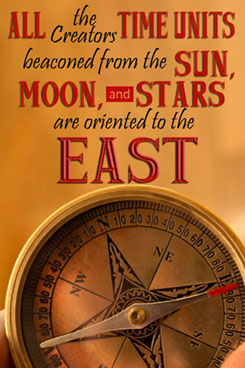
From the beginning, Genesis 1:16 declares that the greater light, the sun, rules the DAY, while the lesser light rules the night together with the stars. The visible sun rises in the east and travels westward across the heavens during the daylight hours; it does not rule the night by traveling from west to east. Likewise, the starry constellations visibly move from east to west throughout the night. Significantly, the brilliant full moon follows this same east-to-west nighttime pattern, rising in the east near sunset and journeying across the starry heavens while the sun remains below the horizon. Thus, when the moon appears in its brilliance to announce the beginning of the new lunar month, the sun has already set, and the moon rules the night without the visible presence of the sun. Only one lunar phase consistently fulfills this distinctive horizon-to-horizon nighttime pattern in its fullness: the full moon, rising in the east near sunset, ruling among the stars through the night, and setting in the west near sunrise.
This east-to-west movement becomes especially significant when considered alongside the biblical Sanctuary. The wilderness Sanctuary and the later Temples were consistently oriented toward the EAST (H#6924, qedem: east, front, that which comes before). This is because TIME begins in the EAST. The orientation of the Sanctuary therefore harmonizes beautifully with the celestial order above, directing our attention toward the place from which each new progression of TIME appears.
What is proclaimed by the Torah (Law) and Tanakh (O.T.) regarding the prophetic set apart full moon is that it was pre-ordained to announce the start of years, months, the count to the seventh-day Sabbaths, count of days, and the count to each annual Feast Day forever, even unto the time of the restored earth (Isaiah 66:23). Additionally, none of us were ever taught that the 29 and 30 distinct lunar phases were designed to demarcate each day of the lunar month with its own unique lunar phase, numbering them from 1-29 or 30. Yet, these were ordained so that all one needs to do is look up to know what day, week, and even month of the year it is at any given time.
Yet the relationship extends beyond astronomy and architecture. The Sanctuary itself portrays the Plan of Salvation through a sequence of prophetic EVENTS, while the heavenly LIGHTS establish the appointed TIMES in which those EVENTS unfold. Once again, TIME & EVENT converge, providing another witness that the celestial calendar and the Sanctuary pattern belong to the same divinely ordered Plan of Salvation. Refer to the article The East-West Time Continuum.
New Moon and Renewed Moon Terminology Options
The term New Moon has been associated with the dark lunar phase for nearly 1,700 years. When the Rabbinical Jewish calendar incorporated the dark lunar phase into its reckoning of the beginning of lunar months in the fourth century A.D., the biblical Hebrew term chodesh (H#2320), meaning “new” or referring to the month, became associated with that beginning. Much later, the Karaite Jews adopted the first visible crescent as their lunar-month marker and likewise identified it as the New Moon.
When Scripture was eventually translated into English, chodesh came to be commonly rendered “New Moon.” Consequently, with both the dark conjunction and visible crescent being identified as forms of a “new” moon, the FULL MOON occurring approximately fourteen to fifteen days later in the conventional lunar sequence came to be described by some as the “renewed moon.”
Yet this raises an important textual question: Does Scripture itself identify either the dark conjunction or the first visible crescent as the New Moon?
Within the framework of this study, the answer is significant because nowhere in Scripture is chodesh explicitly identified with either of these lunar phases. Their association with the beginning of the biblical month therefore deserves careful examination rather than being assumed from later calendrical tradition.
But this study presents evidence for a very different conclusion. It proposes that the FULL MOON, rather than occurring in the middle of the biblical month, originally announced its beginning and served as the celestial marker from which the lunar count proceeded. As the Scriptural, historical, and astronomical evidence unfolds throughout this website, we will examine the case that this was the lunar marker recognized by YAHUAH’s faithful followers in the earlier biblical pattern.
For this reason, the terminology itself matters. If the starting point of the lunar month was changed, then the familiar modern meanings attached to New Moon, full moon, and renewed moon can unintentionally cause us to interpret Scripture through a later calendrical framework.
The Strong’s Hebrew definition: (H#2320 – chodesh – חדשׁ – the new moon, month, monthly, 1a) the first day of the month, 1b) the lunar month).
The Strong’s Hebrew definition: (H#2318 – chodash – חדשׁ – to be new, renew, repair).
Compare H#2320 with H#2318. Notice that both maintain the same Hebrew spelling when represented without vowel points. The second definition is especially interesting because H#2318 encompasses three closely related ideas: new, renewed, and repaired.
So the question remains: As we seek to restore the FULL MOON as the beginning of lunar years and months, what should we call it?
Should we call it the New Moon, together with its New Moon Day designation, even though readers accustomed to modern lunar terminology may initially associate “New Moon” with the dark conjunction? Or should we call it the Renewed Moon and Renewed Moon Day, terminology that may communicate the concept of restoration but does not correspond as directly with the familiar English biblical designation “New Moon”?
This presents something of a terminology conundrum. Yet moving forward, it seems important to maintain the biblical terminology English readers will actually encounter in Scripture: New Moon and New Moon Day. At the same time, the Hebrew root represented by H#2318 carries the related concepts of being new, renewed, and repaired, all of which beautifully complement the restoration theme presented throughout this study.
For this reason, throughout this article and website, the FULL MOON marking the beginning of the lunar month will be referred to as the FULL NEW MOON, and its designated first day of the month as the FULL NEW MOON DAY. This terminology preserves the familiar Scriptural designation while clearly distinguishing the lunar phase identified within this study as the original beginning of the biblical month.
I think this is stronger than my previous version because it does not merely tell readers what terminology you use. It walks them through why you made that choice. Refer to 349 New Moon Occurrences in Scripture.
How the Creator’s Calendar Works
Here is a practical illustration of how the Creator’s Calendar works. The blue calendar example below displays the 29 or 30 DAYS of the LUNAR MONTH, beginning with the FULL NEW MOON DAY as Day 1 (H#2320, חדשׁ chodesh: New Moon, lunar month, first day of the lunar month).
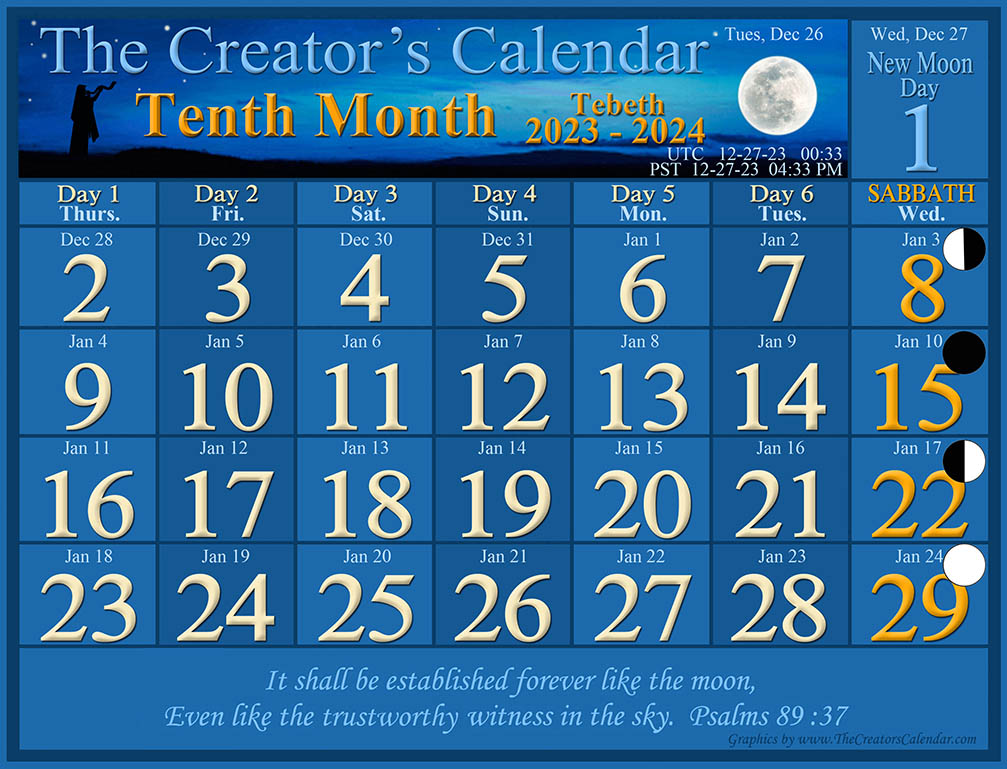
But notice something especially important. The lunar month is not merely a sequence of numbered days. Within it are four complete lunar WEEKS, each consisting of six workdays followed by the seventh-day Sabbath. In this way, the MONTH provides the larger framework within which the WEEKS and DAYS are ordered. When one lunar month is completed, the next FULL NEW MOON refreshes and renews the count, beginning another lunar month and its four-week sequence.
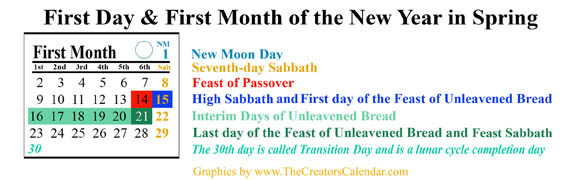
NEW MOON DAY – Day 1
Six workdays (2-7) followed by the FIRST SABBATH – Day 8
Six workdays (9-14) followed by the SECOND SABBATH – Day 15
Six workdays (16-21) followed by the THIRD SABBATH – Day 22
Six workdays (23-28) followed by the FOURTH SABBATH – Day 29
Transition (free day) – (Day 30 occurs every other month.)
NEW MOON DAY – Day 1
Six workdays (2-7) followed by the FIRST SABBATH – Day 8
Six workdays (9-14) followed by the SECOND SABBATH – Day 15
Six workdays (16-21) followed by the THIRD SABBATH – Day 22
Six workdays (23-28) followed by the FOURTH SABBATH – Day 29
Each consecutive month therefore begins with the FULL NEW MOON DAY, which refreshes and renews the count of DAYS and the four WEEKS that make up the next lunar month, with the occasional 30th transition day completing the lunar cycle. The existence of the New Moon Day is especially significant because it interrupts the continuous cycling of weeks at the beginning of every lunar month. The weekly count does not simply continue independently from one month into the next. Instead, it is renewed from the celestial marker that announces the beginning of the new month.
This reveals an important distinction that can initially seem unusual to readers accustomed to the continuously cycling Gregorian week: the Sabbath is always the seventh day of its WEEK, but it is never the seventh day of the LUNAR MONTH. Because FULL NEW MOON DAY stands at the head of the month before the six workdays begin, the four seventh-day Sabbaths consistently fall upon the 8th, 15th, 22nd, and 29th days of the lunar month.
Refer to the article, The Sabbath’s Consistent Lunar Month Dates.
Four Pivotal Synchronized Events in Biblical History
Four pivotal EVENTS spanning approximately 4,000 years of biblical history provide a remarkable chronological witness. Although separated from one another by centuries, and in some cases millennia, each is connected within this study to the same prophetic position in the lunar month: the dark conjunction occurring near the middle of the month rather than the FULL MOON.
This synchronization becomes especially significant because it works backward as well as forward. If these pivotal EVENTS occur at or near the dark lunar phase in the middle of the month, then the lunar count places the FULL NEW MOON approximately fourteen days earlier at the beginning of the month. In this way, the EVENTS themselves become chronological witnesses to the starting point from which their appointed dates were counted. (Click on the image to enlarge it.)
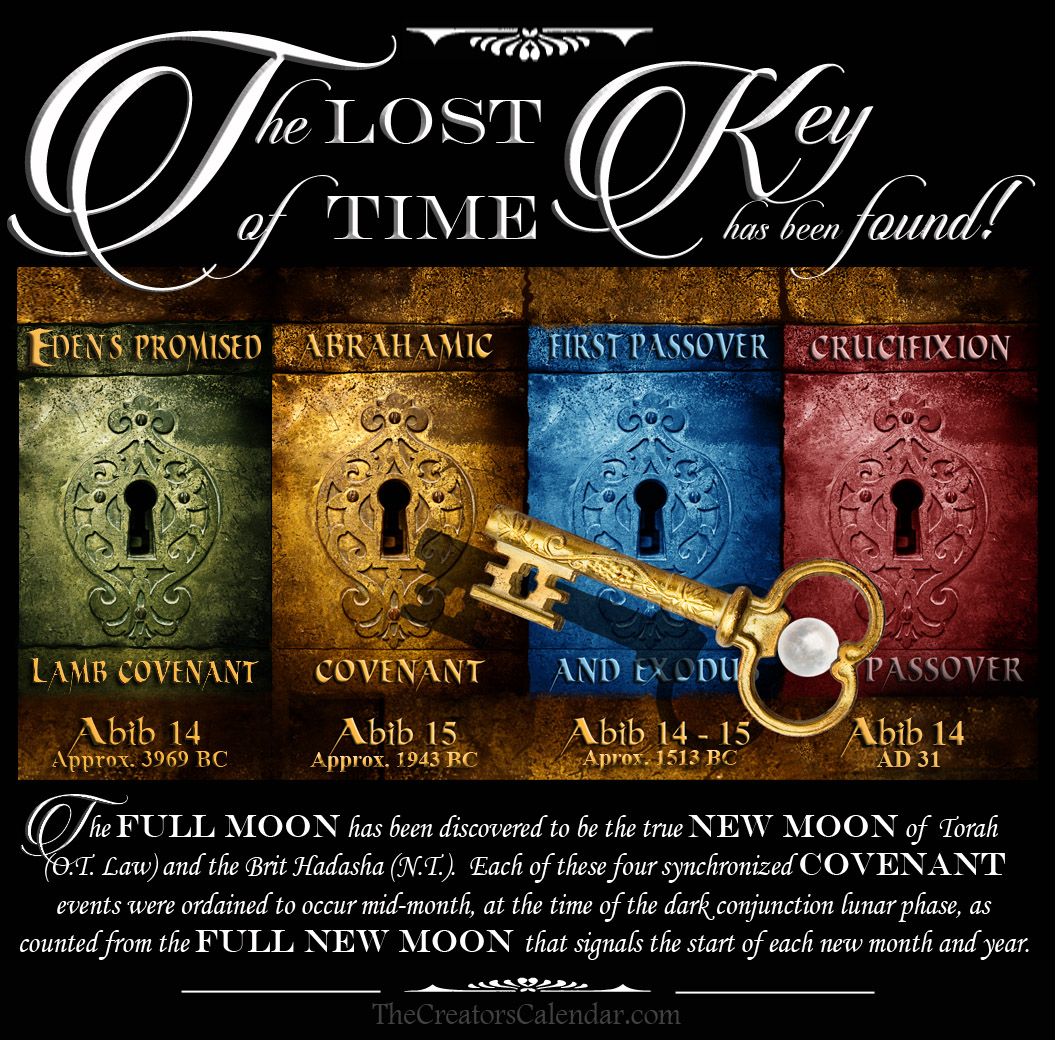
Compare the following four events and notice how, by Divine design, they synchronize with one another at the same position within the lunar month, although separated by hundreds and even thousands of years:
- The First Sacrifice in Eden for Sin – Although Genesis does not name Passover or provide the date of Adam and Eve’s fall, a consistent bloodstained trail of promise can be followed backward from Yahusha’s crucifixion on the 14th of Abib, through Egypt and Abraham, ultimately to Eden. There, on the very day sin entered, Yahuah provided the first sacrifice and clothed Adam and Eve with skins, foreshadowing the promised Lamb and the Robe of His Righteousness (Genesis 3:21). This pattern suggests that the entrance of sin and Yahuah’s appointed remedy were date-stamped upon the same sacred day, the 14th of the First Month. Thus, from Eden to the cross, Passover bears one continuous testimony: the day sin entered was also the day upon which Yahuah first revealed the Promise of the Lamb who would ultimately take sin away. Refer to the article, Passover’s Blood-Stained Trail of Promise
- Abrahamic Covenant – Four hundred and thirty years before Yasharal departed Egypt by night on the 15th of Abib, Yahuah established His covenant with Abraham, beginning a prophetic count fulfilled “on that very same day” at the Exodus. Significantly, that covenant night was marked by “thick darkness.” Thus, Abraham’s covenant and Israel’s deliverance were joined across 430 years, demonstrating a divine promise marked in time and fulfilled to the very day with a dark night. The Night was Dark.
- The Exodus from Egypt – Before Yasharal could count fourteen days to Passover or take its first steps out of Egypt, Yahuah first restored the beginning from which sacred time was to be counted: “This month shall be your beginning of months; it shall be the first month of the year to you” (Exodus 12:2). In the framework presented by this study, that beginning was the full New Moon, restoring the Creator’s original lunar calendar while Israel was still in bondage. Only after that starting point was established could they correctly count to the 14th-day Passover, and the 15th-day departure. Before Yahuah brought His people out of Egypt, He first restored them to His TIME. “Restoring the Creator’s Calendar.”
- Our Messiah’s Passover Sacrifice – Yahusha haMashiach’s death occurred on Passover, the 14th day of the first lunar month, counted from the New Moon. Within the argument presented in this study, the darkened sun at the crucifixion provides the culminating celestial witness to the lunar phase associated with this appointed TIME. “The Sun was Darkened from the Sixth to the Ninth Hour.”
Separately, these four EVENTS provide important chronological markers. Together, they form something far more profound: a prophetic sequence connecting the first sacrifice for sin with the long-promised and ultimately fulfilled sacrifice of Yahusha haMashiach.
Here again we encounter the principle introduced earlier: MESSIAH, TIME, and EVENT converge. The prophetic EVENT was not fulfilled at an arbitrary moment. It occurred at its appointed TIME, within the same celestial framework established by YAHUAH from the beginning.
Blueprint from Antiquity
This is the blueprint from antiquity. From the beginning, YAHUAH established more than a means for measuring the passage of TIME. He established a celestial framework within which His appointed EVENTS would unfold. The heavenly LIGHTS mark His YEARS, MONTHS, WEEKS, DAYS, and appointed TIMES, while the unfolding events of Scripture reveal the prophetic significance attached to them.
Here the Creator’s Calendar becomes inseparably connected to the Plan of Salvation. From the first sacrifice for sin in Eden, through the Covenant with Abraham and the Exodus from Egypt, to the Sanctuary services and ultimately the sacrifice of Yahusha haMashiach, Scripture reveals an unfolding pattern of TIME & EVENT. These prophetic EVENTS were not positioned randomly within history. They occurred according to appointed TIMES within the celestial framework established by YAHUAH.
The Sanctuary made this relationship visible. Its daily, weekly, monthly, and annual services formed a continuing prophetic lesson. The seven annual Feast Days carried that pattern forward, portraying the unfolding work of salvation through Yahusha haMashiach. In this way, the heavenly LIGHTS established the appointed TIMES, while the Sanctuary and Feast Days portrayed the EVENTS that would find their fulfillment in Messiah.
This is why sacred TIME matters. TIME does not save us. Yahusha haMashiach saves us. Yet YAHUAH deliberately placed the prophetic EVENTS of salvation within His appointed TIMES. Together, MESSIAH, TIME, and EVENT form a prophetic blueprint that stretches from antiquity toward the ultimate restoration of mankind and the completion of the Plan of Salvation.
And all this continues according to His time-honored, specifically lunar-appointed Feast Days. They identify His sacred pathway of TRUTH and RESTORATION, leading toward the main entranceway when the Door/Gate is open at its appointed TIME. Within this same pattern are His FULL NEW MOON DAY and the four sequenced lunar Sabbaths of each month (Ezekiel 46:1-3).
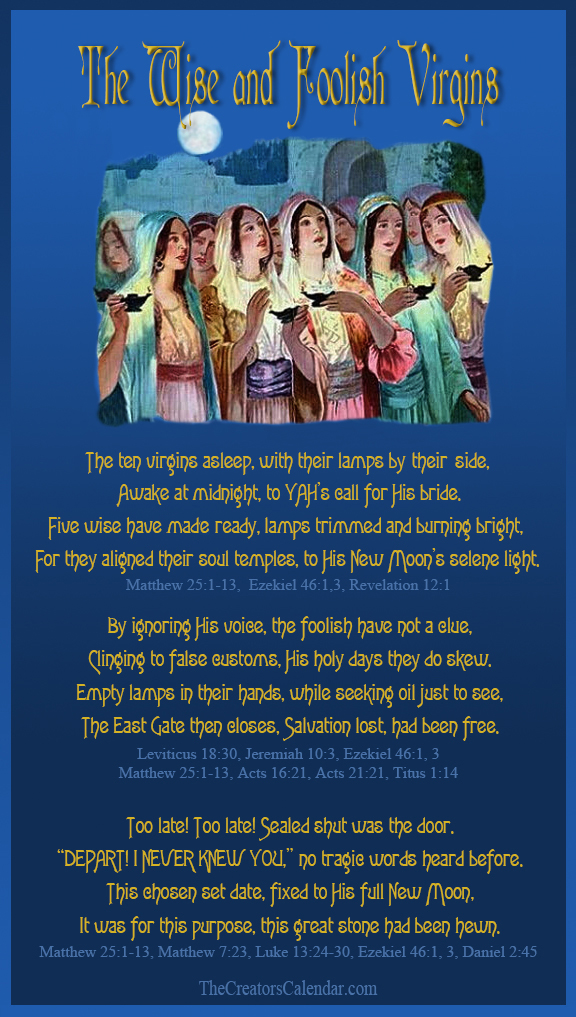
Might this ancient blueprint also illuminate our Messiah’s parable of the five wise and five foolish virgins? All ten awaited the Bridegroom, yet only those who were prepared entered through the Door before it was shut. Could there also be a time-centric dimension to His warning, calling His faithful not only to recognize the Bridegroom, but to be prepared to meet Him at the appointed TIME? (Matthew 25:1-13).
There’s No Debate

No one is debating that Sunday is the first day and Saturday the seventh day of the modern Gregorian calendar, because they are. The more important question is whether that continuously cycling week is the same weekly structure established by the Creator in Scripture.
This distinction is crucial. The Julian/Gregorian calendar belongs to a Roman-derived system of timekeeping whose week operates continuously and independently of the lunar month. By contrast, the calendar model presented throughout this study is rooted in the celestial LIGHTS established at Creation, with the sun, moon, and stars functioning together as markers of sacred TIME (Genesis 1:14).
The issue, therefore, is not whether Saturday occupies the seventh position in the modern week. It does. The issue is whether the modern continuously cycling week provides the biblical standard by which YAHUAH’s seventh-day Sabbath is to be identified.
The historical development of the Roman calendar through Julius Caesar, later imperial and ecclesiastical developments, and eventually the Gregorian reform produced the calendar framework inherited by much of the modern world. Within the argument presented here, however, that framework does not preserve the Scriptural relationship between the New Moon, lunar month, weekly Sabbath, and annual Feast Days.
This distinction carries profound prophetic implications. Scripture warns of a power that would “think to change times and laws” (Daniel 7:25), while Revelation describes an opposing system of authority and worship. Within the prophetic framework developed throughout this website, the displacement of YAHUAH’s appointed TIMES by a calendar system operating independently of His celestial markers deserves serious consideration.
For this reason, neither Saturday nor Sunday should be assumed to be sacred merely because of its position within the modern continuous week. Each must be tested against the Scriptural pattern. If the seventh-day Sabbath is determined within the lunar framework established by YAHUAH, then a Saturday or Sunday can coincide with that Sabbath only when the two calendar systems happen to intersect. Refer to the article, No Debate, Saturday is the Seventh Day of the Roman Calendar.
Our Creator’s Original Sabbath
The Creator’s authentic and original Kadosh (Holy) Sabbath, as presented in this study, is counted within the same lunar framework that governs the month and year. But its count does not begin from the dark conjunction honored within the modern Rabbinical calendar, nor from the visible crescent associated with Karaite reckoning. Instead, the weekly count begins in relationship to the restored FULL NEW MOON marker.
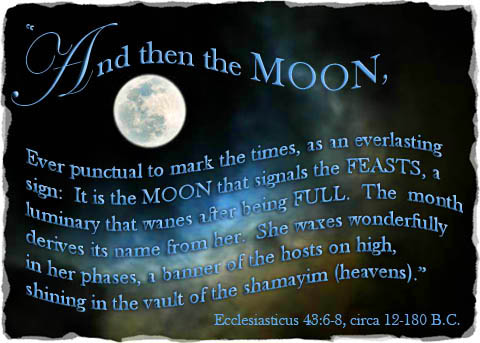
Why is this important? Because the Creator’s divisions of TIME do not function as unrelated cycles. Within this model, each smaller division of TIME exists within the framework of the next larger division. DAYS form WEEKS, WEEKS are contained within the lunar MONTH, and lunar MONTHS are contained within the YEAR. Rather than operating independently, they form an integrated celestial system.
I would actually remove the “whole pizza” analogy here. It is understandable, but the surrounding material has become much more sophisticated, and the pizza suddenly makes the article sound informal.
Then I would keep your image and revise the next portion:
There are two significant indicators that a calendar system has departed from this original pattern:
- Its divisions of TIME have become separated from the coordinated testimony of the sun, moon, and stars.
- Its smaller divisions of TIME operate independently rather than functioning as subdivisions within the larger units.
In contrast to today’s commonly used systems of timekeeping, the Creator’s lunar month presented in this study contains four Sabbaths within the boundary established from one FULL NEW MOON DAY to the next. These Sabbaths consistently occupy the 8th, 15th, 22nd, and 29th dates of the lunar month, maintaining the relationship between New Moon and Sabbath reflected throughout this study (Isaiah 66:23).
Because twelve lunar months are shorter than a solar year, a strictly twelve-month lunar count would gradually move through the seasons. Yet the relationship between the lunar and solar cycles provides a recurring nineteen-year pattern in which seven years require a thirteenth month to maintain seasonal synchronization. These occur in years 3, 6, 8, 11, 14, 17, and 19 of the familiar nineteen-year cycle. Such years are commonly called embolismic years because they contain an additional intercalary month. Today this relationship is commonly known as the Metonic Cycle, after the Greek astronomer Meton.
It looks like this, with the twelve-month years represented in blue and the thirteen-month years represented in green. 1 – 2 – 3 – 4 – 5 – 6 – 7 – 8 – 9 – 10 – 11 – 12 – 13 – 14 – 15 – 16 – 17 – 18 – 19. Refer to the article/study, “New Moon by New Moon You Shall Keep.”
He set for a sign, His Sabbath with care,
To be counted from New Moons, high up in the air.
The full moon that’s seen tells us Sabbath’s the eighth,
The fifteenth, twenty-second, and twenty-ninth are the dates.
Genesis 1:14-18; Exodus 12:1-3; 16; 19; Psalms 19:1-3; Psalms 97:6-7;
1 Chronicles 23:3-32; 1 Samuel 20:5; 2 Kings 4:23; Psalms 81:3;
Isaiah 66:23; Ezekiel 46:1-3; Amos 8:5
While the Sabbath remains consistently the seventh day of the WEEK, it is never the seventh day of the lunar MONTH. At first this may appear contradictory, but the distinction becomes clear once the FULL NEW MOON DAY is recognized as the first day of each lunar month. The six workdays begin the following day and are followed by the seventh-day Sabbath, establishing the four-week sequence. At the completion of the lunar month, the next FULL NEW MOON DAY renews the monthly count, and the pattern begins again.
October 22, 1844, and the Crescent Moon
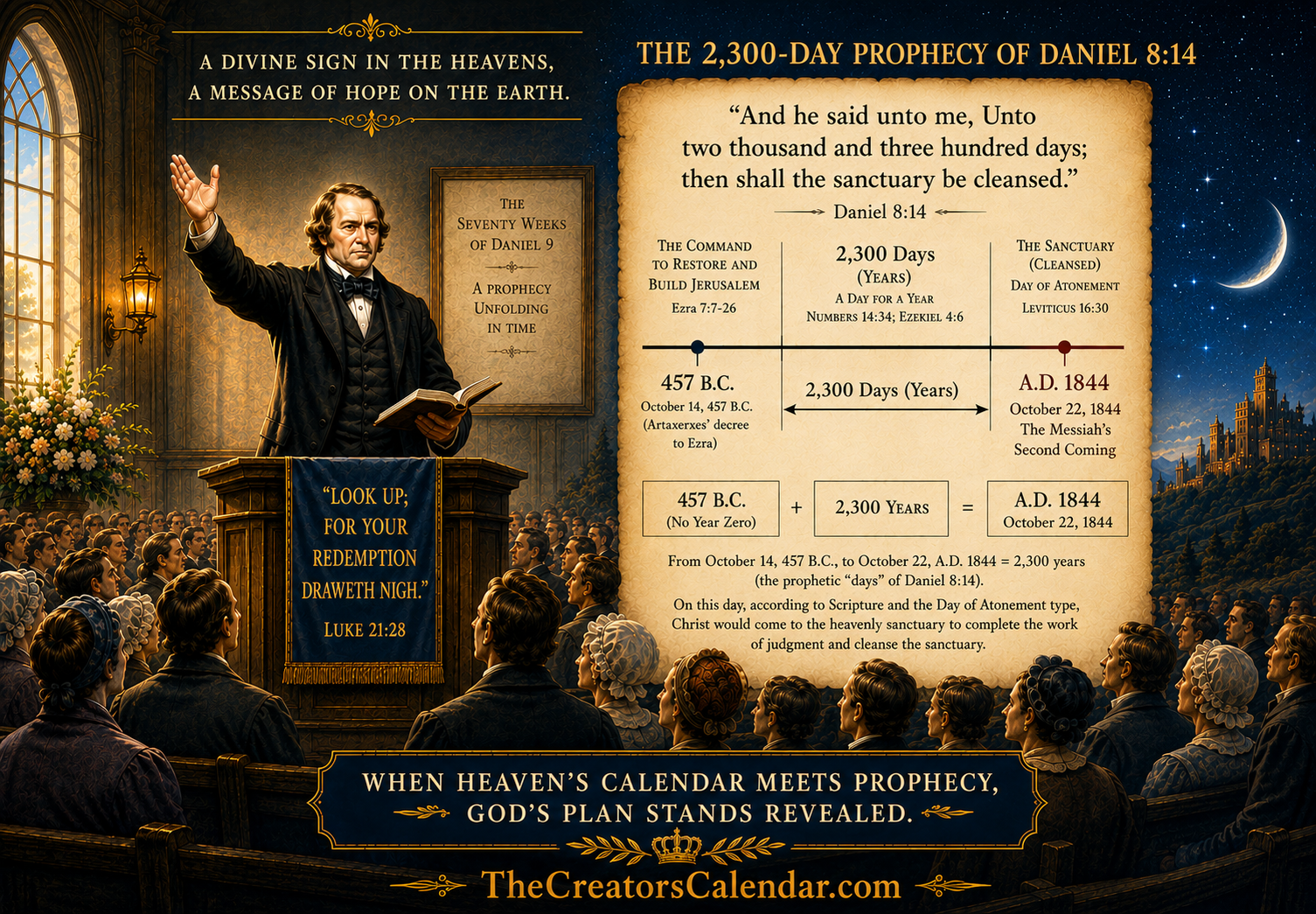
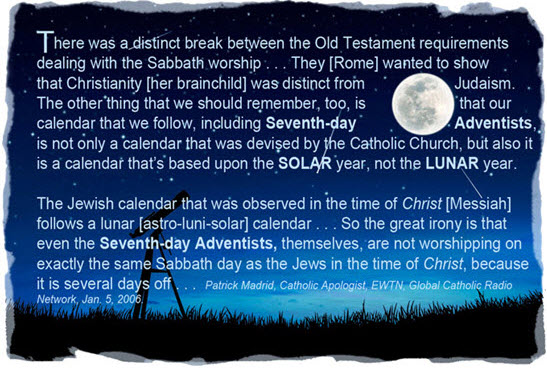
The article link below is included specifically for the consideration of our Seventh-day Adventist friends. It presents foundational evidence connecting October 22, 1844, to lunar-calendar reckoning and examines the significant role of the crescent moon in establishing that historic date. Yet the calendrical implications of this evidence have received remarkably little attention.
For those who continue to recognize the significance traditionally assigned to October 22, 1844, this raises an important question: If the date itself was established through lunar reckoning, what might that reveal about the calendar upon which biblical appointed TIMES were originally determined? Refer to the article October 22, 1844, and the Crescent Moon.
The Restored Definition of “Seasons” aka Mo’edim
The Hebrew keyword H#4150, mo’edim (מועדים), translated as seasons in Genesis 1:14, Leviticus 23:4, and Psalms 104:19, is one of the most important terms for understanding the Creator’s Calendar. Over the centuries, its specific connection to the lunar framework of sacred TIME has become obscured as solar methods of time-measuring became dominant. Yet despite the changes in how this important word has come to be understood, Scripture itself provides the remedy.
Beginning with Genesis 1:14, let us trace this critical keyword through Scripture and discover how its lunar connection can be restored:
“And Alahim said, ‘Let there be lights in the firmament of the heaven to divide the day from the night; and let them be for signs, and for seasons, and for days, and years.’” Genesis 1:14 KJV
According to Strong’s and Brown-Driver-Briggs Hebrew dictionaries, the term translated seasons is H#4150, mo’edim (מועדים), carrying such meanings as appointed time, appointed place, set feast, fixed time, appointment, festival, and assembly. These definitions are helpful, but they do not by themselves identify the celestial means by which those appointed TIMES are determined. For that, we must allow Scripture to provide its own additional witness. Pasted text(3)
Psalms 104:19 supplies a remarkable piece of that evidence. Referring to the Creator, YAHUAH Alahim, it declares:
“He [YAHUAH] ordained the MOON for seasons…” Psalms 104:19
This raises an important question. Do the seasons here refer merely to the four familiar solar seasons of spring, summer, autumn, and winter? Or does the verse reveal something much more specific about the role of the moon in regulating YAHUAH’s appointed TIMES?
Consider the verse again with the Hebrew term identified:
“He ordained the MOON for seasons [H#4150, mo’edim (מועדים), appointed TIMES]…” Psalms 104:19
Here Scripture itself establishes the connection that is essential to this study: the MOON was ordained in relationship to the mo’edim. The lexicons provide the meaning of appointed times, while Psalms 104:19 identifies the celestial body specifically associated with those appointments. Together they restore an important dimension that can easily be missed when the English word seasons is read through the lens of our modern solar calendar.
Modern Hebrew provides an additional and interesting witness. The online Hebrew translator referenced in this study renders mo’edim in the sense of “specific dates” or “commemorative dates.” This harmonizes beautifully with the purpose of YAHUAH’s sacred appointments, which commemorate and prophetically portray the work of our Messiah, the Plan of Salvation, and ultimately the REMEDY for SIN. Pasted text(3)
Bringing these witnesses together, the meaning intended throughout this study can therefore be expressed as:
Mo’edim = specific lunar-appointed TIMES or commemorative dates.
This restored connection provides an illuminating way to understand Genesis 1:14. To make explicit the lunar relationship established by the Scriptural witnesses above, its calendar intent may be expressed as follows:
“And Alahim said, ‘Let there be lights in the firmament of the heaven to divide the day from the night; and let them be for signs, and for specific lunar-appointed TIMES, and for days, and years.’” Genesis 1:14,
Restored Hebrew intent according to the multitude of witnesses presented above.
Because Psalms 104:19 identifies the MOON in relation to the mo’edim, the Creator’s authentic calendar dates are found within the lunation, the lunar month of approximately 29-30 days. His calendar year therefore comprises lunar MONTHS divided into their smaller units of WEEKS and DAYS, each functioning within the larger celestial framework. Then, with each FULL NEW MOON DAY, the lunar sequence begins again.
The Interlocking Lunar Puzzle Pieces
Like interlocking pieces of a puzzle, the FULL NEW MOON DAY, lunar MONTH, six WORK DAYS, seventh-day SABBATH, and annual FEAST DAYS belong to one integrated time-measuring system. Each piece has its appointed place, and together they reveal a larger pattern that is difficult to recognize when any one of them is considered independently. Leviticus 23 provides an important key to seeing how these pieces fit together.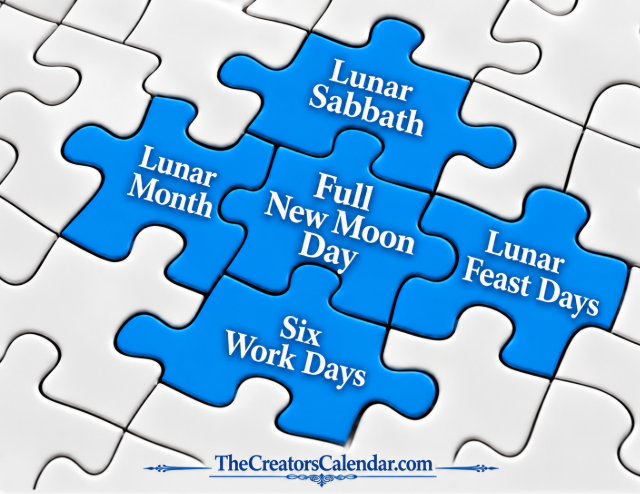
Notice how these interlocking time elements appear within the restored-text presentation of Leviticus 23:1-5:
Leviticus 23:1-5
- “And declared Yahuah unto Moses, saying,
- ‘Speak unto the children of Yasharal (Israel), and command them concerning the specific lunar appointed dates (H#4150 mo’edim) of Yahuah, which you shall proclaim My set-apart (Holy) rehearsal assemblies (H#4744 miqra). These are themselves My specific lunar appointed dates (H#4150 mo’edim): [Note the colon.]
- Six days from sunrise to sunset you shall do your work, but in the day of the seventh it is the Sabbath-rest to observe the covenant, a set-apart (Holy) rehearsal assembly (H#4744 miqra) in which you shall do no work, for it is the Sabbath unto Yahuah in all your dwellings.
- These are the specific lunar appointed dates (H#4150 mo’edim) of Yahuah, the set-apart (Holy) rehearsal assemblies (H#4744 miqra), which you shall proclaim as SIGNS [of prophetic events to be fulfilled by the Messiah alone] at their specific lunar appointed dates (H#4150 mo’edim): [Note the colon.]
- In the lunar month (H#2320 chodesh), the first one of the year, in the fourteenth day counted from the New Moon Day (H#2320 chodesh), between (H#996 beyn) the evenings (plural twilights) (H#6153 ereb), is the PASSOVER of Yahuah.'” Leviticus 23:1-5 and beyond…
With these interlocking pieces in view, the Creator’s WEEKS are also understood within these lunar dates. They are counted within the monthly framework from FULL NEW MOON DAY to FULL NEW MOON DAY, through the 29 or 30 days of the lunation. The four seventh-day Sabbaths consequently occupy the recurring lunar-month dates of the 8th, 15th, 22nd, and 29th. Isaiah 66:23 provides an additional witness by placing the recurring New Moon and Sabbath together in the rhythm of worship.
Each of the annual mo’edim, commonly called Feast Days, likewise follows in its prescribed sequential order within the lunar month. Because the seventh-day Sabbaths and annual Feast Days are both understood within the same lunar framework, the Feast Days are anchored by their count from the FULL NEW MOON DAY as well as by their relationship to the weekly Sabbath sequence. Within the argument of this study, this makes a weekly cycle operating perpetually and independently of the lunar month incompatible with the Scriptural pattern. Pasted text(3)
There is another important consequence. Because the FULL NEW MOON DAY, seventh-day Sabbaths, and annual prophetic Feast appointments each occupy their own prescribed positions within the same lunar framework, they do not randomly overlap one another. They appear to float across weekdays and Saturdays only when the lunar pattern is viewed through the grid of the Roman Gregorian calendar, whose months and continuous weeks operate independently of the lunar cycle.
This reverses the perspective. Rather than asking where YAHUAH’s appointed TIMES happen to fall upon the modern wall calendar, we must first ask a more foundational question: Which calendar provides the Scriptural STANDARD by which those sacred appointments were intended to be identified?
Is It Really Impossible to Know Which Lunar Phase is Full?
It is easy to dismiss the FULL NEW MOON DAY as the beginning of the lunar month for a couple of reasons. First, it is not practiced by Rabbinical Jews or Muslims today, nor is it widely recognized among other long-established religious groups. Second, the first visible crescent can be watched for, while the dark conjunction can be mathematically calculated.
But an objection is frequently raised concerning the FULL MOON: “The moon can appear full for two or even three nights, so how can anyone know which lunar phase is the actual FULL MOON, and therefore which following day is the FULL NEW MOON DAY and the beginning of the lunar month?”
The difficulty seems convincing only until we recognize something most of us were never taught about the lunar phases. The first secret to unlocking the mystery is that every visible lunar phase is related to both PHASE and POSITION.

From Earth’s perspective, each waxing and waning lunar phase corresponds to a particular geometric relationship among the SUN, EARTH, and MOON. As the moon progresses through its monthly orbit, both its visible PHASE and its POSITION relative to the sun continually change. Together, these celestial coordinates provide far more information than the appearance of the moon alone.
At the FULL MOON, that geometry becomes especially significant. The moon reaches opposition, with the Earth positioned between the sun and moon. Astronomically, this sun-Earth-moon alignment is called a syzygy, or what we will refer to throughout this study as the line of opposition. This is also the only lunar phase during which a lunar eclipse can occur, although an eclipse does not occur every month because the moon’s orbit does not ordinarily pass directly through Earth’s shadow.
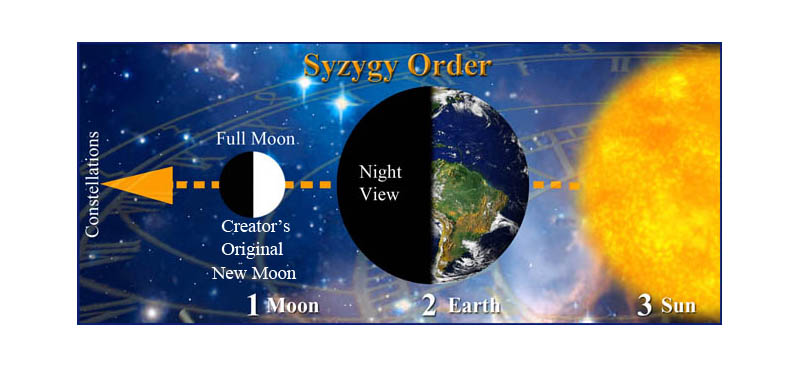
This brings us to the observable celestial witness.
The confirming sign used within this study occurs on the morning when the FULL MOON and rising SUN can first be observed simultaneously from opposite horizons, the moon toward the WEST and the sun toward the EAST. Rather than relying solely upon which of several nearly round moons looks fullest, the observer is watching for the relationship between PHASE and POSITION.
Within this observational model, that first morning encounter between the two great LIGHTS provides the natural marker for the commencement of the FULL NEW MOON DAY (Rosh Chodesh). The moon has passed through opposition and is beginning its waning journey, while the rising sun announces the beginning of the new DAY from the opposite horizon.
This is what makes the observation so meaningful. The FULL MOON is not identified merely by its round appearance. Its celestial POSITION provides the confirming witness. The two great LIGHTS themselves participate in identifying the transition.
So the question is no longer simply, “Which night does the moon look fullest?” The more revealing question becomes:
When do PHASE and POSITION come together to identify the FULL MOON and announce the beginning of the FULL NEW MOON DAY?
The moon is not visible above the horizon the previous morning at sunrise, and the following morning, it is too high in the sky.
Three Kinds of Days Each Month
Genesis 1 establishes the familiar pattern of the WEEK: six workdays followed by one seventh-day Sabbath. Yet when we widen the lens from the WEEK to the entire lunar MONTH, Scripture reveals another important piece of the Creator’s timekeeping pattern. Ezekiel 46:1, Leviticus 23:1-44, and Isaiah 66:23 distinguish three primary kinds of days within the lunar month: FULL NEW MOON DAYS, WORKDAYS, and seventh-day SABBATHS.
At first, this may seem surprising. How can the month contain a kind of day that is neither one of the six workdays nor the seventh-day Sabbath?
The answer is the FULL NEW MOON DAY. It stands at the head of the lunar month and renews the monthly count. It is not counted as one of the six workdays, nor is it one of the four seventh-day Sabbaths. After FULL NEW MOON DAY, we count the first sequence of six workdays, followed by the first seventh-day Sabbath on the 8th day of the lunar month. The pattern then continues through the Sabbaths of the 15th, 22nd, and 29th.
There is also an occasional 30th day, required because a lunation is approximately 29½ days long. In a 30-day lunar month, this additional day functions as a transition day between the fourth Sabbath on the 29th and the next FULL NEW MOON DAY. It does not begin another six-day work sequence before the month is renewed.
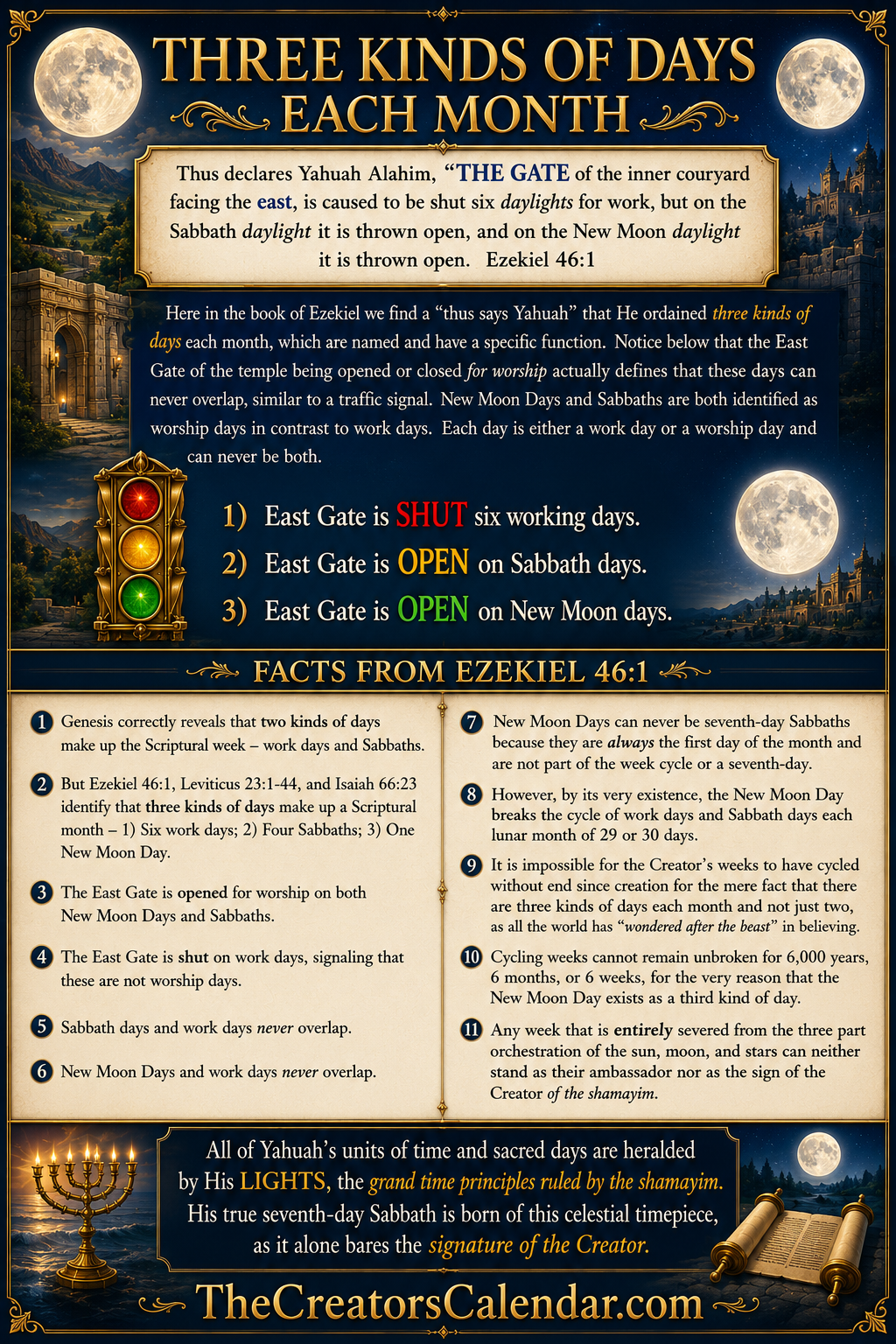
This distinction is fundamental to understanding the Creator’s Calendar. The modern continuous week recognizes only an uninterrupted succession of workdays and seventh days. The lunar framework presented in this study recognizes the FULL NEW MOON DAY as a distinct monthly appointment around which the weekly sequence is ordered.
This also resolves what might otherwise appear to be a contradiction: the Sabbath is always the seventh day of its WEEK, but it is never the seventh day of the lunar MONTH. FULL NEW MOON DAY stands first, followed by six workdays, making the first seventh-day Sabbath the 8th day of the month. The same pattern produces the four recurring Sabbath dates of the 8th, 15th, 22nd, and 29th.
I think this section should stay relatively short because your chart does much of the teaching visually.
Why the Sacred Days Never Overlap
Because the New Moon Day exists as a uniquely set-apart day of worship (Ezekiel 46:3), the weekly sequence does not cycle continuously and independently through successive lunar months. Instead, within the calendar model presented throughout this study, the FULL NEW MOON DAY establishes the boundary of each new lunar cycle, and the weekly count proceeds within that monthly framework (Isaiah 66:23).
As a result, the authentic WEEK recorded in Scripture, together with its seventh-day Sabbath, was ordained to cycle only within the preset boundaries of the lunar month, from one sacred FULL NEW MOON DAY to the next. This rule of boundaries prevents the Sabbath and New Moon Day from overlapping, because each occupies its own distinct position and function within the lunar month. The sacrificial schedule of the Sanctuary and Temple provides an especially important witness to this distinction. Refer to the article, The Sacrifice Schedule, The Master-Key of Time.
The idea of overlapping arises when the lunar appointments are placed upon the framework of the Roman Julian/Gregorian continuous week. That calendar recognizes essentially two recurring kinds of days within the weekly cycle: workdays and the seventh day, while the week itself continues without interruption from one month into another. Consequently, when New Moon Days, Sabbaths, and annual Feast Days are superimposed upon that continuous-week framework, they naturally appear to overlap.
But the Scriptural lunar model presented here operates differently. It recognizes distinct categories of days within the boundaries of the lunar month, each occupying its own appointed position.
An intriguing historical statement illustrates this distinction:
“Sabbath, the Full Moon Day, and the week are independent of each other.” Meinhold, “Sabbath und Woche im O.T.” Göttingen, 1905, Jewish Encyclopedia.com, unedited full-text of the 1906 Jewish Encyclopedia, “Week,” by Emil G. Hirsch, Vol. 12, p. 481.

Notice the distinction expressed in the quotation. The Sabbath, FULL MOON DAY, and week are identified separately rather than treated as interchangeable designations. Within the framework presented in this study, this can be illustrated much like the three colors of a traffic light. Each has its own identity, purpose, and position. One does not become another, nor do two occupy the same function simultaneously.
In the same way, the FULL NEW MOON DAY, workdays, and seventh-day Sabbaths fit together within the numbered sequence of the 29 or 30-day lunar month like interlocking puzzle pieces. They are distinct from one another, yet each remains dependent upon its ordered position within the larger lunar framework.
This distinction is important. Independence from one another does not necessarily mean independence from the lunar month itself. Within the model presented here, these different kinds of days remain ordered within the same monthly structure. Overlapping becomes possible only when these sacred appointments are detached from that structure and placed upon an independently cycling weekly calendar.
The Creator’s calendar model presented throughout this study therefore utilizes three primary kinds of days within each lunar month: the FULL NEW MOON DAY, the six workdays, and the seventh-day Sabbath. In a 30-day lunar month, there is also a fourth kind of day, the single transition day following the fourth Sabbath. It stands alone, neither beginning another six-day work sequence nor functioning as one of the monthly worship appointments.
Thus, both the FULL NEW MOON DAY and the seventh-day Sabbath remain sacred worship days every lunar month, each occupying its own appointed position without overlapping the other. Refer to the article “The Fourth Day of Creation.”
The historical record provides another noteworthy witness:
“In the time of the earliest prophets, the New Moon stood in the same line with another lunar observance, the Sabbath. Ezekiel, who curiously enough frequently dates his prophecies on the New Moon . . . describes the gate of the inner court of the (new) temple looking eastward as kept shut for the six working days, but opened on the Sabbath and the New Moon.” Scribner’s Dictionary of the Bible, (1898 edit), p. 521.
This description harmonizes particularly well with Ezekiel 46:1-3. The Temple’s East Gate distinguishes six working days from the Sabbath and New Moon, providing a striking biblical picture of the different categories of days that form the lunar-month pattern presented here.
Neither Saturday nor Sunday
With the purest of motives, countless Scripture-believing Christians and Rabbinical Jews have for centuries faithfully observed either Saturday or Sunday as their weekly Sabbath or sacred day. Most have never thought to question the calendar framework upon which those days are identified. Why would they? We were born into a world in which the continuously cycling seven-day week appears fixed, universal, and virtually unquestionable.
Yet sincerity of worship does not establish the accuracy of the calendar by which that worship is scheduled. Beneath both Saturday and Sunday observance lies the same fundamental assumption: that the continuously cycling week of the modern Roman Gregorian calendar preserves the weekly pattern established by YAHUAH at Creation.
But is that assumption supported by Scripture?
This is where the issue becomes much larger than the familiar Saturday-versus-Sunday debate. If the calendar framework itself has changed, then arguing over which day occupies the seventh position within that later calendar does not resolve the more foundational question. The real question is not whether Saturday is the seventh day of the modern week. It is. The question is whether the modern continuous week is the Scriptural WEEK by which YAHUAH ordained His Sabbath to be identified.
Throughout this study, we have encountered a very different timekeeping pattern. The heavenly LIGHTS establish the celestial framework for YEARS, MONTHS, WEEKS, DAYS, and appointed TIMES. The FULL NEW MOON DAY stands at the head of the lunar month. Six workdays follow, culminating in the seventh-day Sabbath, with the four monthly Sabbaths recurring on the 8th, 15th, 22nd, and 29th. The lunar month then reaches its boundary, and the count is renewed with the next FULL NEW MOON DAY.
Within this framework, neither Saturday nor Sunday possesses an inherent sacred identity. Both belong to the continuously cycling Roman week and move independently through the lunar month. Either may occasionally coincide with one of the Creator’s lunar Sabbaths, but neither can permanently identify it.
This changes the question entirely. The issue is no longer Saturday versus Sunday. It is the Roman continuous week versus the celestial timekeeping pattern presented in Scripture.
For a deeper examination of how the continuous-week framework became embedded within Christian practice, refer to the article, The Constantinian Creed, the Forgotten Foundation of All Christian Churches. Refer to the article, The Constantinian Creed, the Forgotten Foundation of All Christian Churches.
The Full Moon, the Starting Point for All Other Divisions of Time
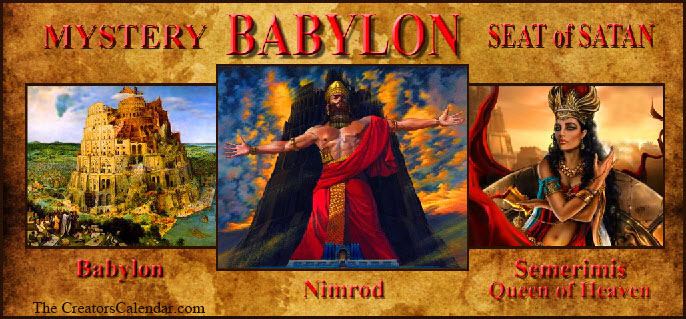
An intriguing historical witness adds another dimension to the evidence presented throughout this study. It appears in the 1911 Encyclopaedia Britannica article on the Zodiac, which cites the work of the distinguished nineteenth-century French Assyriologist François Lenormant and discusses the development of astronomical time-measuring among the early inhabitants of Mesopotamia. Wikisource
This geographical setting is especially significant within the biblical narrative. Mesopotamia was home to some of the earliest civilizations described following the Flood and later became associated with Babel and the rise of Babylon. For this reason, evidence concerning the earliest methods of measuring TIME in this region deserves careful consideration.
“Assyria and Babylonia—The twelvefold division of the zodiac was evidently suggested by the occurrence of twelve full moons in successive parts of it in the course of each year. This approximate relation was first systematically developed [or maintained] by the early inhabitants of Mesopotamia and formed the starting point for all other divisions of time… [Later] The idea of tracing the sun’s path among the “stars” [by daylight] was when it occurred to Chaldaean astronomers, an original and, relatively to their means, a recondite one. We owe to its realization by them the constitution and nomenclature of the [modern] twelve signs of the zodiac.” 1911 Encyclopaedia Britannica – Zodiac, p. 993, Lenormant, Orgines de l’Histoire, Vol. 1, p. 236.
Three observations from this remarkable historical statement deserve our attention.
First: Twelve Full Moons Marked the Year
The quotation explicitly connects the twelvefold division of the zodiac with “twelve full moons” occurring successively throughout the year. This provides an important historical witness to the prominent role of the FULL MOON in the earliest Mesopotamian development of celestial time-measuring. Wikisource
This does not eliminate the occasional thirteenth lunar month required to maintain synchronization between lunar months and the solar year. Rather, twelve lunar months constitute the ordinary year, with intercalation periodically providing the additional month necessary for continued seasonal alignment.
The FULL MOON is also particularly significant within the Scriptural framework developed throughout this study because it belongs to the NIGHT sky together with the stars. This relationship harmonizes with the four Scriptural witnesses already examined in Genesis 1:16, Psalms 136:7-9, Jeremiah 31:35-36, and Revelation 12:1, where the moon and stars are repeatedly associated with the NIGHT.
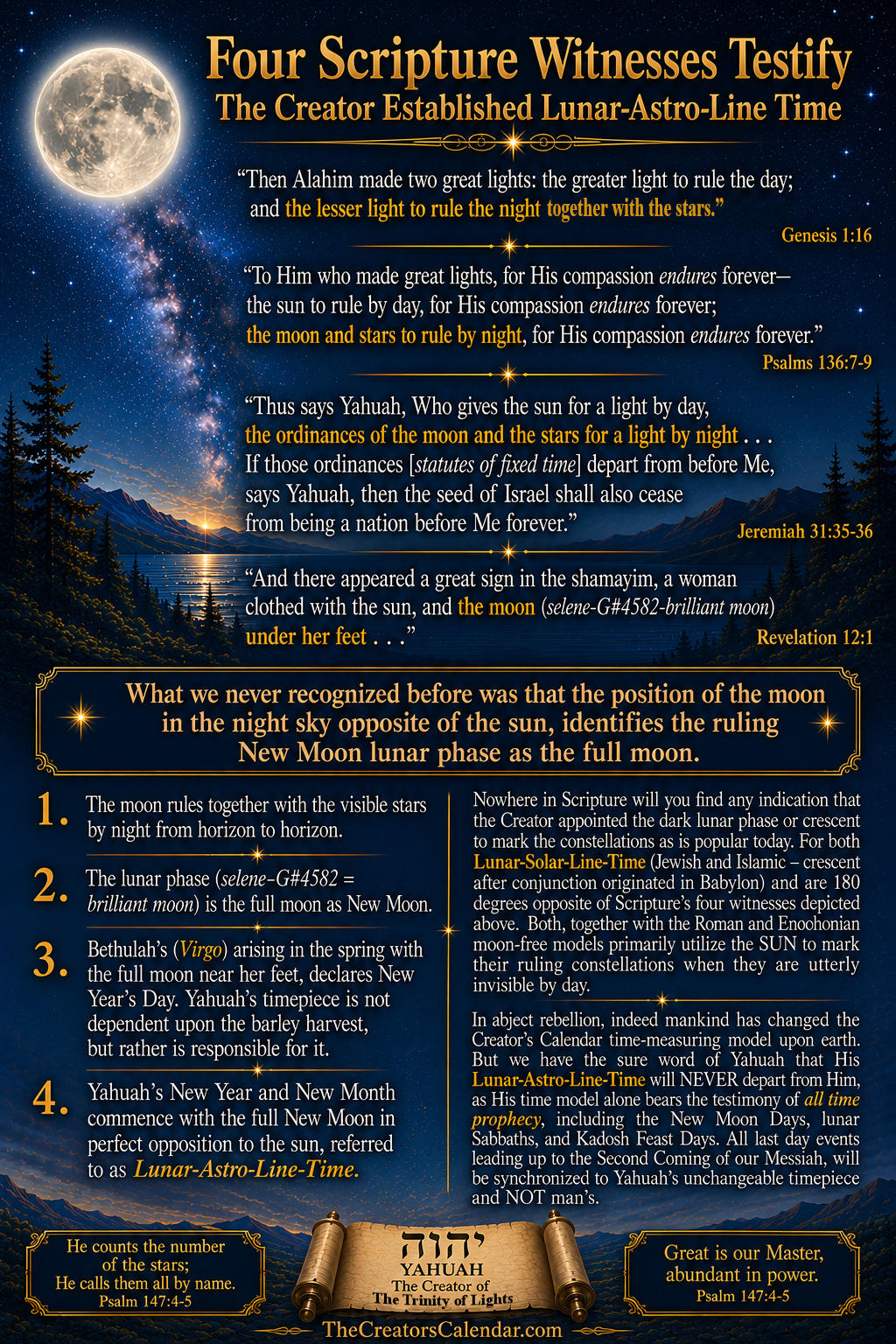
Second: The Starting Point for Other Divisions of Time
Perhaps the most provocative phrase in the historical quotation is that this early Mesopotamian celestial relationship “formed the starting point for all other divisions of time.” Wikisource
Within the framework of this study, that statement deserves special attention. YEARS contain MONTHS, MONTHS contain WEEKS, and WEEKS contain DAYS. If the FULL MOON occupied a foundational position in the earliest celestial division of the year and month, it provides a striking historical parallel to the Scriptural model developed throughout this article, in which the FULL NEW MOON establishes the beginning from which the smaller divisions of TIME are ordered.
This is where the historical evidence and the biblical argument intersect. The historical source establishes the importance of the FULL MOON within early Mesopotamian time division. The Scriptural evidence presented throughout this study is what we use to investigate whether that same celestial marker governed YAHUAH’s MONTHS, WEEKS, DAYS, Sabbaths, and appointed TIMES.
That distinction actually strengthens your case because you are not asking the historical source to prove more than it says.
Within the Scriptural model presented here, the seventh-day Sabbath consequently remains synchronized with the lunar month rather than cycling independently of it. Isaiah 66:23 then carries both the New Moon and Sabbath forward into the prophetic picture of continuing worship.
Third: A Later Development in Chaldaean Astronomy
The same historical source makes another fascinating statement. It describes the idea of tracing the sun’s path among the stars as an original and, relative to the astronomical resources available at the time, “recondite” achievement of Chaldaean astronomers. From this development came the constitution and nomenclature of the twelve signs of the zodiac. Refer to the article Five Historical Methods of Time Measuring.
What Does This Historical Evidence Reveal?
The importance of this quotation lies in what it actually establishes: FULL MOONS occupied a foundational role in the early Mesopotamian development of celestial time-measuring, and that relationship became a starting point for further divisions of TIME.
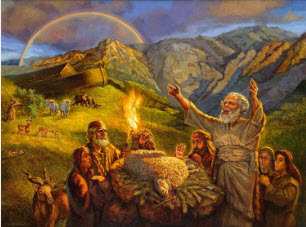
Within the biblical framework presented throughout this website, this historical witness becomes especially intriguing. Scripture describes the post-Flood world beginning with Noah and his family, followed by the development of civilization in Mesopotamia and eventually the rebellion at Babel. This raises an important question: Could the ancient prominence of the FULL MOON preserve traces of an earlier celestial timekeeping pattern carried forward from the generations preceding Babel?
That is a powerful question. I would present it as a question, because the Britannica quotation itself cannot establish the Noah connection.
 Likewise, the later association of Mesopotamia with Nimrod and Babel invites consideration of whether changes in celestial reckoning accompanied the larger spiritual and cultural departures described in Genesis. But here again, we should distinguish what Scripture explicitly states from what we are proposing as a possible historical reconstruction. Scripture connects Nimrod with Babel, but it does not state that Nimrod or Semiramis personally changed the lunar calendar.
What remains especially beautiful is the simplicity of the celestial model itself. In the earliest world there were no wall calendars, wristwatches, or international date lines. The Creator’s LIGHTS were visible above mankind, beyond human alteration. The sun, moon, and stars provided recurring celestial witnesses by which TIME could be observed and measured.
Within the model presented throughout this study, each smaller unit of TIME fits within the next larger unit: DAYS within WEEKS, WEEKS within MONTHS, and MONTHS within YEARS. The FULL NEW MOON provides the recurring celestial anchor from which the monthly sequence is renewed, creating a visible rhythm through which mankind may rendezvous with the Creator at His sacred lunar-appointed TIMES. Uncovered: Lunar Secrets from Ancient Babylon.
In the third generation, after Noah’s Ark came to rest,
Nimrod’s astrologers altered time, as they were possessed,
From the full moon to the dark, the occult was then born,
Babel’s tower was built, for YAH’S mo’edim* they did scorn.
(*mo’edim = lunar appointed time – Psalms 104:19)
1911 Encyclopaedia Britannica
Uncovered: Lunar Secrets From Ancient Babylon
Out of her dark, deceitful midst, faithful Abraham was called,
From His Covenant unto Moses, YAH’S Torah Law was reinstalled.
Through this lineage of obedience, the Promised Lamb was to come,
Keeping the full moon for set time, as the rhythm of a drum.
Treasury of Evidence for the Full New Moon Announces Lunar Times.
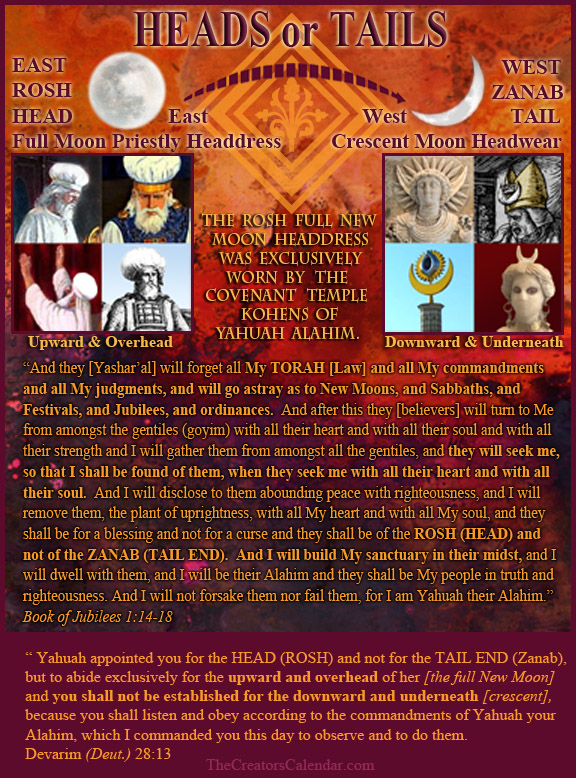
What the Solar Eclipse at Our Messiah’s Crucifixion Reveals
While there is a wealth of Scriptural evidence supporting the lunar calendar and, as presented throughout this study, the FULL MOON as the beginning of the lunar month, perhaps no evidence is more dramatic than the celestial darkness recorded at the appointed epicenter of prophetic TIME: the crucifixion of Yahusha haMashiach.
The significance begins with the date.
Scripture repeatedly identifies Passover as occurring on the fourteenth day of the first lunar month of Abib, counted from the New Moon. This is not an incidental detail. The date forms part of the prophetic appointment itself.
| Exodus 12:6 | Exodus 12:18 | Leviticus 23:5 | Numbers 9:3 |
| Numbers 9:5 | Numbers 9:11 | Numbers 28:16 | Joshua 5:10 |
| 2 Chronicles 30:15 | 2 Chronicles 35:1 | Ezra 6:19 | Ezekiel 45:21 |
| Acts 27:33 |
1. Passover Was Appointed to the Fourteenth Day of the Lunar Month
Notice that English translations commonly describe Passover as occurring on the fourteenth day of the “month.” Yet the Hebrew word translated month is chodesh (H#2320, חדשׁ), the same term associated throughout Scripture with the lunar month and New Moon.
This distinction matters because modern readers naturally encounter the word month through the framework of the Gregorian calendar. We instinctively picture a conventional solar-calendar month even though that is not the calendrical framework of the biblical text.
Passover therefore carried a precise TIME coordinate: the fourteenth day of the first lunar month. Whatever lunar phase occupied that fourteenth day becomes extremely important for identifying the lunar phase from which the month began.
2. Passover Was Both an Appointed TIME and a Prophetic EVENT
Nothing surrounding the sacrifice of Yahusha was without prophetic significance. The Passover had long portrayed the saving blood of the promised Lamb, the only REMEDY for SIN.
The ancient Passover EVENT therefore pointed forward to a greater fulfillment. Yahusha laid down His life at the appointed Passover TIME, on the fourteenth day of the first lunar month.
Here again we encounter the relationship developed throughout this study: MESSIAH + TIME + EVENT. The promised Messiah fulfilled the prophetic EVENT at its appointed TIME.
3. At Noon, the Sun Was Darkened
Luke records:
“It was now about the sixth hour, and there was darkness over the whole land until the ninth hour, while the sun’s light failed…”
Luke 23:44-45. Bible Gateway
The sixth hour corresponds approximately to noon, and the ninth to approximately 3 p.m. Thus, Luke places the extraordinary darkness in broad daylight. Bible Gateway
Luke first describes what was experienced: darkness came over the land. He then specifically connects that darkness with the SUN.
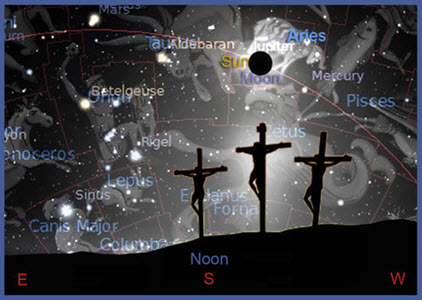
Within the interpretation presented in this study, this description is understood as solar-eclipse imagery, a darkening of the sun associated with the moon’s conjunction position.
That leads to an extraordinary calendrical question.
4. What Would a Solar Eclipse Reveal About the Lunar Phase?
Astronomically, an ordinary solar eclipse can occur only when the moon is at or very near conjunction, positioned between Earth and the sun. A solar eclipse cannot occur at FULL MOON because the moon is then on the opposite side of Earth from the sun. Third Millennium Ministries
Therefore, if the darkness described by Luke is understood as an eclipse-type conjunction event, its calendrical implications within the model presented here are profound.
Passover occurred on the fourteenth day of the lunar month. If the moon occupied its dark conjunction position at that midmonth appointment, then approximately half a lunation earlier it would have occupied the opposite position: FULL MOON.
Within the chronology developed throughout this study, that places the FULL MOON at or near the beginning of the lunar count.
In other words:
Day 1: FULL NEW MOON
↓
Fourteen-day count
↓
Passover: conjunction/dark-moon position
↓
The SUN is darkened at noon
This is why the crucifixion account is so important to the calendar question. The celestial EVENT potentially provides a lunar TIME-STAMP at the very Passover when the prophetic Lamb fulfilled the ancient promise.
For a fuller explanation and illustrations, refer to From the Sixth to the Ninth Hour.
5. Amos Foretold Darkness at Noon
The connection becomes even more striking when we turn to Amos:
“I will make the sun go down at noon and darken the earth in broad daylight.”
Amos 8:9. Bible Gateway
Centuries later, the Synoptic Gospels describe darkness beginning around noon during Yahusha’s crucifixion. Matthew likewise records darkness from noon until approximately 3 p.m. Bible Gateway
This creates a remarkable Scriptural parallel:
AMOS: the SUN darkened at NOON in DAYLIGHT.
LUKE: darkness begins at the SIXTH HOUR, and the SUN is darkened/fails.
PASSOVER: Yahusha dies at the appointed midmonth Feast.
Within the prophetic interpretation presented here, Amos supplies the Tanakh witness and Luke records its ultimate Messianic fulfillment.
I would add one sentence of scholarly transparency:
Some interpreters understand Amos 8:9 primarily as imagery of judgment or relate its imagery to eclipses known in Amos’s own period, while Christian interpreters have also connected the passage with the crucifixion darkness. Bible Hub
Refer to Amos Prophesied a Solar Eclipse and From the Sixth to the Ninth Hour for the fuller development of this evidence.
6. A Celestial Time-Stamp at the Cross
Taken together, these witnesses form the argument presented in this study:
Passover establishes the DATE.
Luke records the DARKENED SUN at NOON.
Astronomy identifies conjunction as the lunar position required for a natural solar eclipse.
Amos prophetically describes the SUN going down at NOON.
And counting backward approximately half a lunar cycle points toward the FULL MOON at the beginning of the month.
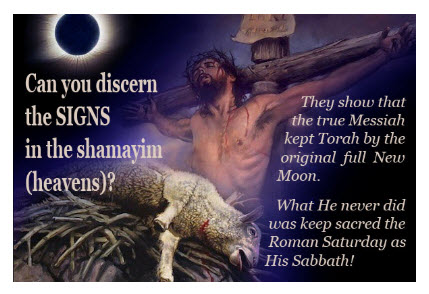
Thus, the crucifixion becomes far more than an isolated moment of supernatural darkness. Within the calendar framework presented here, it functions as a celestial TIME-STAMP, linking the sacrifice of Yahusha haMashiach with the lunar appointed TIME established for Passover.
 Did All the Jews Lose Track of Their Week and Sabbath?
Could all the Torah (the first five books of the Old Testament) and Tanakh-honoring Jews lose track of their original Sabbath and preordained time-measuring system? The answer is yes! Not only could it happen, but it occurred multiple times, as recorded in Scripture and later in history.
It is a well-known fact that when taken captive, all prisoners are compelled to adhere to the civil laws and calendar systems of their captors. Scripture records at least two times in which Yasharal (Israel) was taken captive, first in Egypt and later in Babylon, forfeiting all connection to the Torah Laws, New Moon Days, lunar Sabbaths, and Feast Days of their God, Yahuah Alahim. Having submitted to their captor’s laws for a time, ultimately, they were released under the guidance of their compassionate Eternal Father. Upon their return, they restored not only the walls of Jerusalem but also each doctrinal stone of truth relating to the Torah Law, including TIME & EVENT. In each case, their laws and sacred calendar were at last restored. But history records a third time when Yasharal (Israel) was conquered and went into Roman captivity.
Long before the Romans held Yasharal (Israel) captive, Julius Caesar made significant changes to the Roman calendar that would, through the centuries, have a most powerful effect on the Creator’s original and authentic calendar and, specifically, the week of seven days. By removing the moon entirely from defining the lunar month and the lunar week from its count from one New Moon to the next (Isaiah 66:23), Caesar had the option to make them of any length to complete 365 solar days. Thus, twelve months were determined to vary from 28 to 31 days. And the week was changed from a lunar count of seven to an eight-day continuous weekly cycle. Who knew then the diabolical (demonic) tsunami effect this would have on the world, including the Creator’s original worship calendar layout, entrusted to the Yasharalites (Israelites) as a wall of protection?
“In the mid-1st century B.C. Julius Caesar invited Sosigenes,
an Alexandrian astronomer, to advise him about the reform of the calendar, and Sosigenes decided that the only practical step was to abandon the lunar calendar altogether. Months must be arranged on a seasonal basis, and a tropical [solar] year used, as in the Egyptian calendar, but with its length 365.25 days.” Encyclopedia Britannica, The Julian Calendar, Paragraph 1.
https://www.britannica.com/science/calendar/The-Western-calendar-and-calendar-reforms.
“Julius Caesar’s conquest of Egypt in the 1st century BC introduced this planetary week to the Roman Empire… Since the astrological and Jewish weeks were both seven days long, by the 1st century AD the day of Saturn had become identified with the Jewish Sabbath. After Christianity became the state religion, the Church integrated both cycles to produce our present week, used also by Jews and Muslims.” (Sarah Belle Dougherty in her book review of The Seven Day Circle: The History and Meaning of the Week by Eviatar Zerubavel, University of Chicago Press, Chicago and London, 1989. As published in Sunrise magazine, August/September 2003; copyright © 2003 Theosophical University Press)
“In 46 B.C. Julius Caesar asked astronomer Sosigenes to suggest ways to improve the calendar. Acting on Sosigenes suggestions, Caesar ordered the Romans to disregard the moon in calculating their calendars.“ World Book Encyclopedia, Vol. 3, p. 28.
Years later, in A.D. 70, under the command of the Roman Emperor Titus, Yarushalom (Jerusalem) and the Temple were surrounded and destroyed. From that time forward, the Rabbinical Pharisees rose in power and influence from within while the Roman conquerors ruled from without. From the beginning, the Roman forces began to pressure their Jewish captives to adopt the new Roman calendar with its newly revised seven-day weekly cycle.
By the middle of the fourth century A.D., all Roman units of time had been entirely changed and fixed in perpetuity. The Roman Emperor Constantine had created, for all time, the new “Christian religion” and, with it, a counterpart replacement solar calendar to match. Its year was set to start in winter, and the new month, divorced from the lunar cycle, was designed to be of varying lengths. The eight-day cycling week was changed to a seven-day cycling week, but still devoid of a New Moon day interlude to break its cycle or mark the first day of the month. The days were stylized to commence at midnight instead of sunrise. All was purposely and proactively designed in opposition to all things the Jews had once held sacred, specifically the Torah Law of instruction in the O.T. Scriptures, their New Moon Days, lunar seventh-day Sabbaths, and lunar Feast Days.
“The history of the Jewish calendar may be divided into three periods—the Biblical, the Talmudic, and the post-Talmudic. The first rested purely on the observation of the sun and the moon, the second on observation and reckoning, the third entirely on reckoning.” Jewish Encyclopedia.com, the unedited full-text of the 1906 Jewish Encyclopedia, “History of the Calendar,” by Joseph Jacobs, Cyrus Adler, Vol. 3, p. 498
“In 325 CE the Council of Nicaea was held… This council made no practical change in the existing civil calendar, but addressed itself to the reform of the Church calendar, which was soli-lunar on the Jewish system. Great disputes had arisen as to the time of celebrating Easter. Moreover, the Church was not fully established, many Christians [Messiah followers] being still simply Jewish sectarians. A new rule was therefore made, which, while still keeping Easter dependent on the moon, prevented it from coinciding with Passover.” Jewish Encyclopedia.com, the unedited full-text of the 1906 Jewish Encyclopedia, “History of the Calendar,” “Talmudic Period,” by Joseph Jacobs, Cyrus Adler, Vol. 3, p. 500.
By this time, the crooked Rabbinical Talmudic Pharisees who followed the practices of mystic Babylon had risen to power among the captive Jews, and their leadership was in full swing, even under the iron thumb of Roman rule. With the continual pressure from their Roman captors, the Jewish leaders caved to the Roman leadership and discontinued the use of the original and authentic calendar of Scripture’s Torah Law. They returned to their once familiar Babylonian calendar for their dark New Moon. Still, only to locate a new arrangement of Feast Days, and that is when calendar chaos first commenced. Yet, they ultimately accepted the new Roman continuous weekly cycle, which ironically appears to have originated in Babylon as well. Might this be a primary reason for the call to come out of Babylon throughout Revelation? Refer to the article, The Christian Creed, the Forgotten Foundation of All Christian Churches.
First-century B.C., in the city of Rome,
Caesar thought to remove TIME from YAH’s heavenly dome.
Sinister plans then began, for an all-out-and-out lie,
For of TIME man must be the master and not the full moon in the sky.
Genesis 1:14-18; Daniel 7:25; Encyclopedia Britannica; Encyclopaedia Biblica, 1903 p. 5290
While all the world slumbered and all the world slept,
The Julian calendar was crafted, and on walls has been kept.
Through the hands of Constantine and Pope Gregory it passed,
T’was perfected and honed, and in cement, it was cast.
Matthew 25:5; Roman Calendar Encyclopedia, Days of the Week
Solar years, solar months, and solar weeks were declared!
As from a long string of pearls, days were divided and shared.
The full moon and her phases were erased from the books,
Even from Torah Scriptures, by those dirty crooks.
Iranaeus 2nd Century A.D.; Daniel 7:25;
Jeremiah 8:8-9 and Psalms 74:1-4, 7-9
YAH’s New Moons became “solar months,” to confuse every saint,
Lunar weeks became “cycles,” a Satanic calendar taint,
Years beginning in spring soon began “fall” or “winter,”
And sunrise to sunset, “a midnight or sundown splinter.”
Exodus 12:1-3; Leviticus 23:1-44; Ezekiel 46:1; Isaiah 66:23; Psalms 136:7-9
Floating unbroken cycles of successive weeks,
Reflect not of creation but of the counterfeit it speaks.
While the theory of evolution must be avoided at all cost,
Cycling weeks are not an option, or the world will be lost.
Exodus 12:1-28; Exodus 16:1-36; Exodus 19:1-25;
Ezekiel 46:1; Isaiah 66:23; Leviticus 23:1-44
 Calendar Chaos and the Four Rules of Postponement
With a newly adopted lunar month calendar on one hand and a solar Sabbath and continuous weekly cycle on the other, the Rabbinical Pharisees now faced total calendar chaos. The resulting problem necessitated the creation of a new set of rules called the Four Rules of Postponement. Their purpose was to bring harmony to the two conflicting calendar methods. Without these rules, their newly adopted Roman week cycles were on a collision course with their Babylonian-styled lunar months, depositing “Saturday Sabbaths” upon every day of the lunar cycle throughout the year, including New Moon Days and all the annual lunar Feast Days. This caused it to appear that the lunar months and weeks floated, but in fact, the opposite was occurring without notice. So, to keep their new “Saturday Sabbath” from falling on their pseudo-Passover and Yom Kippur (Day of Atonement), these rules of postponing the Feast Days by one or two days were implemented. It was determined that if a lunar Feast Day was destined to occur on a Friday or Saturday, it must be postponed to protect the immovable Saturday at all costs, rather than the other way around. Thus, Saturday, the seventh day of a Roman manmade institution, took precedence.
“The FOUR RULES OF POSTPONEMENTS were specifically designed to allow the [new Roman] seven-day week to cycle without interruption, while corrections by way of DELAYS are imposed upon the day of the New Moons [mo’ed H#4150 – new moon, lunar month, first day of the lunar month) and its specific lunar appointed dates]. This system proactively DELAYS the Feast Days by one to two days.” Explanatory Supplement to the Astronomical Almanac – U.S. Naval Observatory, Edited by P. Kenneth Seidelmann, p. 586.
This compelling evidence that, indeed, the Four Rules of Postponement were necessary from that day onward illuminates the FACT that the modern Rabbinical Pharisee calendar bears no resemblance to the Creator’s original timepiece. Ultimately, Sunday became the first day of the new Rabbinical week cycle, causing Saturday, without fanfare, to be the seventh day. These only appear to fit, as our well-groomed indoctrination of the fraudulent Roman calendar model has become a deeply rooted paradigm for nearly 1,700 years. And because most Christian Churches remain daughters of Roman dogma, they don’t even try to keep the lunar Feast Days anymore. As oil and water don’t mix, the lunar Feast Days cannot be harmonized or located according to the modern solar calendar. Thus, the incompatibility problem between the modern Roman calendar and Scripture’s remarkable lunar (astro-luni-solar) time-measuring, as portrayed long ago in the wilderness Tabernacle and later Temple in Jerusalem, goes unnoticed among most Bible adherents, Theologians, and Pastors. The following quote is one of several that will never be shared from a church pulpit of either the Saturday or Sunday persuasion:
“In AD 351-352 Roman persecution flared and the Jews revolted. They were soon crushed. Many Jewish towns were destroyed and decrees issued against the local authorities and against Judaism. The privileges of the head of the Sanhedrin and the freedoms of the Sanhedrin itself were curtailed. Roman pressure to conform “Jewish” TIME to Roman TIME had reached crisis level.
Under this pressure Hillel II agreed to limit the functions of the head of the Sanhedrin, as well as the Sanhedrin itself, with respect to proclaiming the New Moon, setting festival dates, and employing intercalation [inserting the 13th lunar month]. With the decline of the Jewish power-base in Israel, the Jewish community in Babylon had been rising in influence to fill the vacuum. Hillel II published details informing all Jews of the methods of the [newly adopted] calculated calendar developed in Babylon. From that time on the Sanhedrin in Judea ceased to function or to maintain calendar experts. Hillel II is thus given the credit for the present fixed Rabbinical calendar, but in reality it originated in BABYLON and was just the starting point of the development of the Rabbinical calendar in use today.” Encyclopedia Judaica, s.v. “Hillel.”“The arrangement of the Jewish calendar as used in the time of
Christ[the annointed Messiah] is no longer operative. Modern Jews are divided into two classes. The Karaite Jews, whose numbers are small, reject tradition and the Talmud, observe their feasts and festivals more nearly with those ofChrist’s[Yahusha the Messiah’s] time as regards to the true season. The larger number of Jews follow the Rabbinical Calendar, the product of Rabbi Hillel II and others about 353 A.D. These incorporated into it many of the ancient rules of calculation, but begin their year, and feasts and festivals a month earlier in the season than the Karaites. We have in 1844 the atonement by the Rabbinical Calendar would be September 23rd, while by the Karaites it was about that time in October. By the Rabbinical calendar the First day of Nisan is always between March 12 and April 11, and is always one of four days, Sunday, Tuesday, Thursday or Saturday the first one after the new moon for that month.” Creation Centered in Christ, by H.G. Guinness, D.D., page 276. Also from Approximate Chronology, H. H. Perry, p. 21-22.
For more Historical Evidence, refer to Stunning Historical Evidence
The Creator’s Calendar Comparison Chart
Discover the profound and unique features of our Creator’s original time-measuring model compared to the witty calendar inventions presented by the Rabbinical Pharisee Jews and the Roman Christians, which are so popular among the masses today. (Click on the chart to enlarge it.) Refer to the article “The Creator’s Calendar Comparison Chart.”
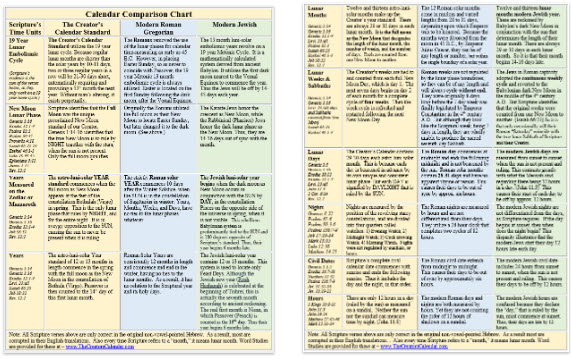 A Spherical Earth – Evidence from the Sun, Moon, & Stars
Our creator has provided us with three predominant ways to know with certainty that the Earth is shaped like a sphere. We have visible evidence that all eight planets in our solar system, which include Mercury, Venus, Earth, Mars, Jupiter, Saturn, Uranus, and Neptune, are equally spherical in nature. Add to these the Moon, which orbits the Earth, and then they orbit the spherical Sun together in a heliocentric paradigm. (I do not take sides as to whether the Earth circles the Sun or the Sun circles the Earth in a geocentric model because the measuring of time is the same either way.) On the other hand, there has been no visible evidence of a flat planet anywhere in our universe.
 Aside from some Scripture verses where the authors or their translators seek to explain some aspects of the earth’s shape, these have caused considerable confusion. In each case, a harmonious alternate word can be found by looking into the several definitions of each original Hebrew word. (Click on the images to enlarge them.)
The Witness of the Sun

This continuity of size and shape from sunrise to sunset indicates that the sun’s distance from the observer on Earth remains relatively the same from the moment it comes into view until it goes out of view. Furthermore, the sunlight intensity remains consistent. This evidence establishes the Earth as a sphere.

According to the Flat Earth Theory, the first view of the sun is a tiny dot that grows steadily to a slender light that grows in length and width as it comes closer, with a glaring beam shining downward. As a result, the only time the sun could appear round is when it is directly overhead at noon. So it is that, in contrast to the physical and visible spherical phenomenon of the sun that all the world can see, the Flat Earth Theory folks must deny their own eyes. Have you ever witnessed the sun appearing like this? Me neither.
The Witness of the Moon
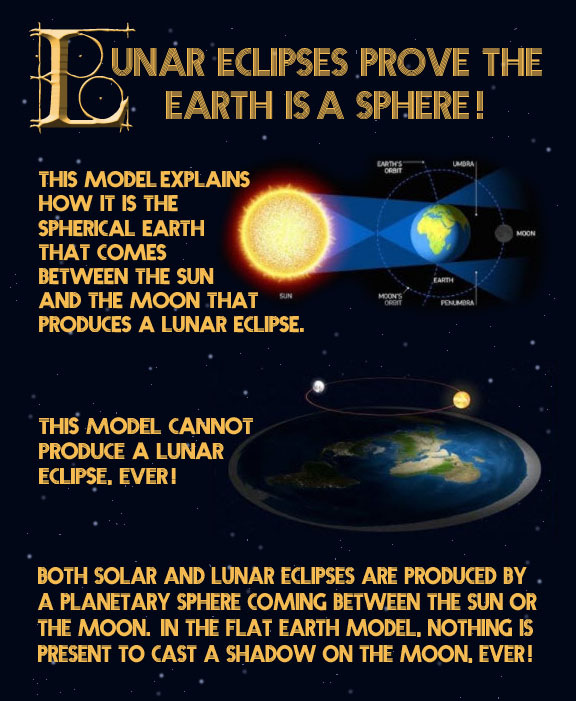
This illustration identifies the pragmatic reality that a lunar eclipse is impossible within the flat Earth model. Yet lunar eclipses do occur a couple of times each year, and everyone can see with their own eyes the shadow of the spherical Earth pass across the face of the full moon, like a giant movie screen.
The Witness of the Stars

Anyone in the Northern Hemisphere with a time-lapse camera feature can photograph star trails circling near Polaris, the North Star, by night. The circling aspect of these stars is up and over from east to west, just as the sun and moon rise up and over from east to west. But did you know that the same phenomenon can be witnessed in the Southern Hemisphere on a clear night, looking south? These stars also rise in the east and circle up and over a point near the Southern Cross. This is also evidenced in time-lapse photography.
The supporters of the Flat Earth Theory must entirely ignore this reality. Why? Because the flat earth model presupposes that all stars in the universe only circle the point at the north pole in the center of the Earth’s assumed circular disc shape. This paradigm assumes the stars circle at their widest point in parallel with the Earth’s 360-degree circumference, the further south one goes in South Africa, South America, Australia, New Zealand, and the Antarctic. However, if a time-lapse video can illustrate the stars circling a point, such as the Southern Cross, in the Southern Hemisphere, the entire Flat Earth house of cards falls. In 3.5 minutes, you can know which view from the three southern continents is correct by watching the attached short video.
Video – Flat Earth Theorist’s Greatest Challenge: Southern Stars ~ Brandon Cooper (3.5 minutes). https://www.youtube.com/watch?v=a4CPL4mcpDc
Separately, each of the trinity of lights (sun, moon, and stars) bears witness to the spherical shape of our earth, but together, their testimony is exponential. United, they stand to declare the magnificent creation designed to synchronize faithful mankind to their Benevolent Creator. What He created shall stand up to the scrutiny of all alternate views, unharmed and unchanged. Refer to the full article with many illustrations, Three Unanswerable Objections to the Flat Earth Theory.
What it Means to be a Berean
We have been counseled to be faithful and obedient Bereans with our eyes and ears wide open: 1) first by hearing, 2) second by searching the Scriptures daily to see if these things are correct, and 3) third by accepting the new light of truth in obedience and walking accordingly with joy. (Acts 17:11)
The disheartening words, “I never knew you; depart from Me, you who practice lawlessness,” will yield life’s greatest regret. (Matthew 7:23) Yet, these words will be spoken to all those who refuse to listen, second to search, and third to obey the voice of the Eternal Father when it is inconvenient, unpopular, and opposed to one’s current doctrinal paradigms. Mostly, folks will turn a blind eye when anything contrasts too greatly with the views of their established church creed, synagogue leaders, presumed modern prophets, and other long-cherished traditions of men.
Lawlessness is none other than the breaking of the TORAH LAW, which includes 1) the Ten Commandments, 2) the Judgments, 3) Statutes, and 4) the Testimony of the Messiah. Oblivious to the historical facts, all Christian churches have abandoned many of the teachings in the Torah Law merely to keep in step with Roman Christian dogma for the past 1,700 years. And specifically, the lunar calendar, which begins with the full moon for the count of all dates.
But at this late hour, our Eternal Father and Son are calling their followers to rise up and come out of the false teachings to restore the sacred names of Yahuah Alahim and Yahusha ha Mashiach, reinstate the Kadosh (holy) full New Moon for the start of the lunar months, return to the Kadosh (holy) lunar seventh-day Sabbath, and reestablish all the lunar appointed Feast Days. Not so we become Jews (Yahudim), but so that we become Yasharal (Israel), Yahuah’s faithful followers. These are they who obediently guard and keep all the Torah Law, the original sacred names, and His authentic worship calendar rhythm that is time-centric to the Plan of Salvation illustrated through the Temple ceremonies in the Heavenlies, not made with human hands.
“…not giving heed to Jewish fables and commandments of men who turn from the truth.” Titus 1:14
When Sincerity Fails
The story is told of a little girl who went to a petting zoo with her family. Once inside, she became terrified of being knocked down and trampled by the many larger than life animals scurrying around. Her mother, occupied with a younger sibling, was unable to attend to her and her growing fears.
After closing her eyes tightly, she reached out with both arms for the security of her mother’s familiar nubby woolen skirt. At that very moment, a woolly llama intercepted her embrace. In apparent safety, she buried her face in the wool and held firmly for dear life, believing all this would shortly pass as she would soon be on the other side of the protection of the gate.
After some time of moving about the pen, she opened her eyes just enough to peer out. To her dismay, her mother and siblings were on the far side of the petting zoo. In abject horror, she released her grip!
All the time her eyes were closed, she had believed with all sincerity that she was holding onto the protection of her mother’s skirt, only to discover she had been mistakenly clinging to the very beast she feared.
Being sincere in one’s beliefs is simply not enough. For when our eyes are opened, some will discover only too late that they had been erroneously clinging to the very Beast Power they feared, as described in Revelation 13:16-17.
The Single Antidote
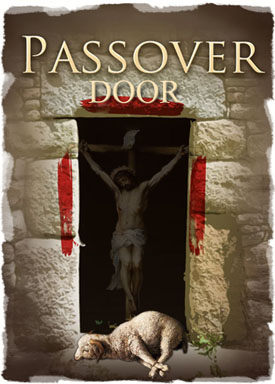
The same singular antidote remains for the Jew and the Gentile alike. The only WAY to straighten out the lies is to follow the path of Yahusha haMashiach (the Messiah), the Savior of mankind, the Redeemer of the World, and enter at the door of Rosh Hashanah (the full New Moon of New Year’s Day in the spring) and count 14 days to Passover, the 14th.
Your Messiah bore the cross/stake for you and me, and He alone has the power and provision to change any human being who comes to Him in humility, seeking forgiveness and a desire to TURN IT ALL AROUND. Passover’s epic appointed time was marked by a dark conjunction lunar phase in the middle of the lunar month, made manifest by a solar eclipse from the sixth to the ninth hour (12:00 P.M. to 3:00 P.M.). This identified the authentic New Moon as the full moon fourteen days earlier. Refer to the article, The Sun was Darkened from the Sixth to the Ninth Hour.
PASSOVER is the eternal symbol and seal in your hand and forehead of the fulfilled PROMISE & PROVISION made by Yahusha haMashiach (the Messiah) to protect all His set-apart and faithful followers from receiving the Mark of the Beast. The power unto salvation has always been THE BLOOD OF THE LAMB, shed for you and me.
Appointed Feast Days of YAH were replaced with the new,
Passover became “Easter,” on a counterfeit day too.
While Sunday has never been the Sabbath, it´s true,
Neither Friday night nor Saturday, as kept by the Jew.
Exodus 12:1-8; Leviticus 23:5; Psalms 74:3, Psalms 74:7-8; Isaiah 66:23; Ezekiel 46:1
You are not alone! All humankind has been SOLD under sin, but also under these long-standing and deep-seated deceptions of the Roman Christians and the Rabbinical Pharisee Jews alike. It is they who, together, have sold ALL the world into Babylonian captivity, the seat of Satan, by way of fraudulent calendars with their altered units of time and the abandonment of the Torah Law. All are counterfeit substitute appointments for meeting with their Maker on their own terms for worship assemblies designed by the enemy of souls unto their undoing.
However, each person can receive the free gift, for you were BOUGHT WITH A PRICE. The price was the LIFE and DEATH of our MESSIAH so that you may be restored into His likeness and synchronize your soul temple to His divinely prescribed worship rhythm, the time model set forth by our Creator that contains the promise of Salvation and REMEDY for SIN. Today, His voice is heard calling, “COME OUT OF BABYLON,” “BABYLON HAS FALLEN, HAS FALLEN,” “BE NOT PARTAKERS OF HER SINS!” “FOR BEHOLD THE BRIDEGROOM IS COMING, GO YOU OUT TO MEET HIM!”
Over true TIME is the battle, astro-lunar time will be found,
It is the secret of those living, who are eternity bound.
Yet, in accordance with ROME, and a pagan “holiday” feast,
“All the world in complacency, wonder after the BEAST.”
Revelation 16:16; Mark 4:11-12; Leviticus 23:1-44; Psalms 74:3,
Psalms 74:7-8; Acts 18:21; Revelation 13:3-4; Revelation 19:20
While all the world slumbered, and all the world slept,
The Messiah died on conjunction, PASSOVER’S solar eclipse to project;
The truth as is beaconed, from our Creator’s time-centric space,
Full New Moons are the secret, to see His marvelous face.
Luke 23:44-45; Matthew 25:5; Matthew 26:19; 1 Corinthians 5:7;
Ezekiel 46:1; Isaiah 66:23; Leviticus 23:1-44
Referring to the parable of the five wise and five foolish virgins, only those who first hear the voice of the Ruach ha Kadosh (voice of the Father) restoring His authentic truths of His full New Moon, lunar Sabbath, and prophetic Feast Days to His faithful will enter at the door at the LUNAR APPOINTED TIME WHEN IT IS OPEN. All others who continue to follow the erroneous customs and traditions of their chosen pied piper, whether the Pope, modern Prophet, Reformer, Rabbi, Pastor, or church denominations, will arrive too late, and the door will be forever shut. And this for the simple reason they smugly believed they already had the truth. Because they did not have a heart that sought to get just as close as possible to Yahusha haMashiach, they lacked “the eyes to see and the ears to hear” His still, small voice calling them out.
Overcoming is a Choice
“Truly, these times of ignorance Yahuah overlooked, but now commands all men everywhere to repent.” Acts 17:30
- If you have not yet received the lunar Sabbath as truth, might it be because you believe Saturday or Sunday have already been nailed down as fact by the Jews, Saturday Sabbatarians, Roman Catholics, or protestant churches, as the actual rest day or Sabbath of Scripture?
- Perhaps you have traditionally kept Sunday as the “Lord’s Day,” believing you are no longer under the binding claims of the Torah (O.T.) Law, but under the New Christian dispensation of grace?
- Perhaps you believe the lunar Sabbath to be a mere wind of doctrine blowing about to unsettle you from your perceived “Saturday Sabbath” antidote to receiving the Mark of the Beast?
- Is it altogether possible that our loving Eternal Father may have reserved this Full New Moon and lunar Sabbath revelation for the remnant at such a time as this? Through His progressive and incremental Reformation and leading by His Ruach (power, presence, and provision), might this subject be chosen as a final test and vetting system to discern who you and I seek to worship and serve, before His Second Coming?
- Has it ever been suggested from Scripture that when “new light” is presented that Yahuah’s obedient followers are to REJECT IT OUTRIGHT by closing both their eyes and ears to it, as a sign of allegiance to Him and their preconceived paradigms? It was the Bereans who were honored for first hearing, then searching the Scriptures to see if these things were so.
- Might the reference in Revelation to “come out of Babylon” aptly apply to our coming out of all counterfeit worship rhythms that stunningly originated in Babylon? A system so deceptive, it was designed to cause you to miss out on your eternal reward. Especially as it disregards the time-centric worship rhythm, our appointments with Him, our Creator on His Kadosh (Holy) full New Moon Days, lunar seventh-day Sabbaths, and prophetic lunar appointed annual Feast Days?
Not only are His ARMS outstretched and open to receive you, but He continues to STAND AT THE DOOR OF YOUR HEART and KNOCK. All you have to do is let Him in and be willing to follow the LAMB wherever He goes. He ever proceeds along the well-worn path from one time-centric Feast Day to the next, according to His time-measuring model, and He leads those who diligently follow into all TRUTH. Honoring Him by keeping His authentic calendar with its lunar-appointed Feast Days is the only method provided for His believers to take action and partake in the Plan of Salvation, illustrating those who actually do “follow the Lamb wherever He goes.”
“He who overcomes shall be clothed in white garments, and I will not blot out his name from the Book of Life; but I will confess his name before My Father and before His divine messengers [angels].” Revelation 3:4-5
If, in the process of your research, you determine the full New Moon and lunar Sabbath to be in error, the burden of proof falls on you. You are responsible for demonstrating this error from Scripture, as no doctrinal truth will lose anything by close examination. As long as there is a need to restore mankind, Yahuah’s Ruach will progressively lead and reveal His truths to all those who seek Him with all their hearts. The incremental reformation that began with Martin Luther has been unfolding nuggets of truth ever since and will continue unraveling and exposing the time-centric lies until the Second Coming.
You are encouraged to read the evidence presented prayerfully and with an open mind. As a TESTING TRUTH of whether you hear and obey the Most High Father’s call, your choice of a calendar may determine your ETERNAL DESTINY.
 As you seek the truth, may you be guided by “the FATHER OF LIGHTS with whom there is no variation or shadow of a turning orbit [full sun, full stars, full moon]?” James 1:17
Please take a moment to listen to this song: While You Were Sleeping
Fellow Truth Seeker,
Kerrie French
TheCreatorsCalendar.com
TheCreatorsCalendar29.5@gmail.com

Begin your journey into the discovery of the Creator’s genuine and original time-measuring model sanctioned for ALL His full moon lunar-appointed worship assemblies, and you will be blessed beyond your wildest dreams.
Refer to the article, Hidden in Plain Sight: The Mosaic of Lunar Time
Refer to the article, The Bride in Waiting
Refer to the article, The Mark of the Beast or the Seal of Yahuah Alahim
Refer to the article, Our Journey Out of Babylon
Refer to the article, Mark of the Beast – Weighed in the Balances and Found Wanting.
To the Reader… This website has been created to share exciting discoveries from Scripture, History, and Astronomy. Its purpose is to restore truths relating to the sacred NAMES and set apart LUNAR TIMES & EVENTS of the Bridal Covenant and its sole REMEDY for sinners contained in the annual lunar Feast Days performed by our Messiah alone.
This website is copyrighted. It is not in competition with any other website, person, or organization. Meaning it stands alone under Yahusha’s divine guidance. The articles are intended for your consideration, spiritual enlightenment, and knowledge of the truth in preparation for Yahusha haMashiach’s soon RETURN.
While I am happy to answer questions that further your understanding of these subjects, I am not here to debate or respond to questions about your beliefs, paradigms, or criticisms.
Rather, I encourage you to read and study more than one article, and even build on them for greater insight, understanding, and edification. None of this has been taught in the churches or synagogues, but has been long hidden under the rubble of Roman laws, fraudulent Jewish traditions, and proactive Scriptural translation alterations, which were allowed by the Father “until the times of the Gentiles are fulfilled.” (Luke 21:24) The times of the Gentiles have now been fulfilled. Yahusha’s followers are waking up as they hear His voice calling them to come out of all the false systems of worship. PRAISE HIM WITH ALL YOUR HEART THAT YOU ARE ONE OF THESE!!!
Clarifying Our Purpose
This article and the materials presented on this website are not directed against Jews, Romans, Seventh-day Adventists, or any other people or faith communities. Our purpose is not to single out individuals, question motives, or assign blame. People are not the issue.
What is examined here are doctrinal systems and inherited teachings throughout history, measured carefully against the testimony of Scripture (Titus 1:13-14). Where those teachings diverge from the biblical record, we believe it is both appropriate and necessary to name the discrepancy with clarity and respect, identifying the who, what, when, where, why, and how.
Disagreement with doctrine is not an attack on persons. To question tradition is not to reject people. On the contrary, this work is offered in the spirit of informed choice, inviting readers to consider the sources of what they have been taught and to weigh those teachings thoughtfully against the Word of the Creator.
Each individual remains free to agree or disagree. Our role is not to persuade by pressure, but to inform with evidence, allowing conscience, prayer, and personal study to guide the outcome.
Truth can be examined without hostility, and conviction can be expressed without contempt. That is the standard we seek to uphold here.
Footnotes / Endnotes
1) Scripture References
Torah (Genesis–Deuteronomy)
Genesis 1:14; 1:14–16; 1:14–18; 1:16.
Exodus 12:1–3; 12:1–4; 12:1–8; 12:1–28; 12:6; 12:18; 16; 16:1–36; 19; 19:1–25.
Leviticus 23:1–44; 23:4; 23:5.
Numbers 9:3; 9:5; 9:11; 10:10; 28:11–15; 28:16.
Historical Books
Joshua 5:10.
1 Samuel 20:5; 20:18–34.
2 Kings 4:23.
1 Chronicles 23:3–32.
2 Chronicles 2:4; 8:13; 30:15; 35:1.
Ezra 3:5; 6:19.
Nehemiah 10:33.
Wisdom / Poetry
Psalms 19:1–3; 19:1–4; 74:1–4; 74:3; 74:7–8; 74:7–9; 81:3; 97:6–7; 104:19; 136:7–9.
Prophets
Isaiah 58:12; 66:23.
Jeremiah 8:8–9; 31:35–36.
Ezekiel 45:21; 46:1; 46:1–3; 46:3.
Hosea 2:13 (AV 11).
Amos 8:5.
Daniel 7:25.
Gospels & Acts
Matthew 25:1–13; 25:5; 26:19.
Mark 4:11–12.
Luke 23:44–45.
Acts 18:21; 27:33.
Epistles
1 Corinthians 5:7.
Titus 1:14.
James 1:17.
Revelation
Revelation 3:4–5; 12:1; 13:3–4; 13:16–17; 16:16; 17:5; 18:4; 18:10; 18:21; 19:20.
2) Quoted Passages
2.1 Bible quotations appearing verbatim in the article
-
Isaiah 58:12
“And they that shall be of thee shall build the old waste places: thou shalt raise up the foundations of many generations; and thou shalt be called, the repairer of the breach, the restorer of paths to dwell in.” -
Genesis 1:14 (KJV)
“And Alahim said, ‘Let there be lights in the firmament of the heaven to divide the day from the night; and let them be for signs, and for seasons, and for days, and years:’” -
Psalms 104:19
“He [Yahuah] ordained the MOON for ‘seasons…’” -
Luke 23:44–45
“Therefore, it was about the sixth hour, and darkness occurred over all the land until the ninth hour. The sun was darkened, and the veil was rent in the midst of the temple of Jerusalem.” -
Leviticus 23:1–5 (Article’s restored rendering for study)
“And declared Yahuah unto Moses, saying,
‘Speak unto the children of Yasharal (Israel), and command them concerning the specific lunar appointed dates (H#4150 mo’edim) of Yahuah, which you shall proclaim My set-apart (Holy) rehearsal assemblies (H#4744 miqra). These are themselves My specific lunar appointed dates (H#4150 mo’edim): [Note the colon.]
Six days from sunrise to sunset you shall do your work, but in the day of the seventh it is the Sabbath-rest to observe the covenant, a set-apart (Holy) rehearsal assembly (H#4744 miqra) in which you shall do no work, for it is the Sabbath unto Yahuah in all your dwellings.
These are the specific lunar appointed dates (H#4150 mo’edim) of Yahuah, the set-apart (Holy) rehearsal assemblies (H#4744 miqra), which you shall proclaim as SIGNS [of prophetic events to be fulfilled by the Messiah alone] at their specific lunar appointed dates (H#4150 mo’edim): [Note the colon.]
In the lunar month (H#2320 chodesh), the first one of the year, in the fourteenth day counted from the New Moon Day (H#2320 chodesh), between (H#996 beyn) the evenings (plural twilights) (H#6153 ereb), is the PASSOVER of Yahuah.’” -
Ezekiel 46:1–3 (Article’s translated/expanded rendering for study)
“Thus declares the Almighty YAHUAH, ‘the GATE of the courtyard interior facing the EAST shall be SHUT six days for work, and in the day of the SABBATH it shall be thrown open wide, and in the day of the NEW MOON it shall be thrown open wide. But come unto the exalted one, by way of the porch of the temple gate without, and stand beside the doorpost of the gate and observe the Kohenim’s (Priest’s) symbolic first and last burnt offering and symbolic Aleph and Tav peace offering. And you shall prostrate in worship upon the threshold of the open GATE, coming and going at any time, but the GATE shall not be shut until sunset.’ And so WORSHIPED the people of the land at the entrance way of the same GATE, in the SABBATHS and in the NEW MOON DAYS, before the face of YAHUAH.”
2.2 Non-biblical quotations reproduced in the article
-
Dresden James
“A truth’s initial commotion is directly proportional to how deeply the lie was believed. When a well-packaged web of lies has been sold gradually to the masses over generations, the truth will seem utterly preposterous and its speaker, a raving lunatic.” -
Universal Jewish Encyclopedia, “Holidays,” Vol. 5, p. 410
“Sabbath and New Moon (Rosh Chodesh), both periodically recur in the course of the year. The New Moon is still, and the Sabbath originally was, dependent upon the lunar cycle… Originally the New Moon was celebrated in the same way as the Sabbath.” -
Jewish Encyclopedia (1906), “New Moon,” Kaufmann Kohler, Vol. 9, p. 243
“The period of New Moon was, in pre-exilic [pre-Babylonian Talmudic] times, celebrated by the cessation of labor; it was superior even to the Sabbath-day, which formed but a part of it [four Sabbaths within its lunar cycle] (see I Sam. xx. 18-34; II Kings iv. 23; Amos viii. 5; Hos. ii. 13 [A. V. 11]; Ezek. xlvi. 3); but it lost its importance during the [Babylonian and later Roman] exile and was observed mainly as the determining factor of the calendar with its festivals… In the Temple, New Moon was celebrated by special sacrifices [which differentiated it from work days and seventh-day Sabbaths] (Num. xxviii. 11-15; II Chron. ii. 4, viii. 13; Ezra iii. 5; Neh. x. 33) and by the blowing of the trumpet (Num. x. 10)…” -
Scribner’s Dictionary of the Bible (1898), p. 521
“In the time of the earliest prophets, the New Moon stood in the same line with another lunar observance, the Sabbath. Ezekiel, who curiously enough frequently dates his prophecies on the New Moon . . . describes the gate of the inner court of the (new) temple looking eastward as kept shut for the six working days, but opened on the Sabbath and the New Moon.” -
Meinhold, “Sabbath und Woche im O.T.” (cited via Jewish Encyclopedia, 1906, “Week,” Vol. 12, p. 481)
“Sabbath, the Full Moon Day, and the week are independent of each other.” -
Encyclopaedia Britannica, “The Julian Calendar”
“In the mid-1st century B.C. Julius Caesar invited Sosigenes, an Alexandrian astronomer, to advise him about the reform of the calendar, and Sosigenes decided that the only practical step was to abandon the lunar calendar altogether. Months must be arranged on a seasonal basis, and a tropical [solar] year used, as in the Egyptian calendar, but with its length 365.25 days.” -
World Book Encyclopedia, Vol. 3, p. 28
“In 46 B.C. Julius Caesar asked astronomer Sosigenes to suggest ways to improve the calendar. Acting on Sosigenes suggestions, Caesar ordered the Romans to disregard the moon in calculating their calendars.“ -
Sunrise magazine (Aug/Sept 2003), Sarah Belle Dougherty, review of E. Zerubavel, The Seven Day Circle*
“Julius Caesar’s conquest of Egypt in the 1st century BC introduced this planetary week to the Roman Empire… Since the astrological and Jewish weeks were both seven days long, by the 1st century AD the day of Saturn had become identified with the Jewish Sabbath. After Christianity became the state religion, the Church integrated both cycles to produce our present week, used also by Jews and Muslims.” -
Explanatory Supplement to the Astronomical Almanac, U.S. Naval Observatory, ed. P. K. Seidelmann, p. 586
“The FOUR RULES OF POSTPONEMENTS were specifically designed to allow the [new Roman] seven-day week to cycle without interruption, while corrections by way of DELAYS are imposed upon the day of the New Moons [mo’ed H#4150 – new moon, lunar month, first day of the lunar month) and its specific lunar appointed dates]. This system proactively DELAYS the Feast Days by one to two days.” -
Encyclopedia Judaica, s.v. “Hillel.”
“In AD 351-352 Roman persecution flared and the Jews revolted… Under this pressure Hillel II agreed to limit the functions of the head of the Sanhedrin… Hillel II published details informing all Jews of the methods of the [newly adopted] calculated calendar developed in Babylon… Hillel II is thus given the credit for the present fixed Rabbinical calendar, but in reality it originated in BABYLON and was just the starting point of the development of the Rabbinical calendar in use today.” -
Jewish Encyclopedia (1906), “History of the Calendar,” Jacobs & Adler, Vol. 3, pp. 498, 500
“The history of the Jewish calendar may be divided into three periods—the Biblical, the Talmudic, and the post-Talmudic. The first rested purely on the observation of the sun and the moon, the second on observation and reckoning, the third entirely on reckoning.”
“In 325 CE the Council of Nicaea was held… A new rule was therefore made, which, while still keeping Easter dependent on the moon, prevented it from coinciding with Passover.” -
H. Grattan Guinness, Creation Centered in Christ, p. 276; H. H. Perry, Approximate Chronology, pp. 21–22
“The arrangement of the Jewish calendar as used in the time of Christ… Modern Jews are divided into two classes… The larger number of Jews follow the Rabbinical Calendar… We have in 1844 the atonement by the Rabbinical Calendar would be September 23rd, while by the Karaites it was about that time in October…” -
1911 Encyclopaedia Britannica – “Zodiac,” p. 993 (quoting F. Lenormant, Origines de l’Histoire, vol. 1, p. 236)
“Assyria and Babylonia—The twelvefold division of the zodiac was evidently suggested by the occurrence of twelve full moons in successive parts of it in the course of each year… We owe to its realization by them the constitution and nomenclature of the [modern] twelve signs of the zodiac.”