349 New Moon References in Scripture
349 New Moon References
in Scripture
The New/Renewed Moon is referred to 349 times in Scripture. It is derived from the Hebrew word “Chodesh” (H#2320 – חדשׁ; H#2319 – חדשׁ; H#2318 – חדשׁ). It literally means the new moon, renewed moon, month, monthly, the first day of the month, or the lunar month. Notably, it never refers to a solar month, underscoring its unique significance in the Creator’s time-measuring system.
This consistent emphasis on the New Moon throughout the Bible offers compelling evidence that the divine model for measuring years, months, weeks, and days, including the seventh-day Sabbaths, is inherently lunar. This realization opens the door to a deeper understanding of how the biblical calendar aligns with the natural cycles established at creation among the trinity of lights (sun, moon, and stars), challenging conventional solar-based systems and inviting a return to the original and divinely ordained lunar rhythms of time.
The 349 times the New Moon (Chodesh) is mentioned in Scripture is more than double the number of times the Sabbath is mentioned. This means that anciently, it was not only essential but strategic to harmonize the faithful of earth to the Creator’s call to worship, according to His correct time-measuring model.
Having departed from the Creator’s original timekeeping and entrusted sacred order, the synagogues and churches, now the guardians of the lie, are therefore unable to consistently harmonize their assemblies with the worship rhythms ordained in Scripture, except on rare occasions when their Saturday or Sunday coincides with the true lunar Sabbath of Creation, as counted from the full moon. Only those who hear the still, small voice of Yahusha, their Messiah, will care enough to come out of the false narratives in preparation for His soon nike air force 1 low max air vt qs camo black return.
Brown nike sabrina 2 sneaker release date-Driver-Briggs Hebrew Definitions
H#2320 (Chodesh – חדשׁ) 296 times:
1) the new moon, month, monthly
1a) the first day of the month
1b) the lunar month
Above is the primary definition utilized for the Hebrew word Chodesh. Note that the focus is lunar, except for the descriptions of month, monthly, and the first day of the month. While these three definitions can represent either lunar or solar months, Scripture alone determines which they represent. The fact remains that there is not one single reference in all of Scripture that determines these month definitions as solar. Yet, following the Roman Emperor Constantine’s calendar swap of A.D. 325 and its abolition of Scripture’s Torah Law, New Moons, lunar Sabbaths, and lunar appointed Feast Days, it has been difficult for mankind to recognize our Creator’s lunar truths preordained for His unique worship rhythm.
Additionally, there exist two other Hebrew words with the same spelling that have been given different definitions. Some might challenge me on this, claiming these definitions have different vowel points and are, therefore, other words. And they would be partly correct. But the reality is that the vowel pointing did not exist at the time Scripture was written, nor did it exist as late as the first century A.D., when our Messiah lived on earth.
Instead, it was during the long centuries in Roman captivity that a group of Jews known as the Masorites developed what is called the vowel points. It became a new addition to the Hebrew text under the guise of fixing vocalization by adding vowel sounds. However, it was also an opportunity air jordan 13 black flint to alter Scripture to meet the views of men, rather than the other way. Thus, these vowel points were used to divide specific words into multiple definitions, allowing them to apply the definition of their choice, without anyone being the wiser.
Much later, Strong’s Hebrew Dictionary assigned each of these separated words its own unique number, forever separating definitions from their fullest meanings. This caused good folks to trust Strong’s numbered definitions without considering the other numbered definitions before or after for a fuller meaning. This is also a form of textual criticism. This early system designed to alter truth began in the 7th century A.D. and is known today as the Masoretic Text, which is the Hebrew basis for most Christian Bibles.
H#2318 (Chadash – חדשׁ) 10 times:
1) to be new, renew, repair
1a1) to renew, make anew
1b2) to repair
1b) to renew oneself
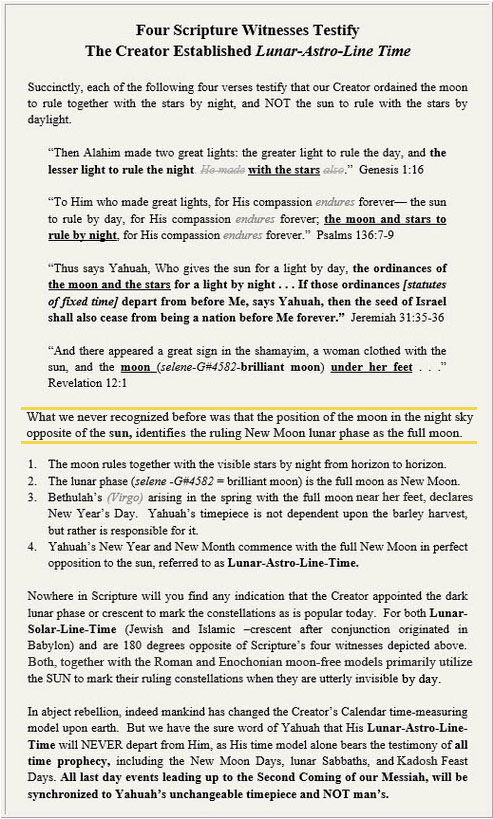
I personally believe that the H#2318 definition is the most accurate as it best describes the renewal that comes as each full moon cycles from lunation to lunation and returns, rebuilding to its most brilliant and glorious manifestation in the heavens. This is the only visible lunar phase observed in both hemispheres on the same night over a 24-hour period of the Earth’s rotation. It also meets the great sign criteria of Revelation 12:1, which identifies the moon as the brilliant (G#4582 – selene) moon.
Remember, according to four Scripture witnesses, only one lunar phase rules the night with the stars. This means from moonrise to moonset the entire night.
H#2319 (Chadash – חדשׁ) 53 times:
1) new, new thing, fresh
It is not difficult to discern that calling a dark conjunction lunar phase “new” would make no sense for two reasons: 1) Something invisible of its own volition is neither new nor old; it simply remains unaccounted for and invisible. 2) Add to this that Scripture refers to the most important lunar phase as the lesser light, as it is compared to the greater light of the sun. The crescent, on the other hand, could be considered new as it follows a dark phase and appears as if it is reborn. However, neither of these traditional views is supported by the weight of evidence in Scripture. Refer to the articles contained in the Treasury of Evidence, the Full Moon Announces Lunar Months.
Consider the Parts of a Rope
 Like a rope, the definition of the Hebrew word Chodesh (lunar month) has three parts: two ends and a middle. Whether it’s long or short, the two ends remain attached and can never be severed. Like one end of the rope, the lunar month has a first day called New Moon Day. This is followed by four successive weeks of seven days. And like a rope’s other end, the lunar month has a last day.
The bottom line is that neither the first day (New Moon Day) nor the last day can ever be severed from its month or count of days whether 29 or 30 days in length. It is for this reason that the Hebrew word Chodesh is defined as both the first day (New Moon Day) and the entire lunar month. This fact exposes the error of following a solar month that has no connection to the Hebrew word Chodesh (lunar month) or a first day. All have made a false assumption that when we read in Scripture the word month in either the Tanakh (Old Testament) or the Brit Hadasha (New Testament), it refers to the modern Roman solar month. Although a long-held tradition, it’s a paradigm that carries no time-centric connection to Scripture, the Torah Law, or the Plan of Salvation, as worked out in real lunar time by Yahusha, the Messiah, in the Temple, not made with hands.
The Evidence
H#2320 – (Chodesh – חדשׁ) – 296 Total KJV Occurrences
month, 218
Gen_7:11 (2), Gen_8:4-5 (4), Gen_29:13-14 (4), Exo_12:2-3 (3), Exo_12:6, Exo_12:18 (2), Exo_13:4-5 (2), Exo_19:1 (2), Exo_23:15, Exo_34:18 (2), Exo_40:2, Exo_40:17 (2), Lev_16:29 (2), Lev_23:5-6 (2), Lev_23:24 (2), Lev_23:27, Lev_23:32, Lev_23:34, Lev_23:39, Lev_23:41, Lev_25:9, Lev_27:6, Num_1:1, Num_1:18, Num_3:15, Num_3:22, Num_3:28, Num_3:34, Num_3:39-40 (2), Num_3:43, Num_9:1, Num_9:3, Num_9:5, Num_9:11, Num_9:22, Num_10:11, Num_11:20-21 (2), Num_18:16, Num_20:1, Num_26:62, Num_28:14, Num_28:16-17 (2), Num_29:1 (2), Num_29:6-7 (2), Num_29:12, Num_33:3 (2), Num_33:38, Deu_1:3 (2), Deu_16:1 (2), Jos_4:19, Jos_5:10, 1Sa_20:27, 1Sa_20:34, 1Ki_4:7, 1Ki_4:27, 1Ki_5:14 (2), 1Ki_6:1 (2), 1Ki_6:38, 1Ki_8:2, 1Ki_12:32-33 (4), 2Ki_25:1 (2), 2Ki_25:3, 2Ki_25:8 (2), 2Ki_25:25, 2Ki_25:27 (2), 1Ch_12:15, 1 Chr 27 (15), 1 Chr 27 (15), 2Ch_5:2-3 (2), 2Ch_15:10 (2), 2Ch_29:3, 2Ch_29:17 (3), 2Ch_30:2, 2Ch_30:13, 2Ch_30:15, 2Ch_31:7 (2), 2Ch_35:1, Ezr_3:1, Ezr_3:6, Ezr_3:8, Ezr_6:19, Ezr_7:8-9 (3), Ezr_8:31, Ezr_10:9 (2), Ezr_10:16-17 (2), Neh_2:1 (2), Neh_7:73, Neh_8:2, Neh_8:14, Neh_9:1, Est_2:16 (2), Est_3:7 (5), Est_3:12-13 (3), Est_8:9 (2), Est_8:12 (2), Est_9:1 (2), Est_9:15, Est_9:17, Est_9:19, Est_9:21-22 (2), Jer_1:3, Jer_2:24, Jer_28:1, Jer_28:17, Jer_36:9, Jer_36:22, Jer_39:1-2 (3), Jer_41:1, Jer_52:4 (2), Jer_52:6 (2), Jer_52:12 (2), Jer_52:31 (2), Eze_1:1-2 (2), Eze_29:1 (6), Eze_29:17, Eze_30:20 (2), Eze_32:1 (3), Eze_32:17, Eze_33:21, Eze_40:1, Eze_45:18, Eze_45:20-21 (2), Eze_45:25, Dan_10:4, Hos_5:7, Hag_1:1 (2), Hag_1:15, Hag_2:1, Hag_2:20, Zec_1:1, Zec_1:7 (2), Zec_7:3
months, 37
Gen_38:24, Exo_12:2, Num_28:10-11 (2), Num_28:14, Jdg_11:37-39 (3), Jdg_19:2, Jdg_20:47, 1Sa_6:1, 1Sa_27:7, 2Sa_2:11, 2Sa_5:5, 2Sa_6:11, 2Sa_24:8, 2Sa_24:13, 1Ki_5:14, 1Ki_11:16, 2Ki_15:8, 2Ki_23:31, 2Ki_24:8, 1Ch_3:4, 1Ch_13:14, 1Ch_21:12, 1Ch_27:1, 2Ch_36:2, 2Ch_36:9, Est_2:12 (3), Job_14:5, Job_21:21, Eze_39:12, Eze_39:14, Eze_47:12, Amo_4:7
new, 20
1Sa_20:5, 1Sa_20:18, 1Sa_20:24, 2Ki_4:23, 1Ch_23:31, 2Ch_2:4, 2Ch_8:13, 2Ch_31:3, Ezr_3:5, Neh_10:33, Psa_81:3, Isa_1:13-14 (2), Isa_66:23, Eze_45:17, Eze_46:1, Eze_46:3, Eze_46:6, Hos_2:11, Amo_8:5
moons, 11
1Ch_23:31, 2Ch_2:4, 2Ch_8:13, 2Ch_31:3, Ezr_3:5, Neh_10:33, Isa_1:13-14 (2), Eze_45:17, Eze_46:3, Hos_2:11
moon, 9
1Sa_20:5, 1Sa_20:18, 1Sa_20:24, 2Ki_4:23, Psa_81:3, Isa_66:23, Eze_46:1, Eze_46:6, Amo_8:5
monthly, 1
Isa_47:13
Add to this list the word H#2318 – חדשׁ, which, as you can see, is the same exact Hebrew word as Chodesh, yet translated as “renewed, repaired.”
H2318 (Chadash – חדשׁ)– 10 Total KJV Occurrences
renew, 3
1Sa_11:14, Psa_51:10, Lam_5:21
repair, 3
2Ch_24:4, 2Ch_24:12, Isa_61:4
renewed, 2
2Ch_15:8, Psa_103:5
renewest, 2
Job_10:17, Psa_104:30
And finally, add to this list the Hebrew word H#2319 – חדשׁ, which, as you can see, is the same exact Hebrew word as Chodesh, yet translated as “new and fresh.”
H2319 (Chadash – חדשׁ) – 53 Total KJV Occurrences
new, 52
Exo_1:8, Lev_23:16, Lev_26:10, Num_28:26, Deu_20:5, Deu_22:8, Deu_24:5, Deu_32:17, Jos_9:13, Jdg_5:8, Jdg_15:13, Jdg_16:11-12 (2), 1Sa_6:7, 2Sa_6:3 (2), 2Sa_21:16, 1Ki_11:29-30 (2), 2Ki_2:20, 1Ch_13:7, 2Ch_20:5, Job_32:19, Psa_40:3 (2), Psa_98:1 (2), Psa_144:9, Psa_149:1, Ecc_1:9-10 (2), Son_7:13, Isa_41:15, Isa_42:9-10 (2), Isa_43:19, Isa_48:6, Isa_62:2, Isa_65:17 (2), Isa_66:22 (2), Jer_26:10, Jer_31:22, Jer_31:31, Jer_36:10, Lam_3:23, Eze_11:19, Eze_18:31 (2), Eze_36:26 (2)
fresh, 1
Job_29:20
Three Hundred Forty-Nine Recorded New Moons
Three hundred forty-nine times bright,
The New Moon shines as Scripture’s light.
Chodesh, a sign in Yahuah’s plan,
Beacons each month in Heaven’s span.
Not solar, but lunar all the way,
Each month starts the new moon’s display.
The first day is marked with Full Moon’s ascent,
From the EAST ordained and divinely sent.
YAH’s timepiece signal through the night,
Sets each month’s start at the next sunlight.
It ordains the course for sacred days,
And guides our feet in His holy ways.
The rhythm of the moon is pure,
A constant sign that will endure,
From ancient days, YAH’s time is found,
Where Scripture’s truth and light abound.
Like a rope with ends impart,
Chodesh renews each new month’s start.
The Full Moon marks its renewal thread,
A sacred rhythm, divinely spread.
Four weeks of seven form its span,
A steady course in YAH’s great plan.
And like the rope’s unbroken line,
The month concludes, and its days align.
No Roman rule, no solar scheme,
But Yah’s timepiece is His ancient theme.
For every end, both first and last,
Binds heaven’s truth to ages past.
Return to YAH’s unyielding cord,
Where time is set for your reward.
The Full Moon path, so bright, so clear,
Restores our steps to draw us near Iconic Bangs – Iconic Hairstyles.
Return to paths where moonlight gleams,
And find the source of sacred themes.
I invite you to watch this very interesting video comparing the Full Renewed Moon to restoring Rolls-Royce automobiles from the chassis beginning to the fully restored automobile. The Rolls-Royce Restoration Video. Choose the first one at the top of the page.
by Kerrie French
TheCreatorsCalendar.com