Giants in the Land
Giants in the Land
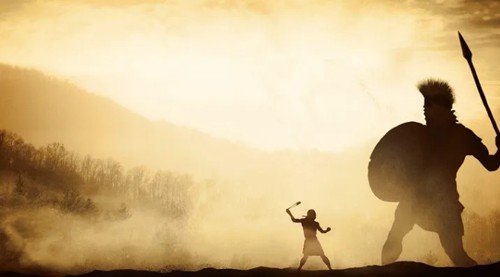
“But Alahim (God) chose what is foolish in the world to shame the wise; Alahim chose what is weak in the world to shame the strong; Alahim chose what is low and despised in the world, even things that are not, to bring to nothing things that are, so that no human being might boast in the presence of Alahim.” 1 Corinthians 1:27–29
The Test of Faith and Measure of Trust
Throughout Scripture, the presence of giants serves as more than a record of great stature or physical strength; it symbolizes the overwhelming challenges that confront the people of Yahuah in every generation. From the sons of Anak who terrified Israel’s spies (Numbers 13:33) to Goliath of Gath, who defied the armies of the living Alahim, these towering figures represent the intimidation of unbelief, pride, and rebellion that dares to stand against divine authority. They loom large not only in the ancient land but also in the spiritual landscape of our own lives, giants of fear, compromise, and deception that test who we truly trust.
In the story of David and Goliath, Yahuah reveals that no enemy, however mighty, can prevail against the heart that is fully surrendered to Him. The battle in the Valley of Elah was not simply between a shepherd and a soldier but between faith and presumption, light and darkness, trust in divine strength and reliance on human might. This account reminds us that the greatest victories are born in the valleys where the giants roar, for it is there that Yahuah’s power is made perfect in weakness. As David once proved, and as every believer must rediscover, the battle is never ours; it is Yahuah’s.
Scripture’s Narrative of David and Goliath
1Sa 17:1 Now the Philistines gathered together their armies to battle, and were gathered together at Shochoh, which belongeth to Judah, and pitched between Shochoh and Azekah, in Ephesdammim.
1Sa 17:2 And Saul and the men of Israel were gathered together, and pitched by the valley of Elah, and set the battle in array against the Philistines.
1Sa 17:3 And the Philistines stood on a mountain on the one side, and Israel stood on a mountain on the other side: and there was a valley between them.
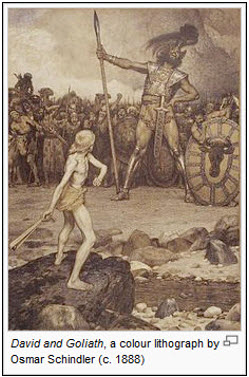
1Sa 17:4 And there went out a champion out of the camp of the Philistines, named Goliath, of Gath, whose height was six cubits and a span.
1Sa 17:5 And he had a helmet of brass upon his head, and he was armed with a coat of mail; and the weight of the coat was five thousand shekels of brass.
1Sa 17:6 And he had greaves of brass upon his legs, and a target of brass between his shoulders.
1Sa 17:7 And the staff of his spear was like a weaver’s beam; and his spear’s head weighed six hundred shekels of iron: and one bearing a shield went before him.
1Sa 17:8 And he stood and cried unto the armies of Israel, and said unto them, Why are ye come out to set your battle in array? Am I not a Philistine, and ye servants to Saul? Choose a man for you, and let him come down to me.
1Sa 17:9 If he be able to fight with me, and to kill me, then will we be your servants: but if I prevail against him, and kill him, then shall ye be our servants, and serve us.
1Sa 17:10 And the Philistine said, I defy the armies of Israel this day; give me a man, that we may fight together.
1Sa 17:11 When Saul and all Israel heard those words of the Philistine, they were dismayed, and greatly afraid.
1Sa 17:12 Now David was the son of that Ephrathite of Bethlehemjudah, whose name was Jesse; and he had eight sons: and the man went among men for an old man in the days of Saul… READ THE REST OF THE STORY HERE.
Parallel Lessons from David and Goliath
-
The Valley of Decision
Both armies stood upon mountains with a valley between them (1 Samuel 17:3). This valley represents the place of testing, where belief must become action. Just as David descended into the Valley of Elah, every believer must descend from the high ground of theory into the valley where faith is proven. It is here, in the low places of life, that courage and trust are revealed, not in our words, but in our walk.
Yahuah often leads us into valleys so that His strength may be displayed against the backdrop of our weakness. The mountain represents what we know; the valley reveals who we trust.
“Though I walk through the valley of the shadow of death, I will fear no evil: for Thou art with me.” (Psalm 23:4)
-
The Five Smooth Stones – Weapons of the Spirit
David chose five smooth stones, not jagged, not freshly broken, but stones that had been worn smooth by the flowing water of time. This imagery beautifully mirrors the Word refined through trial and meditation. Each stone could represent a principle of divine warfare:
- Faith – Confidence in Yahuah’s promises.
- Obedience – Willingness to move when He says, “go.”
- Humility – Refusing man’s armor for the simplicity of trust.
- Courage – Running toward the giant, not away.
- Praise – Declaring His name before the battle is won.
David didn’t pick up weapons forged by man but tools refined by the hand of the Creator, stones from the brook, symbolizing truth shaped by the Living Water (Yahusha, John 4:14). Likewise, our weapons are not carnal but mighty through Alahim to the pulling down of strongholds (2 Corinthians 10:4).
-
The Unproven Armor
Saul’s armor represents the strength of human systems, religion without power, protection without presence, ritual without relationship. David wisely refused what was not “proven.” We cannot fight spiritual battles wearing someone else’s armor, borrowed traditions, borrowed faith, or borrowed understanding. Yahuah calls us to walk in our own proven relationship with Him, tested in the secret pastures of obedience.
Just as David had faced the lion and the bear before facing the giant, our smaller trials prepare us for greater ones. Each test in life is a rehearsal for a future victory.
-
The Defiant Giant
Goliath is not merely a man; he is the embodiment of defiance against Yahuah, the voice of intimidation that shouts morning and evening for forty days (symbolic of testing and probation). The giant’s armor of brass and iron speaks of worldly strength and oppression, while David’s sling of trust speaks of spiritual liberty. Every believer encounters such “giants” voices that mock faith, circumstances that appear immovable, or fears that defy the promise of Yahuah. Yet the battle cry remains the same:
“The battle is Yahuah’s.” (1 Samuel 17:47)
-
The Stone that Struck the Forehead
The stone lodged in Goliath’s forehead, his seat of reasoning, reveals that the Word of Yahuah conquers not through brute force but by striking at the mind’s rebellion. The living Word penetrates false reasoning, bringing down lofty thoughts that exalt themselves against the knowledge of Alahim (2 Corinthians 10:5).
In this way, David’s victory prefigures Yahusha the Messiah, the rejected Stone who became the chief Cornerstone (Psalm 118:22). He, too, struck the enemy in the head, fulfilling Genesis 3:15: “He shall bruise your head.”
-
The Aftermath – Glory to Yahuah Alone
When David triumphed, he took no glory to himself. The boy with the sling became a living testimony that deliverance comes not by sword or spear but by the Spirit of Yahuah. Likewise, our victories are designed to make His name known “that all the earth may know there is a God in Israel” (1 Samuel 17:46).
Each trial, each battle, each valley is a stage upon which Yahuah displays His majesty, not merely to save us, but to reveal Himself through us.
Conclusion: The Battle Still Belongs to Yahuah
Every believer faces giants of fear, doubt, loss, or conflict. Yet our calling remains as David’s: to meet the enemy not in our strength but in His name. The sling of trust still works. The smooth stones of His Word still bring down every high thing that exalts itself against His truth.
“Be still, and know that I am Alahim.” (Psalm 46:10)
“Thanks be to Yahuah, who gives us the victory through our Master Yahusha the Messiah.” (1 Corinthians 15:57)
So take heart, your valley is not a defeat, but an invitation for Yahuah to display His power once again. Stand firm, for the same One who guided David’s stone will guide your faith to its mark.
In the chaos around us, let us never forget that the battle is Yahuah’s … He is in CONTROL of everything!
Behold, Yahuah’s hand is not shortened, that it cannot save; neither His ear heavy, that it cannot hear, Isaiah 59:1.
Be still, and know that I am Alahim: I will be exalted among the heathen; I will be exalted in the earth. Yahuah of hosts is with us; the Alahim of Jacob is our refuge, Psalm 46:11.
But thanks be to Yahuah, who gives us the triumphant success through our Master, Yahusha the Messiah. 1 Corinthians 15:57
Praise Yahuah and Yahusha! His compassion endures forever.
Kerrie French
www.TheCreatorsCalendar.com