A Day of Rest ~ Trump, Sabbath, and Prophecy
“A Day of Rest”
Trump, Sabbath, and Bible Prophecy
May 2026
by Kerrie L. French
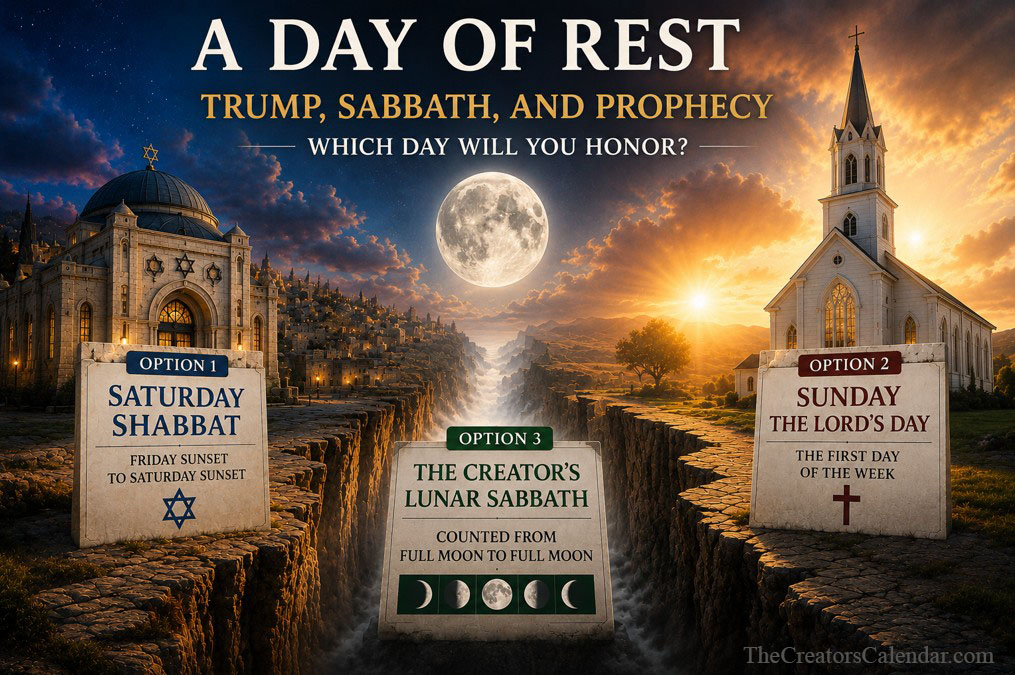
Throughout history, moments have arisen when political movements, religious traditions, and prophetic expectations suddenly converge in ways that capture the attention of the world. What once seemed unthinkable gradually becomes normalized, and ideas once confined to small religious circles begin moving toward the center of public discussion and national policy. We may now be witnessing the early stages of such a shift unfolding before our eyes.
President Donald J. Trump’s recent public letter encouraging Americans to honor a national Sabbath (Shabbat) rest during Jewish American Heritage Month may appear, at first glance, to be little more than a respectful acknowledgment of Jewish culture, faith, and religious liberty. Yet for many thoughtful believers, such developments naturally raise deeper questions regarding the future relationship between civil leadership, public expressions of worship, and the growing role of religious observance within national life. What once seemed unlikely is now steadily moving into mainstream discussion, causing many to pause and consider where these developments may ultimately lead, especially within the broader themes of spiritual restoration and the Rededicate 250 celebration surrounding America’s national heritage and identity of One Nation Under God.
This article is not written as an attack against any people group, denomination, or sincere believer. Rather, it is a thoughtful appeal to carefully examine the very foundations beneath the modern worship-day debate itself, particularly the long-standing assumptions surrounding Saturday and Sunday observance, and to prayerfully consider whether either fully reflects the original pattern of sacred time established by Yahuah Alahim from the beginning. By examining Scripture, history, and the heavenly order established at Creation, we may better discern whether inherited religious systems have preserved or obscured the Creator’s original pattern of sacred time.
President Trump Calls for a National Sabbath Rest
In his recent letter calling for reflection and Rededicate 250, President Trump introduced language concerning a national Sabbath (Shabbat) rest that is both weighty and consequential. While many may receive this as an expression of respect for Jewish heritage and religious liberty, its implications extend well beyond cultural recognition. It brings into public view a conversation capable of shaping how worship, rest, and religious identity are defined, not only within a nation but across a broader global framework.
What makes this development especially compelling is the growing call to unify around a defined day of rest, particularly the modern observance of Shabbat from Friday sunset to Saturday sunset. Such a proposal will almost certainly invite engagement from the wider Christian world, where Sunday has long been upheld as the primary day of worship. As these perspectives begin to converge, the matter of sacred time rises once again to the forefront, carrying with it the potential for renewed tension between two longstanding traditions.
In this light, the issue is not merely which day is observed, but which authority defines the calendar by which that day is established. Any system of worship grounded in a man-altered framework of time inevitably brings into focus its origin, its governing authority, and its alignment with the Creator’s design.
The presentation from OrionMedia.com raises several important considerations, yet it remains framed within the assumption of only two opposing viewpoints. In view of this, a more searching reconsideration becomes necessary: might there be a third perspective, long overlooked, that invites fresh examination?
Video Presentation of Two of the Conflicting Issues
Please watch this video by OrionMedia.com. I have also provided the written paragraphs in the letter for you to copy as needed. The important parts are highlighted below this Video.
 President Trump Signs National Sabbath Rest for All Americans. One Word Changes Everything. Video (20 Min): https://www.youtube.com/watch?v=pZdB1qLd4W4
President Trump Signs the National Day of Rest Letter
This is only the last portion of President Donald J. Trump’s letter.
“…Under my leadership, we are aggressively fighting the violence against Jewish Americans that increased under my predecessor, prosecuting hateful criminals to the fullest extent of the law, and working to end the scourge of antisemitism throughout our institutions, especially on college campuses. As President, I will never stop fighting to protect our birthright of religious freedom – a sacred right that continues to guide our Nation, drawing us closer to the Almighty each and every day.
Throughout this historic year, we rejoice in the triumph of the American spirit and rededicate ourselves to the cause of liberty and justice for all. In special honor of the 250 glorious years of American independence and on the weekend of Rededicate 250 – a national jubilee of prayer, praise, and thanksgiving – Jewish Americans are encouraged to observe a national Sabbath. From sundown on May 15 to nightfall on May 16, friends, families, and communities of all backgrounds may come together in gratitude for our great Nation. This day will recognize the sacred Jewish tradition of setting aside time for rest, reflection, and gratitude to the Almighty.
This month, we celebrate the contributions that Jewish Americans have made to our way of life, we honor their role in shaping the story of our Nation, and we remember that religious devotion, learning, and service to others are enduring pillars of a thriving culture. Through every trial and triumph, the contributions of Jewish Americans have shaped our past, have strengthened our communities, and will continue to inspire American greatness for generations to come.
NOW, THEREFORE, I, DONALD J. TRUMP, President of the United States of America, by virtue of the authority vested in me by the Constitution and the laws of the United States, do hereby proclaim May 2026 as Jewish American Heritage Month. I call upon Americans to celebrate the heritage and contributions of Jewish Americans and to observe this month with appropriate programs, activities, and ceremonies. I further call on all Americans to celebrate their faith and freedom throughout this year, during this month, and especially on Shabbat to celebrate our 250th year.
IN WITNESS WHEREOF, I have hereunto set my hand this fourth day of May, in the year of our Lord two thousand twenty-six, and of the Independence of the United States of America the two hundred and fiftieth.”
[Signed] Donald J. Trump
Consider the Back Story
 President Trump’s family connections provide helpful context for understanding his language and emphasis. His daughter, Ivanka Trump, married Jared Kushner, who is of Orthodox Jewish background, and she embraced that faith herself. Through these close ties, President Trump has naturally gained a greater familiarity with Jewish heritage, traditions, and religious customs, including the long-standing observance of Shabbat from Friday sundown to Saturday sundown.
From a cultural and national standpoint, it is not difficult to understand why he would publicly honor the Jewish people and acknowledge their meaningful contributions to American life. Such recognition reflects a broader commitment to religious liberty, affirming that every community should be afforded dignity, protection, and respect under the law. Many will therefore receive these statements as a sincere effort to uphold those values while recognizing the enduring influence of Jewish Americans across the nation’s history and institutions.
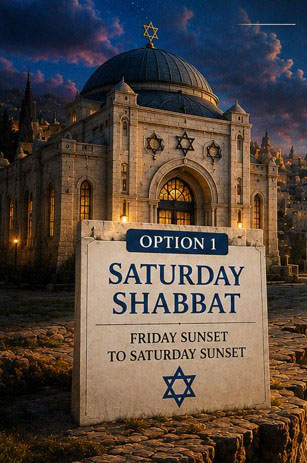
Yet within this call to rededicate and honor, a more foundational consideration emerges: are we aligning that honor with the original pattern established by the Creator, or with a later tradition? More specifically, does the modern observance of Shabbat from Friday sundown to Saturday sundown faithfully preserve the sacred structure of time recorded in Scripture?
Tradition, however ancient or sincerely practiced, does not in itself establish biblical or the most ancient historical authenticity. It is here that a deeper and more careful examination must begin.
When Restoration Conceals a Deeper Question
If the modern Jewish Shabbat, observed from Friday sunset to Saturday sunset, rests upon a calendar framework that departed from the original heavenly order established by Yahuah Alahim, then what, in substance, is being restored before the world? Is humanity being called back to the Creator’s appointed times revealed through the heavens, or toward a tradition long regarded as biblical through repetition and institutional acceptance?
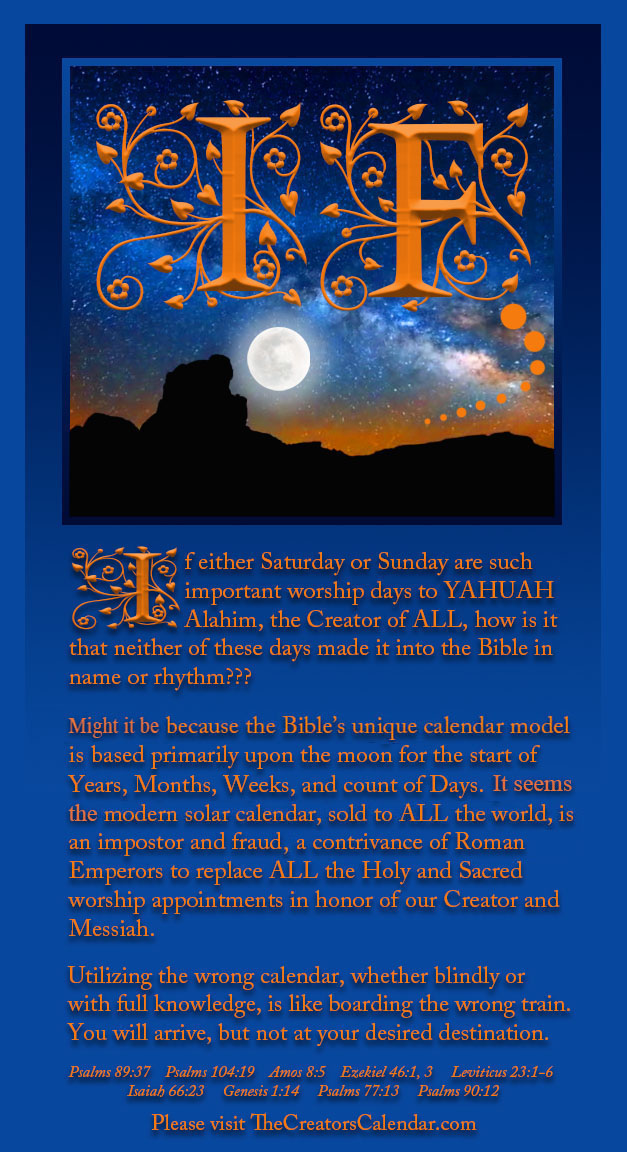
Most believers have rarely examined whether the modern continuous weekly cycle reflects the calendar structure set forth at Creation and recorded in Genesis. As a result, the present discussion over worship days may be unfolding within the limits of inherited assumptions. If the underlying calendar has indeed been altered, the entire debate risks resting on a flawed foundation, where two established traditions contend within the same displaced Roman solar calendar framework rather than returning to the original order.
This brings the matter into sharper focus: can restoration be genuine if it proceeds from a system of timekeeping that may not align with the Creator’s original design?
The Heart of the Issue
Many Christians accept Saturday as the biblical Sabbath because it is observed in modern Judaism, while Sunday keepers observe the first day of the Roman week in connection with the resurrection tradition. Seventh-day Adventists likewise affirm Saturday with deep conviction, influenced in part by the teachings of Ellen G. White. Yet, when examined more closely, these positions share a common foundation: both operate within the same continuous weekly cycle inherited from the Roman calendar system. This framework, shaped in its present form during the reign of Constantine the Great, reflects earlier reforms under Julius Caesar, when the reckoning of time was deliberately detached from the lunar cycle and given an eight-day cycling week. What was never restored was the original method of timekeeping governed by the count from the New Moon to New Moon (Isaiah 66:23).
Historical voices have openly acknowledged this tension. As Patrick Madrid stated:
“…There was a distinct break between the Old Testament requirements…dealing with the Sabbath worship…They [Rome] wanted to show that Christianity [their brainchild] was distinct from Judaism…
The other thing that we should remember, too, is that our calendar that we follow, including Seventh-day Adventists, is not only a calendar that was devised by the Catholic Church, but also it is a calendar that’s based upon the solar year, not the lunar year. The Jewish calendar that was observed in the time of Christ follows a lunar calendar…
So the great irony is that even the Seventh-day Adventists themselves are not worshiping on exactly the same Sabbath day as the Jews of the time of Christ, because it is several days off…” Patrick Madrid, Catholic Priest, EWTN, Global Catholic Radio Network, Jan 5, 2006
According to the combined testimony of Scripture, history, and the heavens, the calendar established at Creation was not built upon an uninterrupted weekly cycle detached from the moon. Rather, the Creator established a timekeeping system governed by the heavenly lights, especially the moon, for signs, appointed times, days, and years (Genesis 1:14). Within this design, the New Moon, Sabbaths, and Feast Days formed an integrated rhythm of worship, revealing a unified pattern rather than isolated observances.
This connection is also reflected in assorted historical records:
“In 46 B.C. Julius Caesar asked astronomer Sosigenes to suggest ways to improve the calendar. Acting on Sosigenes suggestions, Caesar ordered the Romans to disregard the moon in calculating their calendars.“ World Book Encyclopedia, Vol. 3, p. 28.
“Sabbath and New Moon (Rosh Chodesh), both periodically recur in the course of the year. The New Moon is still, and the Sabbath originally was, dependent upon the lunar cycle… Originally the New was was celebrated in the same way as the Sabbath.” Universal Jewish Encyclopedia, “Holidays,” Vol. 5, p. 410.
“The period of New Moon was, in pre-exilic [Babylonian] times, celebrated by the cessation of labor; it was superior even to the Sabbath-day, which formed but a part of it [four Sabbaths within its lunar cycle] (see I Sam. xx. 18-34; II Kings iv. 23; Amos viii. 5; Hos. ii. 13 [A. V. 11]; Ezek. xlvi. 3); but it lost its importance during the Exile and was observed mainly as the determining factor of the calendar with its festivals… In the Temple, New Moon was celebrated by special sacrifices [which differentiated it from workdays and seventh-day Sabbaths] (Num. xxviii. 11-15; II Chron. ii. 4, viii. 13; Ezra iii. 5; Neh. x. 33) and by the blowing of the trumpet (Num. x. 10)…” Jewish Encyclopedia, 1906 Edition, New Moon, Kaufmann Kohler, Vol 9, p. 243.
The Hegelian Dialectic Worship Conflict
One of the most effective tools utilized throughout history to guide public opinion and reshape societies has been what is commonly referred to as the Hegelian Dialectic. In its simplest form, it operates by creating two opposing sides: a thesis and an antithesis. As the conflict between the two grows, people are gradually driven toward a controlled resolution, or synthesis, that ultimately advances an agenda entirely different from what either side originally anticipated. Whether in politics, religion, economics, or social movements, this method has repeatedly been used to channel populations into accepting outcomes that might otherwise have been resisted.
This growing worship-day controversy appears to fit that pattern with remarkable precision. What is largely overlooked is that no matter which day, Saturday, Sunday, Tuesday, Thursday, or any other, selected from the Roman Gregorian calendar, it still operates within the same altered system of time. When the foundation itself has been replaced, the outcome cannot reflect the original design. Therefore, any structure of worship rooted in a substituted calendar, rather than the Creator’s appointed order, will inevitably lead to results that are misaligned with what was ordained from the beginning.
On one side stands the call for honoring Saturday as the biblical Sabbath, promoted by modern Judaism and supported by many Sabbath-keeping Christians. On the opposite side stands the long-established Sunday tradition defended by most of Christianity (Roman Catholicism and its daughter Protestant Churches). As tensions rise between these two positions, the world becomes increasingly polarized around a debate framed entirely within the boundaries of two days within the single fraudulent calendar system created by Roman Emperors. Both sides are arguing within a framework already detached from the Creator’s sacred calendar revealed through the heavenly lights. In that case, the conflict itself may function as a carefully shaped dialectic, drawing sincere believers into choosing between two fictional traditions while the ordained pattern of sacred time remains almost absent from the discussion.
This is what makes the present developments so deeply sobering. The final issue, therefore, may not be simply concerned with whether one worships on either day, but whether mankind will submit and give their full allegiance to a man-altered system of authority as a replacement for the Creator’s original and ordained lunar time principles. In such a scenario, the world is gradually conditioned to accept externally regulated worship practices while believing it is defending truth and religious liberty. Meanwhile, the original calendar established through the heavenly lights for signs, lunar appointed times, days, and years (Genesis 1:14) becomes obscured beneath the conflict. Thus, the enemy’s greatest success may not be convincing the world to reject worship altogether, but persuading it to fight passionately over two competing substitutes while the original pattern established by the Creator remains hidden in plain sight. After all, didn’t Satan once declare that he would be like the Eternal and receive worship in His place:
“How art thou fallen from heaven, O Lucifer (H#1966 – Hillel), son of the morning! How art thou cut down to the ground, which didst weaken the nations! For thou hast said in thine heart:
‘I will ascend into heaven, I will exalt my throne above the stars of Alahim (God): I will sit also upon the mount of the congregation, in the sides of the north: I will ascend above the heights of the clouds; I will be like the Most High.’ Yet thou shalt be brought down to hell, to the sides of the pit.” Isaiah 14:12-14
Can we now begin to see how such a carefully crafted conflict could ultimately funnel worship directly into the enemy’s hands? If Satan’s ancient ambition was to exalt his throne above the stars of Alahim, to replace the authority of the Most High, and to receive worship for himself, then the most effective deception would not be the abolition of worship altogether, but the substitution of the Creator’s ordained system with a counterfeit worship rhythm of man’s own design.
In this way, many, although sincere, may nevertheless render allegiance through a man-altered calendar and worship structure, having placed unquestioning trust in pope, prophet, rabbi, pastor, or inherited religious tradition. In doing so, they often fail to heed the still small voice of Yahuah Alahim or to search beyond inherited translations and long-accepted doctrines in order to uncover the deeper truths surrounding the lunar calendar and His originally ordained times of worship established from the beginning.
Thus, the issue surrounding the Mark of the Beast may reach far deeper than the enforcement of a particular worship day alone. At its core lies the acceptance of a substituted authority over sacred time itself through allegiance to a man-altered calendar system, regardless of which day upon that system is ultimately exalted. Scripture warns of a power that would seek to “change times and laws” (Daniel 7:25) while directing worship away from the Creator’s ordained order and toward itself. In this light, the controversy is not merely about two inherited traditions, but about the long-standing effort of the adversary to replace the authority of Yahuah Alahim with a counterfeit system designed to receive the worship and loyalty that belong to the Father, alone.
Staggering Implications
If this is true, then the implications are staggering. It would mean the coming global controversy over worship may ultimately center upon two competing fictional traditions rather than truths. Both of which would funnel sincere followers toward the Mark of the Beast. All of this would unfold in the name of rededication and restoration to the Creator, Yahuah Alahim. Such a development would create the perfect counterfeit conflict foretold in prophecy, drawing the world into a debate framed around inherited tradition that misses its target by a mile.
This is what gives the moment its gravity. What appears at first to be a respectful acknowledgment of heritage may, whether intentionally or not, become part of a broader movement shaping how worship is understood and practiced on a global scale. If so, the stage may be quietly set for a decisive moment in which allegiance is formed, not merely by intention, but by the system to which that devotion is ultimately anchored.
What is the Mark of the Beast?
The question of the Mark of the Beast has stirred much speculation, yet Scripture presents it less as a visible imprint and more as a matter of allegiance. In the closing conflict, it is revealed through the choices a person makes. The “forehead” represents the mind, where convictions are formed, while the “right hand” reflects the outward actions that follow. Together, they describe a unity between belief and behavior.
In this light, the mark is not something externally imposed apart from one’s will. It is the result of a settled decision to resist the continual drawing of YAHUAH Alahim and His Son, the Messiah, through the quiet prompting of His Ruach ha Kodesh. It reflects a conscious alignment of thought and practice with an authority that stands in contrast to the Creator. While external systems may arise that regulate participation in society, the mark itself is rooted in personal consent, expressed through belief and lived out through action.
Scripture indicates that it would influence commerce and daily life, restricting the ability to buy or sell to only those who comply. This creates a powerful pressure to conform, offering security and acceptance to those who align with it, while marginalizing those who do not. Yet even in such circumstances, the defining issue remains unchanged: no external force can determine one’s allegiance. That choice rests within each individual.
Who Receives the Mark of the Beast?
The book of Revelation presents a sobering picture of this final division. It describes a time when the vast majority of the world yields to the system, while a smaller remnant refuses to give its allegiance:
“And he causes all, both small and great, rich and poor, free and bond, to receive a mark in their right hand, or in their foreheads: And that no man might buy or sell, save he that had the mark, or the name of the beast, or the number of his name.” (Revelation 13:16–17)
At first glance, compliance may appear to offer stability and continued participation in society. Those who conform seem able to function freely within the emerging order. Yet Scripture consistently warns that such security is temporary. The system that promises provision ultimately demands allegiance, and those who knowingly align themselves with it place themselves under the judgments described in prophecy.
What appears advantageous in the moment is revealed, in the end, to be a profound loss. The issue, therefore, is not merely survival or convenience, but faithfulness. It is a matter of whether one’s loyalty rests with the authority of the Creator or with a substitute system that seeks to take His place.
Who Is Protected From the Mark with the Seal of Yahuah?
In contrast to the many who yield to the pressures of the emerging system, Scripture reveals a small and faithful remnant who refuse to surrender their allegiance. While the world exchanges its eternal inheritance for temporary security, not unlike Esau for a bowl of porridge, this remnant remains anchored in Yahuah Alahim and His appointed order.
The defining issue is first introduced through the mark itself:
“And he causes all, both small and great, rich and poor, free and bond, to receive a mark in their right hand, or in their foreheads: And that no man might buy or sell, save he that had the mark, or the name of the Beast, or the number of his name.” Revelation 13:16–17
This establishes the pattern: allegiance expressed through the mind (forehead) and action (hand). Yet this pattern did not originate with the Beast, but reflects an earlier design established by the Creator:
“And it [Passover] shall be for a sign unto thee upon thine hand, and for a memorial between thine eyes [forehead], that YAHUAH’S Torah law may be in thy mouth: for with a strong hand hath YAHUAH brought thee out of Egypt. Thou shalt therefore keep this ordinance in his season from year to year.” Exodus 13:9–10
This design is rooted in the appointed structure of time itself:
“And declared Yahuah [H#3068 – יהוה – YHUH] unto Moses and unto Aaron, while in the land of Egypt, commanding that: ‘The New Moon [H#2320 – chodesh – new moon, lunar month], this self-same one, is HEAD (ROSH) of the lunar months [H#2320 – chodesh – new moon, lunar month], which is first in place as the New Moon [H#2320 – chodesh – new moon, lunar month], for measuring the revolution of the year (hashanah)’… take to them every man a lamb, according to the house of their fathers, a lamb for an house…And you shall keep it [PASSOVER LAMB] up until the fourteenth day of the same lunar month [H#2320 – chodesh – new moon, lunar month]: and the whole assembly of the congregation of Israel shall kill it in between the evenings…And this day [PASSOVER] shall be unto you for a memorial; and you shall keep it a feast to Yahuah throughout your generations; you shall keep it a feast by an ordinance forever. ‘” Exodus 12:1-3, 6,14
The final expression of this pattern appears in the sealing of the faithful:
“And I looked, and lo, a Lamb stood on the mount Zion, and with him an hundred forty and four thousand, having his Father’s name written in their foreheads… Here is the patience of the saints: here are they that keep the commandments of Alahim, and the Faith of Yahusha.” Revelation 14:1–5, 12
Together, these passages reveal a profound symmetry. The mark and the seal both involve the forehead and the hand, yet they represent two opposing authorities. One reflects submission to a man-altered system, while the other signifies alignment with the Creator’s ordained order.
Those who receive the seal are not defined by outward label alone, but by inward allegiance expressed through faithful practice. They remain set apart from false systems of worship, follow the Lamb in both faith and obedience, and walk in truth without compromise. As it is written:
“To the Torah Law [H#8451] and to the Testimony [of Messiah], if they speak not according to this word, it is because there is no light in them.” Isaiah 8:20
Within this framework, Scripture identifies the sealed remnant through the following characteristics:
- They have responded to the call to “Come Out of Babylon, and be not partakers of her sins!” (Revelation 18:4).
- They are aligned with the Creator’s lunar-appointed times, beginning with the full New/Renewed Moon as the beginning of years, lunar months, weeks, and count of days (Exodus 12:1–2), preserving the original structure of sacred time.
- They keep the Passover in its appointed fourteen-day count from the full New/Renewed Moon, marking both deliverance and covenant faithfulness (Exodus 13:9–10).
- They have the Father’s, Yahuah Alahim, or Yahusha haMashiach’s name in their foreheads, signifying settled allegiance in the mind (Revelation 14:1).
- They follow the Lamb wherever He goes, reflecting obedience to the full pattern of worship revealed through the lunar appointed Feast Days (Revelation 14:4).
- They are not defiled by false religious systems, remaining spiritually set apart (Revelation 14:4).
- They speak truth without guile, their lives marked by integrity and repentance (Revelation 14:5; 12:11).
- They keep the commandments, which include the Torah Law, Statutes, Judgments, and Testimonies of Yahuah and the faith of Yahusha, uniting obedience and trust (Deuteronomy 5:31-33; Deuteronomy 30:16; 1 Kings 2:3; 1 Kings 11:38; Jeremiah 7:23; Malachi 4:4; all of Psalms 119; Revelation 14:12).
- They stand as the covenant bride adorned for her husband, for she has made herself ready, clothed in righteousness and set apart for the Lamb, fully devoted to the Creator in both identity and practice (Revelation 14:4).
Taken together, these characteristics reveal that the seal of Yahuah is not an external mark, but a complete alignment of belief, worship, and life with His authority.
In this way, the Seal of Yahuah stands in direct contrast to the Mark of the Beast. Both involve the forehead and the hand, yet one reflects allegiance to a man-altered system, while the other reflects fidelity to the Creator’s ordained order. The distinction is not merely symbolic, but lived out through the choices each individual makes.
The Seal of Yahuah Alahim is Passover
Those who remain faithful to this covenant pattern are ultimately secured within the Eternal Kingdom, not by outward force, but through steadfast allegiance. Their loyalty is revealed in their willingness to trust and follow Yahusha haMashiach, even at great personal cost, for they “loved not their lives unto the death.” Whether living or resting in the grave, they remain under the promise of the resurrection of the righteous and the covering of divine protection (Psalms 91:1–16).
At the center of this covenant relationship stands Passover, observed on the fourteenth day counted from the first full New/Renewed Moon of the year. This appointed time functions as a visible expression of allegiance, identifying whom one honors, worships, and obeys. It is not an isolated observance, but part of the Creator’s ordered system of time, in which the full New/Renewed Moon, Sabbaths, and Feast Days are all harmonized within the same lunar framework.
This is why the faithful do not receive the Mark of the Beast. Their allegiance is already established. They walk in obedience to the Torah Law and hold firmly to the testimony of Yahusha (Isaiah 8:20; Revelation 14:12), aligning their lives with the worship rhythm established from the beginning. Within this pattern, Passover becomes more than a remembrance of deliverance from Egypt; it stands as the covenant marker of redemption under the covering of the Lamb.
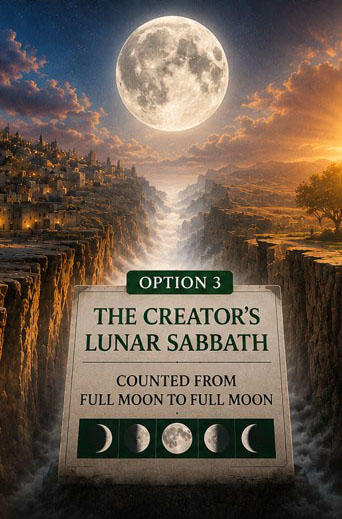 In keeping this appointed time according to its true reckoning, they enter into the same covenant structure established with Moses, Aaron, and all Yasharal, moving forward under the promise and protection of the Most High. Thus, Passover endures as a sign of belonging, a seal of loyalty, and a testimony of faith that spans from earth to eternity.
“And it shall come to pass from its abundance, New Moon by New Moon you shall keep; and from its abundance, Sabbath by Sabbath you shall keep. It [the full New Moon] shall lead all flesh to prostrate in worship, according to My chief corner [stone],” declares Yahuah.” Isaiah 66:23
The calendar revealed in Scripture reflects a unified and orderly system, where each measure of time is connected to the others. Beginning with the full New/Renewed Moon that marks the year, the Sabbaths are counted within the monthly cycle, and the Feast Days are appointed accordingly. In this way, days, Sabbaths, months, and annual assemblies function together in harmony, reflecting the coherent worship order established by the Creator from the beginning.
The Lunar Sabbath’s Stunning Historical Evidence
The Mark of the Beast and the Seal of Yahuah