Bible Study Guide – Lesson 1 – Know Your Creator’s Calendar
Bible Study Guide

Lesson Title: Know Your Creator’s Calendar
Prepared by Kerrie L. French and Samuel M. Kaara
Lesson 1: The Calendar of Scripture
Introduction:
In the beginning, during the week of creation, our Creator, Yahuah Alahim/Elohim, together with His Son, Yahusha haMashiach, lovingly shared their eternally established calendar, their divine time-measuring model, with humanity. This sacred calendar, introduced in Genesis 1, was later expanded upon throughout Scripture. It serves as a symbol of our belonging to the Creator of the Universe, the one who formed TIME itself. (Exodus 31:13, Ezekiel 20:12, Ezekiel 20:20.)
Designed with stunning precision, it invites all creation into His divine rhythm of life, aligning our soul temples with His so that we may honor and worship Him on His specifically appointed and ordained holy days. Unlike man-made time measuring systems, His calendar alone carries the time-centered PLAN OF SALVATION, the REMEDY FOR SIN, guiding all who seek faithfulness to Him, ultimately restoring all who will come back to His eternal kingdom.
The Creator’s divine calendar has never changed; it has only been hidden, obscured by an illegitimate system born from rebellion and deception. This scheme was orchestrated by powerful men in high places who, in defiance of Yahuah’s law, sought to exalt themselves as masters over time. By rejecting the sacred timepiece established in Scripture, they introduced a counterfeit calendar, one designed to sever creation from the celestial time markers of the sun, moon, and stars, the very system ordained by the Creator.
Historical records confirm that the oldest known calendars were all astro-luni-solar, synchronized by the three-part harmony of the sun (solar), the moon (luni), and the stars (astro). Though scattered pagan and heathen civilizations varied in their starting and ending points, this interconnected Jordan 10 Retro Light Smoke Grey310805-062 , 602 Release Date - Verse 555088 - Air Jordan 1 Origin Story Spider - IetpShops system was universally recognized by the ancient kingdoms of the world. Stunning Historical Evidence.
A defining feature of all astro-luni-solar-based calendars is that years and months were measured by the appearance of the New Moon, announcing the first day of a new lunar month, which was identified alongside a specific starry constellation by night when the sun is not present. Because of this, the ancient Hebrews vigilantly watched the heavens, awaiting this celestial time marker to accurately begin their sacred years, months, and count of weeks and days.
Today, three major religious groups, claiming Scripture as their guide, hold opposing views on which lunar phase marks the authentic New Moon, the start of the year, and lunar months, or discount the moon altogether. Adding to this complexity, the Christian world has adopted the Roman-inspired Julian/Gregorian calendar, which has entirely severed itself from the moon, its phases, and its divinely ordained role in measuring time.
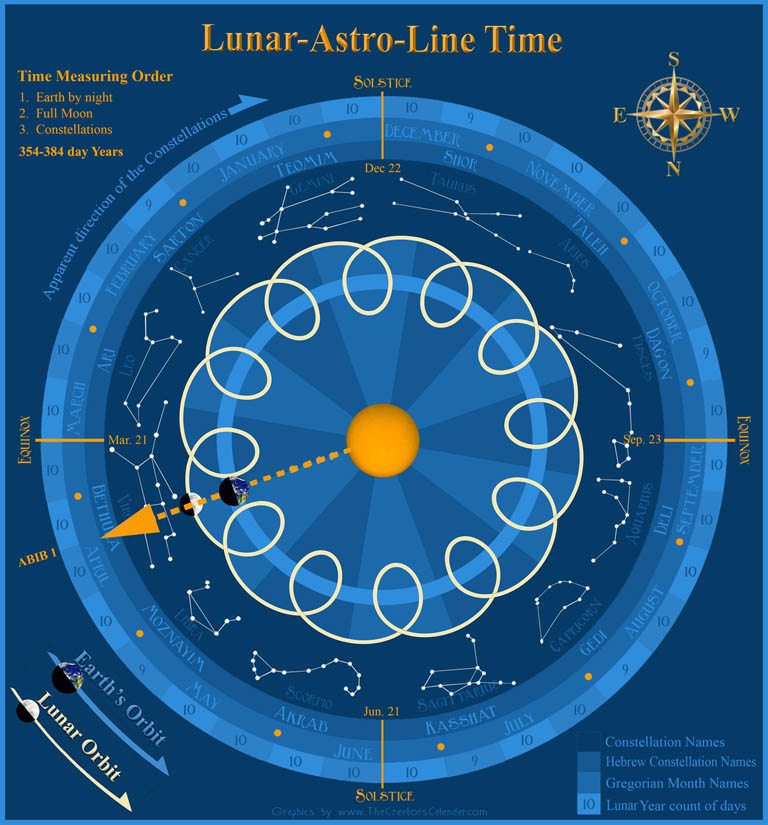
Most heathen and pagan nations once kept unique calendars for their non-biblical sacred days, but now utilize the popular Roman Gregorian calendar to harmonize with the world’s solar time measuring system, mostly for economic reasons. This departure from the Creator’s unique lunar model has not only obscured His original design, upon which all prophecy (History in advance) is based, but has also led to the loss of accurately locating His sacred worship days, including the New Moon Days, lunar seventh-day Sabbaths, and lunar appointed Feast Days. According to Scripture, every divinely appointed day is measured exclusively by the Creator’s lunar phases, counting from 1 – 29 or 30, from the New Moon, without exception. This graphic below illustrates the full moon as the New (Renewed) Moon. (Click on the image to enlarge it.)
Here’s how different religious groups define the New Moon today:
- Following their Roman captivity of A.D. 70, Rabbinical Jews adopted the dark conjunction phase as their New Moon, but only for locating lunar Feast Days. Only then, did they begin to utilize the Roman calendar for their Saturday Sabbaths. This means they use two opposing calendars that regularly conflict with each other. For this reason, they created the Rules of Postponement in A.D. 358 to postpone Feast Days if they were going to fall on their new Saturday Sabbath, such as Passover or the Day of Atonement.
- In protest of the Rabbinical dark New Moon system, the Karaite Jews broke off from them. They began to identify the first visible crescent after conjunction as the New Moon, but only for locating lunar Feast Days. Like the Rabbinical Jews, they continue to use the Roman calendar for their Saturday Sabbaths. Thus, they also use two opposing calendars that regularly conflict with each other. Yet, they have opted not to utilize the Rules of Postponement. As a result, every year as the Roman Saturday floats through the fixed lunar calendar it will often fall on the New Moon Day, Passover, and Feast of Trumpets, a reality that never occurred when all units of time remained consistent on the lunar calendar.
- Christian Churches, from Roman Catholicism to Protestant denominations, follow a strictly solar calendar, completely disregarding the moon’s role in measuring years, months, weeks, and days since the 4th Century A.D. The reason the church membership does not recognize the conflict between their Roman solar calendar and that of Scripture is that they have been taught that the Torah Law and the entire lunar time measuring model that includes New Moon Days, seventh-day Sabbaths, and lunar appointed Feast Days, 1) ended at the cross, and also that 2) we are no longer under the Law of the Old Testament but under grace. Yet, neither of these views is taught in Scripture but was actually proclaimed by the Roman Emperor, Constantine in His Creed. Constantine’s Creed.
In this lesson, we will explore the Creator’s instructions for measuring time and accurately identify His true start of years, months, seventh-day Sabbaths, and count of days to His lunar appointed Feast Days.
The question at large is, can any calendar or alternative method of timekeeping, one that deviates from the clear weight of Scriptural evidence, truly air jordan 3 black cat 2025 align worshipers with the divine rhythm set by their loving Creator and Savior? Meaning, are all calendar types acceptable to the Creator (YHUH)? Now is the time for His faithful followers to rediscover and restore the sacred timekeeping that has been obscured for nearly 2,000 years.
As Yahusha haMashiach (the Messiah) prepares His people for His soon return, He is calling His obedient ones to embrace His ordained system, refining and guiding them in truth.
Questions and Answers
1. What did Alahim (God) give mankind to keep track of time? Read: Genesis 1:14.
Answer: Alahim/Elohim gave lights in the heavens.
2. Which heavenly body of light, created on the fourth day, rules the day (daylight)? Read: Genesis 1:16.
Answer: The visible sun rules the day (daylight) from sunrise to sunset along the east-west time continuum.
3. Which two heavenly bodies of light, created on the fourth day, rule together by night? Read: Genesis 1:14, 16, Psalms 136:7-9, Jeremiah 31:35-36, Revelation 12:1.
Answer: The visible moon rules together with the visible stars by night. One night only, the night of the fully renewed moon (full moon). On this night the moon and stars rule the entire night from sunset to sunrise along the east-west time continuum.
 4. What are the four Scriptural criteria that identify which lunar phase is the authentic and original New Moon of creation? Will the real New Moon please stand up? As illustrated above… Is the New Moon the full moon, the last visible crescent, the dark conjunction, or the first visible crescent? Read: Genesis 1:14, 16, Psalms 136:7-9, Jeremiah 31:35-36, Revelation 12:1.
Answer:
- The ruling moon must be a brilliant light (Geek #4582 – selene – brilliant moon). (Genesis 1:14, 16, Revelation 12:1)
- The ruling moon rules together with the stars. (Genesis 1:16, Psalms 136:7-9, Jeremiah 31:35-36.)
- The moon and stars only rule together by night when the sun is not present. (Genesis 1:16, Psalms 136:7-9, Jeremiah 31:35-36.)
- By extension, the moon and stars rule all night from sunset to sunrise along the east-west time continuum because, on this one night of each lunar month, the moon is in opposition to the sun. This is the only night that a lunar eclipse can occur. This means a solar eclipse will always occur in the middle of the lunar month as it did on Passover the 14th, the day of our Messiah’s crucifixion.
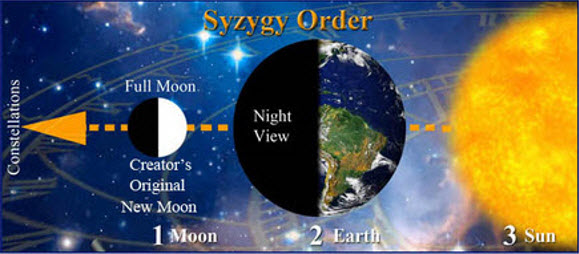
In contrast to what we were all taught, only the Full Moon lunar phase meets all four requirements of Scripture. Below, you will see the placement and Syzygy order of the authentic Full New/Renewed Moon as it relates to the sun, earth, and ruling starry constellations.
5. Which heavenly body of light, created on the fourth day, determines nike sabrina 1 brooklyn fq3381 301 the Creator’s years, months, weeks, and days? Read: Psalms 104:19, Psalms 89:37, Isaiah 66:23, and Genesis 1:14.
Answer: “He appointed the moon for seasons (H#4150 – mo’edim = lunar appointed time).” This means that the count of days, weeks, months, and the start of years are distinctly designated by the moon and its 29-30 unique lunar phases. The stars play an active role in identifying the start of each year and distinguishing between each lunar month. The sun plays an active role in revealing the full moon, illuminating it completely with reflected light. The Fourth Day of Creation.
6. How is the word “season” (H#4150 – mo’ed = lunar appointed time) most often translated? Read: Genesis 1:14, Joshua 8:14, 1 Samuel 13:8, 1 Samuel 20:35, Psalms 104:19.
Answer: The term “season or seasons” (H#4050 – mo’edim) is most often translated as “congregation, appointed, feasts, solemn, seasons, assembly, and time….” What the translators never included in the translation is a fact explained in Scripture itself, where the definition of mo’edim is clarified in Psalms 104:19:
“He appointed the moon for seasons [mo’edim]
(H#4150 – mo’edim = lunar appointed time).”
The term translated as “seasons” in Genesis 1:14 and other places is always a lunar designation from the Hebrew word (H#4150 – mo’edim). Psalms 104:19 exposes the long-hidden secret, revealing the authentic and original meaning of mo’edim. This truth and its reality have been ignored and covered over by those of the Christian persuasion who bought into the Roman solar calendar system and who remain guardians of the lie. Here is what Psalms 104:19 should say in every Bible:
“He appointed the moon for lunar appointed time…”
Psalms 104:19
This verse also defines that all appointed times are lunar. This is accomplished because each day of the year and month is appointed its own unique lunar phase. So, wherever this Hebrew word is found in Scripture, it is always connected to lunar time. This evidence brings Genesis 1:14, which states, “signs, seasons (lunar appointed times), days, and years,” back into harmony with the rest of Scripture (Ezekiel 46:1-3, 2 Kings 4:22-23, Amos 8:5, Isaiah 66:23, Psalms 104:19, Psalms 89:37). So, it is that the word seasons in the first chapter of the Bible establishes our Creator’s unique holy, sacred, and set-apart time measuring system as lunar.
Now we can see that in the first chapter of Genesis, our Creator intended for us to understand that the moon played a major role in measuring time for all years, months, weeks, and days, including seventh-day Sabbaths and all the Feast Days, from creation to the end of time on Earth and beyond. Mo’edim and the Missing Key Puzzle Piece.
7. What role does the moon play in keeping track of time? Read: Leviticus 23, 1 Samuel 20:24-27.
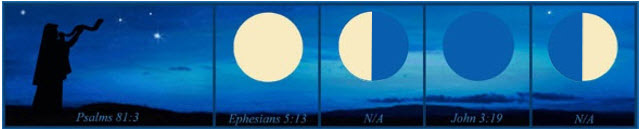
Answer: While each 24-hour day/night cycle has its own unique lunar phase, each week of seven days, the moon changes in appearance by a whole quarter lunar phase. It begins with the renewed full moon as phase one; and then moves by degrees during seven days to the first waning quarter phase; over the next seven days it moves to the second quarter phase when it will be completely dark, referred to as in conjunction with the sun; during the following seven days the moon moves to the first waxing quarter phase, then back to the full moon for the start of the next lunar month. Note that because the moon does not orbit the Earth in a perfect circle, but rather in an elliptical orbit, there is some variation.
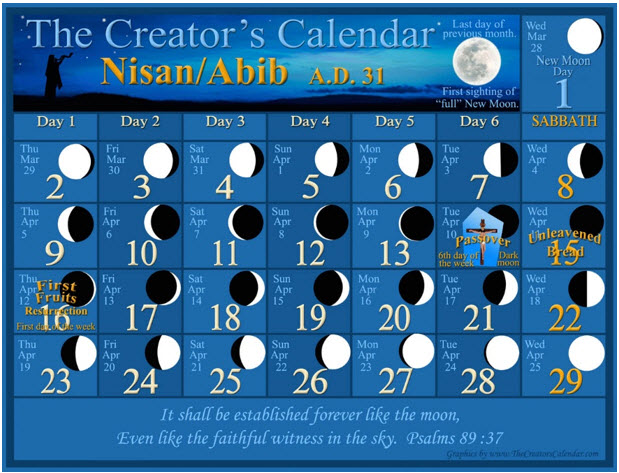
8. How long does it take the moon to complete one full cycle? Read: Genesis 7:11, 8:3-4, Revelation 11:3, 13:5, Daniel 7:25
Answer: A month is measured by one complete lunar cycle of 29.5 days, called a lunation. Each lunation cycle will alternate between 29 and 30 days because 29.5 is not a whole number. Approximately half of the year will contain 29-day months, and half will contain 30-day months. This action is performed by the moon itself, with no help from mankind. Even a child can discover this phenomenon by counting the lunar phases or days from full moon to full moon.
9. How many categories of days are mentioned in the Bible? Read: Genesis 1, Isaiah 66:23, Ezekiel 46:1-3, 2 Kings 4:22-23, Amos 8:5.
Answer: Most of us have been taught that, according to Genesis 1, there are only two kinds of days for both months and weeks, work days and Sabbaths that cycle without end. Surprisingly, this is only true according to the layout of the Roman solar Gregorian calendar model. In marked contrast, Scripture identifies three kinds of days that never overlap.
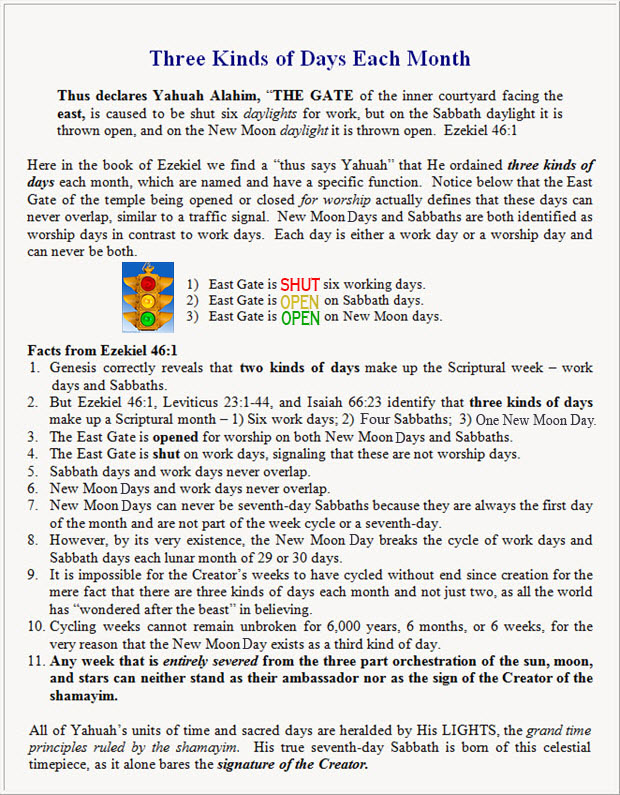
As we have discovered in this lesson, the moon and its phases were the primary counter together with the stars for years, months, weeks, and days. But often overlooked is that in each lunar month cycle, there is a first day called the New Moon Day. It is the most important day of each month as it refreshes and restarts the months and years. The New Moon Day is NOT a work day nor a seventh-day Sabbath, as it stands alone as the first day of each lunar month. The New Moon Day is the third kind of day, in addition to the work days, and seventh-day Sabbaths that occur each lunar month. From there, the work days and Sabbaths are counted as they cycle four times within the lunar month.
While the New Moon Day is neither a workday nor a Sabbath, it is a Holy Day, a rest day in the same manner as the Sabbath, and sets the count to the Sabbath. Yet we can never call it a Sabbath because it serves a different purpose. It was ordained by our Creator to align the calendar of Earth with that of heaven. In so doing, all the seventh-day Sabbaths and lunar-appointed Feast Days will be aligned with our Creator and Messiah’s prophetic purposes concerning the Plan of Salvation, from start to finish.
10. From the calendar illustration above, which third kind of day of each lunar month breaks the week of seven days from cycling without end? Read: Isaiah 66:23, Ezekiel 46:1, 3, Amos 8:5.
Answer: The mere fact that the New Moon Day exists as a third kind of day ensures that the weeks will never cycle unbroken beyond four weeks of 28 days.
11. What can we discover from the first words in Genesis 1:1 that tie the words “IN THE BEGINNING” to the lunar calendar? Read: Genesis 1:1, Exodus 12:2.
Answer: Most of us have missed the fact that the words of Genesis 1:1, stating “IN THE BEGINNING,” come from the Hebrew term (H#7218 – rosh – ראשׁ – beginning, first, head, chief). It contains both a prefix (ב) “IN” and a suffix (ית), which is explained as causing the word to be diminutive and sometimes feminine. Nonetheless, this is further supported in Exodus 12:2, when Yahuah restored His sacred lunar calendar to Moses and Aaron by night, after the long years in Egyptian captivity, and fourteen days before Passover. He says:
“This New Moon [H#2320 – chodesh – lunar month, New Moon, first day of the lunar month] shall be unto you the BEGINNING [H#7218 – rosh – beginning, first, head, chief] of lunar months [H#2320 – chodesh – lunar month, New Moon, first day of the lunar month]: it shall be the first lunar month [H#2320 – chodesh – lunar month, New Moon, first day of the lunar month] of the year for you.” Exodus 12:2
Simply, every time in Scripture that ROSH (beginning, first, head, or chief) is connected to time, it is always a reference to the first day, which in turn will be the first New Moon of the year or the first New Moon of any lunar month. As a result, Genesis 1:1 sets the stage with the first New Year’s Day (Rosh Hashanah) and as the first New Moon Day of Earth’s history. What does this mean? It means right there in Genesis 1, the layout and count of all the days, weeks, and Sabbaths are set in stone as unchangeable.
We were also taught that the weeks cycle continuously without a New Moon break. Because the whole world has fallen victim to the Roman calendar propaganda, it was easy to believe that Genesis 1 supported a continuous week without a New Moon Day to reset each month and year. However, both Scripture and History reveal another story.
12. Is there evidence in Scripture that the ancient Hebrews ever allowed themselves to be under the influence of the Babylonian/Egyptian-inspired calendar model for worship days and other miscellaneous “holidays?” Read: Exodus 12:1-4, Isaiah 1:14-16, Jeremiah 31:35, Psalms 136:79.
Answer: Yes! The first record of this is when they became slaves in Egypt. The first thing YHUH (Yahuah) Alahim did fourteen days before Passover and fifteen days before bringing them out of Egypt by night was to re-establish His authentic lunar calendar layout with the correct New Moon.
This marked the first test of faithfulness for the enslaved Israelites. They were being called to make a complete reversal of 180 degrees in their understanding of time, turning away from the Babylonian and Egyptian practice of beginning the month with the first visible crescent, known as Sin, seen only on the western horizon after sunset. Instead, they were invited to recognize the Full Moon as the governing light of the night, ruling visibly all night together with the ruling constellation of Bethulah (Virgo) instead of Pisces. If they had not embraced this ordained time-measuring model, they would have been off track by half a month for Passover and would have suffered the same fate as all the firstborn males in Egypt. This tells us that this subject is of grave importance, as we are about to leave our own captivity in this world for the heavenly Promised Land.
They were also unfaithful to the correct layout of the lunar calendar at the time of the prophet Isaiah (YashaYahu) as illustrated in the image below. Every time the Yasharalites (Israelites) were unfaithful, YHUH (Yahuah) led them into captivity. The examples of their captivities were in Egypt, Babylon, and, lastly, Rome. Each time Yahuah brought them out and restored them to His lunar worship rhythm, except in the case of their Roman captivity.
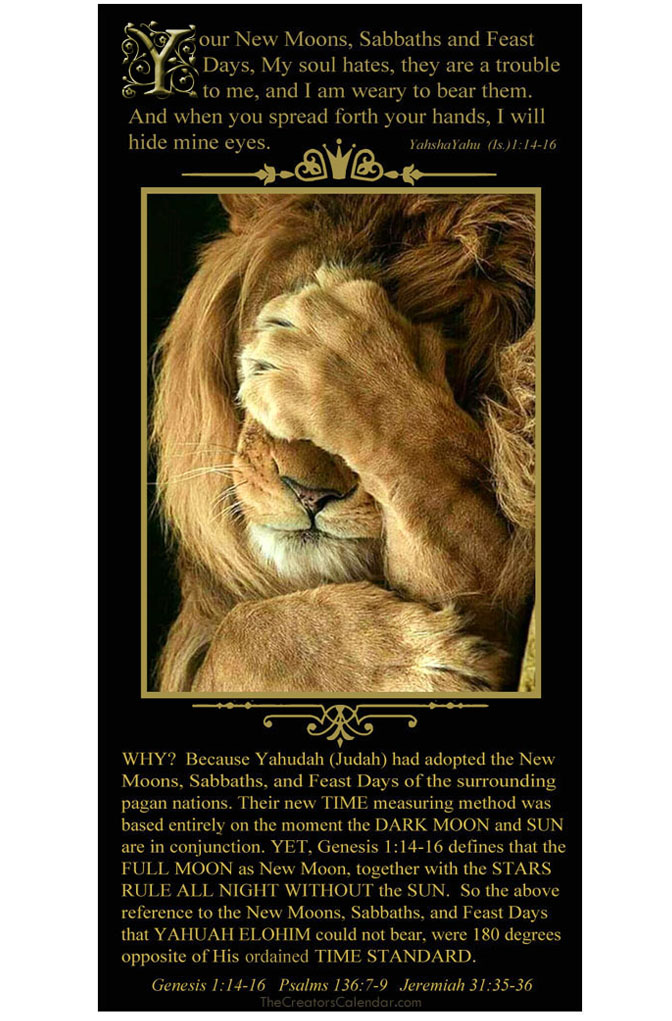
Following the Jewish leaders’ rejection of the Messiah and their role in His death, many hearts grew hardened. In A.D. 70, this resistance culminated in Roman captivity, and over time, under mounting pressure, the Full Moon was abandoned as the New Moon. In doing so, they disengaged from the historical and astronomical reality that Passover had always fallen on the fourteenth day counted from the Full Moon, a day marked by a dark conjunction lunar phase, when Yahusha was crucified, and a solar eclipse darkened the sun. That mid-month eclipse testified that the dark conjunction occurs in the middle of the lunar cycle, not at its beginning. In its place, they accepted Rome’s continuous solar-based weekly cycle and Saturday as the sacred seventh-day Sabbath.
To this day, the Jewish leadership has had no desire to be restored to YHUH and His original sacred (kodesh) worship rhythm. This fact relating to the Jews having changed their calendar is never taught in the churches, and has caused many to believe that Saturday is the original seventh-day Sabbath, or at the minimum that the modern week has always existed. But nothing could be further from the truth. How might these biblical and historical scenarios apply to you and the calendar and Sabbath you keep?
What is the hope for Israel today? That they humble their hearts and seek restoration to YHUH and His son Yahusha the Messiah and their lost sacred calendar.
13. Are there any historical quotes that clarify how our Creator’s original lunar calendar was undermined and yet hidden in plain sight these last 2,000 years?
Answer: Yes, there is a plethora of historical quotes that expose the deviant plan to undermine and destroy YHUH’s sacred time-measuring system.
The Gregorian calendar, utilized by most of the world today, is rooted in the Julian calendar devised by Julius Caesar in the first century B.C., more than 2,000 years ago. It was his desire to create a time-keeping system all his own that was free from the binding constraints of the Creator, His Torah Law, and His lunar phases for measuring years, months, weeks, and days.
His efforts to absolve himself and his empire from the lunar calendar remain solid evidence that they and all the early nations originally adhered to it. It was Julius Caesar who first divided the year into twelve solar months of variable lengths and created the eight-day week, designing it to cycle without end, without the New Moon Day break, or ties to the 29-30 lunar phases.
“By the 1st century B.C.E., the Roman calendar had become hopelessly confused. The year, based on cycles and phases of the moon…about 10¼ days shorter than the solar year…The confusion was compounded by political maneuvers. The Pontifex Maximus and the College of Pontiffs had the authority to alter the calendar, and they sometimes did so to reduce or extend the term of a particular magistrate or other public official. Finally, in 46 B.C.E., Julius Caesar initiated a thorough reform that resulted in the establishment of a new dating system, the Julian calendar.”http://www.webexhibits.org/calendars/calendar-roman.html
“In the mid-1st century B.C. Julius Caesar [Emperor of Rome] invited Sosigenes, an Alexandrian astronomer, to advise him about the reform of the calendar, and Sosigenes decided that the only practical step was to abandon the lunar calendar altogether. Months must be arranged on a seasonal basis, and a tropical [solar] year used, as in the Egyptian calendar, but with its length 365.25 days.” Encyclopedia Britannica, The Julian Calendar, Paragraph 1. https://www.britannica.com/science/calendar/The-Western-calendar-and-calendar-reforms
“Julius Caesar’s conquest of Egypt in the 1st century BC introduced this planetary week to the Roman Empire… by the 1st century AD the day of Saturn had become identified with the Jewish Sabbath. After Christianity became the state religion, the Church integrated both cycles to produce our present week, used also by Jews and Muslims.” (Sarah Belle Dougherty in her book review of The Seven Day Circle: The History and Meaning of the Week by Eviatar Zerubavel, University of Chicago Press, Chicago and London, 1989. As published in Sunrise magazine, August/September 2003; copyright © 2003 Theosophical University Press)
“In 46 B.C. Julius Caesar asked astronomer Sosigenes to suggest ways Teka-marburgShops , Nike Air Dunk Jumbo 'Medium Olive' , The Stussy X Nike Air Zoom Spiridon Cage 2 "Black Grey" Has Surfaced to improve the calendar. Acting on Sosigenes suggestions, Caesar ordered the Romans to disregard the moon in calculating their calendars.” World Book Encyclopedia, Vol. 3, p. 28.
“A space or period of time constituting a division of the year. Month, originally signified the time of one revolution of the moon, a lunation, or the period from one change… of the moon with the sun to another…This is the periodical [synodical] month, or as we generally call it, the lunar month. In the year there are twelve solar months, and thirteen lunar months.” American Dictionary of the English Language, Noah Webster, 1828 edition.
“…the Jewish festivals being regulated solely by the moon, may fall on any day of the [modern Roman] week.” Oxford English Dictionary, 1971 Edition, Vol. 2, Pentecost, p. 658.
“It is certain that the Jews celebrated… Pentecost…without regard in either case to the day of the [modern Roman] week.” Oxford English Dictionary, 1971 Edition, Vol. 2, Pentecost, p. 658.
“… A month in law, is a lunar month…unless otherwise expressed… In legal proceedings, the word ‘months,’ means lunar months…” Stroud’s Judicial Dictionary (of Great Britain), 1903 Edition, p. 1221.
For more historical quotes, refer to The Lunar Sabbath’s Stunning Historical Evidence.
14. What unique insight does Amos 8:5 reveal about the New Moon Days relative to the seventh-day Sabbaths? Read Amos 8:1-5.
Answer: Amos 8:5 is unique as it provides insights into ancient Israel’s daily life. It illustrates that the same commandment that applies to keeping the Sabbath sacred (Kadosh) also applies to the sacredness of the New Moon Day. In this way, it provides foundational evidence that indeed the original calendar of Scripture and of the Yasharalites (Israelites) was the lunar calendar in which the New Moon Day, as the first day of the lunar month, was honored as a holy day, just as was the seventh-day Sabbath.
“Saying, ‘When will the New Moon be gone, that we may sell corn? and the Sabbath, that we may set forth wheat, making the ephah small, and the shekel great, and falsifying the balances by deceit?'” Amos 8:5
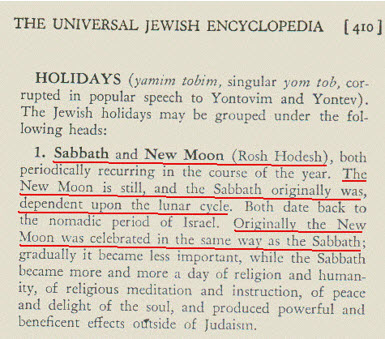
“Sabbath and New Moon (Rosh Chodesh), both periodically recur in the course of the year. The New Moon is still, and the Sabbath originally was, dependent upon the lunar cycle… Originally the New Moon was celebrated in the same way as the Sabbath.” Universal Jewish Encyclopedia, “Holidays,” Vol. 5, p. 410.
For if the New Moon Day had not been a Kadosh (sacred and set-apart) worship day, then these Israelites, during the time of the prophet Amos, would NOT have been secretly wishing that it would be past so that they could buy and sell grain. There is no getting around it; this story would never have been written to include New Moon Day if it had not always been regarded as a sacred day to the Most High. For more details on Amos 8:5, refer to “When Will the New Moon and Sabbath be Past?”
15. What factual evidence with regard to time-measuring can be found in the sacrificial system of the wilderness Sanctuary and later Tabernacle or Temple of Israel? Read: Leviticus 23 and Numbers 28-29.
Answer: The detailed sacrificial prescriptions recorded in Leviticus 23 and Numbers 28–29 function as what might be termed our Creator’s “Rules of Engagement.” In this light, the sacrificial calendar is established as the MASTER KEY of TIME and PROPHECY. As the Master Key, it unlocks both the measure of sacred time and the unfolding of prophecy by revealing the precise pattern of years, months, weeks, and days within the lunar‑appointed system upon which the Plan of Salvation is fulfilled.
In the Sacrifice schedule below, note that every single day of the year, there was the Daily Sacrifice of two lambs, one in the morning and one in the evening. But on the Sabbath, there were two male lambs sacrificed, plus the morning and evening sacrifices. Then, on the New Moon Day, there were two bulls, one ram, seven lambs, and one goat sacrificed, plus the morning and evening sacrifice.
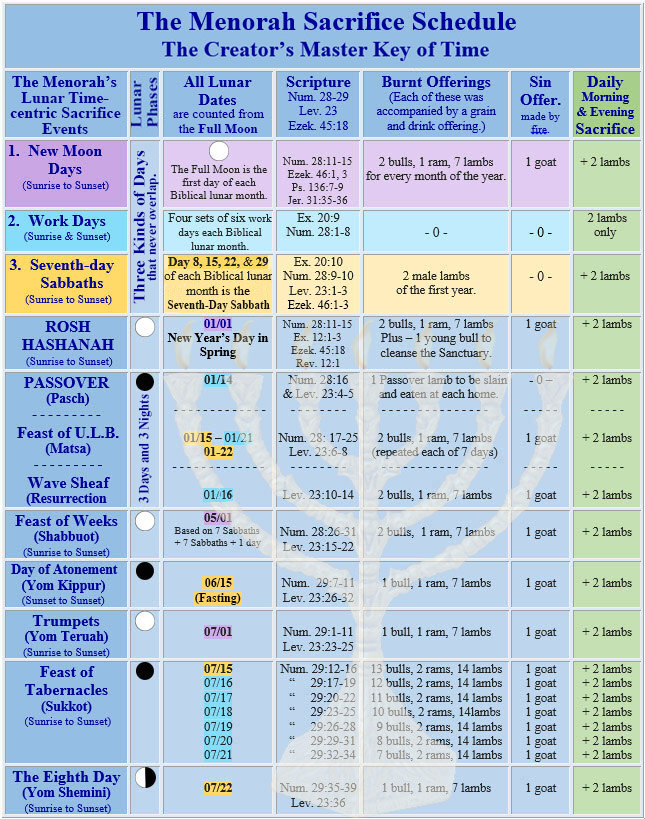
Of profound importance, the sacrificial schedule illustrates a distinction between each of the three kinds of days (purple, blue, and yellow) and ties the sacrificial system to the Creator’s calendar, as manifest by lunar phases in the heavens. As long as this system was utilized to harmonize each specific sacrifice with its own unique lunar phase, the correct lunar calendar model was followed without error or deception.
This system of identifying each day and lunar phase with its own unique set of sacrifices ensures that the Creator’s original and authentic Calendar would never make an error by mixing a New Moon Day with a work day, a Sabbath, and vice versa.
The Tabernacle’s Sacrificial system was ordained to number all days of the lunar year and highlight each of the three kinds of days as manifest to ensure Yasharal (Israel) understood the placement of each of the sacred and set-apart days for rest and worship. This pattern was strictly upheld and guarded by the priesthood during Israel’s periods of faithfulness, ensuring that the Temple ceremonies were aligned with the throne room of heaven itself.
The New Moon Day is significant because it marks the beginning of the count of all other days within one lunation (lunar month).
Therefore, in the Creator’s weeks of seven days, there are two kinds of days, work days and Sabbaths, but in His months and years, there are three kinds of days: New Moon Days, followed by four cycles of work days and seventh-day Sabbaths.
Six times a year, there is a work day that follows the last Sabbath of the lunar month. It is called the translation day. It stands alone. It is not sacred, but it is not part of a weekly cycle either. Some refer to this as a “no day,” but that is not accurate. The Jews add it to their dark conjunction New Moon for what they call a two-day New Moon Day. But that is easily proven false in 1 Samuel 20. On that day, the sun rises and sets, and it has its own lunar phase count for the month. It is counted for the month and for the year, but just not for the week. Refer to the article Tomorrow is the New Moon.
As a result, there are actually four distinct categories of days, not just two. These are the New Moon Days, work days, Sabbath days, and the translation days. These are unique and cannot be interchanged or overlapped, unlike the Roman solar calendar paradigm. However, with the Creator’s Calendar, as recorded in Scripture, each kind of day stands alone as distinct within the lunar framework. This truth was highly guarded by the temple priests, who adhered strictly to the sacrifice schedule, as illustrated above.
16. What activities were the Hebrews instructed to do and not to do on the sacred New Moon Day? Read: Numbers 10:10, Numbers 28:11-15, Numbers 29:1-6, Amos 8:5.
Answer: They were instructed to blow the New Moon Shofar and perform the New Moon Day Sacrifices; they were commanded to honor the New Moon Day and keep it as a sacred time of remembrance. Yahuah’s faithful and obedient were to keep the New Moon Day Holy in a manner similar to the Sabbath by doing no work, buying, selling, or doing their own pleasure on His holy day.
 17. Can any calendar that ignores the Full New (Renewed) Moon Day and entire lunar time-measuring model locate any of the Creator’s sacred and set-apart Sabbaths or Feast Days for worship? Read: Psalms 89:37.
Answer: No! No! A thousand times, No! The Creator’s Calendar is built upon the foundation of the full moon that announces the next day as New Moon Day. So, neglecting this pivotal day throws the entire system of biblical timekeeping into disorder and chaos. As a result, it is discovered that neither Friday night, Saturday, nor Sunday can be the ordained seventh-day Sabbath of Scripture. Might this be the reason that none of these Roman day designations nor their rhythm can be found anywhere in Scripture? Instead, these are man-made substitutions on an illegitimate calendar system purposely designed as a detour from the divine worship rhythm established by the Creator.
18. How did the dates, according to lunar phases, surrounding our Messiah’s crucifixion, illustrate that He was the authentic and long-promised Messiah? Read: Exodus 12:1-7, Leviticus 23:5, Matthew 27:62, Mark 15:42, Luke 23:54, John 19:31, Matthew 27:62-66. (Note: Be sure to recognize that every time the term “month” is recorded in Scripture, it always means (H#2320 – chodesh – New Moon, renewed moon, first day of the lunar month), and never a solar month.)
Answer: Yahusha haMashiach died according to the lunar dating system in which Passover was a prophecy of the Promised Lamb, the true Messiah, who would take away the sins of the world.
Yahusha laid down His life on the cross on the sixth day of the second lunar week, not on a Friday, as that day’s name and rhythm did not exist at the time among the Israelites. This most sacred event of Passover occurred on the fourteenth day of the lunar month, the middle of the month, on a dark conjunction lunar phase. The dark conjunction lunar phase is aligned with the sun and is the only day of a lunar month when a solar eclipse can occur. Solar eclipses take place only during daylight hours, and this is precisely what occurred on the day of Yahusha the Messiah’s crucifixion. From the sixth to the ninth hour, noon until three in the afternoon, darkness covered the land, as recorded in Scripture. This mid-day darkness serves as an astronomical witness, confirming that the true New Moon, which begins the lunar month, stands in harmony with the event that identified the true Messiah.
The Messiah will always be in full harmony with the Laws of His Father in heaven. He is our example.
None of the terms “Friday,“ “Saturday,“ or “Sunday” can be found anywhere in Scripture, as this system of time measurement was the witty invention created by Roman Emperors in the 4th century A.D. Refer to the article Constantine and the Week.
19. What did those dates during the Messiah’s crucifixion and time in the tomb tell us about the seventh-day Sabbath and all other days of the same lunar month? Read: Isaiah 66:23, Exodus 12:1-7, Leviticus 23:5, Matthew 27:62, Mark 15:42, Luke 23:54, John 19:31, Matthew 27:62-66.
Answer: The seventh-day Sabbath occurred the very next day after Passover, on the 15th of the lunar month, while the Messiah lay in the tomb. What this means is that all the Sabbaths of that lunar month occurred on the 8th, 15th, 22nd, and 29th.

Add to this that Leviticus 23 establishes that every year, Passover occurs on the same 14th day counted from the New Moon, followed the next day (the 15th), which is always a seventh-day Sabbath. This reveals that all the days of the month, as well as every month of every year, are to be counted from the New Moon Day. This means that, according to Scripture, all days and weeks, including Sabbaths, are counted in the same way from one New Moon to another (Isaiah 66:23), which includes all the lunar phases, from month to month and year to year. As a result, the seventh-day Sabbath can only be found on the lunar calendar, where months are counted from the full New Moon as the start of each month.
My Answer Sheet
Seventeen significant things I learned in this Bible Study Guide. (Fill in the blanks.)
- On the fourth day of creation, the Creator gave mankind ________ in the heavens to measure time. (See question 1.)
- The visible ______ was given to rule the day (daylight) from sunrise to sunset only. (See question 2.)
- The visible and brilliant ______ _______ was given to rule together with the visible ________ by night, from sunset to sunrise, when the sun is not present. (See question 3.)
- The ruling New Moon must be a _____________ light. (See question 4.)
- The New Moon and stars rule one night only when the _______ is not present. (See question 4.)
- The Scripture witnesses identify the New Moon lunar phase is the _______ _______ for four reasons. One night each month, the moon is on the opposite side of the Earth from the sun, and a lunar eclipse can occur. (See question 4.)
- The ______ _______ was created to determine the start of years and months, along with the count of days and weeks. (See question 5.)
- The English word “seasons” from the Hebrew “mo’edim, is most often translated without utilizing the testimony of Scripture itself, which states, “He appointed the ________ for seasons (H#4150 – mo’edim = lunar appointed time)… (See question 6.)
- Each day of the month has its own unique _________ phase, counted from 1-29 or 30. Each week divides the lunar month into four quarter phases. (See question 7.)
- The moon makes one full circle around the Earth in _______ days. This is a visible phenomenon that each person, young or old, can validate. (See question 8.)
- While we were all taught there are only two kinds of days, Scripture reveals that there are _________ kinds of days each month. (See question 9.)
- Because the full _______ _________ exists as a third kind of day, it breaks the week of seven days from cycling beyond one lunar month. (See question 10.)
- The sacrificial schedule in the wilderness Sanctuary/Tabernacle and later Temples was utilized to illustrate that all the _______ of the lunar month and year are counted. Each day is part of the week or month count. The additional sacrifices also distinguish which days are sacred and set apart for worship, as each is tied to its specific lunar _________. (See question 11.)
- The New Moon Day is a ________ day, in like manner as the seventh-day Sabbath, but never a seventh day. (See question 12.)
- Any calendar system on earth that ignores the New Moon Day will never be able to locate any of the Creator’s ordained Holy seventh-day ______________ or lunar appointed Feast Days. (See question 13.)
- Because Passover is a lunar appointed date counted fourteen days from the full ______ ________, it identifies Yahusha, the true Messiah who fulfilled the Prophecy about Him, the Promised Lamb, to take away the ______ of the world. (See question 14.)
- Every year, _______________ occurs on the 14th day counted from the New Moon of the first month in spring. The Messiah’s crucifixion also occurred on Passover, fulfilling this prophecy of His first coming. Scripture tells us that the next day, when He was in the tomb, was the seventh-day Sabbath and the Feast of Unleavened Bread. This fact reveals that the seventh-day ________________ occurred on the ______ day of the same lunar month and places all the seventh-day Sabbaths for that month on the 8th, 15th, 22nd, and 29th. This is one of many Scripture witnesses illustrating that the seventh-day Sabbath is a lunar designation counted from the full New/Renewed Moon. Strikingly, it can never be found on the seventh day of the Roman Gregorian Calendar. (See question 15.)
How might this evidence from Scripture affect the way I live and my future eternal reward?
Prayer and Commitment
Eternal Heavenly Father, in the name of your Son, Yahusha haMashiach (the Messiah), open my mind to understand Your sacred calendar ordained for all Your creation. As I grow in understanding of these sacred truths, may my love for You and Your called-out ones grow deeper. Help me to yield my life in loving submission to You and Your sacred lunar time-measuring calendar so that I may honor and worship You on Your authentic and original sacred days. In this way, I seek to represent your authority in my life. Amen.
Clarifying Our Purpose…
This article and the materials presented on this website are not directed against Jews, Romans, Seventh-day Adventists, or any other people or faith communities. Our purpose is not to single out individuals, question motives, or assign blame. People are not the issue.
What is examined here are doctrinal systems and inherited teachings throughout history, measured carefully against the testimony of Scripture (Titus 1:13-14). Where those teachings diverge from the biblical record, we believe it is both appropriate and necessary to name the discrepancy with clarity and respect, identifying the who, what, when, where, why, and how.
Disagreement with doctrine is not an attack on persons. To question tradition is not to reject people. On the contrary, this work is offered in the spirit of informed choice, inviting readers to consider the sources of what they have been taught and to weigh those teachings thoughtfully against the Word of the Creator.
Each individual remains free to agree or disagree. Our role is not to persuade by pressure, but to inform with evidence, allowing conscience, prayer, and personal study to guide the outcome.
Truth can be examined without hostility, and conviction can be expressed without contempt. That is the standard we seek to uphold here.