Sabbath’s Consistent Lunar Month Dates
Sabbath’s Consistent Lunar Month Dates
The Celestial Choreography of Redemption
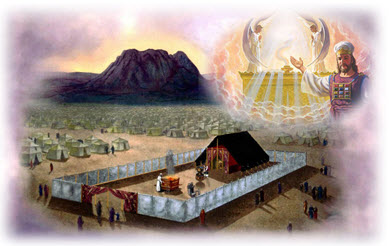
From the very first chapter of Genesis, the Creator openly declares that His sacred times are ordained by the lights in the shamayim (heavens). The sun, moon, and stars were appointed as His visible clock and calendar for signs, for lunar appointed times, and for days and years. Because this is so, His true calendar must reveal itself, not in a single isolated verse, but in a consistent, repeating pattern that can be traced from Genesis to Revelation. Scripture itself teaches that every matter is to be established by “two or three witnesses,” and the rhythm of the seventh-day Sabbath is no exception. It stands or falls, not on human tradition, but on the united testimony of multiple time-stamped stories that all agree on the same arrangement of days, weeks, months, and years.
Included in this introduction are several long-hidden foundational principles that together provide the solid framework needed to understand every narrative that follows, each one bearing witness to the Sabbath’s consistent lunar month dates.
Side-by-Side Comparison Principle
When we lay these narratives 200 Release Date - nike gold air chukka moc high school - SBD - nike gold air yeezy glow in the dark sneakers boys Rattan Obsidian CZ4149 side by side, a remarkable mosaic comes into view. So when Scripture provides us two or more details, like a GPS, to identify both the lunar month date and the weekly Sabbath for a given event, the seventh-day Sabbaths are found consistently on the 8th, 15th, 22nd, and 29th days of the month, counted from the full New Moon Day. This is not an accident, nor the result of clever arithmetic. It is the quiet witness of the inspired record, showing that the weekly cycle in Scripture is not a free-floating, continuous chain of sevens, but is anchored to the New Moon Day and refreshed each lunar month.
Three and Four Kinds of Days Each Month Principle
This Scriptural pattern clearly reveals that each lunar month contains three, at times even four, distinct kinds of days: New Moon Days, six workdays, and the seventh-day Sabbaths that complete each weekly cycle. And six times a year, the moon introduces an additional day after the final Sabbath, a day appointed to complete the lunar month and preserve the harmony of the lunar year, yet never counted as part of the seven-day week. Therefore, half the months are 29 days and half are 30 days in length. This is a lunar phenomenon none of us were ever taught.
Since the New Moon Day is its own category, the weekly cycle never drifts across it, and the Sabbaths never overlap with New Moons or ordinary workdays. The result is a divinely ordered month that always yields four complete weeks, with each seventh-day Sabbath ending on the same set-apart dates each lunar month. In this way, the Sabbath is inseparably bound to the heavenly timepiece ordained in Genesis 1:14, and affirmed in Leviticus 23, Psalms 104:19, Isaiah 66:23, and Ezekiel 46:1-3.
Principle of Which Times were Changed?
Some church denominations teach that only the Sabbath was changed from Saturday to Sunday during the Council of Nicaea and Laodicea, A.D. 325-364 (Daniel 7:25). All the while, both days are contrivances of the same Roman solar calendar model that came into existence as recently as A.D. 325, whose purpose was to ignore the moon altogether. News Flash! The entire calendar model created and placed in the heavens has, in its entirety, been usurped by the enemy of souls. What is the evidence? And what will you do about it?
Tapestry of Witnesses Across Sacred History Principle
What follows is a simple yet powerful survey of this very pattern as it appears in the sacred history of Yahuah’s people. From the Exodus out of Egypt, through the giving of the manna, the arrival at Sinai, the forty years in the wilderness, the Feast Days of Leviticus 23, the reforms of righteous kings, the Kohen courses of David, the ministry and death of our Messiah, and the prophetic scenes that reach into the earth made new, the same set of lunar Sabbath dates quietly repeat month after month and year after year into eternity.
As you read through each of these Scriptural witnesses, notice how the dates, the Feasts, the Sabbaths, and the recorded miracles all fit together without strain when placed back into the original astro-luni-solar calendar of Creation, in which they were designed upon. These are not isolated curiosities. Together, they provide a weight of evidence that exposes the Roman Gregorian (solar-only) calendar as an illegitimate intruder and vindicates the Creator’s own system, in which full New/Renewed Moons, Sabbaths, and Feast Days are perfectly synchronized and celebrated.
With this in mind, we now turn to the first witness in this prophetic chain: the story of the Exodus, where the Sabbath pattern of the 8th, 15th, 22nd, and 29th is first revealed in the First Month and then affirmed unmistakably in the Second and Third Months in succession for forty years of wilderness wandering.
In the Beginning Principle
In the beginning, our Creator synchronized Earth’s Sabbath with His. Exodus 20:10 declares, “The seventh day is the Sabbath of Yahuah your Elohim.” Our Creator shared “His Sabbath” with humanity so that we may be in sync with the worship rhythms of heaven, the messengers, and unfallen worlds as they assemble on His pre-appointed sacred days. But in addition to Yahuah sharing His Sabbaths with humanity, He also attributed to Earth heaven’s lunar months and astro-luni-solar years via the full moon time indicator at His very throne. How can we know for sure?
Each day of Earth’s creation week fell upon a workday of the Almighty Father. These six workdays are sandwiched between His two sacred and set-apart Holy days. These were the full New Moon day and His seventh-day Sabbath. These set-apart days had been sacred rest days for all eternity past, not only for the Creator but also for His creations, that He may avail Himself to receive their corporate worship. As a result, there are never more than six days in a row in which the Almighty Father is free to create. This is self-evident in Genesis 1 and in perfect harmony with Exodus 20:8-11.

While our Creator is omnipotent, it is a known fact that there is ONE THING HE CANNOT DO. Yahuah cannot lie! However, it has been discovered that there is at least one additional thing that He cannot do, which is significant for establishing the parameters of His preordained calendar rhythms. Our Creator could not create the moon on the New Moon Day, which occurred the day before the six days of creation. This is impossible because the New Moon day is a sacred, set-apart day unto Yahuah and the entire universe, rendering it a “rest” day, not a workday. Our loving Creator is both consistent and He “changes not.”
To create the New Moon on the New Moon Day runs contrary to His sacred laws of time and would be considered a sin. The calendar illustration below demonstrates what occurred during the creation week. On the full New Moon day (in blue text), the Creator could not have been creating the Earth, as He was both resting and receiving corporate worship from the angel messengers and all the previous creations. Each of the Creator’s six workdays is identified below in green. The first day of creation on Earth was the second day of the month for the Creator and His (angel) messengers, whose time rhythms He was to share with Adam and Eve in a few short days.
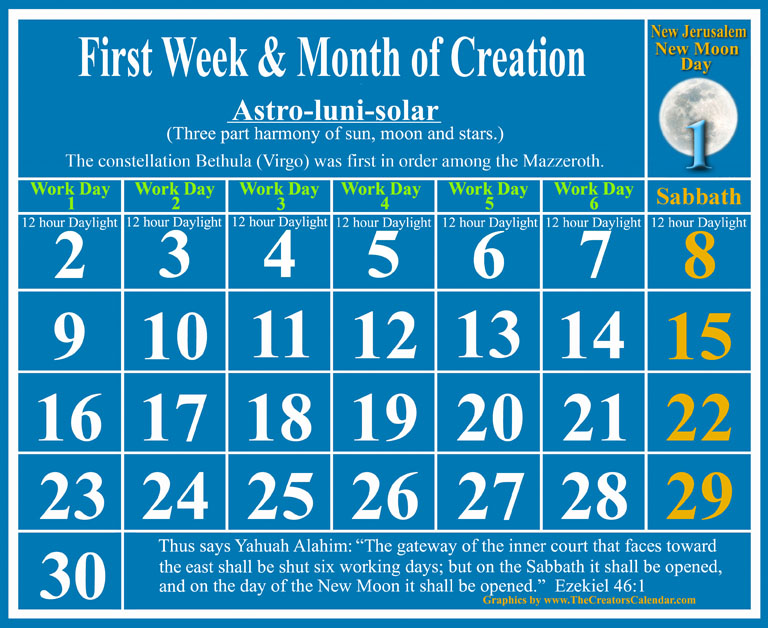 It is difficult for humanity today to fathom that from the Creator’s perspective, time was ongoing while Earth’s time was only just beginning. The 8th day of the month (in gold) was the seventh day of the Creator’s week, an eternal seventh-day Sabbath within Yahuah’s existence, past, present, and future. Here again, He would be resting and receiving worship from all His creation, but now, for the first time, earthlings would be included in the Creator’s corporate day of rest and worship, His eternal “sign of the times,” and symbol of unity.
The fact that the sun, moon, and stars were created on the fourth day of the creation week was a most dramatic “sign” to humankind that earth’s “time” was not independent of that of Yahuah’s dwelling and His seat of power. Instead, earth’s “time” was hung from Yahuah’s own portals of time, His own New Moon day. This grand day marked the commencement of EARTH’s new beginning. It was the first day of the year and the first day of the month from which the workdays and seventh-day Sabbaths could be demarcated and counted. From here, the creative works were applied day by day until they were complete, as marked by the first Sabbath rest day on Earth. They were synchronized with the continued lunar rhythm of time that had always existed in the New Yarushalom and the very throne room of Yahuah Alahim. Thus, the first Sabbath was the seventh day of the week and the 8th day of Earth’s first lunar month. This was designed to harmonize Earth with Heaven forever.
Just as the Tree of Life was placed in the garden, fully endowed with fruit on the third day, all creation was created in its complete form with apparent age. Nothing was created as seeds, eggs, or babies. Likewise, on the fourth day, each celestial body was created and placed in its precise and advanced-upon positions in the shamayim (heavens), reflecting by their locations east to west, the passage of the first recorded days of creation.
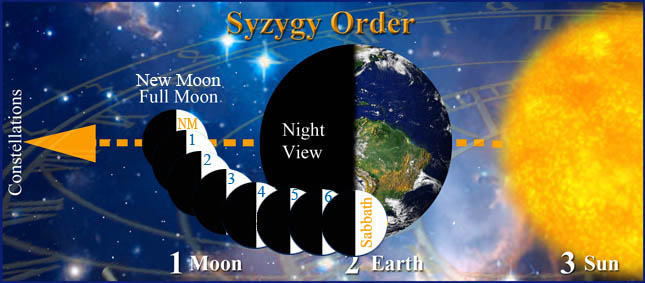
Therefore, Earth’s first week and month were set as a clock would be, placing the moon in the position of the fourth day according to Yahuah’s own New Moon and seat of power. Earth was never intended to operate on an independent time system from that of heaven or His faithful throughout the entire universe. This was the missing puzzle piece in the Genesis account of the weeks. Yahuah’s own New Moon from His dwelling place above set the count for days, weeks, months, and years upon the earth. Now Genesis can be harmonized with the remainder of the Scriptures.
“Likewise the people of the land shall worship at the entrance to this gateway before Yahuah on the Sabbaths and the New Moons.” Ezekiel 46:3-4 NKJV
Earth’s sun, moon, and stars were not created nor their time set and placed in their celestial positions until the fourth day as a testimony that TIME upon Earth was designed after the pattern of, and in harmony with, Yahuah’s own dwelling. While the time system of the sacred city above remains mankind’s benefactor, only those who are obedient to its principles are the beneficiaries. Revelation represents this group of people as a pure woman with the following unique qualities:
“Now a great sign appeared in the heavens: a woman clothed with the sun, with the moon under her feet, and on her head a garland of twelve stars.” Revelation 12:1-2 NKJV
“‘And it shall come to pass that from New Moon to New Moon, and from Sabbath to Sabbath, all flesh shall come to worship before me,’ says Yahuah.” Isaiah 66:23
There is no getting around the importance the Almighty Father places upon His sacred New Moon Days and seventh-day Sabbaths. The New Moon Day marks the commencement of each month and year, but it also starts and refreshes the count of four lunar weeks and a count of 1-29 or 30 unique lunar days. Try as one might, the Creator’s true Sabbaths cannot be located by any other method.
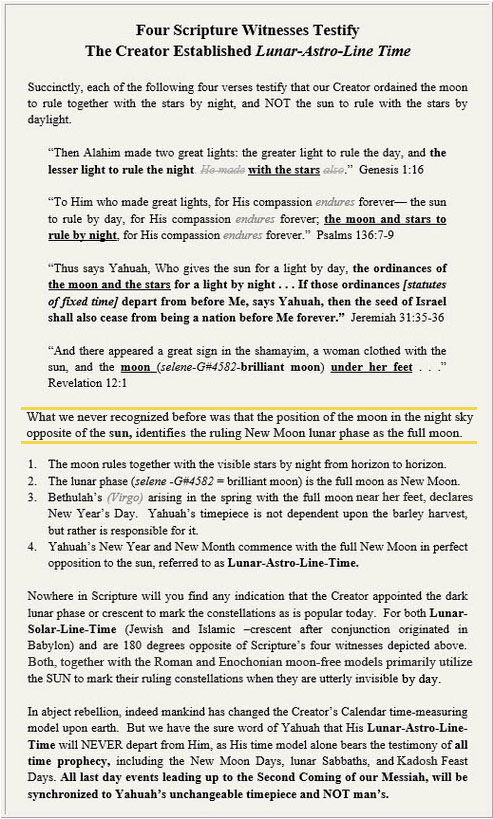
Four Witnesses Principle that the Moon Rules With the Stars by Night
Principle of 349 New Moon References in Scripture
The 349 times the New Moon (Chodesh) is mentioned in Scripture is more than double the number of times the Sabbath is mentioned. This means that anciently, it was not only essential but strategic to harmonize the faithful of Earth to the Creator’s correct time measurements and count to His authentic seventh-day Sabbaths each month, along with the annual Feast Days according to His call to worship. Added to this is the reality that the New Moon Day stands as a distinct third category of day, ensuring by its very design that weekdays, Sabbaths, and New Moon Days each occupy their own place in the monthly cycle and never overlap. 349 New Moon References in Scripture.
* * * * *
Nineteen Biblical Narratives
Identify the Sabbath as Lunar
#1- The Exodus – First Month in a Row
At the time of the first Passover, and every year after that, Passover was fixed to the 14th day counted from the first day of the First Lunar Month (Abib) in spring. It was dually fixed to the sixth day of the year’s second week, followed the next day by the seventh-day Sabbath, the 15th. The first day of the Feast of Unleavened Bread was called a “High Day” only because it was both the seventh-day Sabbath and the first day of the Feast. (Leviticus 23:4-16). This caused the Sabbaths for the First Month (Abib) of each year to be consistently fixed to the 8th, 15th, 22nd, and 29th (Exodus 12). Refer to the full article, Three Months in a Row.

This harmony is only possible when each month is refreshed and restarted on the full New/Renewed Moon Day, a day that stands alone and does not belong to any of the four weekly cycles. The Creator’s purpose in creating the moon’s light was to measure months and years in unison with the starry constellations after sunset, when they arise from the east and shine to the west in a panoramic display the entire night.
#2 – Second Month in a Row – The Manna
At the commencement of the Second Month of the Exodus, Yahuah sent manna from heaven, which presents the second detailed calendar layout. This means that Yahuah has given us two months in a row for comparison, each of which establishes details for New Moons, monthly calendation, weekly cycles, and lunar seventh-day Sabbaths. The story of the manna sent from above presents some unique details that will, step by step, reveal an otherwise hidden calendar system.
One month after the Exodus from Egypt, manna was provided each morning for six days, but none was given on the seventh-day Sabbath.
“And they [Moses with Israel] departed from Elim, and all the congregation of the children of Israel came to the wilderness of Sin, which is between Elim and Sinai; and on the fifteenth day, in the second month after their departure from the land of Egypt, all the congregation of the children of Israel murmured against Moses and Aaron.” Exodus 16:1-2 Septuagint

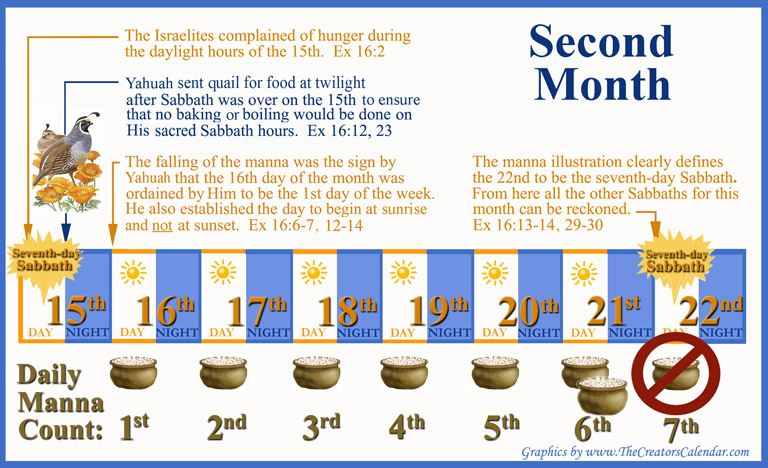 The first Sabbath following these first six days of receiving the manna was the 22nd lunar calendar date as counted from the New Moon. This fixed the other Sabbaths for the month to the 8th, 15th, and 29th (Exodus 16). Refer to the full article, Three Months in a Row.
#3 – Third Month in a Row – The Mountain
Commencing the Third Month, on the precise anniversary of the Exodus from Egypt at night, Israel was led by the pillar of fire by night, to the foot of Mt. Sinai. It was in the third month on the same lunar calendar date of the 15th, after the sacred Sabbath hours had passed (Deuteronomy 16:1; Numbers 33:3; Exodus 19:1-2). So, it is divinely demonstrated that the Sabbath was located on the same consistent lunar calendar dates for three lunar months in a row.
NEWS FLASH! It is utterly impossible to produce three identical months in succession using the Roman Gregorian calendar, the very system by which nearly all the world’s religions now mark their worship days. By setting aside the Scriptural evidence, these systems have led their followers into deep confusion, a condition not unlike the lingering shadows of the so-called “dark ages.” Yet the pathway out of this inherited error begins with a willingness to hear and respond to the wake-up call: to come out, to reconsider, and to return to the Creator’s own appointed rhythm of time.
 In striking contrast to our modern calendar, all the Creator’s units of time were then, as well as today, proclaimed by the three-part orchestration of the sun, moon, and stars (Genesis 1:14-18). This third month in a row was laid out identically to the previous two months, with the seventh-day Sabbaths falling consistently upon the 8th, 15th, 22nd, and 29th of the lunar month. Refer to the full article, Three Months in a Row.
#4 – Entering Canaan Forty Years Later
For forty years, manna was perpetually bestowed upon Israel by Yahuah Alahim to sustain His people. All during that time, the manna never fell on the seventh-day Sabbath. Upon entering Canaan, Israel celebrated Passover on Abib‘s (Nissan) 14th lunar calendar date, perpetually coincident with the 6th day of the week, in the Promised Land for the first time. As usual, a double portion of manna was given on that 6th day (Passover’s preparation day) to carry over for the Sabbath. On Sabbath, the 15th lunar calendar date, also the first day of the Feast of Unleavened Bread, the Israelites ate their regular supply of manna for the last time, along with the produce of the land. On the 16th day, when the manna would have typically resumed for the week, it was not provided, and thus ceased entirely. This was the morning after the Sabbath of the 15th. Three Months in a Row.

Stunningly, a full forty years after the manna had first been given, the seventh-day Sabbath continued to be located on precisely the same lunar calendar dates as when the manna had first been provided forty years earlier. As a nail in a sure place, the record in Joshua, written forty years after the Exodus, confirms that the identical lunar date layout observed in the first three months was not an isolated pattern. Rather, throughout the entire forty-year wilderness sojourn, the Creator’s astro-luni-solar calendar unfailingly placed the sacred seventh-day Sabbath on the 8th, 15th, 22nd, and 29th days of every lunar month, counted from the full moon, the start of the year and month.
#5 – Two Annual Feasts and their Respective High Sabbaths
According to Leviticus 23 and the Sanctuary astro-luni-solar time model, every year, the Feast of Unleavened Bread begins on the 15th, as counted from the full New/Renewed Moon of the First Month of Abib, which is always fixed to a seventh-day Sabbath of the second week of the year.
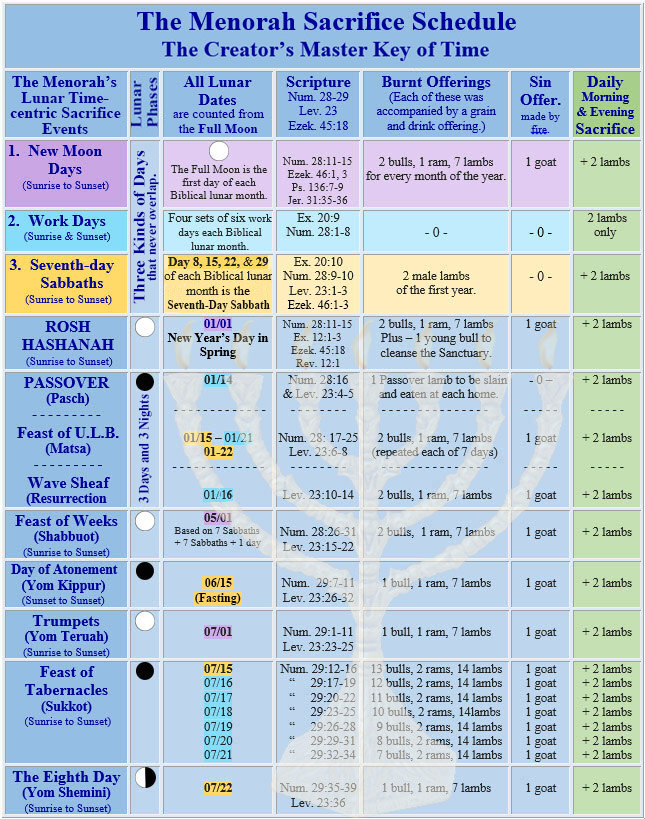
Six months later, the first day of the Feast of Tabernacles also falls on the 15th, as counted from the New Moon, which is fixed to a seventh-day Sabbath. As confirmation, this seven-day Feast is followed eight days later by a sacred convocation (the seventh-day Sabbath) on the 22nd of each and every single year. So these two seven-day Feast events, separated by 6 months according to Scripture, consistently commence on the seventh-day Sabbath. Both start days are identified as the 15th of their respective months, a full six months apart exactly.
As a result, ironically, in utilizing the Scriptural criteria above, it is impossible to place both Feasts six months apart and have them both commence on the 15th of the Roman Gregorian calendar month and be a Saturday at the same time. If, perchance, one year, it happens to work out successfully, it cannot occur two years in a row and definitely not every year, as is required by Scripture. The problem lies within the Gregorian calendar’s popular promotion of the floating continuous weekly cycle. This is a perfect example and profound evidence that a continuous weekly cycle cannot be found in Scripture. Over and over again, Scripture demonstrates that it has never utilized an unbroken, continuous weekly cycle. (Numbers 29:12-39; Leviticus 23:5, 6, 34-35). Refer to the full article, Passover to Tabernacles Calendar Challenge.
This sample lunar calendar illustrates the full moon as the first day of both the year and the month. It also reflects the Leviticus 23 layout of the Feast Days, though with the understanding that some traditional placements are no longer believed to be accurate, particularly the date assigned to Yom Kippur (Day of Atonement), which is entirely disconnected from the Menorah sacrifice schedule (posted above), as well as the conventional timing of Shabbuot (the Feast of Weeks). Please compare this calendar with the sacrifice schedule above that places these two Feast Days differently.
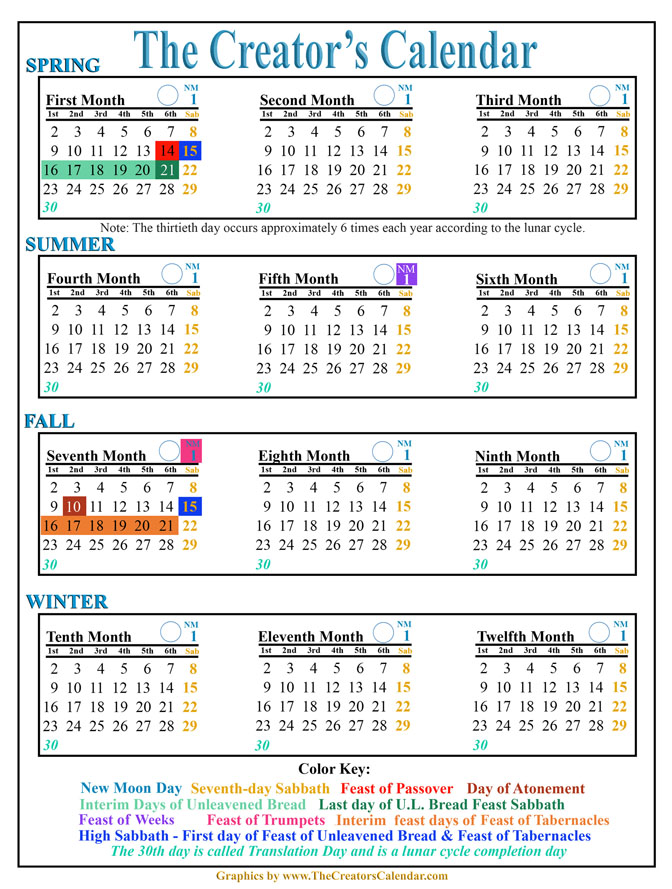 Although somewhat flawed by two Feast Days, please use the Leviticus 23 calendar above to identify dates in all the Scripture stories presented, as it is the only calendar model recognized in Scripture. The additional 30th day, every other month, as well as the extra (intercalary) month approximately every three years, never affects the placement of the annual Feast days nor the lunar seventh-day Sabbath calendar dates. Each of these is dependent on its systematic count from the full New/Renewed Moon Day each month, which starts the Year on Rosh Hashanah in the spring, and the Feast Day count, and is refreshed each lunar month.
#6 – The Lunar Sabbath and Feast Days of Leviticus 23
Directly given from above with a “thus says Yahuah,” Leviticus 23:1-3 references the seventh-day Sabbath as the first of the set-apart lunar appointed Feast days. Yahuah Himself defined two categories of Feast days, the weekly and the yearly. Even though the translators have not applied the correct punctuation to the following verses, it is still recognizable by any novice that, indeed, two types of Feast days are being described, but nonetheless, each corresponds to the “lunar appointed times of assembly.”
“And Alahim said, ‘Let there be LIGHTS in the firmament of the heaven to divide the day from the night; and let them be for SIGNS, and for SEASONS (H#4150 – mo’edim = lunar appointed times), and for DAYS, and YEARS: Genesis 1:14
Did you know that the word translated as SEASONS does not refer to the four seasons of the year? Note that this term comes from the Hebrew word mo’edim. In all Hebrew dictionaries, mo’edim is defined as merely “appointed times.” However, it has been discovered that Scripture itself provides a more detailed explanation of SEASONS (H#4150 – mo’edim) than the translators and Dictionary writers care to share. This is the moment to consider why they have been hiding this evidence.
Our Creator made the moon with specific lunar phases to highlight or mark His Kadosh (holy) appointments with humankind and all His creation for worship. In the creation story, we discover what Alahim created and ordained to determine His worship SEASONS (H#4150 “mo’edim” lunar appointed times). This truth is then emphasized by Psalms 104:19
Here we find the uncelebrated evidence in Psalms 104:19:
“He ordained the MOON for SEASONS….” Psalms 104:19
Wow! Wow! Wow!
SEASONS literally means “APPOINTED TIMES AS ANNOUNCED BY THE MOON or (#4150 – mo’edim – lunar appointed times)! What a concept!
The reason you have you ever heard of this concept that SEASONS literally means “LUNAR APPOINTED TIMES” is because your pastors and rabbis are simply following the leader and not researching things for themselves in Hebrew.
“He made (H6203 -asah) THE MOON (H3394 – yareak) for lunar appointed times (H4150 – mo’edim).” Psalms 104:19
Scripture itself identifies that all the lunar appointed times include New Moon Days, seventh-day Sabbaths, and all the Kadosh (Holy) Feast Days. Each is demarcated by this same lunar beacon with a specific lunar phase identifier. So the question is asked, does Leviticus 23:1-5 illustrate that both the Sabbaths and Feast Days are lunar? Let’s take a look.
Leviticus 23 Lunar Appointed Times
Leviticus 23:1-5 as it was originally intended to be translated:
- (H#4150 – mo’edim) = Lunar appointed times = sacred holy days for worship AS BEACONED BY THE MOON = Feast Days (Psalms 104:19).
- (H#4744 miqra) = Holy convocations = rehearsal assemblies = include both seventh-day Sabbaths and annual Feast Days.
“And declared Yahuah unto Moses, saying, speak unto the children of Yasharal (Israel), and command them concerning the lunar appointed times (H#4150 mo’edim) of Yahuah, which you shall proclaim My set-apart (Holy) rehearsal assemblies (H#4744 miqra). THESE ARE MY LUNAR APPOINTED TIMES (H#4150 mo’edim): (COLON)
Six days from sunrise to sunset you shall do your work, but in the day of the seventh, it is the Sabbath-rest to observe the covenant, a set-apart (Holy) rehearsal assembly (H#4744 miqra) in which you shall do no work, for it is the Sabbath unto Yahuah in all your dwellings.
These are the lunar appointed times (H#4150 mo’edim) of Yahuah, the set-apart (Holy) rehearsal assemblies (H#4744 miqra), which you shall proclaim as SIGNS [of prophetic events to be fulfilled by the Messiah alone] at their lunar appointed times (H#4150 mo’edim): (COLON)
In the lunar month (H#2320 chodesh), the first one of the year, in the fourteenth day [counted from] the New Moon (H#2320 chodesh), between (H#996 beyn) the evenings (plural twilights referring to between sunrise and sunset) (H#6153 ereb), is the PASSOVER of Yahuah.” Leviticus 23:1-5 and beyond…
Even though translators have not applied the correct punctuation to these verses, it is still evident, even to a novice, that two distinct types of Holy Days are being described. Yet both are identified in Leviticus as “lunar appointed times of rehearsal assemblies,” each belonging to the sacred rhythm established at Creation.
As we have already seen, both the weekly seventh-day Sabbaths and the annual Feast Days follow the same gracious rhythm of the lunar appointed times. With this understanding, we can rest in the certainty that the seventh-day Sabbath was never set aside, for it is woven into the eternal fabric of the Ten Commandments themselves (Exodus 20:8-11). Our Creator’s Sabbaths will continue to be cherished in the earth made new, “from new moon to new moon and from Sabbath to Sabbath” (Isaiah 66:23). And this very promise, that future worship will flow from one New Moon to the next, serves as a loving confirmation that His Sabbath was always meant to be counted exactly the same way today (Malachi 3:6). It becomes beautifully self-evident that Yahuah Alahim’s seventh-day Sabbath is eternally anchored to the New Moon and upheld in the gentle cadence of lunar time.
In this same spirit, the annual Feast Days remain living treasures, for our Creator designed them to reveal His ongoing and “daily” work of redemption, carried out step by step, precisely according to the sacred timing of His pre-ordained astro-luni-solar calendar in the Sanctuary above. Yahusha Himself affirmed this enduring reality in Matthew 26:29, Mark 14:25, and Luke 22:18, assuring us that both the weekly and yearly Feast Days will continue in their purity throughout eternity. And His bride-elect will joyfully honor them in harmony with His Full New Moon that begins the year each spring.
“But I say unto you, I will not drink henceforth of this fruit of the vine, until that day when I drink it new with you in my Father’s kingdom.” Matthew 26:29
This statement is not simply about abstaining from grape juice or wine until the Second Coming. Rather, Yahusha is pointing to something far deeper: He is declaring that He will not partake of the Passover celebration again until every redeemed soul, those who have embraced His gracious gift of salvation, is gathered with Him in the New Jerusalem. In this promise, He lifts our eyes beyond the present world to the joyous restoration of His Kingdom, where the true Passover will once more be celebrated in His honor and presence every year for all eternity, on the 14th day counted from Rosh Hashanah.
So, the questions one should ask are these:
1) If the Feast Days, the lunar appointed times, represent the ongoing redemptive work of our Messiah, and they do, and if that work continues beyond His first advent and is not completed until His Second Coming, why would the prophetic symbols of His most precious work be abolished before they have even reached their fulfillment on His preordained timeline?
2) And since these same Feast Days symbolize the very work of Redemption that the redeemed will joyfully celebrate with their Messiah throughout all eternity, why would they be considered null and void during the span of two thousand years between His crucifixion and His return, precisely the period when their promises, their meaning, and their hope are most desperately needed?
Do you see the picture beginning to take shape? The Kadosh, set-apart, Feast Days, the lunar appointed times, were never abolished by our Eternal Father. Rather, it has been the constant, persistent influence of both Papal tradition and later Jewish reinterpretation that has sought to muffle the sacred harmony found between the true seventh-day Sabbaths and their coordinating lunar Feast Days.
These appointed times alone carry the profound and unified testimony of the Greatest Story ever told, a step-by-step revelation of the Messiah and His perfectly calibrated, time-centered sacrifice for humanity. Salvation and restoration unfold through the Creator’s beautiful twofold system of TIME and EVENT, lovingly worked out on our behalf through His Son. This unique rhythm of worship, anchored in the lunar cycle, was preserved in Scripture so that His faithful followers might discover it as they seek faithfulness to His still, small voice and enter into fellowship with Him in the appointed seasons He designed.
And when this system is restored to view, it becomes unmistakably clear, much to the disgust of the Yahudim (Jews), that the Messiah truly did come, and equally unsettling to Papal Rome that His redemptive work was carried out according to the Creator’s lunar calendar, not the artificial construct later imposed upon the world and subtly woven into our thinking and even into the translated pages of Scripture.
#7 – Dedication of the Priesthood of Aaron and His Sons
Aaron and his sons were inducted into the Priesthood and sanctified for seven days beginning on New Moon Day (Exodus 40:2, 17). On the eighth day, which was the 8th day of the lunar month, there was an assembly of the congregation. Why? Because the eighth day of the lunar month is the Sabbath, the seventh day of the lunar week cycle.
During the preceding seven days, they were not to leave the Tabernacle (Leviticus 8:1-13; 33-35; 9:1-5). According to Exodus 40:17, this was the First Month (Abib) of the second year since their departure from Egypt and the lunar month in which the third Passover was to be kept. This is an affirmation that the Sabbaths for this month fell on the 8th, 15th, 22nd, and 29th of the lunar month.
#8 – The Time of Solomon
Solomon consistently kept the Feast of Tabernacles for seven days. On the eighth day, which was the day following the seven-day Feast and also dated as the 22nd of the lunar month, he brought the people together in a solemn assembly because it was the seventh-day Sabbath. Solomon sent the people away on the 23rd (the first day of the lunar week) after the Kadosh (sacred) Sabbath was passed.
In addition, the first day of the Feast of Tabernacles is always fixed to the Sabbath, the 15th day, as counted from the Seventh New Moon each year. So, here is a double confirmation that the Sabbath was located on the 15th and the 22nd of the seventh month every year. This automatically places the Sabbath for the seventh month on the 8th, 15th, 22nd, and 29th (2 Chronicles 7:8-10).
#9 – The Time of Esther
The 15th of the Twelfth Month was a seventh-day Sabbath rest-day, making the 8th, 22nd, and 29th Sabbath rest days as well for that month (Esther 9:18).
#10 – King Hezekiah’s Reform
The people began to sanctify on the New Moon Day of the First Month, but then, on the 8th of the month, they went to the temple because it was the seventh-day Sabbath. On the 16th of the month, they “made an end,” which was the first day of the workweek (2 Chronicles 29:17). Here again, the Sabbaths are fixed to the 8th, 15th, 22nd, and 29th lunar calendar dates. Refer to the article: Ten Degrees To and Fro on the Sundial
#11 – Three Kinds of Days That Never Overlap
While Genesis 1 records the foundational framework of Creation and provides key details regarding the first seven days, it does not, by itself, fully define the precise commencement or termination of either months or years. The chapter establishes the divine principle of time, but it does not yet supply the complete operational mechanics of the Creator’s calendar. As a result, the careful reader is invited to follow Scripture’s own method of progressive revelation, allowing later passages to clarify what was first introduced at Creation. Only by gathering these additional witnesses from across the Torah, the Prophets, and the Writings can we discern the full parameters of days, weeks, months, and years as they function together on the Creator’s authentic and original calendar. Scripture interprets Scripture, and the calendar, like all divine truth, is revealed line upon line, precept upon precept. Here is evidence from Ezekiel.
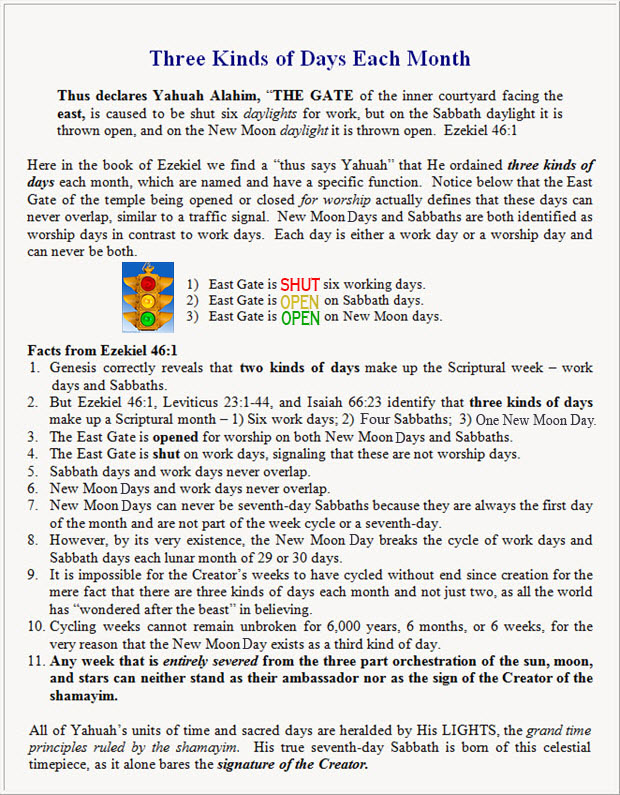
This Scriptural rule cannot be fulfilled through the use of the Roman Gregorian calendar. A simple examination of modern wall calendars reveals that Rome instituted an uninterrupted, continuous weekly cycle, one that operates independently of the moon. As a result, ordinary workdays are routinely forced to fall upon New Moon days and lunar Sabbaths alike, collapsing distinctions that Scripture consistently maintains Adidas Adidas Sports Resort Club Sweater , Украина #174050986 , Футболные шорты adidas real madrid🔥 — цена 350 грн в каталоге Спортивные шорты ✓ Купить мужские вещи по доступной цене на Шафе. In doing so, the Gregorian system disregards the Creator’s ordered rhythm of time and blurs the boundaries between common days and sacred appointments.
Yet Scripture speaks with remarkable clarity on this matter. The passages in Amos 8:5, 2 Kings 4:23, Isaiah 66:23, and Ezekiel 46:1–3 all testify to a calendar framework in which New Moon days and Sabbaths are recognized as distinct, recurring markers of worship, never absorbed into ordinary workweeks. These texts assume a timekeeping system that preserves separation, order, and repetition, something the Roman Gregorian calendar simply cannot replicate. Far from being a neutral or compatible system, it stands exposed by Scripture itself as a foreign construct, an imposed framework that does not reflect the Creator’s appointed design for sacred time. Refer to the article, Worship at the East Gate
#12 – Twenty-four Prophetic Kohen Courses – 1 Chronicles 24:1-19
In the days of King David, the record preserved in 1 Chronicles 24:1-19 reveals that twenty-four Kohen (priestly) course divisions were established to serve in the Temple. These divisions rotated through sacred service twice each year, first in the wilderness Tabernacle and later in the permanent Temple in Jerusalem. Each Kohen course was carefully measured from Sabbath to Sabbath and from morning to morning (1 Chronicles 9:27), resulting in a total of forty-eight weeks and Sabbaths annually devoted to the ordered cycle of priestly service (2 Chronicles 23:8).
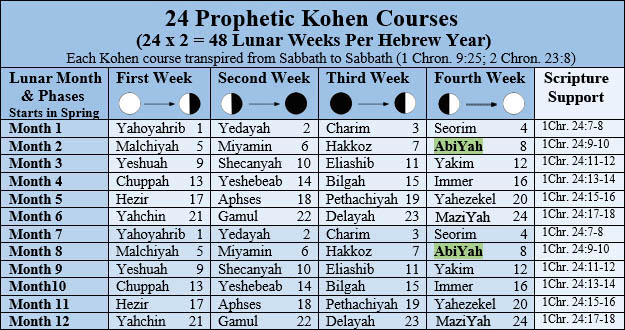
According to the account, King David, together with the priest Jehoiada, cast lots and divinely arranged the order of these priestly divisions, establishing a system intended to endure “for all time.” Yet this raises an important question: Did they somehow overlook the fifty-two-week structure of the later Roman Gregorian solar calendar? The answer is clear: they did not, nor was there any need to do so. The priestly courses were not designed around a solar-only framework of 52 weeks, and no attempt was made to force them into one. Instead, the Kohen divisions were structured according to the Creator’s own timekeeping system, one that naturally accounted for forty-eight Sabbaths each year within a lunar framework from spring to spring. There are at least three compelling reasons for this, which follow:
- Because the Romans were not in Israel at the time of King David.
- The Romans themselves utilized a lunisolar calendar of 48 weeks during that same perior of time and until the year 45 B.C., when Julius Caesar changed their calendar to the solar only time-measuring system for all time to come.
- During the years when Yasharal (Israel) was obedient they only utilized the Creator’s astro-luni-solar Calendar of 48 weeks that commenced with the full moon (not the crescent or conjunction), which was passed down from creation to Noah, to Abraham, Moses, David, Jeremiah, Ezekiel, Daniel, and to the Messiah.
The regular years of the Creator’s calendar are composed of precisely forty-eight weeks and Sabbaths. Although seven years within the nineteen-year cycle contain an additional thirteenth month, all years, nonetheless, maintain twelve temple months structured around forty-eight weeks. Scripture does not explicitly describe how the Kohen divisions were accommodated during a thirteenth month when it occurred, and we need not speculate beyond what is written. What Scripture does establish with certainty is this: the twenty-four Kohen courses define a calendar in which each temple month consists of exactly four weeks. This structure alone secures the perpetual placement of the seventh-day Sabbath on the consistent lunar dates of the 8th, 15th, 22nd, and 29th of every month. Refer to the article, Our Messiah’s True Prophetic Birthday
#13 – At the Fullness of Time, Yahusha, our Messiah, was Born
Luke chapters 1 and 2 record the miraculous account of the messenger Gabriel’s announcements, first to ZachariYah (Zacharias), and then, six months later, to Mary, concerning the births of YAHUchanon (John the Baptist) and YAHUSHA, the long-awaited Messiah. While the text does not state calendar dates explicitly, it provides a crucial chronological nike ja 1 scratch marker: Gabriel appeared to ZachariYah at the precise time he was serving as a Kohen in the Temple, during his assigned priestly course.
This was no random encounter. It was a divinely appointed moment, anchored firmly in the unchanging Kohen divisions established by King David more than eight centuries earlier. Far from being obsolete, these divisions remained fully operative and prophetically relevant, serving as a foundational key for identifying the true Promised Messiah. ZachariYah’s service always occurred within the Kohen division of AbiYah, which corresponded to the fourth week of the Second Lunar Month and again to the fourth week of the Eighth Lunar Month. In both instances, this fourth-week service marked the final week of the lunar month, consistently spanning the same dates, the 22nd through the 29th.
This seemingly small detail, the Kohen division of AbiYah, carries extraordinary significance, and it does so for five compelling reasons:
First, the Kohen division of AbiYah binds the prophet YAHUchanon (John the Baptist) to the Messiah through the unbreakable framework of TIME. The moment Gabriel appeared to ZachariYah marked the divinely appointed starting point of Elizabeth’s miraculous pregnancy of the prophet John, setting the prophetic clock in motion for the forerunner who would prepare the way for the Messiah.
Second, this same time marker establishes the beginning of Mary’s miracle pregnancy precisely six months later, exactly as Scripture records. Through this shared, time-centric event, the lives and missions of YAHUchanon (John the Baptist) and YAHUSHA are inseparably linked, confirming Heaven’s deliberate sequencing of the forerunner and the One whose ministry he would announce.
Third, the identification of the AbiYah priestly week anchors both births firmly within the Creator’s astro-luni-solar calendar, a system defined by forty-eight weeks and Sabbaths each year, measured from one New Moon to the next. This detail removes speculation and places these events squarely within the authentic lunar timekeeping structure established at Creation.
Fourth, from this precise calendrical framework, we discover that the Messiah was born in late summer to early fall, on the first day of the sixth lunar month of the Hebrew calendar (September–October). His birth occurred nowhere near winter, and certainly not on December 25. The widespread insistence among Christian denominations on celebrating the Messiah’s birth with all the Pagan dieties, and the new year during the winter, on a calendar divorced entirely from the moon, reveals that most have not yet sought alignment with the rhythm of the only calendar model found in Scripture. Tragically, many continue, often unknowingly, in conflict with it, perpetuating time-centric traditions rooted in pagan systems rather than the Bible, despite professing allegiance to the Eternal Father and His Son. (Note: It is possible that the Kohen course names or placement were altered, as I believe the Messiah would more likely have been born on the first day of the seventh lunar month, aligning with the day of His Second Coming.)
Fifth, the Kohen divisions established by King David permanently fix the seventh-day Sabbath dates within every lunar month, on the 8th, 15th, 22nd, and 29th. This consistent pattern governed sacred time from David’s reign through the birth of the Messiah, standing as yet another witness to the unchanging order of the Creator’s calendar.
For the full article, refer to Our Messiah’s True Prophetic Birthday.
#14 – The Messiah Healed the Blind Man on the Sabbath
Because the first day of the Feast of Tabernacles is fixed to the fifteenth day of the lunar month, the progression of the feast is securely anchored in time. This allows us to identify the seventh day of the feast as falling on the twenty-first day of the month, immediately preceding the seventh-day Sabbath on the twenty-second. (Leviticus 23:34, 39). This ordered sequence repeats in the same manner year after year, preserving the integrity of the Creator’s appointed rhythm into perpetuity.
“On the first day there shall be a sacred convocation [seventh-day Sabbath]. You shall do no customary work on it. For seven days you shall offer an offering made by fire to Yahuah. On the eighth day you shall have a sacred convocation [seventh-day Sabbath], and you shall offer an offering made by fire to Yahuah. It is a sacred assembly, and you shall do no customary work on it.” Leviticus 23:35-36 NKJV
With this foundation in place, a careful reading of John chapters 7 through 9 reveals that our Messiah Himself lived and ministered within this same lunar framework. His months, His weeks, and His Sabbaths all align precisely with the Creator’s calendar, a reality that becomes unmistakable as the narrative unfolds, as illustrated below:
- The Messiah, Yahusha, attended the seven-day Feast of Taberna
cles (John 7:10).
- On the last day of the seven day Feast, the 21st of the Seventh Month, Yahusha stood and spoke, reading from Isaiah (John 7:37).
- The Messiah spent that following night on the Mount of Olives (John 8:1).
- The next morning, the 22nd of the Seventh Month Yahusha returned to the temple. Why? Because it was the seventh-day Sabbath and the Feast of Yom Shemini (Eighth Day) (John 8:2).
- At the temple the Messiah, Yahusha, healed a blind man (John 9:6).
- The healing of the blind man caused great anger among the Priests, for the very reason that it was done on the seventh-day Sabbath (the 22nd of the lunar month) (John 9:14).
Below, I have provided an example of how it worked, as outlined in Leviticus 23 and John 7-9.
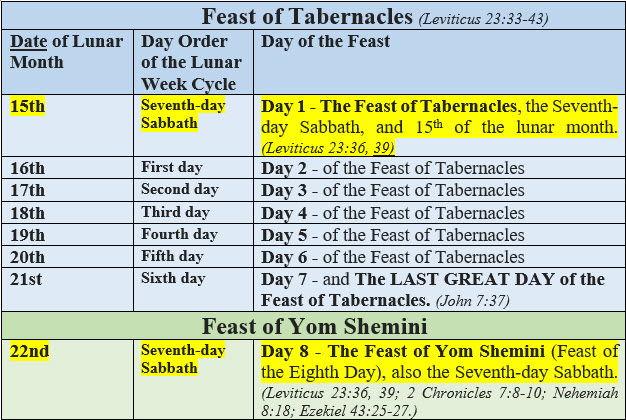
Notice that the Feast of Yom Shemini occurs the next day after the Feast of Tabernacles has ended. The Feast of Tabernacles extends from the 15th day of the lunar month through the 21st day. This seventh day of the feast is called “the last great day” because it is the last day of the Feast of Tabernacles. The Feast of Yom Shemini (the Eighth Day) occurs the next day and falls on the seventh-day Sabbath of the 22nd. Because this event occurs every year, and because Yahusha, our Messiah, healed the blind man on that very day, we know with certainty that it is a lunar Sabbath, fixed to the 22nd day of the month. This is the only layout of days that meets all Scriptural criteria. (Leviticus 23:34-43; John 7:10; John 7:37; John 8:1; John 8:2; John 9:6; John 9:14.)
This places the weekly seventh-day Sabbaths in our Messiah’s lifetime consistently on the 8th, 15th, 22nd, and 29th of the lunar month yet again.
#15 – The Abrahamic Covenant of Circumcision
The rite of circumcision was divinely designed for males as an Abrahamic Covenant with Yahuah. Baby boys were to be circumcised on the eighth day from birth (Leviticus 12:3). Joshua testifies to all the Hebrew males being circumcised upon entering the Promised Land on the “tenth day” of the First Month, four days before the Feast of Passover (Joshua 4:19-5:10). Evidently, it did not matter what day circumcision was performed, but infants were to be circumcised according to the eight-day rule. As a result, it appears that there were to be circumcisions performed by the priests in the temple every day of the week, including the seventh-day Sabbath.
In the verse below, Yahusha, the Messiah, responds to the priests, who are angry because He has just healed the blind man on the seventh-day Sabbath, during the Feast of Yom Shemini, following the Feast of Tabernacles. Refer to the story above regarding the healing of the blind man. He responded to the priests with…
“Moses therefore gave you circumcision (not that it is from Moses, but from the fathers), and you circumcise a man on the Sabbath. If a man [male] receives circumcision on the Sabbath, so that the law of Moses should not be broken, [why] are you angry with Me because I made a man [male] completely well on the Sabbath?” John 7:21-24 NKJV
#16 – Time of the Crucifixion
In this sacred alignment of time and event, the Passover Lamb was fulfilled by the Messiah at His crucifixion on Passover, the sixth day of the week, corresponding precisely to the fourteenth day of the lunar month of Abib, counted from the first Full New Moon of spring. In perfect harmony with the Torah pattern established in Eden and seconded at the Exodus, His sacrifice unfolded exactly as foreshadowed, leaving no room for coincidence or human alteration. This divinely orchestrated moment not only sealed the redemptive work accomplished at the cross but also reached forward prophetically, assuring that the final acts of judgment, resurrection, and restoration will likewise unfold according to the same unchanging calendar of the Creator.
Luke records that on this sacred day, “the sun was darkened from the sixth to the ninth hour,” a detail of profound significance. This description aligns precisely with the defining characteristics of a solar eclipse, which can only occur during daylight hours and requires a lunar conjunction between the Earth and the sun. Remarkably, this darkening of the sun also serves as a silent witness that the original and authentic New Moon fourteen days earlier was the Full Moon, confirming the lunar framework upon which Passover was established.
Following His crucifixion, Yahusha rested in the tomb on the fifteenth day of the lunar month, the first day of the Feast of Unleavened Bread, which was also a High Sabbath (Leviticus 23:6–7). A High Sabbath occurs when an annual Feast Sabbath coincides with the weekly seventh-day Sabbath, a convergence that naturally happens only twice each year within the Creator’s calendar. Because this divine timing is inherently harmonious, there was never any need for the rabbinical “Rules of Postponement” introduced in the fourth century A.D. to reconcile conflicting calendar systems. The Scriptural calendar stands complete and self-consistent on its own.
As has already been demonstrated, Passover consistently fell on the sixth day of the week, the Preparation Day, each year. On that day, the extraordinary sign of the darkened sun from the sixth to the ninth hour (approximately noon to 3:00 p.m.) marked the climactic moment of redemption. The fourteenth day of the lunar month was always followed by the seventh-day Sabbath the next morning, which coincided with the fifteenth day. Scripture provides no evidence that the Passover ever occurred on any other weekday, nor that it was ever detached from the fourteenth lunar date. Such precision cannot be achieved within the Roman Gregorian calendar (Mark 15:42; John 19:31, 42; Leviticus 23:6–7, 11, 15). Refer to the article, The Sun was Darkened From the Sixth to the Ninth Hour.
The day Yahusha lay in the tomb was therefore the fifteenth of Abib, a true seventh-day Sabbath. Consequently, both the final month before His death and the first month following His resurrection testify to the same enduring pattern: the seventh-day Sabbaths fell on the 8th, 15th, 22nd, and 29th days of the lunar month. Once again, the rhythm of redemption unfolds in perfect harmony with the Creator’s appointed times.
#17 – The Three Days and Three Nights Riddle of our Messiah

This riddle of “three days and three nights,” as given by our Messiah shortly before His crucifixion, was a prefigured SIGN and way-mark of truth for His obedient followers until the end of time. But, for nearly 1,700 years, this three-day plus three-night time sequence has been a source of contention among scholars, religious leaders, and non-specialists alike. They have all struggled to appropriate Roman or Jewish artificial time units to define this most monumental preordained time event.
Utilizing Scripture and the following chart, it is discovered that our Messiah’s marvelous resurrection occurred during the “fourth watch of the night” on the 16th. This happened 1-2 hours before the sunrise of the 17th, rendering an additional 24 hours to the time sequence. Only in this way was the resurrection able to be harmonized with the events of the Feast of First Fruits and the three days and three nights criterion of the example of Yonah (Jonah).
Days are only twelve hours long, from sunrise to sunset, followed by the four watches of the night to complete each 24-hour civil calendar date.
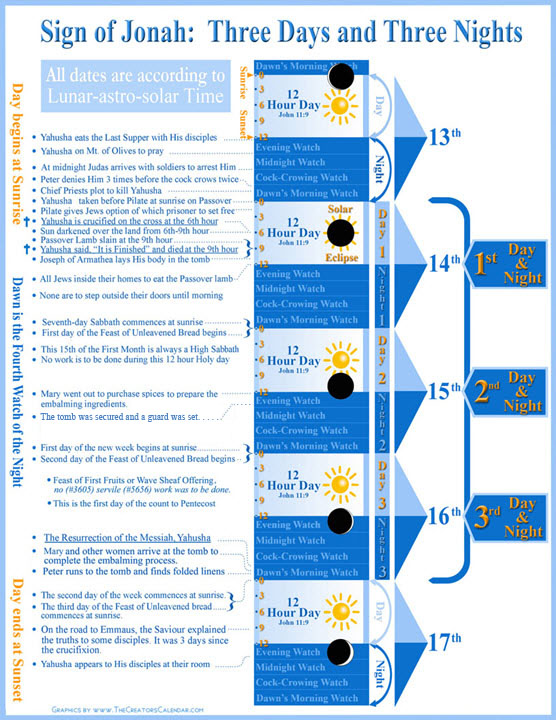 For the entire article, refer to – Three Days and Three Nights. Matthew 20:1; Matthew 28:1; Mark 16:1-2; Luke 24:1; John 20:1.
#18 – According to Scripture
According to Scripture, the Sabbath existed before the creation of this Earth, even among unfallen worlds and the dwelling place of Yahuah Alahim. It will continue as an eternal tribute of worship beyond humankind’s restoration unto the Father and the earth made new. However, this begs the question of which calendar/time-keeping model the seventh-day Sabbath will be regulated by following redemption and the new earth. Will the Sabbath be synchronized to the Roman Gregorian solar calendar of man’s devising? Will the Sabbath follow another unique and altogether new rhythm or time sequence? Or, will the divinely preordained Scriptural model remain steadfast, which has previously been utilized by all the unfallen worlds for times of presenting themselves before their Creator three times every year?
Several examples of this are found in Job 1:6; 2:1; 38:7, “… when the sons of Alahim/Elohim came to present themselves before Yahuah, Satan also came among them to present himself before Yahuah.” This was likely either the Feast of Unleavened Bread or the Feast of Tabernacles. This time model was first given to Adam, then Abraham, and then reintroduced to Moses to regulate the time-centric Sanctuary service shown to him on the mount, which was according to the heavenly pattern not made with [human] hands.
Notice in the verse below that the wilderness Sanctuary and each of the earthly temples made by the hands of men were nothing more than copies, types, and shadows of the correct and Kadosh (sacred) heavenly model. The earthly sanctuary ceremonies were given to illustrate to Israel in visual rehearsals the detailed ministry and work of the Messiah in restoring humanity back to the Father. His divine ministry and set-apart work to be accomplished in the heavenly Sanctuary could not commence until the Messiah, our Savior and Redeemer, had laid down His life as our ransom lamb. This was accomplished at Yahusha’s death on the cross. The cross marked the commencement, not the termination, of His grand and sacred work of restoring humankind through the system He designed to be fulfilled within the context of the heavenly Sanctuary alone. Thus, there is only one way to Yahuah, and not many as is popularly proclaimed.
The set-apart appointed Feast Days are the rehearsals of each prophetic event, which were designed to occur precisely on their preordained astro-luni-solar calendar dates. Just as Yahusha, the Messiah, fulfilled the Passover and Feast of Unleavened Bread precisely on time to the very day, so too will He complete the fall Feast Days with precision on a specific day.
It is boldly declared among Christianized scholars of most church denominations that the divinely appointed Feast Days, along with their astro-luni-solar calendation, were done away with at the cross by divine design. However, if this were true, there would be no need to worship our Creator at all. This is because those sacred days found only on His celestial time-piece, which they claim were done away with, were the Creator’s appointed worship days: 1) Full New Moon days, 2) seventh-day Sabbaths, and 3) the annual Feast Days, all of which synchronize earth with Yahuah’s sacred throne above. But since we know that all the Feast Days have not yet been fulfilled and the worship days continue as a practical necessity until the second coming of our Messiah and into the earth made new, a fundamental truth becomes apparent. NEWS FLASH! Yahuah DID NOT do away with His preordained astro-luni-solar time mechanism.
This evil task, the dismantling of ALL the Creator’s units of time, which affected each sacred and set apart day, was the mastermind of Lucifer, but accomplished by the two-part amalgamated union of the Roman and Jewish leaders between A.D. 31 and A.D. 325. Together, these form a portion of the “beast power” spoken of in Daniel 7:25, which was to change Yahuah’s “times and laws henceforth.” This appears to be the same Beast power mentioned in Revelation 11:7, which was to kill the righteous followers of Yahusha in the same city where He was crucified. The earthly counterparts of the Sanctuary/Temple were nullified and void at the cross of Yahusha at the epicenter of time, and not the Temple model above in the heavenlies.
1) These included the animal sacrifices primarily, as there was no need for another animal to die on behalf of sin.
2) The Levitical priestly order.
3) The temple itself, for it contained mere shadows of the true.
In contrast, the heavenly Sanctuary/Temple system commenced full throttle at the cross without skipping a beat according to lunar time. The Messiah, Yahusha, was to perform every duty in the Sanctuary above, first as the Lamb, then as High Kohen (Priest), then as Prince, and finally as the omnipotent King of Kings.
“…who serve the copy and shadow of the heavenly things, as Moses was divinely instructed when he was about to make the tabernacle. For He said, ‘See that you make all things according to the pattern shown you on the mountain.'” Hebrews 8:5 NKJV
Was this not the same time-centric system that was given from the heavens for which the Savior of the world laid down His life precisely on the day and hour of Passover, the 14th, as counted from the New Moon, confirming Him to be the Messiah, the Son of Yahuah, and the redeemer of humankind? Was this not a nail in a sure place? Would the rhythm of the Creator’s celestial timepiece, as portrayed in the original Sanctuary/Temple above, not be the very one to continue perpetually, untouched, designating when all the sons of men from the entire universe were to present themselves before their Creator to worship Him?
“Assuredly, according to the order of the heavens, the New Moons, and the earth: The New Moon that I appointed and set in order remains firmly the chief corner [stone],” declares Yahuah. Wherefore, it establishes and confirms your name along with your children.”
“And it shall come to pass according to its abundance (waxed lunar phase), New Moon by New Moon you shall keep; and according to its abundance (waxed lunar phase), Sabbath by Sabbath you shall keep. And I shall lead all flesh to prostrate in worship, according to this chief corner [stone],” declares Yahuah. Isaiah 66:22-23 The Creator’s Calendar Restored Text.
#19 – Lunar Month or New Moon Designations
Some have declared that the New Moon reference in Isaiah 66:23 only means “month.” They believe we shall continue to worship Yahuah from month to month and from week to week. No doubt, this is mainly due to faulty English translations of the word 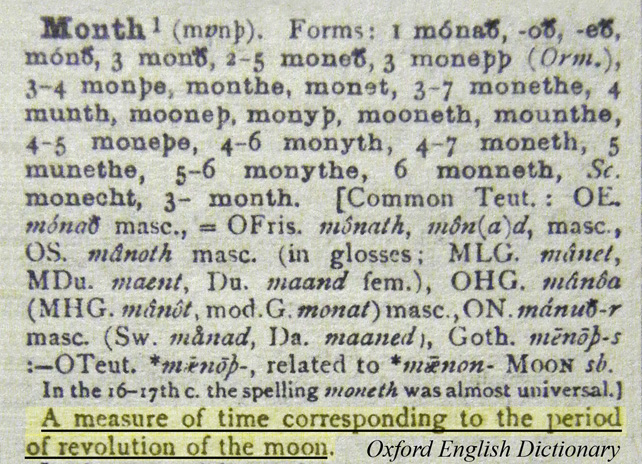 (#2320 Chodesh) and a proactive assault on this verse to hide any traces of the genuine and original time-measuring model. This is a way of ignoring that all the references in Scripture to the terms “month” and “New Moon” refer to lunar months.
This is true because the word “month” is derived from the word “moon.” The Scriptural “lunar month” is made up of 29-30 lunar phases, which commence with the full New Moon. The New Moon is simply the first lunar phase of the lunar month.” The “month” cannot be separated from the “New Moon” any more than the sun can be separated from the term “daylight” or its physical attributes of gas, fire, heat, and light. And finally, the only known “months” utilized by all the Tanakh (OT) prophets and Renewed Covenant (NT) apostles, through to the time of the Messiah and Savior, were lunar months.
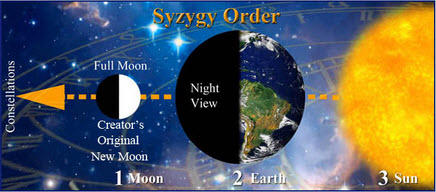
So, Isaiah 66:22-23 establishes the signal for the start of the month is in the specific order of alignment from the outside inward: 1) the stars; 2) the full moon as the New Moon; 3) the earth. This is the astro-lunar-solar sign for each new month as they mark each new ruling constellation. This system of time measuring will then remain the established system for all eternity. The full moon is the only lunar phase that is in perfect opposition to the sun when it rules by night and meets the criteria of Isaiah 66:22, with its placement between the starry constellations and the earth.
The week and true seventh-day Sabbath will cycle four times, beginning after each New Moon day. The choice of words, lunar month or New Moon here, does not change the meaning of the Isaiah 66:23 text in the least because each lunar month commences upon New Moon day.
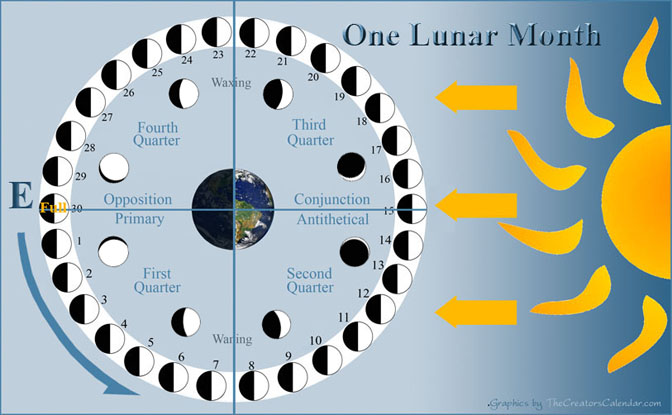
Can it be refuted that all of the set-apart Feast Days, as defined in Scripture, were located within the parameters of lunar calendar dates as they were counted from the full New Moon? For those of you with connections to the Seventh-day Adventist Church, you may be interested in the admission of Angel Rodriguez, former head of the B.R.I.:
“The Israelite calendar was lunisolar, that is to say, time was measured on the basis of the new moon (the rotation of the moon around the earth) and also the sun (the rotation of the earth around the sun). A lunar calendar of 12 months is about 11 days shorter than the solar calendar, which is approximately 365 days. In the ancient world this was solved by adding an extra month seven times in 19 years. In the Bible the moon calendar was used to fix the time for the festivals-for instance, 14 days after the new moon came Passover (Numbers. 28:16).” Angel Rodriguez, Biblical Research Institute
Not for a moment does Angel Rodriguez support or keep a lunar Sabbath today, but here he admits the Israelite calendar was lunisolar, as given by the Creator. Tell me, what is the definition of a hypocrite? At the very minimum, this should stimulate questions about why all the churches that utilize the Scripture as their authority, including the Seventh-day Adventist Church, have abandoned this foundational truth of our Creator and His Bridal Covenant.
One must ask, “Who is behind this abandonment of the sacred time system that was instituted by our Creator, especially when at the very hour the details are being fulfilled in the heavenly (shamayim) Sanctuary above by our Messiah in real-time? Furthermore, can it be disproved that each of the seventh-day Sabbaths, as listed in this article in connection with the sacred Feast Days, is NOT located on the specific lunar rhythm and dates of the 8th, 15th, 22nd, and 29th? Also, is there one human argument that can destroy what was pre-ordained by our Eternal Creator regarding His shamayim celestial time-piece (Genesis 1:14-18)? The sacred and set-apart seventh-day Sabbath has always been and will continue to be the honored SIGN, as it is numbered from the New Moon of the original astro-luni-solar calendar of Creation.
“Now a GREAT SIGN appeared in the shamayim: a woman clothed with the sun, with the moon under her feet, and on her head a garland of twelve stars.” Revelation 12:1-2 NKJV
The article, Scripture’s Weight of Evidence, reveals that the divinely ordained astro-luni-solar time-piece was placed in the shamayim (heavens), out of reach of man and beast, at the time of creation. This has been the celestial regulator upon earth of time eternal, in which all sacred worship days are fastened. As illustrated throughout this article, no other calendar or time-system model is in sync with His heavenly (shamayim) time-centric specifications. Yahuah’s divinely ordained protocol was designed to demonstrate consistent harmony with all His previous creations before earth even came to be.
As a result, the Creator has enabled humankind to be in perfect harmony with the rhythms and councils of righteous messengers, the unfallen worlds, including the dwelling place of the Creator Himself. Even the wilderness Sanctuary/Temple that was utilized from the time of Moses to the Messiah was designed to protect and reveal the sacred shamayim rhythm for worship. In other words, our loving Father proactively designed earth’s timepiece to keep humankind in sync with the grand appointed worship events of His very dwelling place in the New Yarushalom, the promised future home of the righteous obedient, and the extended universe of unfallen worlds.
The Call to Come Out of False Traditions
Make no mistake, in the image below is none other than the Crest of Pope Gregory, as it is displayed at the Vatican. Here, we see that, not by mere chance, “THE DRAGON” represents Pope Gregory and the Roman Gregorian calendar, the world power combined with the tool utilized by Satan himself.
In the sixteenth century, Pope Gregory made the final touches to the Roman solar time-measuring system and changed its name from “Julian” to “Gregorian.” Satan will wage war on all those obedient followers who seek to live according to the laws of the omnipotent King of Kings and His Universal time principles under this banner (crest) representing human-made artificial units of time (Revelation 12:1, 17).
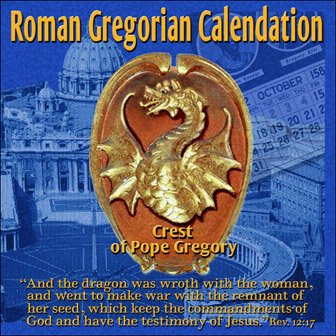
These laws include the divinely inspired astro-luni-solar time system as defined by “types and shadows” (prophecies) as illustrated in the earthly sanctuary. The earthly sanctuary was set up as a tribute to and a copy of the mechanism of time-keeping in the heavens, the original standard, after which it was patterned. Therefore, the preordained shamayim originally defined the time sequence of His eternal Sabbath and annual Feast Days in the New Yarushalom as well as upon the return to earth.
Time, as beaconed by the sun, moon, and stars (Genesis 1:14-18), is discovered to be the very signature of our Creator, Yahuah. Might the catalyst for this battle over worship between the Eternal and His nemesis, Lucifer, which is to be waged in the hearts of every individual, be over the opposing calendar time systems— a human-made counterfeit in contrast to the Creator’s original? Therefore, is it conceivable that the final conflict will be over more than a single unit of time, as some have believed, but rather over the entire TIME-KEEPING mechanism, as a banner of allegiance?
The Creator Himself declared that the Sabbaths will continue to be kept by the obedient according to the abundant, full New Moon. (Isaiah 66:23). From the Scriptures alone, no other form of “month” is recognized by our Creator. If the time on earth were changed, by default, the time-keeping for all the universe, including the unfallen worlds, must also be changed. We have it on the good authority of Daniel the prophet that it was to be the beast power of earth that was to “think” to change not only the law of Yahuah but also His time system.
“He shall speak pompous words against the Most High, shall persecute the saints of the Most High, and shall intend to change times and laws. Then the righteous shall be given into his hand for a time and times and half a time.” Daniel 7:25 NKJV
“He shall insult the Most High, he shall torment/wear out the righteous ones of the Most High, and he shall attempt to change the calendar and the ordinance.” Daniel 7:25 (Twentieth Century Knox translation.)
“How great are the things the enemy did wickedly in the Sacred Place. They hated your majesty and splendor in the midst of your solemnities. They placed their signs and banners on the highest places… They burned with fire your Sanctuary; they befouled the tabernacle of your name on earth. The kindred of them said together in their hearts; ‘make we all the Feast Days of Elohim to cease from the earth.'” Psalms 74:3, 7, 8 Wycliffe Bible, 1378
In the last verse above, who was it that said in their hearts, “Make we all the Feast Days of Elohim to cease from the earth?” The first line of this verse gives us the answer. The “enemies” of Yahuah Elohim would “make all the Feast Days of Elohim to cease from the earth.” Who are the people today who are proclaiming the loudest that “all the Feast Days of Yahuah Elohim have ceased from the earth?” These are the Catholics, the Sunday-keeping Protestants, and the Saturday-keeping Seventh-day Adventist Church. This united effort binds these churches as daughters of the Roman Catholic Church persuasion, commonly referred to as Christians. But according to this verse above, they have chosen to side with the enemy of Yahuah Alahim.
In contrast, His obedient followers (Natsarim, Quartodecimen) are the only ones who will be identified as those who uphold the Feast Days and “who follow the Lamb whithersoever He goes.” This is the language and story of the shamayim (heavenly) Sanctuary, which defines those who seek to be in sync with the Lamb, Yahusha, the Mashiach (Messiah), and His sacred and set-apart Feast Days. Each Feast Day depicts a time-centric phase of the Messiah’s work in the courts of the heavenly Sanctuary and culminates with signaling His return.
The 1378 version of the Wycliffe Bible verse above is more correct than the KJV version in verse 8. Instead of the Hebrew word #4150 mo’ed being rightly translated to mean “Feasts,” the KJV and other modern versions define it as synagogues (mere buildings).
The Almighty Father has never ordained that His Kadosh (sacred) Feast Days were to discontinue nike dunk high blue satin, especially at the time of the Cross. Each Feast Day was a prophecy of a specific work to be performed by the coming Messiah. At the cross/stake, the earthly sanctuary model of the Tanakh (OT) met the shamayim Sanctuary original, which exemplifies the Renewed Covenant (NT). It was at the cross/stake that the Renewed Covenant, with better promises, was to commence with each set-apart Feast Day in their divinely appointed order. Each Feast Day reveals in detail the work and ministry of the Messiah, Yahusha, in the divine plan and system designed for the restoration of humanity in the Sanctuary, which is not made with hands.
This pre-ordained work of our Messiah/Savior did not commence until the cross, and His three-phase ministry, which includes the seven sacred Feast Days, will not end until His return. His seven sacred and set-apart Feast Days have been targeted for removal by the Papal pagan holidays.
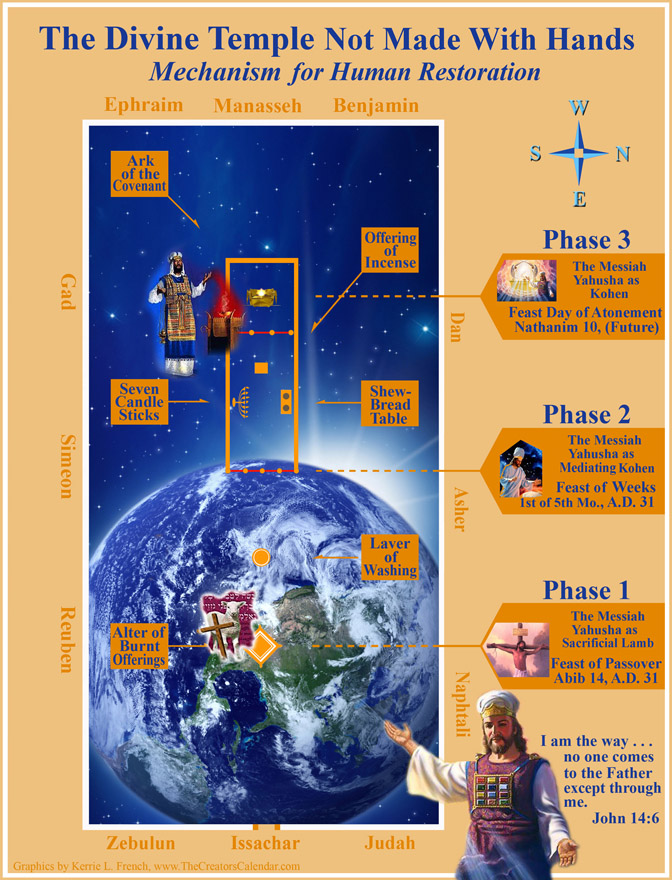
To all appearances, it seems that the satanic agencies have been successful in removing time from the Creator’s shamayim dome. Yet, only now is the artificial time system being exposed, and ultimately, it will fall like a house of cards, according to Daniel 7:25-27. All the while, the Creator’s ordained calendar and divinely designed time-piece continue to stand as a banner waving in the shamayim, declaring to the world that Yahuah is the omnipotent Creator of all and that He changes not (Malachi 3:6). At the end of the day, “ALL THE WORLD have wondered after the beast” (Revelation 13:3) and have followed the beat of a different drum, the rhythm of the beast, and the false prophet of artificial time-measuring.
Wrong New Moon Equals Wrong Sabbath
According to Scripture, the whole world has followed the system of the beast, including the modern Yahudim (Jews) and all Sunday and Saturday Sabbatarians by way of the Gregorian calendar. Not only does the “wrong New Moon equal the wrong Sabbath,” but “NO acknowledgment of a New Moon, as presented by the Roman Gregorian Calendar, also gives way to a fraudulent Saturday Sabbath.”
Yet, full of divine compassion, our loving Father is now urgently calling forth His obedient followers, “Come out of her, my people, lest you share in her sins, and lest you receive of her plagues.” Revelation 18:4. This long-suffering call to “come out” includes coming out of a false and counterfeit system of time-keeping so that we may worship our Creator and Redeemer according to His divine and preordained rhythms and be in harmony with the unfallen universe and perfect creations beyond earth’s boundaries to know.
Would you like to be considered among the Creator’s righteous, obedient, and answer His call to come out of the errors and artificial traditions of the earth? Do you wish to be restored to His sacred and set-apart times for worship? Is it your desire, through consistent obedience, to not only be delivered from the plagues that are shortly to come upon the world but to be perfectly restored to the image of our Most High Father and receive His reward of eternal life?
“These are they which follow the Lamb [THE TORAH AND HIS FEASTS, NOT THE CALENDAR OF THE BEAST] whither soever he goes. These were redeemed from among men, being the first fruits unto Yahuah and to the Lamb.” Revelation 14:4 KJV

Clarifying Our Purpose
This article and the materials presented on this website are not directed against Jews, Romans, Seventh-day Adventists, or any other people or faith communities. Our purpose is not to single out individuals, question motives, or assign blame. People are not the issue.
What is examined here are doctrinal systems and inherited teachings, measured carefully against the testimony of Scripture. Where those teachings diverge from the biblical record, we believe it is both appropriate and necessary to name the discrepancy with clarity and respect.
Disagreement with doctrine is not an attack on persons. To question tradition is not to reject people. On the contrary, this work is offered in the spirit of informed choice, inviting readers to consider the sources of what they have been taught and to weigh those teachings thoughtfully against the Word of the Creator.
Each individual remains free to agree or disagree. Our role is not to persuade by pressure, but to inform with evidence, allowing conscience, prayer, and personal study to guide the outcome.
Truth can be examined without hostility, and conviction can be expressed without contempt. That is the standard we seek to uphold here.