The Count to Shabuot ~ A Fresh Look
The Count of Shabuot
A Fresh Look
Leviticus 23:15, 16, and 21
For generations, the Count of Shabuot, also known as the Feast of Weeks or Pentecost, has been understood through two dominant traditions. Within the Christian framework, it is widely taught as a simple count of fifty consecutive days, measured with the continuous weekly cycle of the modern Roman calendar. But in ignoring the moon as a factor, where will their count begin? In contrast, Rabbinical Judaism maintains a partially lunar-based reckoning, yet continues to rely upon the modern continuous weekly cycle of the Roman calendar, counting seven weeks that include both their conjunction New Moon Days and the transitional thirtieth day into that sequence. Consequently, the Feast is fixed to a predetermined date, the sixth day of the third lunar month, derived from a continuous count that includes all days without distinction: work days, Sabbaths, New Moon Days, and transitional days.
Yet when the Hebrew text of Scripture is examined carefully, word by word, line upon line, an entirely different pattern begins to emerge.
This study invites you to step beyond inherited assumptions and into the text itself. Through a detailed interlinear analysis of Leviticus 23:15–16, 21, supported by multiple Hebrew lexicons, we will examine whether the traditional fifty-day count truly reflects the Creator’s design, or whether critical elements have been overlooked, obscured, or even altered over time.
What unfolds is a model that challenges long-standing interpretations on several foundational points: how time is measured, what constitutes a complete week, and how the appointed times are anchored within the Creator’s calendar. Rather than counting every sequential day, the text appears to emphasize complete Sabbaths, weeks that stand whole and distinct, raising the question of whether the first day of the month is to be included in the count.
In addition, this study will revisit the very beginning of the month itself, examining compelling evidence that the original New Moon was not marked by darkness or a crescent, but by the fullness of light. As these pieces come together, a broader and more intricate framework begins to take shape, one that not only redefines the Count of Shabuot, but also sheds light on the integrity of the Sabbaths and appointed times as a whole.
In addition to Daniel 7:25, which states a power would come to be that would think “to change times and laws,” Ezekiel identifies that among the Jews essentially the same is true, as the priests sought to “hide their eyes from the Sabbaths, violate the Torah, and profane the holy things.“So with both groups willing to remove themselves far from the divine truths of YHUH, the Most High, the Bible would naturally be a target to twist or alter, leaving us far from the original.
Eze 22:23 And the word of YHUH came unto me, saying,
Eze 22:24 Son of man, say unto her, You are the land that is not cleansed,
nor rained upon in the day of indignation.
Eze 22:25 There is a conspiracy of her prophets in the midst thereof,
like a roaring lion ravening the prey; they have devoured souls;
they have taken the treasure and precious things;
they have made her many widows in the midst thereof.
Eze 22:26 Her priests have violated my Torah, and have profaned mine holy things:
they have put no difference between the holy and profane,
neither have they shewed difference between the unclean and the clean,
and have hid their eyes from my sabbaths, and I am profaned among them.
Eze 22:27 Her princes in the midst thereof are like wolves ravening the prey,
to shed blood, and to destroy souls, to get dishonest gain.
Eze 22:28 And her prophets have daubed them with untempered mortar,
seeing vanity, and divining lies unto them, saying, Thus says YHUH Alahim,
when YHUH (Yahuah) has not spoken.
Eze 22:29 The people of the land have used oppression,
and exercised robbery, and have vexed the poor and needy:
yea, they have oppressed the stranger wrongfully.
Eze 22:30 And I sought for a man among them, that should make up the hedge,
and stand in the gap before me for the land, that I should not destroy it:
but I found none.
This is not a call to abandon truth, but to pursue it more deeply and “stand in the gap.” The goal is not to be different, but to be faithful, to test all things, to hold fast to what is good, and to allow the Torah and Hebrew Scriptures to speak for themselves within the testimony of two or three witnesses. (1 Thessalonians 5:21).
A Word-for-Word Examination of the Count of Shabuot
Before forming conclusions, we must first return to the text itself.
Too often, our understanding of Scripture is filtered through translations, traditions, and assumptions that have been repeated for generations. While these may contain elements of truth, they can also carry forward subtle shifts in meaning, especially in passages where time, sequence, and instruction are central.
For this reason, the foundation of this study rests upon a careful, word-for-word examination of the Hebrew text in Leviticus 23:15–16 and 21. Each term has been compared across multiple lexicons, including Strong’s Concordance and Brown-Driver-Briggs, to ensure that the meaning is not only accurate but consistent.
As you move through this section, you may notice details that are often overlooked:
- words that are present in the Hebrew, yet missing in translation
- meanings that have been broadened or narrowed
- and key terms whose implications extend far beyond their traditional rendering
These are not minor observations. When taken together, they form a pattern, one that invites us to reconsider how the Count to Shabuot was originally designed to function.
The goal here is not to reinterpret Scripture through a new lens, but to remove the lens altogether.
Let the text speak. Let each word stand in its place. And allow the cumulative weight of the evidence to guide the understanding that follows.
Please note that this entire article is based upon the details found in this Hebrew word study. It will not carry any weight unless you open the Scripture Word Study link here and see for yourself what has been hidden in plain sight.
 Refer to this Word Study often.
From Observation to Understanding
Having carefully examined the Hebrew text word by word, we now step back to consider what has been revealed.
At first glance in most modern translations, the instructions in Leviticus 23 may appear straightforward. Yet, as the individual Hebrew terms are allowed to stand in their full meaning, a different picture begins to take shape, one that does not fully align with the commonly accepted fifty-day count.
Several details emerge with quiet yet unmistakable force. The emphasis on complete Sabbaths (weeks complete), the precise use of directional terms such as “from,” and the presence of words minimized or omitted in translation all point to a structure that differs from what is commonly assumed. Rather than a continuous tally of sequential days based on the modern solar calendar, with its unbroken cycle of weeks, the count appears deliberate, measured, and anchored to a more defined and purposeful lunar framework of time.
This raises an important question:
If the text does not describe a simple fifty-day progression, then what exactly is being counted?
The answer begins to unfold when we follow the pattern established in the first seven Sabbaths, weeks described as whole and complete. Rather than abandoning this pattern, the Hebrew text appears to extend it, preserving the integrity of these complete units of time. The simple fact that these rules are present, defining only weeks complete, rules out the idea that the months and weeks of Scripture functioned like our modern solar calendar, meaning this is not describing weeks that cycle without interruption. Rather, it points to a system in which time was carefully structured, where weeks were distinct and measurable units, and yet, where certain days, such as New Moon Days and Transition Days, stood outside the regular weekly cycle altogether. And if this is so, then the entire framework by which the count to Shabuot has been traditionally understood must be reconsidered, not as a continuous sequence of days, but as a deliberate and ordered progression of complete Sabbaths, preserved exactly as defined by the Creator from the beginning.
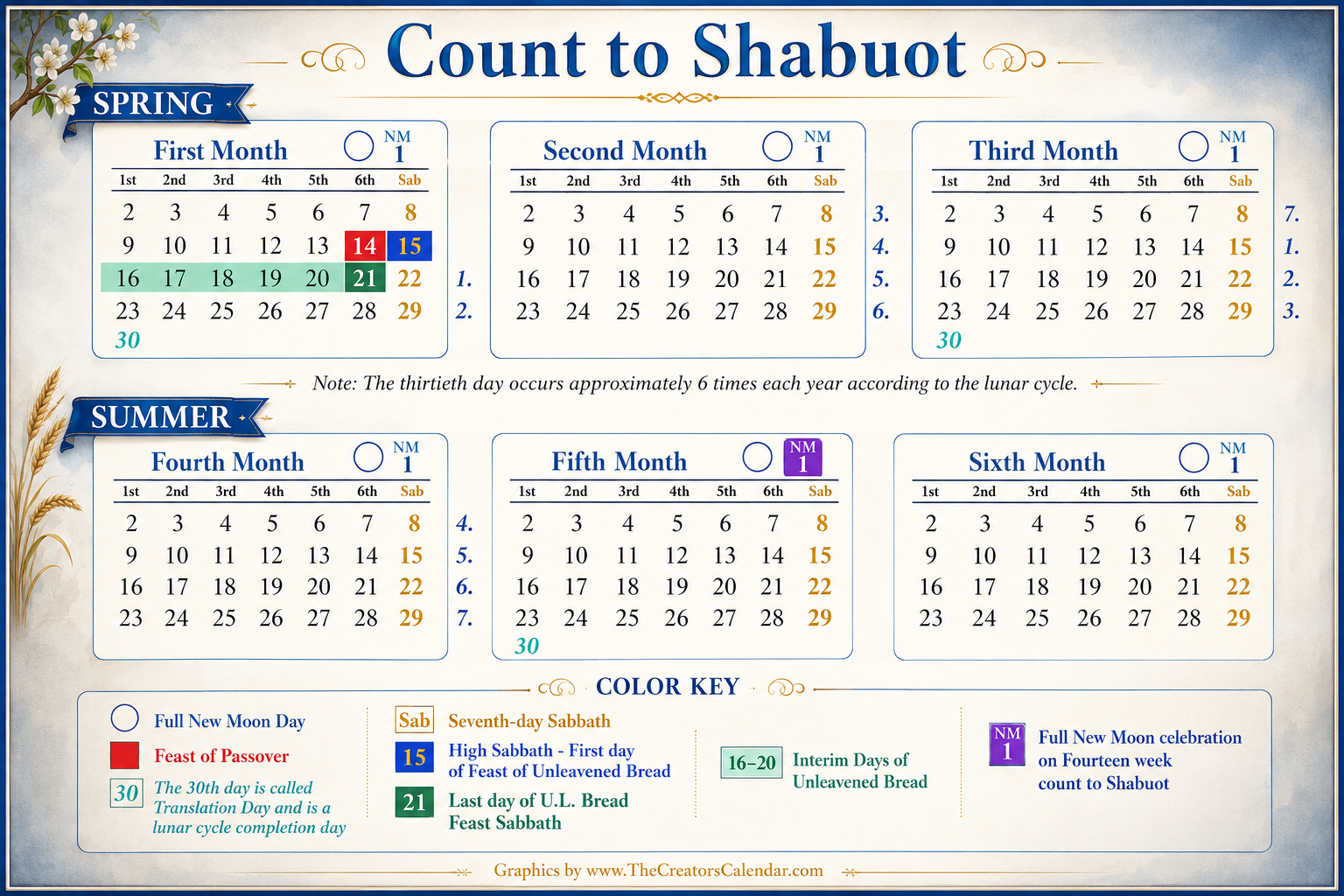
The following chart is used to illustrate the count of Sabbaths (weeks complete) on the biblical lunar calendar that utilizes the full moon as the New/Renewed Moon for the start of each lunar month. (More on this later). Weeks complete include only work days followed by the seventh-day Sabbaths shown in gold. Here they are numbered in dark blue to the right of each week complete. Notice that the New Moon Days and the transition days (30th days) are not counted. It is only when adding the plus one day that we end up on the New Moon of the Fifth Lunar Month.
What emerges is not a rehash or contradiction, but a continuation.
The Discovery of an Additional Count
Building upon the foundation of seven Sabbaths complete, the instruction in verse 16 introduces an additional measure, one that, when properly understood, does not disrupt the established pattern but expands it.
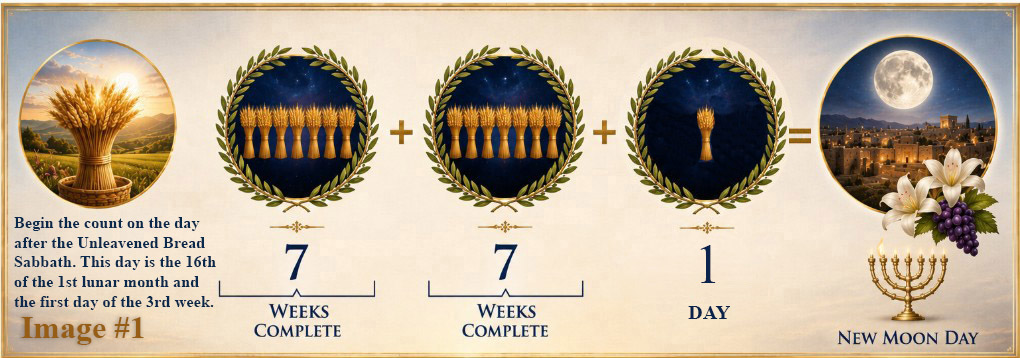
Instead of a single count of seven weeks plus a day, the evidence points to a second sequence that mirrors the first: an additional set of seven complete weeks plus a day as found within the parameters of a fifty-day count, culminating in a ninety-nine-day count. This second period must follow the guidelines of the first portion. Meaning that in this second portion, like the first, one must not count the New Moon Days or the Transition days. Much like the weeks of years that end in a sabbatical year, culminating in the Jubilee (50th year), this expanded count appears to memorialize the Creator’s recurring pattern of seven lunar Sabbaths (weeks complete) plus seven lunar Sabbaths plus one day, with the promise of ultimate release from bondage.
This results in a total count far greater than traditionally assumed, not merely seven weeks, but fourteen complete Sabbaths plus one day, for a comprehensive count of ninety-nine counted days. When this pattern is followed consistently, something remarkable occurs. The count aligns perfectly, not with an arbitrary day, but with a fixed and recurring point in the Creator’s calendar, the New Moon Day of the Fifth Month.
This is no small detail.
For in this alignment, the count to Shabuot is no longer floating within the uncertainties of human-crafted calendars, but is anchored firmly within the celestial order established by the Most High and revealed to Moses and Aaron in the Wilderness and aligned with the Menorah, the gold Standard of Time, and with the Sacrifice Schedule, the Master Key of Time.
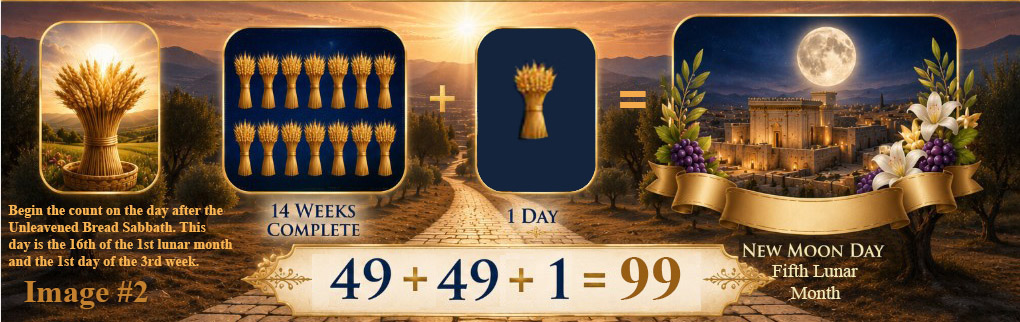
As a result, instead of the assumed fifty-day count to Shabuot, it is a ninety-nine-day count. Who knew???
The Pattern of Weeks Complete
Once the integrity of the first seven Sabbaths is established, the question is no longer whether the count is structured, but whether that structure continues.
The Hebrew text does not suggest a shift in method after the seventh Sabbath. There is no indication that the pattern of complete weeks suddenly gives way to a different form of counting. Instead, the language invites consistency. What begins as a count of Sabbaths complete (weeks complete) appears to remain governed by that same principle.
If the first seven weeks are to be counted as whole and complete units, then it stands to reason that any additional counting must honor that same structure.
This is where the discovery begins to take form.
Rather than concluding the count at seven weeks and introducing an unrelated sequence of days, the text allows for a continuation, a second sequence that mirrors the first. In doing so, the pattern of completeness is preserved, not interrupted.
What emerges is a count of:
- seven Sabbaths complete
- followed by an additional seven Sabbaths complete
A total of fourteen complete weeks emerges, marked by the intentional absence of counting New/Renewed Moon Days and transitional thirtieth days, until the final day is added at the very end. In this way, the count is composed solely of repeating cycles of six working days, culminating in the seventh-day Sabbath.
Each week remains intact. Each Sabbath arrives in its appointed place. No days are inserted that would disrupt the cycle, and none are removed from within it. The rhythm remains steady, ordered, and faithful to the definition of a week as established from Creation.
This alone sets this model apart from both modern approaches. In the popular continuous fifty-day count, there is no need to preserve complete weeks, because there are no days that interrupt the sequence. As a result, the very expression “Sabbaths complete,” or “weeks complete,” is rendered functionally unnecessary, its meaning diminished by the structure itself.
But here, within this detailed instruction for counting to Shabuot, certain days must be set apart so that nothing disrupts the Creator’s ordained weekly cycle.
According to this pattern, what is included and what is excluded, everything aligns with precision. The weeks remain whole, the Sabbaths remain complete, and the integrity of the count is preserved exactly as defined.
The Appointed Objective: The New Moon and Sabbath Alignment
With the pattern of fourteen complete Sabbaths now established, the question naturally follows: Where does this count lead?
A count so carefully structured, preserving complete weeks and excluding all that would disrupt them, cannot terminate arbitrarily. It must arrive at a point equally defined, equally deliberate, and equally set apart within the Creator’s design of time.
And this is precisely what we find.
When the full sequence of “Sabbaths complete” (weeks complete) is honored, and the final day is added as instructed, the count does not drift or vary. It arrives consistently and unerringly at a fixed point, the full New/Renewed Moon Day of the Fifth Month.
This alignment is not incidental. It is the very feature that confirms the count’s integrity.
For in the process of arriving at this appointed day, something greater is revealed. The weeks identified in this count do not behave as continuous, unbroken cycles, but as measured units that begin and end in relation to the New Moon itself. In this way, the count exposes the underlying structure of time: the weeks are lunar, reckoned from one full New/Renewed Moon to the next (Isaiah 66:23).
And if the weeks are lunar, then the Sabbaths that complete those weeks must also be lunar. And if the Sabbaths are lunar, then it follows that this same celestial order governs the months and even the years.
Thus, the count to Shabuot does more than lead us to an appointed day; it uncovers the very framework by which all appointed times are measured.
For just as the weeks and Sabbaths are preserved in their completeness, so too is the conclusion anchored to a day that stands outside the weekly cycle, yet governs the structure of the month itself. The New Moon Day is not merely another date; it is a marker of renewal, a boundary between cycles, and a set-apart appointed time within the Creator’s calendar.
It demonstrates that the appointed times are not dependent upon continuous weeks of human reckoning, but are instead fixed to the celestial order established at creation. And in this, the full New/Renewed Moon stands not as an interruption, but as the appointed destination toward which the entire count has been leading.
The count to Shabuot is, therefore, not only a method of reaching a Feast Day, but a precise witness to the original and authentic calendar of our Creator and His appointed Messiah.
The New Moon in the Beginning: The Waxed Mighty
Having established that the count to Shabuot culminates upon the New Moon Day of the Fifth Month, we must now ask a foundational question:
Which lunar phase is the New Moon, and what is the Scriptural evidence?
For many today, the term “New Moon” has come to be associated with darkness, the unseen conjunction of the moon with the sun, or the first visible crescent. Yet this understanding is not derived from the plain reading of Scripture, but from later traditions that developed over time. When we return to the Hebrew text itself, a very different picture begins to emerge, one rooted not in obscurity but in brilliant fullness of light.
 From the beginning, the trinity of lights was given “for signs, and for lunar appointed times, and for days, and years” (Genesis 1:14). These signs were not hidden, nor were they dependent upon calculation alone. They were visible, observable, and unmistakable to all who would look to the shamayim (heavens). The moon, in its fullness, stands as the most complete and radiant expression of its light, a perfect marker, not of absence, but of renewal. Refer to the article, Mo’edim and the Missing Key Puzzle Piece.
This is where the testimony of Leviticus 23 deepens.
In verse 21, we encounter the Hebrew term often translated “selfsame,” yet upon closer examination, it reveals a far more profound meaning. The word `atsam (#6105), when rightly considered, speaks of that which is waxed mighty, increased in strength, brought to fullness with extraordinary abundance. This is not the language of concealment. It is the language of completion, of something that has reached its height, its fullness, its appointed measure.
What phase of the moon fits this description?
Not the darkened conjunction, hidden from sight. But the full moon, radiant, complete, and visibly established in the heavens.
Thus, in this word study and so many others, the New Moon, as understood in the beginning, was not the absence of light, but the renewal of light, in its fullness, a restored and reigning luminary marking the commencement of a renewed cycle of days.
This understanding is further reinforced by the Hebrew term chodesh (חדש), commonly translated as “month,” yet more precisely referring to the renewed moon, or first day of the new month. Renewal does not imply disappearance, but restoration. It is the returning of light, the re-establishing of order, the visible declaration that a new appointed time has begun.
Yet, over time, this clear testimony appears to have been obscured.
In Leviticus 23:16, what should read as a New Moon offering, connected directly to this appointed day, has been rendered in many translations as a “new grain offering.” While the Hebrew root remains the same (chadash/chodesh), the shift in meaning effectively removed the connection to the New Moon itself. In doing so, the very anchor point of the count is displaced, and the feast was left without its intended celestial marker.
This is no small alteration.
For when the New Moon was redefined, the entire structure of time that depended upon it is likewise affected. The count to Shabuot, which arrives precisely at this renewed, waxed mighty fullness, was then misunderstood, not because the instructions are unclear, but because the foundation upon which they rest has been altered by those who needed it to fit their new calendar model.
But when the New Moon is restored to its rightful place, as the full, renewed, and waxing mighty luminary, the entire pattern comes back into harmony.
The count aligns.
The weeks remain complete. And the appointed time reveals itself exactly where it was always meant to be.
The Witness of the Sacrificial Schedule
If the count to Shabuot reveals a restored framework of time, then that same framework must be found elsewhere within the instructions of Scripture.
And indeed, it is.
The sacrificial system outlined in the Torah provides one of the clearest confirmations that time was not understood as a continuous, unbroken sequence, but as a carefully ordered structure composed of distinct and separate units that remain in harmony. In passages such as Numbers 28 and 29, offerings are prescribed according to a precise pattern: daily sacrifices, weekly Sabbath offerings, New Moon offerings, and those appointed for the annual Feasts.
Each category stands independently.
The daily offering is not counted as the Sabbath offering.
The Sabbath offering is not absorbed into the New Moon.
And the New Moon is not treated as an ordinary day within the weekly cycle.
Instead, each is identified, named, and observed according to its own appointed place.
This distinction is critical.
For if the New Moon were simply another day within an unbroken weekly cycle, there would be no need to distinguish it with its own set of offerings. Yet Scripture does exactly that. The New Moon stands apart, neither one of the six working days, nor the seventh-day Sabbath, but a set-apart appointed time that governs the transition of years, months, and weeks.
This same pattern reflects what has been uncovered in the count to Shabuot.
Just as the sacrificial schedule separates and preserves each category of time, so too does the count preserve complete weeks by excluding those days that do not belong to the weekly cycle. The integrity of the system depends upon this separation.
Nothing overlaps.
Nothing is absorbed.
Nothing is lost.
Thus, the sacrificial schedule does not merely prescribe acts of worship, but bears witness to the structure of time itself. All the activities and ceremonies reflect the workings of the heavens, as ruled by the sun, moon, and stars.
And in this witness, the role of the New Moon is once again confirmed, not as an ordinary day on the modern solar planetary calendar with its continuous weekly cycle, but as a governing marker within the Creator’s calendar revolution of time, standing distinct, purposeful, and essential to the order of all appointed times.
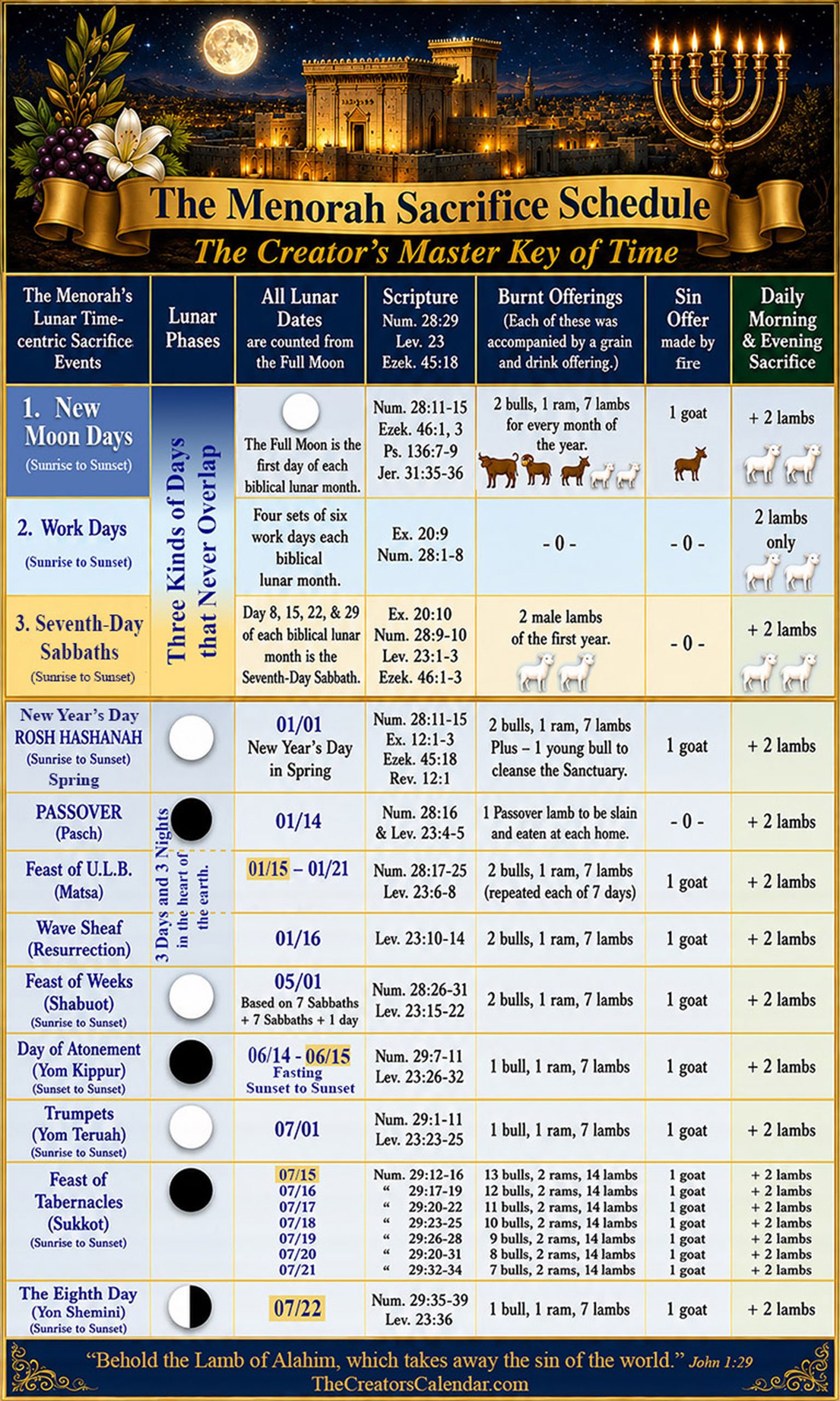
Refer to the article The Sacrifice Schedule ~ The Master Key of Time
The Menorah as a Witness of Time
The placement of the flame upon the Menorah is neither arbitrary nor merely artistic. It is intentional, precise, and rooted in the same ordered system of time revealed through the Count to Shabuot. In its seven-branched design, the Menorah serves as a visual witness to the lunar framework governing the appointed Feast Days. From the perspective of the central shaft, which represents the position of the earth, three branches extend toward the east and three toward the west, reflecting the movement of the lunar phases around it. The three eastern branches represent the three Full Moons that announce the beginning of their respective lunar months, while the three western branches represent the dark conjunction phases that mark the middle of those months. The central branch corresponds to the last-quarter moon phase and identifies Yom Shemini, the final appointed Feast Day in the sequence.
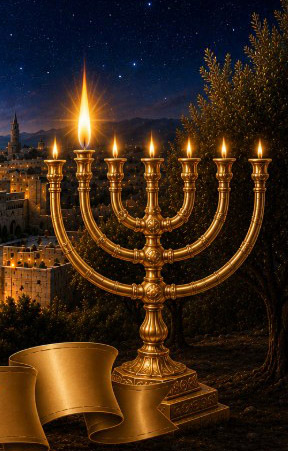 In the image presented, the highlighted flame is placed upon the second branch from the left, yet it is represented as the third Feast, as it follows Rosh Hashanah and Passover. This placement is not meant to represent a waxing progression of light, but rather to identify a specific and fixed moment within the cycle of full moons. Each full moon represented upon the Menorah is already accounted for within the appointed times, leaving only one position where this New Moon event concluding the count to Shabuot can reside.
The first full moon on the far left corresponds to Rosh Hashanah, the New Year’s Day in the spring. Moving forward, the third full moon from the left aligns with the Feast of Trumpets. Each of these positions is fixed and immovable, forming a pattern that defines the structure and pathway of salvation as performed by our Messiah on our behalf. Because these full moon markers are already established, the placement of the Shabuot conclusion is not a matter of preference, but of necessity.
Thus, the second branch from the left stands as the only remaining position where the New Moon Day of the Fifth Month, arrived at through the count of seven weeks plus seven weeks and one day, can be placed. This is not symbolic flexibility, but structural certainty.
Further confirming this arrangement, the branches extending to the right (westward) represent the dark conjunction phases of the moon and the Feast Days that occur within those mid-month positions. The central branch reflects the last quarter phase, signifying “The Last Great Day” following the seven days of the Feast of Tabernacles.
In this way, the Menorah reveals itself as more than a sacred object utilized to illuminate first the Wilderness Sanctuary and later Temples for the work of the Priest; it becomes a map of time. Each branch, each position, and each light corresponds to a defined phase and appointed moment within the Creator’s calendar. Nothing is left unaccounted for. Nothing overlaps.
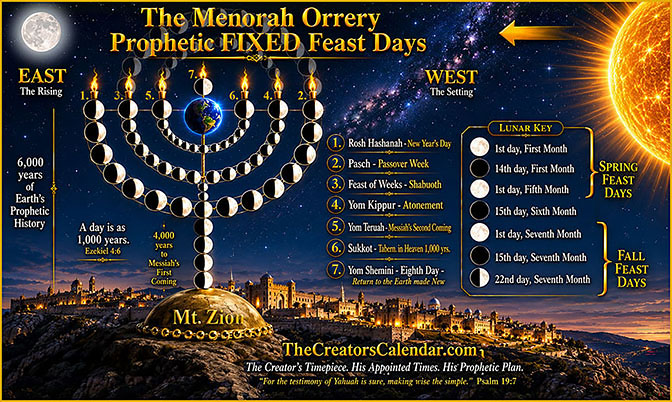
Therefore, the placement of the flame marking the conclusion of the count to Shabuot is not simply meaningful; it is required. It stands as the only position consistent with the full pattern of appointed times, confirming once again that the calendar revealed through Scripture is not fluid, but fixed, ordered, and complete. Refer to the article The Menorah, The Gold Standard of Time.
Why Shabuot and Not Shavuot?
The spelling “Shabuot” reflects a closer alignment with the original Hebrew pronunciation and structure of the word “Shabbat,” the name of the weekly Sabbath, as found in Scripture.
The Hebrew word for this Feast is שָׁבֻעוֹת (Shavuot in modern transliteration), derived from the root שֶׁבַע (sheva), meaning “seven.” Yet, even this word for “seven” was once “sheba.” It is only after the vowel points were invented that the letter for the “b” sound (second letter from the right בַ) “was altered to “v,” and in many cases, even their meaning. This is a significant point, as this Feast is defined by the counting of sevens, complete weeks that end with the seventh-day Sabbath, referred to as Sabbaths complete.
In many modern Hebrew pronunciations, particularly those influenced by later linguistic developments, the softened “v” sound has become standard in this word, leading to the common spelling “Shavuot.”
Historical Timeline of Vowel Points
|
Yet, when considering the root structure and the strength of the word as it relates to counting, completeness, and the firm establishment of weeks and Shabbats (Sabbaths), the use of the hard “b” sound, “Shabuot”, more accurately preserves the original weight and formation of the term. It reflects the foundational connection to “seven” (sheba) and the counting of complete units of weeks and Sabbaths without dilution.
Thus, the choice to use “Shabuot” is not arbitrary, but intentional. It represents a desire to return, as closely as possible, to the original form and sound of the word as it would have been understood in its earliest context, during the three thousand years before the invention of vowel points.
In this way, even the name of the Feast becomes part of the restoration, aligning not only the count, but the language itself with its original design.
The Shift from Shabuot to Pentecost
The transition from the Old Testament Torah term Shabuot to the Greek-derived term Pentecost may appear minor at first glance, yet it reveals an important shift in focus, meaning, and timing. While Shabuot emphasizes the counting of complete weeks, or Sabbaths complete, the Greek term Pentecost simply means “the fiftieth.” The issue, therefore, is not necessarily that the word Pentecost appears in the Greek manuscripts, but that its translational emphasis redirected attention away from the Hebrew structure of the count.
By naming the Feast according to Pentecost, meaning “the fiftieth.”
- The focus shifts toward a numerical total based on tens alone.
- It is severed from the Sabbath alignment.
- It is removed from the New Moon objective.
- It hides the lunar framework upon which Yahuah’s appointed Feast system was originally established.
In the Hebrew model, this Feast Day does not stand alone as an isolated number. It is part of a larger appointed system designed to continually lead the faithful back to the Torah’s time-centered pattern of worship and forward to the unfolding Plan of Salvation. Shabuot preserves this connection because its very name points to complete weeks, sacred lunar cycles, and the ordered rhythm established by the Creator.
- Shabuot = weeks or sevens
- “Sabbaths complete”
- Structural completion rather than merely a numerical total
By contrast, the Greek term Pentecost narrows the focus to a numerical conclusion. For those of the Christian persuasion, this has had far-reaching consequences. It has detached the Feast from its lunar foundation, separated it from the New Moon framework, and obscured its role as one of Yahuah’s sacred appointments designed to reveal the lunar time-centric pathway of redemption.
Thus, while Pentecost may appear ancient within the Greek manuscript tradition, the effect of its use has been profound abuse to the Creator’s Calendar model. The word did not merely translate the Feast; it reframed it. What was once understood through the Hebrew lens of complete weeks and lunar-appointed time became increasingly viewed through the simplified numerical number “50,” severed from the Torah calendar that gave the Feast its meaning.
In this way, the shift from Shabuot to Pentecost represents more than a linguistic change. It became part of a larger movement away from the Creator’s appointed times, away from the lunar calendar, and away from the Feast Days as prophetic signposts of salvation. It appears this was intentional to make way for the solar calendar of Rome.
When the Hebrew framework is restored, however, the Feast is no longer merely “the fiftieth day” but, as we discovered, 49+49+1=99. It becomes once again a sacred appointment within the Creator’s calendar, calling His people back to Torah, back to the appointed times, and back to the pathway prepared for the Bridegroom’s return.
Did the Disciples Tarry Until Pentecost or Shabuot?
When examining New Testament events, it is important first to establish the foundational instructions of the Torah. The Torah provides the pattern, while the New Testament reveals its fulfillment, application, and often its prophetic significance. When the two are in harmony, they fit together like pieces of a completed puzzle, each adding depth and meaning to the other. Difficulties arise, however, when later traditions, cultural influences, altered systems of reckoning, or changes introduced into the New Testament text and its translation are permitted to redefine the original framework established in the Torah.
With this principle in mind, it is worth revisiting the Messiah’s final instructions to His disciples before His ascension.
“And, behold, I send the promise of my Father upon you: but tarry ye in the city of Jerusalem, until ye be endued with power from on high.” Luke 24:49
Notably, Yahusha did not tell His disciples to wait until Pentecost, Shabuot, or the Feast of Weeks. His instruction was simply to remain in Jerusalem until they received the promised power from the Father.
This raises an important question: What did the Messiah mean by the word “tarry”?
Scripture shows that the word does not describe a fixed duration of time. Rather, it carries the meaning of remaining, waiting, abiding, or continuing until a particular event occurs. The length of the wait must always be determined from the surrounding context.
For example, when Yahusha said, “Tarry ye here, and watch with me” (Matthew 26:38), the period was only a matter of hours. In Habakkuk 2:3, the word is used of a prophetic event that may appear delayed: “Though it tarry, wait for it; because it will surely come.” The emphasis is not on the length of the wait, but on the certainty that the appointed event will occur.
The same principle appears in Hebrews 10:37:
“For yet a little while, and he that shall come will come, and will not tarry.”
Here, “will not tarry” does not mean that no time will pass before the Messiah comes. Rather, it means that He will not delay beyond the appointed time established by the Father. What may seem prolonged from a human perspective remains perfectly on schedule within the divine plan.
Thus, the biblical use of “tarry” establishes no fixed duration of time. Whether the waiting period involves hours, days, or a longer interval must always be determined by context. The word itself simply describes remaining faithful until the appointed event arrives.
With this in mind, the account in Acts becomes especially significant. When the promised outpouring occurred, Peter did not first explain it by appealing to a named feast, but by identifying it as the fulfillment of prophecy spoken by Joel.
“But this is that which was spoken by the prophet Joel…” Acts 2:16
Peter then declares:
“And it shall come to pass in the last days, says Alahim, I will pour out of my spirit [Ruach haKadosh) upon all flesh: and your sons and your daughters shall prophesy, and your young men shall see visions, and your old men shall dream dreams: And on my servants and on my handmaidens I will pour out in those days of my Spirit [Ruach haKadosh]; and they shall prophesy: And I will show wonders in heaven above, and signs in the earth beneath; blood, and fire, and vapour of smoke: The sun shall be turned into darkness [solar eclipse], and the moon into blood [lunar eclipse], before that great and notable day of YAHUAH come: And it shall come to pass, that whosoever shall call on the name of YAHUAH shall be saved.” Acts 2:17-21
This quotation is striking because Peter connects the outpouring of power from on high with prophetic signs in the heavens. The darkening of the sun points to a solar eclipse, while the moon turning to blood points to a lunar eclipse. Both are lunar events within the Creator’s calendar, bearing witness that sacred time is marked by the heavenly luminaries appointed from the beginning.
This observation raises an important consideration. If the disciples had witnessed the death, burial, resurrection, and ascension of their Messiah, what period of waiting would naturally be implied by His instruction to tarry in Jerusalem? Scripture does not answer that question directly. It simply records that they obeyed, remaining together in expectation and prayer until they received the promised power from on high.
If this promised event was truly appointed to occur on the day of Shabuot, then the disciples would have continued waiting in Jerusalem until the full Torah-based count was complete, even if that brought them to the ninety-ninth day. However, if the event were tied only to the Greek concept of Pentecost, meaning “the fiftieth,” then their waiting period would have been considerably shorter, lasting only from the Messiah’s ascension to the fiftieth day.
Did the promised outpouring occur? Most certainly. But was it necessarily tied to the traditional understanding of Pentecost as a fiftieth-day observance?
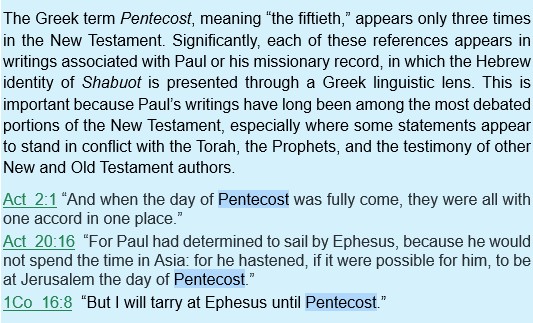
Luke records the promise of the coming outpouring, while Peter identifies its prophetic fulfillment through the words of the prophet Joel. Remarkably, neither Luke nor Peter attaches the event to the term Pentecost or explains it through a fifty-day count. Instead, that timing is often assumed through later interpretive frameworks that rely heavily on Paul’s use of the Greek term, rather than on the wording of Luke, Peter, or Joel.
What I am getting at is that it appears that the events of that great day attributed to “Pentecost” or even the Feast of Weeks (Shabuot) had no such tie. We do not have a second or third witness from another biblical author that can vouch for Paul’s writings that speak of Pentecost or that the event of the Power on High would be tied to the Count to Shabuot.
Taken together, this suggests that the outpouring of power from on high should not automatically be identified with the traditional fiftieth-day Pentecost reckoning or even the Count to Shabuot. The event itself is firmly established, but its connection to Pentecost is not confirmed by multiple independent biblical witnesses, nor does it appear to rest securely upon the Torah’s foundational instructions for Shabuot. Therefore, it is my current belief that the traditional Pentecost framework should be considered suspect, especially where it stands out of harmony with the complete-week structure of the Count to Shabuot established in the Torah.
How Then Shall We Keep the Feast of Shabuot?
With the count restored and its appointed time revealed, a natural question must be asked: How then shall this Feast be observed?
For the Feast of Shabuot is not merely a date to be calculated, but a sacred appointment to be entered into with understanding, reverence, and joy.
Having followed the pattern of Sabbaths complete (weeks complete), and having arrived at the New Moon of the Fifth Month, the waxed mighty, the renewed fullness of light, we find ourselves standing at a moment that is both a conclusion and a beginning. It is the completion of a divinely ordered count, and at the same time, a renewal of alignment with the Creator’s original design of time.
Thus, this Feast becomes a celebration not only of arrival, but of restoration.
It is a time to rejoice in a loving Creator and Redeemer who has left nothing to chance. From the structure of the weeks to the placement of the months, and from the rising of the luminaries to the appointed times they declare, every detail has been established with purpose. The count to Shabuot bears witness to this design, revealing that the path of time itself has been carefully laid out for those who seek to walk in His ways.
To keep this Feast, then, is to acknowledge that design.
In contrast to the confusion born of human reckoning, shaped by an altered system of time disengaged from the Creator’s heavenly luminaries, months vary without consistency, and weeks cycle without anchor due to the absence of the full New/Renewed Moon. In its place, a restored understanding now comes forth through which order and alignment are brought back into view. It is to honor the full New Moon as the marker of renewal, to recognize the completion of the weeks as a testimony of His appointed rhythm, and to gather for worship in a set-apart assembly with hearts turned toward Him.
But more than this, it is a preparation.
For just as the Bride makes herself ready, so too do these appointed times serve as rehearsals of a greater fulfillment yet to come. Each Feast, in its order, calls the faithful to refinement, to alignment, and to readiness for the return of the Bridegroom.
In this light, the Feast of Shabuot stands as a profound reminder that time itself has been given as a gift, a guide, and a witness of our Eternal Father’s tender love and abiding nearness, leading those who seek favor into harmony with their Creator and toward the promise of an eternal dwelling in His presence.
Final Conclusion
What has been outlined in this study is not the invention of a new system, but the uncovering of an ordered design that has always been present within the Torah’s Hebrew text.
When the instructions are followed as given, when the weeks are allowed to remain complete, and when the appointed conclusion is recognized for what it is, the count to Shabuot reveals a consistency that cannot be produced by continuous cycles on a Roman-crafted solar calendar of human reckoning. It bears the marks of something established beyond tradition, beyond translation, and beyond alteration.
This carries with it an important implication.
If even one appointed time has been misunderstood due to changes in how time itself is measured, then the question must be extended beyond a single feast. The matter is no longer isolated; it touches the very framework by which all appointed times are known and observed.
Scripture has already forewarned that there would be an attempt to alter “times and laws.” Yet, embedded within the Word remains a witness that cannot be silenced. The original pattern endures. The original structure remains. And for those willing to examine it closely, the original evidence continues to speak.
The invitation, then, is not to accept this conclusion without thought, but to consider it with care. To return to the text. To test what has been shown in detail in the Word Study link. And to seek alignment, not with what has been most popular or widely practiced, but with what has been most faithfully preserved behind the curtain of truth.
For the appointed times were not given to confuse, but to guide. Not to drift, but to anchor. And not to divide, but to bring all who seek truth into harmony with the order established from the beginning. So it is that a pathway in time was appointed by our Creator to prepare all who seek the Promised Land, a divine order of sacred appointments through which salvation is revealed, rehearsed, and ultimately received by those who desire to walk in obedience and faith.
At the end of the day, if you are not yet persuaded by the evidence presented, take time to prayerfully consider these things before YAHUAH. Continue walking according to the understanding you presently possess until the Father of Lights, from whom comes every good and perfect gift, brings greater clarity and conviction to your heart and mind.
Dear Eternal Father, Yahuah Alahim,
Give us humble and discerning hearts as we examine Your
Word and seek the ancient paths You
established from the beginning.
Teach us to recognize the sacred order of Your appointed
times and to follow the heavenly witnesses
You placed above us.
Grant us wisdom to understand the Count to Shabuot,
testing every conclusion prayerfully rather
than relying upon inherited tradition.
May all your faithful hear the call to restore Your Torah, Your
appointed calendar, and the redemptive
pathway revealed through
Yahusha haMashiach.
Prepare us as a faithful people, ready to walk in
obedience, truth, and joyful anticipation
of the Bridegroom’s return.
Barak hashem Yahusha haMashiach!
(Bless the name of Yahusha the Messiah!)
Kerrie L. French
TheCreatorsCalendar29.5@gmail.com
www.TheCreatorsCalendar.com
Treasury of Evidence: The Full Moon Announces Lunar Months
Menorah, the Gold Standard of Time
The Sacrifice Schedule, the Master Key of Time
Restored Prophetic Feast Days of Yahuah
Mo’edim and the Missing Key Puzzle Piece