Remphan, Chiun, Saturn, and the Legacy of Saturday Worship
Remphan, Chiun, Saturn,
and the Legacy of Saturday Worship
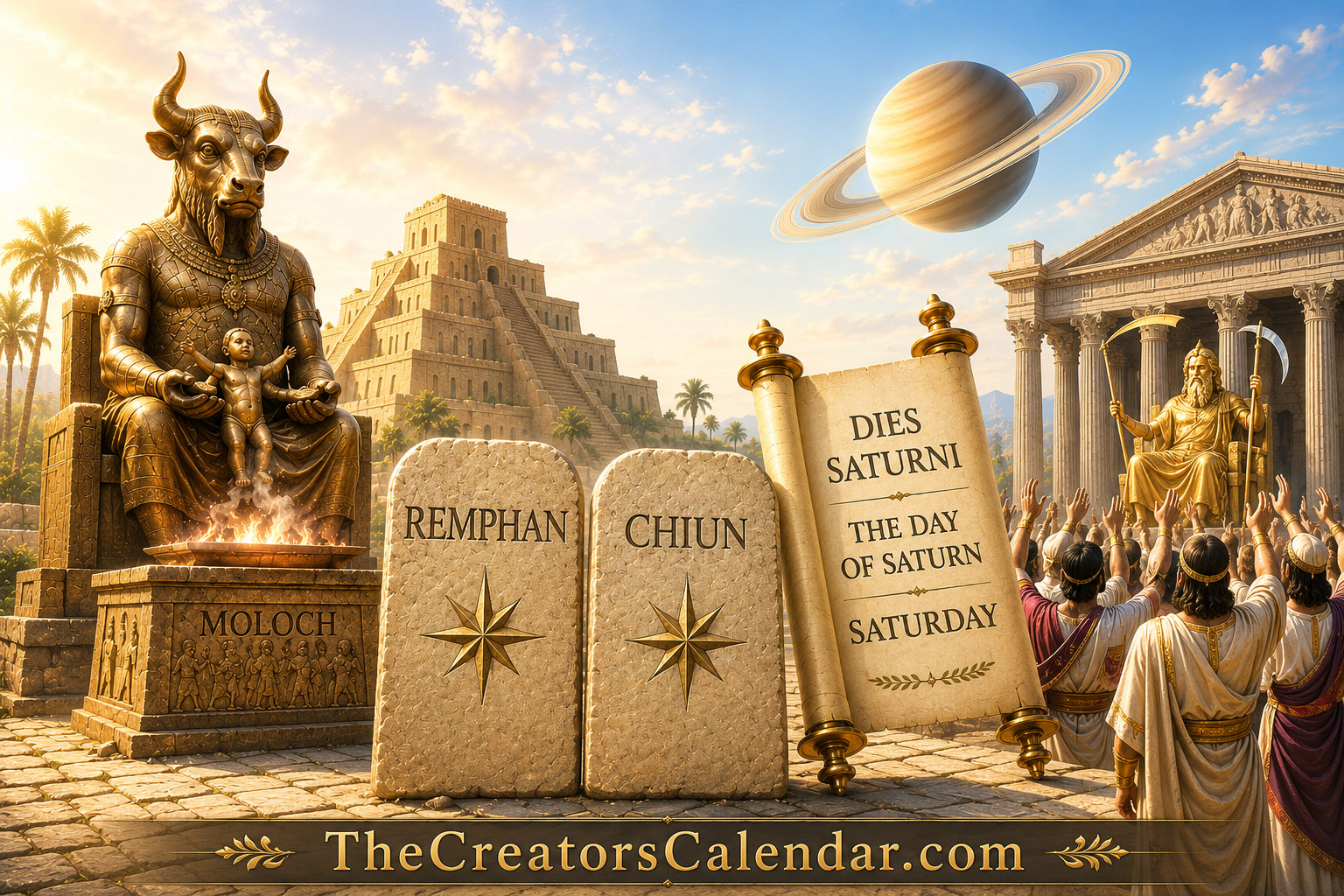
Few subjects generate more discussion among students of Scripture than the origin of the modern weekly cycle and the names assigned to its days. While most worshipers have never questioned why the seventh day is called Saturday, the Scriptures contain several intriguing references that invite closer examination. Among these are the names Chiun and Remphan, two terms associated with celestial worship and linked by many scholars to the planet Saturn.
The prophet Amos issued a solemn warning to ancient Israel for adopting forms of worship borrowed from the surrounding pagan nations, including “Chiun … the star of your god” (Amos 5:26).
Centuries later, Stephen repeated the same rebuke before the Sanhedrin, referring to “the star of your god Remphan” (Acts 7:43).
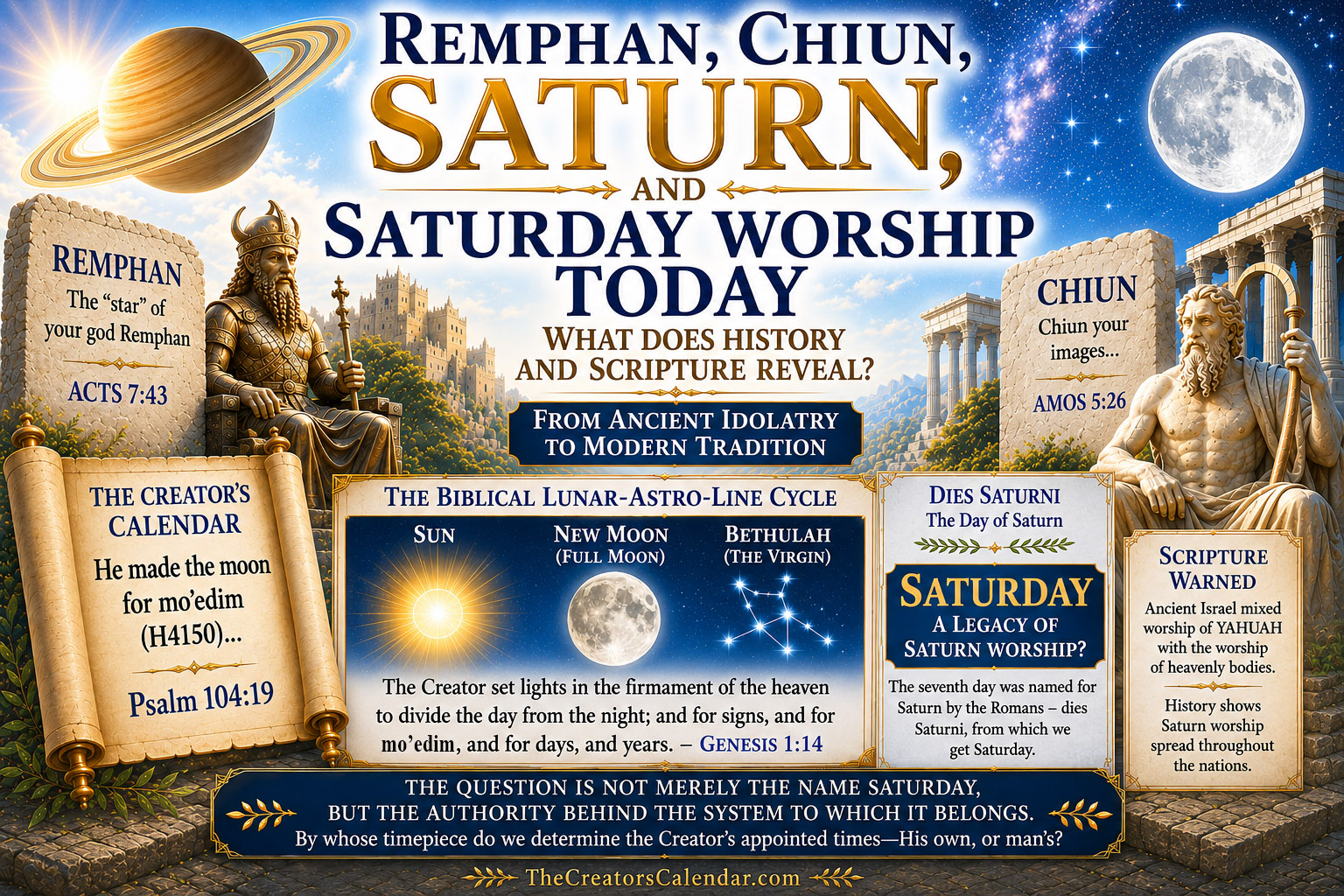
The connection between Chiun and Remphan has long been recognized. Numerous historical and linguistic studies identify both names with Saturn, one of the most prominent celestial deities of the ancient world. The worship of Saturn spread throughout Babylon, Assyria, Egypt, Greece, and ultimately Rome, where the seventh day became known as dies Saturni, the Day of Saturn, from which the English name Saturday is derived.
This raises an important question. Is the modern designation of the seventh day merely a harmless cultural label inherited from Rome, or does it preserve a much older connection to planetary worship that Scripture specifically condemns? More importantly, what calendar cadence did the Creator establish in the beginning, and how does that rhythm compare with the continuous planetary week inherited from the Greco-Roman world?
The purpose of this study is not to attack sincere believers who worship on Saturday, any more than those who worship on Sunday. Rather, it is to examine the historical and biblical evidence surrounding Chiun, Remphan, Saturn, and the development of the modern weekly cycle. In doing so, we will explore whether the Creator’s appointed times were originally governed by a planetary sequence at all, or whether they were established according to an entirely different timekeeping system revealed through the sun, moon, and stars from Creation itself.
Throughout Scripture, the Creator consistently identifies His appointed times through the heavenly lights He established on the fourth day of Creation. The sun was given to govern the day, while the moon and stars were appointed to govern the night and to serve as signs for seasons (H4150 – mo’edim – lunar appointed time), days, and years. Yet the modern continuous weekly cycle operates independently of these celestial witnesses, deriving instead from the planetary week inherited through Babylon, Persia, Greece, and Rome.
The issue before us is not merely the name Saturday, but the authority, cadence, and purpose behind the system to which it belongs.
The question, therefore, is not whether sincere believers may worship the Creator on Saturday, but whether the continuous planetary week represents the original calendar framework established by the Creator or a later substitute and counterfeit system adopted by mankind.
If the Sabbath was originally established within the trinity of lights of the sun, moon, and stars, then the discussion extends far beyond the name Saturday. It reaches into the very heart of the biblical question: By whose authority and timepiece do we determine the Creator’s divine appointments, His own, or man’s?
The Biblical Warning Concerning Chiun and Remphan
Long before the rise of Christianity, before the Roman Empire, and before the modern names assigned to the days of the week, Scripture recorded a solemn warning, as touched on in the intro, regarding the adoption of foreign systems of worship.
The prophet Amos declared:
“But you have borne the tabernacle of your Moloch and Chiun your images, the star of your god, which ye made to yourselves.” Amos 5:26
More than seven centuries later, Stephen stood before the Sanhedrin, shortly before his martyrdom, and quoted the same warning:
“Yea, you took up the tabernacle of Moloch, and the star of your god Remphan, figures which you made to worship them: and I will carry you away beyond Babylon.” Acts 7:43
At first glance, these passages appear obscure. Many readers pass over the names Moloch, Chiun, and Remphan without giving them much thought. Yet Stephen’s decision to revisit this warning is significant. Standing before the religious leaders of his day, he was not merely recounting history. He was reminding them that Yasharal (Israel) had repeatedly fallen into the temptation of blending the worship of Yahuah with religious systems borrowed from surrounding nations.
The warning centers upon two distinct elements. The first is Moloch, a deity associated with some of the most detestable forms of pagan worship. The second is described as “the star of your god,” identified as Chiun in the Hebrew text and Remphan in the Greek account preserved in Acts. The fact that both passages connect these names with a star immediately directs our attention toward the worship of the heavenly host.
This distinction is important. The issue was not simply the worship of carved images made of stone, wood, or metal. The warning extends to celestial worship, the veneration of heavenly bodies, and the adoption of timekeeping and religious systems associated with them. Throughout Scripture, Yahuah consistently forbids His people from lifting their eyes to heaven in order to worship the sun, moon, stars, or any part of the host of heaven.
One of the passages most frequently cited in discussions concerning the heavenly lights is Deuteronomy 4:19:
“And lest thou lift up thine eyes unto heaven, and when thou seest the sun, and the moon, and the stars, even all the host of heaven, shouldest be driven to worship them, and serve them.” Deuteronomy 4:19
Many readers have understood this passage to mean that the heavenly lights possess little or no role beyond their physical existence. Yet a closer examination reveals that Moses was not condemning the Creator’s appointed use of the sun, moon, and stars. Rather, he was warning against transforming them into objects of worship. For more on Deuteronomy 4:19, refer to the article Lest You Worship the Sun, Moon, and Stars.
The Creator had already assigned these heavenly witnesses a sacred purpose. According to Genesis 1:14-18, they were appointed as signs, for mo’edim (appointed times), for days, and for years. Their intended role was to reveal the Creator’s order in time, not to become the focus of devotion themselves.
As reflected in the Restored Hebrew Interlinear Translation, Deuteronomy 4:19 may be understood as emphasizing the heavenly lights as signs appointed by Yahuah for all peoples, while simultaneously warning against setting them aside as objects of worship and service. Thus, the warning is not directed against the Creator’s calendar, but against the corruption of it through idolatry.
Throughout history, many nations transformed these celestial witnesses into deities, assigning them names, personalities, powers, and systems of worship. It is within this context that the names Chiun and Remphan emerge.
The biblical record presents them not as harmless cultural references, but as part of a larger warning against replacing the Creator’s ordained system with traditions rooted in the worship of the host of heaven.
The question before us, therefore, is straightforward: Who were Chiun and Remphan, and why did both Amos and Stephen consider their worship important enough to condemn? The answer leads directly into the ancient world of astral religion, planetary deities, and the historical figure most scholars identify with these names: Saturn.
The Difference Between Astronomy and Astrology
One of the reasons the subject of Chiun, Remphan, and the heavenly host is often avoided today is because many believers understandably associate any discussion of the stars and constellations with astrology. As a result, the entire subject is frequently dismissed as pagan, occult, or contrary to Scripture.
Yet Scripture itself draws an important distinction. The heavenly lights function as witnesses to the Creator’s order and government. Their existence is never condemned. What Scripture condemns is the worship of those lights or the attempt to use them for divination, fortune-telling, or the prediction of personal destiny.
This distinction may be illustrated by the difference between astronomy and astrology. Astronomy is the observation and study of the heavenly bodies and their movements. Astrology, on the other hand, assigns spiritual powers to those bodies and claims they influence or determine human destiny. The prophet Isaiah addressed this very practice when he challenged the astrologers and stargazers of Babylon:
“Let now the astrologers, the stargazers, the monthly prognosticators, stand up, and save thee from these things that shall come upon thee.” Isaiah 47:13
The issue, therefore, is not the existence of the heavenly lights, but the misuse of them. The very lights that were appointed to reveal the Creator’s order became the foundation for elaborate systems of astral religion and planetary worship.
Many historians trace the development of such systems to the ancient civilizations of Mesopotamia and Babylon, where celestial bodies became associated with various deities. Over time, these associations spread throughout the ancient world, influencing the religious traditions of Assyria, Egypt, Greece, and Rome. As these traditions developed, the names of celestial deities became attached to days, months, and other units of time.
This historical background is particularly relevant when examining the names Chiun and Remphan. Both Amos and Stephen associate these names with the worship of a “star” or celestial deity. Their warning was not directed against the Creator’s heavenly lights, but against the corruption of their intended purpose through systems of worship that exalted the creation above the Creator.
Understanding this distinction allows us to approach the subject without confusion. The question before us is not whether the heavenly bodies have significance. Scripture plainly says they do. The question is whether mankind has faithfully preserved the Creator’s intended use of those lights, or whether alternative systems arose that gradually obscured their original purpose. To answer that question, we must now examine the historical identity of Chiun and Remphan.
Who Were Chiun and Remphan?
Having established the biblical warning concerning Chiun and Remphan, the next question is obvious: Who were they?
At first glance, the names appear mysterious. Outside of Amos 5:26 and Acts 7:43, neither name receives extensive treatment in Scripture. Yet despite their limited appearance, they have generated considerable interest among historians, linguists, and students of biblical antiquity.
The immediate question is whether Chiun and Remphan refer to two different entities or simply two names for the same one. The overwhelming conclusion of both ancient and modern scholarship is that they represent the same celestial deity viewed through different languages and cultures.
The Hebrew term Chiun (also rendered Kiyyun, Kaiwan, or Chiwan) bears striking similarities to ancient Near Eastern names associated with Saturn. Variations of the name appear in Assyrian, Babylonian, Persian, Arabic, and other Semitic traditions. In several of these languages, forms of Kaiwan became established names for the planet Saturn itself.
The identification of Chiun with Saturn is not a modern theory. Morris Jastrow and George A. Barton, writing in The Jewish Encyclopedia, observed that Chiun (Kaiwan/Kewan) was associated with the Assyrian-Babylonian designation for Saturn. (The Jewish Encyclopedia, Vol. 4, 1903, p. 39.)
The Greek translators of the Septuagint, working several centuries before the Messiah’s earthly ministry, appear to have understood this connection. Rather than transliterating Chiun directly, they rendered the name as Rephan or Remphan, a designation that Stephen later repeated in Acts. Although scholars continue to debate the precise linguistic pathway between the names, the association with Saturn has remained remarkably consistent.
This identification becomes even more significant when the biblical text is examined carefully. Neither Amos nor Stephen merely mentions a deity. Both associate Chiun and Remphan with a “star.” This detail points directly toward astral religion, a form of worship in which heavenly bodies were personified, deified, and incorporated into elaborate religious systems.
Such practices were widespread throughout the ancient world. Babylon associated celestial bodies with divine powers. Assyria incorporated planetary worship into state religion. Egypt blended astronomical observations with its pantheon of gods. Greece and Rome later adopted many of the same concepts, assigning planetary deities to the days of the week and embedding them within their calendars.
Within this broader historical setting, Chiun and Remphan are best understood not merely as obscure names but as representatives of a much larger system of celestial worship that spread throughout the ancient world. It is this system, rather than a simple name, that Amos and Stephen condemned.
The evidence, therefore, leads naturally to the next question: How did Saturn become one of the most revered celestial deities of antiquity, and how did its influence eventually become woven into the calendar still used throughout much of the world today?
Saturn Worship in the Ancient World
If Chiun and Remphan were indeed names associated with Saturn, then understanding Saturn’s place in the ancient world becomes essential to understanding the biblical warning itself.
The roots of planetary worship reach deep into antiquity. Ancient Mesopotamian civilizations carefully observed the movements of the heavenly bodies and gradually associated them with various divine powers. Over time, these associations became integrated into religious systems, state ceremonies, and calendars. What began as observation gradually evolved into reverence, devotion, and eventually worship.
Among the most influential of these systems was that of Babylon. The Babylonians developed extensive astronomical records and assigned spiritual significance to the visible planets. Saturn, the slowest-moving of the commonly observed planets, came to occupy a prominent place within this celestial hierarchy. Its movements were believed to carry meaning, influence events, and reveal the intentions of the gods.
As Babylonian influence spread throughout the ancient Near East, so too did its celestial religion. Assyria adopted many of the same concepts. Persia inherited portions of the tradition. Egypt blended planetary symbolism into its own religious framework. By the time of the Greek and Roman empires, planetary deities had become deeply woven into the fabric of society.
The Greeks identified Saturn with Kronos, a powerful figure in their mythology. The Romans later adopted and adapted this tradition, referring to the deity as Saturnus. Annual festivals known as Saturnalia were celebrated throughout the Roman world, honoring Saturn through feasting, gift-giving, and public festivities.
Yet the significance of Saturn extended beyond festivals and mythology. The deity’s influence became permanently embedded within the Roman method of reckoning time. As the planetary week gained acceptance, each day was assigned to a celestial deity. Saturn was given rulership over the seventh day, which became known as dies Saturni, the Day of Saturn.
Their concern was the elevation of created things into objects of worship and the adoption of religious systems rooted in that practice.
The issue, therefore, was never the planet itself. The issue was the religious significance attached to it. What the Creator established as a witness in the heavens, mankind repeatedly transformed into a deity.
This distinction becomes increasingly important as we examine how the planetary week developed and how the name of Saturn eventually became attached to the day now known as Saturday.
Why Are Moloch and Remphan Mentioned Together?
One of the most intriguing features of Amos 5:26 and Acts 7:43 is that Moloch and Chiun (Remphan) appear together in the same warning. This association is unlikely to be accidental.
Moloch was among the most notorious deities of the ancient world, becoming synonymous with practices that Scripture repeatedly condemns, including child sacrifice. Chiun and Remphan, by contrast, are connected to the worship of a celestial power identified by many scholars with Saturn.
Though different in expression, both represent the same underlying problem: the substitution of man-made religious systems for the worship of the Creator. One centered upon earthly idols and ritual practices. The other elevated a member of the heavenly host into an object of reverence.
This helps explain why Stephen repeated Amos’s warning before the Sanhedrin. The issue was not merely the worship of particular deities, but the adoption of foreign systems that gradually displaced the authority of Yahuah and obscured His appointed order.
Thus, Moloch and Remphan stand as two witnesses to the same recurring temptation: exchanging the worship of the Creator for the worship of created things.
It is against this backdrop that Saturn’s prominent role in the ancient world must now be examined.
How Saturn Came to be Associated with the Seventh Day
Saturn was not merely a distant planet in the ancient world, but a major celestial deity within the religious systems of Babylon, Greece, and Rome. This raises an important question: how did the name of Saturn become attached to the seventh day of the modern week?
The answer lies in the development of what historians commonly call the planetary week. Unlike the biblical calendar, which marks each day of the week with a unique lunar phase, its hours by the movement of the sun, and its years and months with a starry constellation, the planetary week assigned each day to one of the seven visible celestial bodies recognized by the ancient world: the Sun, Moon, Mars, Mercury, Jupiter, Venus, and Saturn.
The origins of this system are generally traced to ancient Mesopotamia, where celestial bodies were associated with various deities and believed to exert influence over earthly affairs.
The Greeks identified the visible planets with members of their pantheon. The Romans later adopted many of these associations, assigning each day of the week to a particular planetary deity. Thus arose such designations as the Day of the Sun, the Day of the Moon, the Day of Mars, and the Day of Saturn.
The Roman designation for the seventh day was dies Saturni, literally meaning “the Day of Saturn.” Unlike the names of several other weekdays, which changed significantly as they passed through Germanic and English traditions, Saturn’s name survived largely intact. As a result, the English word Saturday remains one of the clearest surviving witnesses to the planetary origins of the modern week.
This fact does not prove that everyone who observes Saturday is worshiping Saturn, any more than using the month names January or March implies devotion to the Roman gods Janus or Mars. Most people are entirely unaware of the historical origins of the names they use. Nevertheless, the historical connection itself is difficult to deny.
The more significant question concerns the system behind the name. The planetary week was not originally established as a neutral method of counting time. It developed within cultures that associated celestial bodies with divine powers and integrated those associations into their calendars, religious observances, and civil administration.
This observation brings us back to the warnings of Amos and Stephen. Their concern was not merely the pronunciation of a name, but the adoption of religious systems rooted in concepts foreign to the worship of Yahuah. The issue was never whether a planet existed in the heavens. The issue was the spiritual significance and rhythm of worship that men attached to it.
The question before us, therefore, is not whether Saturn gave its name to Saturday. History has already answered that. The deeper question is whether the continuous weekly cycle, named after the various planets, itself originated with the Creator’s calendar, or whether unbroken cycling week represents a later development that gradually displaced the original biblical framework for measuring the week.
To answer that question, we must examine whether Scripture establishes a planetary week at all.
Did the Creator Establish a Planetary Week?
Having traced the historical development of the planetary week, an important question remains: Did the Creator ever establish such a system?
The answer must be sought in Scripture itself.
If the planetary week originated with the Creator, one would expect to find some reference to it within the biblical record. Yet from Genesis to Revelation, the Scriptures never assign the names of planetary deities to the days of the week, nor can we find evidence of a week that cycles continuously. Nowhere in the Bible do we read of the Day of Saturn, the Day of the Sun, the Day of Mars, the Day of Venus, or any of the other designations that later became common throughout the Greco-Roman world.
Instead, the biblical account directs our attention to an entirely different method of reckoning time.
At Creation, the heavenly lights were given a specific purpose:
“And Alahim said, Let there be lights in the firmament of the heaven to divide the day from the night; and let them be for signs, and for
seasonsmo’edim (H4150 – specific lunar appointed time), and for days, and years.” Genesis 1:14
The Hebrew word translated “seasons” is mo’edim (H4150), a term used throughout Scripture to describe appointed times, sacred assemblies, and divine appointments, based upon the moon. From the very beginning, the heavenly lights were established as the Creator’s witnesses of time.
Notice what is absent from the creation account. There is no mention of planetary gods. There is no assignment of weekdays to celestial deities. There is no instruction to follow a continuous planetary cycle independent of the heavenly lights. Instead, the sun, moon, and stars are presented as the Creator’s appointed timekeepers.
This pattern continues throughout Scripture. The psalmist declares:
“He appointed the moon for mo’edim.” Psalm 104:19
Likewise, Isaiah describes a future restoration in which worship is measured from New Moon to New Moon and from Sabbath to Sabbath:
“And it shall come to pass, that from New Moon to New Moon, and from Sabbath to Sabbath, shall all flesh come to worship before me, says YAHUAH.” Isaiah 66:23
These passages do not establish every detail of the Creator’s calendar. They do, however, establish a foundational principle: Scripture consistently directs attention to the heavenly lights and the Creator’s appointed times rather than to a continuous sequence of planetary names inherited from later civilizations. Although this calendar is primarily lunar, its year is regulated by a nineteen-year astro-lunar-solar cycle. A regular twelve-month lunar year contains approximately 354 days, making it about eleven days shorter than the solar year and about twenty-two days short after two years. For this reason, a thirteenth month automatically occurs every second or third year, realigning the lunar months with the solar seasons, following the established cycle of years 3, 6, 8, 11, 14, 17, and 19. The Creator’s unique timepiece never gets off track.
The question, therefore, is not whether a planetary week exists. History demonstrates that it does. The question is whether the planetary week originated with the Creator or arose thousands of years later from an entirely different source. If so, generations may have unknowingly exchanged the Creator’s timepiece for one of human origin, obscuring both His appointed order and the unfolding Plan of Salvation through which the remedy for sin is revealed.
To answer that question more fully, we must examine the role of the heavenly lights within the Creator’s calendar and the testimony they continue to provide throughout Scripture.
The Sabbath Question Revisited
At this point, an important clarification must be made. The purpose of this study is not to condemn sincere believers who worship on Saturday. Many faithful men and women throughout history have sought to honor the Creator according to the light available to them. The issue before us is not sincerity, but authority.
The historical evidence demonstrates that the modern planetary week arose from sources outside the biblical record. It also demonstrates that the name Saturday is derived from Saturn, one of the celestial deities of ancient Babylon. Yet these facts alone do not answer the central question.
The real question is this: How did the Creator intend His sacred Sabbath to be identified, according to what rhythm?
Throughout Scripture, the Sabbath is never defined as the seventh day of a continuous planetary cycle. Rather, it is presented as part of a larger framework of appointed times established by the Creator Himself. The same Scriptures that identify the Sabbath also direct attention to the heavenly lights appointed for signs, mo’edim (H4150 – specific lunar appointed times), days, and years.
This distinction is often overlooked. The debate is frequently reduced to whether one should worship on Saturday or Sunday. Yet Scripture presents a different question altogether. Before one can identify the correct Sabbath, one must first identify the calendar upon which that Sabbath was divinely created to be established.
A date cannot exist apart from the calendar that defines it. Likewise, a Sabbath cannot be identified apart from the timekeeping system upon which it rests. Therefore, if the Creator established a specific method for measuring sacred time, that method alone must consistently determine the placement of His Sabbaths and appointed times.
This brings us to the heart of the matter. If the planetary week (Sunday through Saturday) did not originate with the Creator, then by what mechanism were His Sabbaths originally established? Were they intended to function independently of the heavenly lights, as some declare, or were they inseparably connected to His trinity of lights, His celestial witnesses appointed at Creation?
The answer to that question lies not in Roman tradition, rabbinic tradition, or modern Christian convention, but in the testimony of Scripture itself. As we shall see, the Creator embedded multiple witnesses within His calendar system, witnesses that continue to testify to its original structure and design.
Among the most compelling of these witnesses are the Sanctuary’s/Tabernacle’s sacrificial schedule and the Menorah, both of which preserve patterns that point back to the Creator’s appointed order of time.
The Witness of the Sacrificial Schedule
One of the most compelling witnesses to the Creator’s calendar is found within the sacrificial schedule itself. Remarkably, this system was in part re-introduced to Moses only fourteen days before the first Passover and fifteen days before the liberation of the Hebrew captives from Egypt.
At that moment, Yahuah was not merely delivering a people from physical bondage. He was preparing them for an inheritance. The journey from Egypt to the Promised Land would require more than freedom from slavery. It would require a complete reorientation of heart, mind, worship, and time itself. Before the children of Yasharal could enter the Promised Land, they would need to learn the ways of their Creator and be trained in the sacred order by which His kingdom operates.
For this reason, the early months in the wilderness became a period of instruction and preparation. The Wilderness Sanctuary was established as a model of the Plan of Salvation, revealing the pathway by which sinners could be reconciled to their Creator. At the same time, the framework of sacred time was defined through the New Moons, Sabbaths, appointed times, and the sacrificial schedule that governed them.
This was no ordinary calendar. It was a divinely appointed system designed to guide a redeemed people from bondage to their ordained designation. Every sacrifice, every appointed time, and every sacred assembly served as a continual reminder of the Creator’s redemptive purposes and the pathway leading to the Promised Land.
Perhaps most importantly, the sacrificial schedule functioned as a perpetual witness to the calendar itself. As long as the prescribed sacrifices continued to be offered according to their appointed times, the structure of the calendar could never be lost. The daily morning and evening sacrifices identified ordinary days. The unique Sabbath sacrifices identified the Sabbaths. The New Moon day contained the most sacrifices, which identified the beginning of each month. And the annual feast day sacrifices marked the Creator’s appointed times throughout the year.
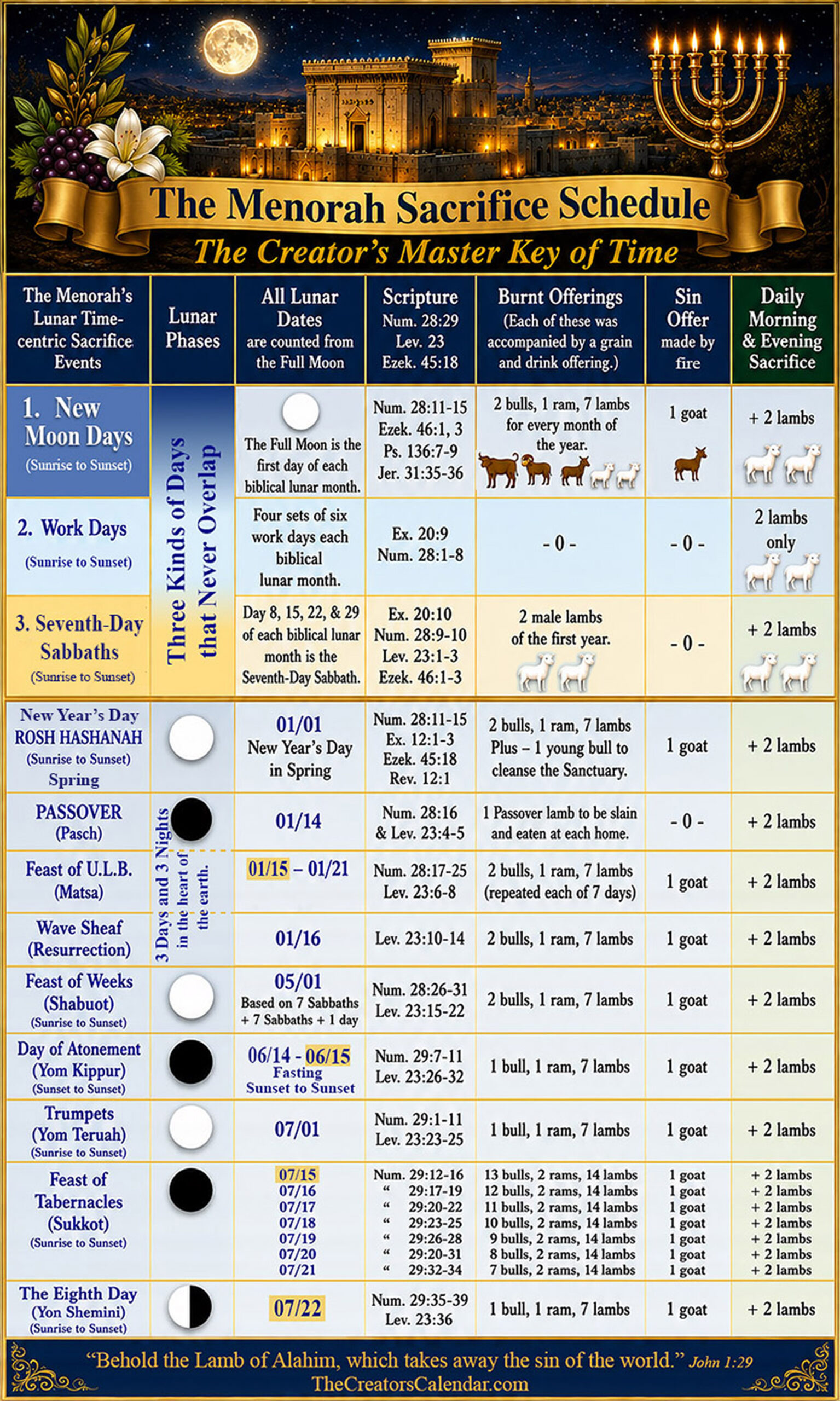
Thus, embedded within the sacrificial schedule is a divinely preserved testimony to the order of sacred time. From year to year and generation to generation, this appointed pattern continued to bear witness to the marvelous work of the Messiah on behalf of all humanity. Since His death and resurrection as the promised and prophesied Lamb of Yahuah, no further animal sacrifices are required, for He paid the full price as the remedy for sin and sinners. Yet the sacrificial schedule, recorded in Scripture for a time such as this, remains a faithful witness. When carefully considered and prayerfully contemplated, it continues to lead diligent seekers of truth back to Yahuah’s ordained rhythm of worship and sacred time.
The principle remains just as relevant today. Just as Yahuah, the Most High, called His people out of Egypt and instructed them in His sacred ways before leading them into the Promised Land, so He continues to call His people out of spiritual confusion and restore the knowledge of His appointed times. The destination has changed. Yet, the Promised Land still lies before His people, and the preparation required to enter it remains unaltered, a matter of learning to walk in harmony with His will.
Four of the most important conclusions emerging from the Sacrificial Schedule are these.
- Three distinct kinds of days are recognized throughout the calendar that never overlap: New Moon Days, work days, and Seventh-day Sabbaths.
- The timekeeping system reflected in Creation, the Sanctuary/Tabernacle and later Temples, as well as the life and sacrificial death of Yahusha the Messiah on Passover, all testify to the same harmonious calendar framework.
- Significantly, none of the sacred Feast Day appointments are identified by the names of planetary deities or arranged according to the rhythm of a continuous planetary week.
- Rather, they reveal the Creator’s own calendar, governed by the heavenly lights with weeks organized into four weekly cycles that extend from New Moon to New Moon. The contrast is striking: both the names and the rhythm of the planetary weekly cycle stand in opposition to the calendar system established by Yahuah Alahim the Creator, and testified throughout Scripture.
The restoration of the Creator’s calendar is therefore far more than an academic exercise in timekeeping. It is part of a larger call to return to the ancient paths, to rediscover the order established at Creation, and to align our soul temples with the sacred appointments through which the Plan of Salvation is revealed and rehearsed. As in the days of Moses, Yahuah is now gathering and preparing a people who seek Him with all their heart, that they may be ready to receive the inheritance He has promised from the beginning. And like ancient Yasharal (Israel), change is required. Absolutely no one entered the Promised Land who clung to the ways of Egypt.
The Menorah as a Witness of Time
Having examined the testimony of the sacrificial schedule, we now turn to another witness that stood at the very heart of the Sanctuary/Tabernacle/Temple itself: the seven-branched candlestick also referred to as the Menorah.
Most believers recognize the Menorah as a sacred symbol of light, truth, and the presence of Yahuah. Yet few have considered that it may also serve as a witness to His ordained calendar displayed in the heavens to preserve His unique cadence of worship.
Moses did not design the Menorah, nor was it borrowed from the religious traditions of Egypt or the surrounding nations. Its pattern was revealed directly by Yahuah Alahim, the Most High, and constructed according to divine instruction. Every detail carried meaning, and every feature was intended to teach eternal spiritual truth.
When viewed from the perspective of a priest entering the Holy Place from the east to tend to the table of shewbread or minister at the altar of incense, the Menorah stood along the southern wall of the Sanctuary. Its seven-branched candlesticks formed a symmetrical arrangement, with three branches extending toward the east, three toward the west, and the central lamp occupying a unique position between them.
When examined as a witness of time, the arrangement presents a remarkable pattern. The eastern positions correspond to the full moon phases that identify the beginnings of lunar months, while the western positions correspond to the dark conjunction phases that occur in the middle of the month. The central candlestick that stands between the east and the west-reaching branches marks the transition from one half of the monthly cycle to the other and is represented by the last quarter phase.
From the perspective of the table of shewbread, each lunar-phase sphere appears the same, with the illuminated portion on the right and the darkened portion on the left. From the perspective of the sun, all of the lunar spheres would appear fully illuminated, as full moons. Yet from the perspective of the Earth, which is placed at the center between the eastern and western branches, the phases are perceived differently. The lunar spheres positioned to the east are seen as full moons, while those positioned to the west represent the dark conjunction phases. The final sphere directly above the center represents the last quarter phase.
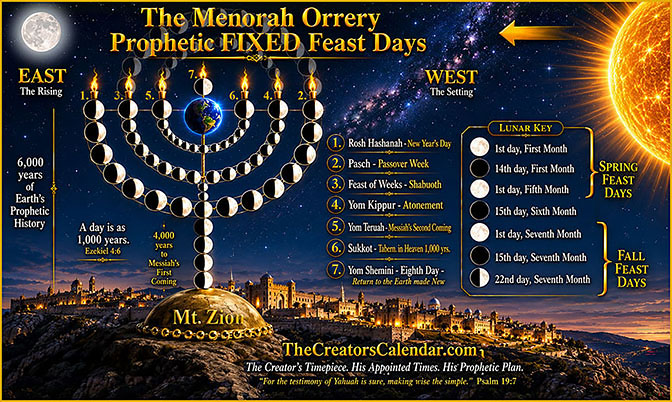
Time was measured by progressing from the eastern full moon position along the branches of the Menorah, counting the intervening days until reaching the western conjunction position. Along this pathway appear the New Moon Days, Sabbaths, and annual appointed times, each occupying a precise location within the Creator’s sacred order.
Significantly, nearly every annual feast is anchored by either a full moon or a conjunction moon, identifying the beginning or midpoint of a lunar month. The lone exception is the final feast, which occupies the central position of the Menorah, standing as the culminating appointment within the overall pattern.
This relationship is especially significant because the Menorah stood within the Sanctuary itself, the earthly model of the Plan of Salvation. If the Sanctuary revealed the pathway of redemption, it should not surprise us to find that the Menorah also bears witness to the timing by which that most sacred plan unfolds.
The result is a second independent witness. Just as the sacrificial schedule reveals an orderly structure of New Moons, Sabbaths, and appointed times, the Menorah likewise testifies to a harmonious framework established by the Creator Himself. Neither witness is anchored to Roman tradition, rabbinic tradition, or the continuous planetary week. Together, these two witnesses direct our attention back to the ancient paths, where the Creator’s sacred order of time remains preserved within the testimony of Scripture itself.
The modern Jewish nine-branched menorah, more accurately called a Hanukkiah, is not utilized in this article because it is not the seven-branched Menorah described in the Torah for the sanctuary service. Modern Jews have lost the meaning of the Menorah and its application to the Messiah and the remedy for sin. The two additional lights are connected to the later celebration of Hanukkah, with eight candles representing the traditional eight days of dedication and an additional servant candle, called the shamash, used to light the others. While the Hanukkiah holds meaning within Jewish tradition, it does not belong to the original sanctuary pattern given to Moses and ignores the marvelous work of the Messiah. For this reason, the focus of this study remains upon the seven-branched Menorah established by Yahuah, whose structure bears witness to the detailed Plan of Salvation. Thus, the seven-branched Menorah is not merely an ancient sanctuary furnishing, but a prophetic witness whose meaning extends from the Torah pattern of the Old Testament to the final events revealed in Revelation. Revelation 1:20; Revelation 2:1, Revelation 11:4.
Whether viewed through the sacrificial schedule, the lunar cycle, or the Menorah itself, the same testimony emerges: the Creator established a measurable and orderly framework of sacred time, one designed to reveal His appointed times and illuminate the unfolding Plan of Salvation.
Taken together, the sacrificial schedule and the Menorah provide two independent witnesses to the same underlying structure.
The New Moon and Sabbath Relationship
The testimony of both the sacrificial schedule and the Menorah points to an important conclusion: the New Moon and the Sabbath cannot be treated as unrelated institutions.
Throughout Scripture, these two assembly appointments repeatedly appear together. Isaiah declares:
“And it shall come to pass, that from New Moon to New Moon, and from Sabbath to Sabbath, shall all flesh come to worship before me, says YAHUAH.” Isaiah 66:23
Likewise, Ezekiel distinguishes between the New Moon and the Sabbath while presenting both as recurring appointments within the Creator’s unique system of worship:
“Thus says YAHUAH Alahim; The gate of the inner court that looks toward the east shall be shut on the six working days; but on the Sabbath it shall be opened, and on the day of the New Moon it shall be opened.” Ezekiel 46:1
These passages reveal an important principle. The New Moon and the Sabbath are not identical, yet neither are they independent of one another. The reality is that both function within the same framework of sacred time.
This relationship becomes even more significant when viewed alongside the sacrificial schedule. As touched on earlier, Scripture assigns distinct offerings to ordinary work days, Sabbaths, and New Moon days. The existence of separate sacrificial instructions reveals that the Creator recognized these as three distinct and non-overlapping categories of time, each fulfilling a unique role within His calendar. Consequently, the Sabbaths cannot be counted independently of the New Moon, but must be reckoned from it, preserving the orderly framework established by the Creator from the beginning.
The Menorah bears witness to the same pattern. Its arrangement portrays a recurring progression through the lunar month, connecting the appointed times to measurable heavenly signs established at Creation.
Taken together, these witnesses suggest that the Sabbaths were not intended to float independently through time. Rather, they functioned within a larger calendar structure governed by the Creator’s appointed heavenly witnesses.
This brings us back to the central question of the study. If the New Moons and Sabbaths were originally linked within a unified framework of sacred time, how did a continuous planetary week, operating independently of the heavenly lights, come to replace that relationship in the minds of so many worshipers?
The Prophecy of Changing Times and Laws
If the Creator established a specific framework of measuring time for His followers, should we be surprised to find a prophecy foretelling an attempt to alter it?
Daniel records the rise of a power that would challenge the authority of the Most High:
“And he shall speak great words against the most High, and shall wear out the saints of the most High, and think to change times and laws.” Daniel 7:25
For generations, students of prophecy have focused primarily upon the phrase “change laws.” Yet the prophecy places equal emphasis upon “times.” This raises an important question: What times were subject to change?
Throughout Scripture, the Creator’s divine appointments are inseparably connected to the heavenly lights He established at Creation. The New Moons, Sabbaths, and annual feast days all derive their placement from the calendar framework ordained by Yahuah. Consequently, any alteration to the method of reckoning time would inevitably affect the appointed times themselves.
No earthly power can alter the movements of the sun, moon, and stars. The heavenly witnesses continue to follow the courses established by their Creator. The prophecy, therefore, points not to a change in the heavens, but to a change in mankind’s understanding of sacred time.
This concept finds a remarkable parallel in Isaiah’s description of Lucifer’s rebellion, declaring how he will receive the worship of the Most High:
“I will ascend into heaven, I will exalt my throne above the stars of Alahim/Elohim, I will sit also upon the mount of the congregation [H4150 – mo’edim], in the sides of the north. I will ascend above the heights of the clouds; I will be like the most High.” Isaiah 14:13-14
The phrase “mount of the congregation” carries profound significance, for the Hebrew word translated “congregation” is mo’ed (H4150), the very word used throughout Scripture for Yahuah’s specific appointed times. Far from describing a vague gathering place, this phrase points to the Creator’s sacred worship rhythm, His ordained appointments, marked by the heavenly lights and centered in His divine order. The phrase “in the sides of the north” refers to the east-west time-continuum where the sun, moon, and stars revolve according to the Creator’s Calendar. Lucifer’s ambition was not merely to obtain a higher position, but to challenge the authority and order of sacred time established by YAHUAH Himself.
Likewise, his desire to exalt his throne above the stars of Alahim suggests an attempt to place himself above the heavenly witnesses appointed to govern sacred time. From this perspective, the controversy extends beyond worship alone and reaches into the realm of authority, appointed times, and the means by which they are determined. If the sun, moon, and stars were established as signs for the Creator’s mo’edim, then obscuring, altering, or replacing that system would strike at the very framework through which His people identify His sacred appointments and assemble for worship.
Whether one accepts this interpretation or not, the language of Isaiah presents a striking parallel. The rebellion in heaven was fundamentally a challenge to the Creator’s government and appointed order. It should not surprise us, therefore, that the conflict on earth would likewise involve competing systems of worship, authority, and timekeeping.
History records numerous calendar reforms and alterations, religious traditions, and systems of reckoning that arose long after the Scriptures were written. As these systems gained acceptance, the original relationship between the heavenly lights and the appointed times became increasingly obscured.
The evidence presented thus far reveals a striking contrast. On one hand stands the Creator’s calendar, witnessed by the heavenly lights, the sacrificial schedule, the Menorah, the New Moons, the Sabbaths, and all the lunar appointed Feast Days. On the other hand stands the continuous planetary week inherited from the religious traditions of the ancient pagan world.
Whether one accepts this conclusion immediately or not, the question deserves careful consideration. If Scripture warned of an attempt to alter times and laws, and if the Creator embedded multiple witnesses to His original calendar within His Word, then those witnesses merit thoughtful examination rather than dismissal.
The encouraging reality is that truth need not remain hidden. The same heavenly witnesses that guided the faithful patriarchs and prophets in ancient times continue to testify to the Creator’s appointed order today. The question is whether we are willing to follow their testimony wherever it leads.
Following the Timepiece of the Creator
The question before us is ultimately not one of history alone, nor merely one of tradition. It is a question of rhythm and authority. By what standard and rhythm shall the Creator’s appointed times be determined?
Throughout this study, a consistent pattern has emerged. The heavenly lights were established at Creation as signs, mo’edim, days, and years. The sacrificial schedule distinguishes between New Moon days, Sabbaths, and ordinary work days. The Menorah bears witness to the same orderly framework. The prophets repeatedly connect worship with the New Moons and Sabbaths, while Scripture nowhere establishes a continuous planetary week governed by the names of celestial deities.
Taken individually, each of these witnesses deserves consideration. Taken together, they form a compelling testimony pointing back to the Creator’s original system of sacred time.
The issue, therefore, is not whether sincere believers may worship Yahuah on a Saturday or a Sunday. The Creator honors every sincere heart that seeks Him in truth. The greater question is whether He is calling His people to a fuller restoration of the sacred order established from the beginning, just as He called the children of Yasharal (Israel) out of Egypt and instructed them in His ways before leading them into the Promised Land. If the first Yasharal (Israel) was required to learn the Creator’s appointed order as preparation for receiving their inheritance, should we not expect the same call to restoration for those preparing to enter the greater Promised Land yet before us?
The Scriptures reveal that truth is often restored progressively. Throughout history, Yahuah has repeatedly called His people to leave behind traditions that obscured His Word and return to the foundations He originally established. Such restorations are rarely popular. Yet they have always required a willingness to follow truth wherever it leads.
Today, the same invitation remains before us. The heavenly witnesses continue to declare the Creator’s appointed order. The moon still marks His mo’edim. The Sabbaths and appointed times continue to testify of the Plan of Salvation. And the call to worship the Creator according to His instructions remains unchanged, beaconed from the trinity of lights.
This study has not sought merely to challenge a name, a day, a rhythm, or a tradition. Rather, it has sought to examine the timepiece by which sacred time is measured. If the Creator established His own calendar and embedded multiple witnesses to it throughout Scripture, then those witnesses deserve our careful attention.
The issue before every believer is therefore a simple one: Will we determine sacred time according to the traditions of men, or according to the witnesses the Creator Himself established in the heavens? The altar you choose will determine the kingdom you inherit.
The answer to that question has implications far beyond the calendar. It is a revealer of the heart. It reaches into worship, obedience, prophecy, and ultimately our preparation for the inheritance promised to the faithful.
Final Summary and Conclusion
The questions that launched this study deserve clear answers.
Who were Chiun and Remphan? The biblical and historical evidence identifies them as names associated with a celestial deity widely recognized throughout the ancient world as Saturn. Amos warned ancient Yasharal against adopting the worship of Chiun, and Stephen repeated the same warning centuries later, using the name Remphan. Their concern was not merely the use of a name, but the adoption of foreign systems of worship that displaced the authority of the Creator.
How did Saturn become associated with the seventh day? History records that the planetary week developed within the religious traditions of the ancient world and eventually spread through Babylon, Persia, Greece, and Rome. Under the leadership of Emperor Constantine, Rome transitioned away from the earlier Julian eight-day continuous weekly market cycle and gave official prominence to a seven-day week that cycled continuously without end. In this new Roman planetary week, the seventh day was designated dies Saturni, the Day of Saturn, a name still preserved today in the English word Saturday and recognized throughout much of the world.
So, did the Creator establish a planetary week?
The evidence presented throughout this study suggests otherwise. From Genesis to Revelation, Scripture never assigns the names of planetary deities to the days of the week. Instead, the Creator directs His people to the heavenly lights He established at Creation as signs, mo’edim [H4150 – specific lunar appointed time], days, and years. The moon was appointed for His appointed times. The prophets pointed to the New Moons and Sabbaths. Even Revelation concludes with celestial signs involving the sun, moon, and stars.
The sacrificial schedule provides a second witness. It distinguishes between ordinary work days, Sabbaths, and New Moon days, revealing three separate categories of time that cannot be merged into a single uninterrupted weekly cycle. The Menorah provides a third witness, portraying a structured pattern that harmonizes with the lunar framework established by the Creator. Together, these witnesses reveal a calendar system rooted in the heavens along the east-west time continuum rather than in the planetary traditions of men.
The prophecy of Daniel adds yet another dimension. Scripture foretold that a power would “think to change times and laws.” While the heavenly lights themselves remain unchanged, mankind’s understanding of sacred time could be altered. The resulting conflict is not merely about days on a calendar. It is a question of authority. Shall sacred time be measured by the witnesses established by the Creator, or by systems introduced later through human tradition?
At its heart, this study is not about condemning sincere believers. Many faithful men and women have sought to honor Yahuah according to the knowledge available to them. Rather, it is about restoration. Just as the children of Yasharal were called out of Egypt and instructed in the Creator’s systematic calendar layout and worship rhythm before entering the Promised Land, so today Yahuah is calling a people to return to the ancient paths and rediscover the sacred order He established from the beginning.
The issue before us is therefore much larger than Saturn, Saturday, Chiun, or Remphan. It is about the restoration of the Creator’s entire sacred calendar system, His appointed times, and the divine pattern through which the Plan of Salvation is revealed. The same heavenly witnesses that guided the faithful in ancient times continue to testify today. The sun, moon, and stars still declare His order. The appointed times still rehearse His redemptive plan. And the invitation remains the same: to seek Him with all our heart and to walk in harmony with the sacred rhythm He established at Creation.
The final question is not whether the evidence exists. The final question is whether we are willing to follow the testimony of Scripture wherever it leads, trusting that the One who established the lights of heaven also knows the way that leads His people home. The path of your worship will determine the destination of your soul. HalleluYAH!!!
Kerrie L. French
Freelance Writer and Illustrator
TheCreatorsCalendar.com
Treasury of Evidence: The Full Moon Announces Lunar Months