Constantine’s Creed
Constantine’s Creed
The Abomination that Makes Desolate and the
Forgotten Foundation of ALL Christian Churches
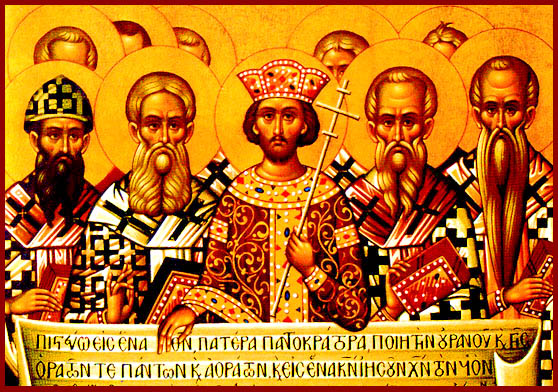
The Creed of Constantinople and the Replacement of Sacred Foundations
The Creed of the Constantinople Church represents the so-called “Christian” legacy formally established under the authority of Emperor Constantine, a legacy that would become the doctrinal and calendrical foundation upon which later institutional Christianity was built.¹ Though often portrayed as a unifying theological achievement, its deeper function was largely political and cultural: to sever the Roman Empire from anything associated with the Yahudim (Jews) and their Hebrew roots.² In accomplishing this, the Creed did far more than redefine religious identity. It systematically undermined obedience to the Scriptures, particularly the Torah Law of the Old Testament, which had been given as divine instruction and as the time-centric prophetic framework revealing the Messiah’s mediatorial work of salvation.³ What had once stood at the very center of worship and covenant life was abruptly dismissed and relegated, almost overnight, to the proverbial trash bin.
By the fourth century, the Temple that once stood in Jerusalem as the visible center of covenant worship had long since been reduced to rubble by Roman hands, with not one stone left upon another, just as foretold.⁴ Yet while the physical structure was gone, the Temple’s governing principles had not vanished with it. Chief among these was the daily sacrifice schedule, the divinely ordained rhythm that regulated sacred time, anchored the calendar, and synchronized worship on earth to the ruling lights in the heavens as ordained at creation.⁵ This timekeeping framework, safeguarded by the Temple service, continued to live on among the Hebrew people even after the building itself was destroyed. So what ultimately fell all these years later was not a structure of stone, but the timepiece the Temple had long protected, once its sacred rhythm was finally crushed under Roman dogma.⁶
This unraveling unfolded in stages. The first rupture occurred when Jewish leaders rejected the Messiah, severing the people from their long-promised Messiah, the One to whom the Temple services prophetically pointed.⁷ The second followed with the Roman overthrow of the nation and the destruction of Jerusalem and the Temple in A.D. 70, along with the dispersion of the people.⁸ Yet the final and most consequential loss came during the years of captivity that followed, when sustained Roman pressure forced Jewish leadership to relinquish the last safeguard of their sacred inheritance: the Temple-regulated daily sacrifice schedule that had preserved the holy and chodesh worship rhythm along with prophetic time itself.⁹ Through this Temple-centered service, sacred time had been preserved among the faithful followers of YHUH (Yahuah) for approximately 4,000 years, regulating days, weeks, months, and years according to the divinely lunar-appointed rhythm.
When this most sacred timepiece was ultimately abandoned, prophetic time fell out of alignment, its once-harmonized worship rhythm fractured, and the calendar through which the events of redemption and the unfolding of salvation history were meant to be discerned became obscured.¹⁰
Daniel’s Prophetic Clock: When the Daily Was Taken Away
Scripture itself provides the framework for understanding this pivotal prophetic event, and it does so with remarkable internal consistency. Rather than describing unrelated occurrences, the book of Daniel repeatedly returns to a single disruption: the removal of what it calls “the daily,” and the setting up of “the abomination of desolation” in its place.11
- Daniel 11:28 and 30 tell us that this king’s heart was filled with indignation against the holy covenant.12 Thus, the sacred Bridal Covenant itself was the target.
“Then shall he return into his land with great riches; and his heart shall be against the holy covenant; and he shall do exploits, and return to his own land… For the ships of Chittim shall come against him: therefore he shall be grieved, and return, and have indignation against the holy covenant: so shall he do; he shall even return, and have intelligence with them that forsake the holy covenant.” Daniel 11:28 & 30
- Daniel 11:31 anchors this disruption directly to the Sanctuary, also referred to as the Temple.13 The phrase “the daily” is not abstract or symbolic in isolation. It refers to the daily sacrificial schedule, the continual offering that regulated the Temple’s worship rhythm and, by extension, safeguarded Yahuah’s appointed structure of sacred time.14 The daily sacrifice functioned as the living mechanism through which days, weeks, months, and years remained synchronized to the lights in the heavens. To remove the daily, therefore, was not merely to halt a ritual, but to strip the Temple of its ordained role as the regulator of sacred time and worship at its divinely appointed start and stop points. When this function was taken away, the calendar it protected was effectively erased from collective memory, though it continues to exist, awaiting rediscovery.15
“And arms shall stand on his part, and they shall pollute the sanctuary of strength, and shall take away the daily sacrifice, and they shall place the abomination that maketh desolate.” Daniel 11:31 - Daniel 12:11 does not introduce a new or separate event, but deliberately revisits the same disruption.16 The daily is again said to be taken away, and the same abomination of desolation is set up in its place. What is new in this passage is not the action, but the emphasis. Here, the removal is explicitly tied to a measured span of time, “a thousand two hundred and ninety days.”17 The prophecy now draws attention to chronology itself, signaling that time has become the battlefield. The focus shifts from what was removed to the enduring consequences of that removal within the realm of prophetic time.
“And from the time that the daily sacrifice shall be taken away, and the abomination that maketh desolate set up, there shall be a thousand two hundred and ninety days.” Daniel 12:11
- Daniel 7:25 provides the interpretive key that allows these passages to be read together coherently.18 The prophecy does not merely speak of persecution, but of an authority that would “think to change times and laws.” This statement grants explicit permission to consider how such an alteration of time-measuring could occur without immediate detection. A change in time would not need to be overt or abrupt. It could be subtle, institutional, and embedded within religious authority, reshaping worship rhythms while preserving the appearance of continuity. Law and time, once inseparable within the Torah framework, would be altered together.
“And he shall speak great words against the Most High, and he shall wear out the saints of the Most High, and think to change times and laws, and they shall be given into his hand until a time and times and the dividing of time.” Daniel 7:25
Taken as a whole, these passages invite careful and humble reconsideration. If the daily sacrifice regulated sacred time itself, and if its removal resulted in a reconfiguration of that time, then it is reasonable to ask whether the accompanying prophetic period of 1,290 days of Daniel 12:11 or the “time, times and half a time” Daniel 7:25 may itself have been obscured, inserted, or misunderstood.20 This possibility does not require dogmatic certainty, but it does help explain why so many have assumed the abomination of desolation must still lie exclusively in the future.
If the sacred clock itself was altered in the fourth century A.D., then the abomination associated with a counterfeit system of time must have already occurred, concealed behind a revised calendar and an imposed worship rhythm.21 This alteration produced the enduring condition Scripture describes, wherein “all the world” has wandered after the Beast, the Roman authority that presumed to change times and laws in defiance of the Creator’s design.22
Rather than weakening confidence in prophecy, this perspective strengthens it. It suggests that Daniel’s words were not vague warnings awaiting modern invention, but precise markers of a historical rupture, one that displaced biblical sacred time and continues to shape belief and practice through a counterfeit replacement system to this day.23
The Emerging Tragedy
What emerges, then, is a twofold tragedy: Rome’s deep-seated hostility toward all things once held sacred by Jewish people, coupled with a desire among Jewish leadership to distance themselves from the Messiah and from the national guilt surrounding His death.24 In seeking protection from further condemnation, they accepted an alternative calendar system, one that concealed the original time structure of Scripture and quietly disrupted their connection to the Temple’s enduring witness.25 In this way, sacred time itself was displaced, not by accident, but through a need for camouflage, fear of their Roman captors, and accommodation.
Following the trail of events, the ancient and well-worn path of truth was obscured. The Torah Law, containing the Commandments, Statutes, Judgments, and Testimonies, faithfully preserved through the generations as the Creator’s enduring instruction and protective boundary wall for His people, was removed from view.26 Yet this Law had never been intended as a burden. It was given as a gracious guide, a wall of safety, through which Yahuah (YHUH) Alahim’s followers, His covenant Bride, could discern the Plan of Salvation, the remedy for sin, and learn how to harmonize their soul temples with His sacred order.27
To set aside this structure of time and worship was not merely a theological shift, but a fundamental alteration of the framework through which salvation’s history was meant to be revealed and followed.28 Within that framework, the Bridal Covenant was to be accomplished by the anointed Messiah and faithfully embraced by His betrothed Bride.29
The Roman Origins of “Christianity”
Most people today are unaware that the term Christian, though widely embraced, is not rooted in the New Testament in the way it is commonly assumed, but was instead systematized and popularized under Roman authority beginning with Emperor Constantine.³⁰ Likewise, the title “Christ” reflects a Greek and Roman rendering that displaced the original Hebrew designation Anointed Messiah.³¹ Despite the appearance of reform in later centuries, most Protestant churches have never fully separated from their Roman Catholic mother church. Much of her theological and doctrinal DNA, assumptions, and inherited traditions remain intact, from head to toe.³²
While individual denominations may preserve certain elements of biblical truth, some more closely aligned with Scripture than others, they also retain varying adaptations of traditions absorbed from a pagan past.³³ Many believers do not examine Scripture or church history deeply, whether by choice, habit, or circumstance. Others are intentionally shielded from uncomfortable historical realities by leadership in the interest of peace, unity, and institutional stability, even when that unity rests upon distorted paradigms rather than truth.³⁴ The question remains: why does this matter?³⁵
Imperial Decrees Versus the Prophetic Messiah
Historically, many of the foundational doctrines shaping modern Christianity did not emerge from prophetic continuity or apostolic teaching, but from imperial decree.³⁶ From the Council of Nicaea convened under Emperor Constantine to later rulings formalized at the Council of Laodicea under imperial authority, these decisions carried political force, yet all-the-while possessed no redemptive power.³⁷ They hold no positive relevance to the true prophetic Messiah of Scripture, to His ordained sin-removing work revealed through the Torah Law as a Bridal Covenant, or to His promise of eternal reward by grace to the humble, forgiven, and obedient.³⁸
Not surprisingly, the Creed of the Constantinople Church openly reflects the ideology and intentions of its architect, Constantine, Emperor of Rome.³⁹ Rather than affirming the Torah and the prophetic foundations upon which the anointed Messiah stood, the Creed positions itself in deliberate opposition to the Law and the sacred framework of Old Testament Scripture.⁴⁰ In doing so, it established an entirely new religious system, one rooted not in revelation, but in Roman authority.
What Was Lost and Why It Matters
The enforcement of this Creed required full compliance from church leadership, including bishops, councils, and ecclesiastical authorities throughout the Empire.³⁰ What began as a theological declaration quickly functioned as an administrative mandate, ensuring uniformity not only of belief, but of worship practice and timekeeping.³¹
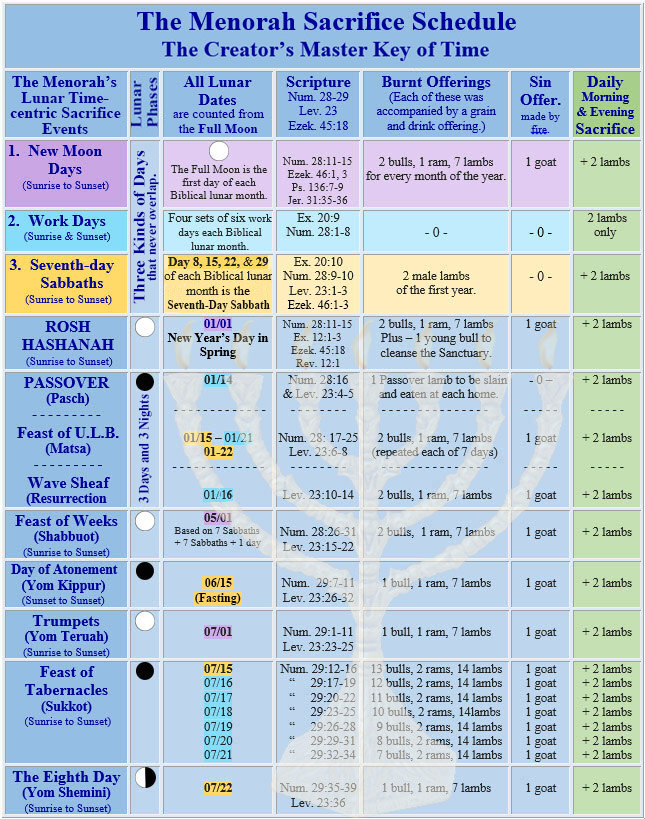
To grasp what was being dismantled, one must first understand the role of the Temple’s Sacrifice Schedule.³² This divinely appointed system visibly tied worship to an ordered and functioning calendar model, regulating sacred time through daily, weekly, monthly, and yearly offerings and ceremonies. The Temple service did not merely accompany the calendar; it safeguarded it. Through this rhythm, the appointed times of Yahuah were preserved, proclaimed, and lived out in harmony with the heavenly lights.³³
As a result of the Creed’s enforcement, the entire Tanakh (Old Testament) was effectively dismantled in practice, even while portions of it were retained in name.³⁴ The Torah Law, the Temple sacrificial schedule, its lunar-appointed sacred days, the sacred Hebrew names of the Father, Yahuah Alahim (Elohim), and His Son, Yahusha haMashiach, along with the Scriptural calendar revealed through the Temple’s service, were systematically set aside.³⁵
Yahuah’s preordained years beginning in the spring, His months signaled by the authentic full New/Renewed Moon, Sabbaths counted from the full New Moon, and all His appointed Feast Days were formally denounced.³⁶ These divine markers of sacred time were cast aside, and tragically, so too were the Yahudim (Jews) themselves during their long Roman captivity. All that had been set apart as holy was declared obsolete; what was eternal was treated as disposable.³⁷
The Abomination That Makes Desolate
This article seeks to bring these realities into the light. It demonstrates how a single fourth-century document, the Creed of the Constantinople Church, fulfills what the prophet Daniel twice identified as the abomination that maketh desolate.³⁸ Rather than pointing only to a distant future event, Daniel’s prophecy identifies a decisive historical moment when sacred time, sacred service, and sacred authority were forcibly displaced.
“And arms shall stand on his part, and they shall pollute the sanctuary of strength, and shall take away the daily sacrifice, and they shall place the abomination that maketh desolate.” Daniel 11:31³⁹
“And from the time that the daily sacrifice shall be taken away, and the abomination that maketh desolate set up, there shall be a thousand two hundred and ninety days.” Daniel 12:11⁴⁰
These passages identify a specific sequence: the removal of the daily, followed immediately by the establishment of a substitute system. The “daily” was not merely a ritual, but the Temple-centered mechanism that preserved sacred time through its continual sacrifice schedule. To take it away was to dismantle the calendar it governed and the worship rhythm it sustained.⁴¹
Far from being a mere historical footnote, Constantine’s Creed marks a profound turning point in which sacred time, sacred law, and sacred identity were deliberately removed and replaced.⁴² The resulting desolation was not the destruction of stone alone, but the emptying of the Temple’s governing function from the life of worship. Its effects did not end in the fourth century; they continue to shape religious belief and practice across the world to this day.⁴³
Constantine’s Creed, the Foundation of all Christian Churches
In the fourth century A.D., loyalty to the Roman state became inseparably bound to loyalty to its newly sanctioned religion.⁴⁴ To be recognized as a faithful Roman citizen, individuals were increasingly required to publicly affirm their allegiance by reciting an approved Creed under oath.⁴⁵ What began as a theological declaration rapidly evolved into a civic mandate, effectively erasing the boundary between faith and imperial authority. Compliance offered protection, legitimacy, and social standing. Refusal, however, often resulted in suspicion, marginalization, loss of rights, or death.⁴⁶ In this way, the Creed functioned not merely as a statement of belief but as an instrument of enforced conformity, reshaping conscience, worship, and religious identity throughout the empire.
It is critical to recognize that this Creed did not remain confined to its original historical moment. It became the theological and calendrical bedrock upon which all subsequent Christian churches were built, whether Roman Catholic or Protestant.⁴⁷ Every later denomination inherited its foundational assumptions, its calendar framework, and its deliberate separation from Torah-based worship through this single imperial act. What Constantine institutionalized by decree was then preserved by tradition, defended by councils, and passed forward as unquestioned orthodoxy.⁴⁸
Creed of Constantinople Church
“I renounce all customs, rites, legalisms, unleavened breads and sacrifices of lambs of the Hebrews, and all the other feasts of the Hebrews, sacrifices, prayers, aspirations, purifications, sanctifications, and propitiations, and fasts, and New Moons, and Sabbaths, and superstitions, and hymns and chants, and observances, and synagogues.
Absolutely everything Jewish, every [TORAH] Law, rite and custom and if afterwards I shall wish to deny and return to Jewish superstition, or shall be found eating with Jews, or feasting with them, or secretly conversing and condemning the Christian religion instead of openly confuting them and condemning their vain faith, then let the trembling of Cain and the leprosy of Gehazi cleave to me, as well as the legal punishments to which I acknowledge myself liable. And may I be an anathema in the world to come, and may my soul be set down with Satan and the devils.”49 Stefano Assemani, Acta Sanctorium Martyrum Orientalium at Occidentalium, Vol. 1, Rome 1748, page 105. [Emphasis mine]
The creed is recorded above in Greek and below in Latin50.
“Renuntio omnium mores, ritus, legalisms azymos panes Hebraeorum et sacrificia ex agnis, et solemnitatibus ceteris Hebraeorum sacrificia, vota, appetitiones, purgationes, sanctificationibus procurationesque et ieiunia et in kalendis et in sabbatis et superstitiones, et hymnis, et canticis, et observationibus, et synagogam eorum. Omnia simpliciter Iudaea omnibus legibus implicatus consuetudine ritus postea negare velitis et revertens et Judaica pravitate sive inventus fuerit comedens cum Iudaeis eis convivium, pro Christiana religione aperte an clam condemnare redarguens eos colloquentes condemnare vana fides, tunc et tremore Cain lepra Giezi adhaereat mihi ut et ego agnosco cui subiacet obnoxium. Et ego anathema esse in futuro seculo, et sedi cum Patre meo anima Satanam eiicit daemonia.”51
Does this not stand as compelling evidence that the year, month, week, and days embedded within the Roman-Gregorian calendar, and still followed by churches for so-called holy days, were deliberately engineered to appear biblical while being fundamentally detached from the Scriptural calendar and the original week of creation?⁵² After abandoning its original eight-day cycle, Rome strategically returned to a seven-day week, not as an act of restoration, but as an act of concealment.⁵³
The critical difference lay in the mechanism itself: the Roman week was designed to cycle endlessly without reference to the New Moon, whereas the biblical week was always counted anew from each full New Moon Day.⁵⁴ This subtle but decisive alteration became the genius of the deception. By preserving the outward form of a seven-day rhythm while severing it from the heavenly lights our Creator ordained for time-keeping, the replacement system succeeded brilliantly through camouflage.⁵⁵ What later appeared familiar felt trustworthy, and thus sacred time was quietly redirected away from its Creator-given anchors to a new self-made god of the Roman Empire.⁵⁶
Jerome Provides a Second Witness
As a second witness, consider the following testimony attributed to Jerome of Rome, the scholar traditionally credited with translating the Greek Septuagint (LXX) into Latin.⁵⁷ As you read his words, consider an important question: Does Jerome appear to recognize a distinction between what later became Roman Christianity and the original followers of the Messiah, who identified themselves as the Natsarim (Nazarenes)?
The Natsarim were those early believers who continued to uphold the entirety of the Torah Law (the Old Testament) while also embracing the sacrificial death of the anointed Messiah on the fourteenth day of the lunar month in spring, offered for the sins of the whole world.⁵⁸ These believers did not abandon the faith of Scripture’s Torah Law and its statutes; rather, they understood the testimony of the Messiah as inseparable from it. Yet, strikingly, Jerome labels such faithful adherence as heretical, specifically because these believers honored the Torah Law, including its full New Moons, lunar seventh-day Sabbaths, and lunar Feast Days.⁵⁹ The gravity of Jerome’s assessment should not be overlooked.
“We shall now especially consider heretics, who… call themselves Nazarenes [Natsarim]; they are mainly Jews and nothing else. They make use not only of the New Testament, but they also use in a way the Old Testament of the Jews; for they do not forbid the books of the Law, the Prophets, and the Writings… so that they are approved of by the Jews, from whom the Nazarenes do not differ in anything, and they profess all the dogmas pertaining to the prescriptions of the [Torah] Law and to the customs of the Jews, except they believe in Messiah… They preach that there is but one god, and His son
Jesus[Yahusha]. But they are very learned in the Hebrew language; for they, like the Jews, read the whole Law, then the Prophets… They differ from the Jews because they believe in Messiah, and from the Christians in that they are to this day bound to the Jewish rites, such as circumcision, the [lunar] Sabbath, and the other ceremonies [such as Passover on the 14th of the lunar month].”60 Jerome – Epiphanius; Panarion 29; translated from the Greek. (Jerome translated Greek Septuagint Bible into Latin language 1,615 years ago, he was an early Roman Christian Church father, here referring to the Natsarim.) [Words in these brackets were added by me.] [My Emphasis]
According to Jerome, an early Roman Church father, the true followers of the Messiah were regarded as heretics not because they rejected Scripture, but because they refused to conform to the newly emerging Roman Christian religion and its solar-based calendar system with its non-scriptural holy days.⁶¹ The Natsarim stood apart precisely because they retained fidelity to the faith as delivered in the Torah Law, its statutes, Judgments, commandments, and testimonies.⁶²
Distinguishing Characteristics of the Natsarim
The Natsarim, the faithful followers of the Messiah, were unique in several key and revealing ways:
- They upheld both Testaments (an unbroken Bridal Covenant).
The Natsarim remained faithful to the entire Torah Law of the Old Testament while also embracing the New Testament testimony of the Messiah. They saw no contradiction between the two, recognizing them as one continuous revelation of Bridal Covenant faithfulness.⁶³ - They did not reject the Hebrew Scriptures.
Unlike later Roman Christianity, which increasingly marginalized or forbade the Torah, the Prophets, and the Writings, the Natsarim fully embraced them. The suppression of the Old Testament was a development initiated by Roman emperors and church councils in the fourth century A.D., not by the Messiah at the cross, despite what many pastors have later taught.⁶⁴ - They were fluent in Hebrew.
Jerome himself acknowledges their deep knowledge of the Hebrew language.⁶⁵ This fluency Ucla Bruins - Air Jordan 1 Low SE Women's Shoes Grey, Sports Illustrated FanNation Kicks News - Analysis and More underscores the reality that the New Testament testimony of the Messiah only finds its full meaning when read through the lens of the Old Testament Hebrew Scriptures. It also raises the possibility, worthy of further scholarly investigation, that portions or even the entirety of the New Testament may originally have been written in Hebrew, and that Greek transmission served, intentionally or otherwise, to distance the text from the Torah Law.⁶⁶ - They taught the oneness of Alahim.
The Natsarim confessed one Alahim (God) and His Son, Yahusha the Messiah. Notably absent is any reference to a third person within a trinitarian godhead. The doctrine of the Holy Spirit as a distinct person emerged later within Roman theology and became one of its unique and central dogmas. In contrast, the Old Testament consistently presents the Ruach haKodesh as the power, presence, and operative provision of Yahuah and Yahusha, not as an independent being.⁶⁷ - They differed from Jews only in their faith in the Messiah.
The Natsarim followed Yahusha the Messiah, who laid down His life for repentant sinners on the fourteenth day of the first lunar month in spring and rose again following the sixteenth day–night cycle. They proclaimed eternal life through His sacrifice while continuing to live according to the Torah Law and under the righteous covering of the blood of the Lamb.⁶⁸ - They differed from Christians in their obedience.
Unlike Roman Christians, the Natsarim remained faithful to the Torah Law and its divinely ordained, lunar-based worship schedule, including the full New (Renewed) Moon, the lunar seventh-day Sabbath, and the annual lunar appointed Feast Days.⁶⁹ - They followed a different calendar entirely.
The Scriptural calendar observed by the Natsarim was neither the Roman Catholic nor Protestant calendar still in use today, nor the later Rabbinic calendar adopted under Roman pressure during Jewish captivity, which identifies the dark conjunction as the New Moon. Neither did they follow the first visible crescent method employed by Karaite Jews in later centuries.⁷⁰
The sacred days outlined in Scripture cannot be synchronized with the pagan solar calendar designed by the Romans, whose continuous weekly cycle is wholly divorced from the lunar phases. This profound discontinuity stands as compelling evidence of a deliberate alteration of sacred time. Scripture itself identifies such an act as the taking away of the daily (sacrifice), and the setting up in its place of the abomination that makes desolate.⁷¹
The Testimony of Two Witnesses
Here, then, is the testimony of two witnesses: first, the Creed attributed to Constantine, and second, the testimony of Jerome. Together, they affirm that our Messiah never abolished the TORAH, the Law of divine instruction. Rather, it was Constantine, driven by hostility toward all things Hebrew (Jewish), who advanced a newly fashioned replacement religion later called Christianity. In doing so, he ensured that this counterfeit system would share nothing in common with the Old Testament teachings, as the Bridal Covenant, found in the TORAH and the Prophets, including the sacred days appointed on the Creator’s astro-luni-solar calendar, t it would appear to be authentic. The best deception is infused with the most truth. Strikingly, it is under this Roman framework of time-keeping that much of the world continues to live today.
From these two witnesses, one must ask: Is there any evidence that the modern Roman continuous weekly cycle, with its planetary designations of Sunday through Saturday, remains synchronized with the first week of creation? The answer is clear. There is none.
Indeed, this modern calendar system arose from a posture of rebellion and was deliberately designed to undermine the Torah-based order of sacred time. Though its clever construction gives the appearance of harmony with Scripture, it is, in truth, wholly disconnected from the biblical calendar and the time-keeping structure established by the Creator.
Unconcealed Explosion of Evidence
This Creed unmistakably reveals that the TORAH (Law of Instruction) had not come to an end at the time of our Messiah’s crucifixion, as is so often asserted today. Rather, the historical record points to a far later rupture. It was Emperor Constantine who, nearly three centuries afterward, actively severed obedience to the Torah in the process of establishing his newly sanctioned religion, Christianity.
From that moment forward, peace within the Roman Empire came at a steep cost. To avoid being branded a heretic, persecuted, or put to death, individuals were compelled to embrace Constantine’s replacement faith, identified as “Christianity,” along with its newly framed object of worship, “Jesus Christ.” This was not merely a theological shift, but a comprehensive reordering of belief, identity, and sacred allegiance.
Alongside this religious transformation came the imposition of a new system of time. All were required to observe the emperor’s solar calendar, complete with its continuous seven-day planetary week. This innovation laid the groundwork for the long-held assumption that either Saturday or Sunday must be the divinely appointed day of worship. What is rarely acknowledged, however, is that this Roman time-measuring system was enforced under threat of death and was intentionally structured to honor pagan deities, incorporating ancient Babylonian festivals such as Easter and Christmas. By selectively attaching Scriptural language to these pre-scripted pagan observances, Rome effectively repackaged them for widespread acceptance among sincere and trusting believers.
In the centuries that followed, the various Protestant denominations that emerged never fully disentangled themselves from this Roman inheritance. Instead, they continued to seek legitimacy within the framework established by their Catholic predecessor, often at the deep cost of renouncing all things distinctly Hebrew, including much or all of the Torah’s instruction.
Consequently, to be recognized as “Christian” within this system has historically required submission to the blood-stained Creed of the Constantinople Church, first set in motion in A.D. 325. From that point onward, generations were conditioned to disregard the teachings of YAHUAH preserved in the Old Testament Torah. In their place arose a redefined portrayal of the promised Messiah, bearing a Greek name, and a paganized calendar of solar years, months, weeks, days, and holidays. Tragically, this convergence has led countless sincere worshipers to unknowingly participate in practices far removed from the faith and worship rhythm established by the Creator Himself.
Not Under Law, But Under Grace
This development laid the groundwork for what would become one of the most foundational teachings within Christian theology: “We are no longer under the LAW but under GRACE.” That assertion was further reinforced through the Roman Christian proclamation that “the LAW was nailed to the cross/stake.” Over time, these phrases were repeated so often that they came to be accepted as self-evident truths, rarely examined in light of the full testimony of Scripture.
Yet this claim was never limited to the Ten Commandments alone, which represent only one portion of the TORAH, the comprehensive Law of Instruction. Rather, the declaration was applied broadly and indiscriminately to the entire body of Torah, despite its integral role in revealing the Creator’s redemptive plan.
Most significantly, the TORAH of the Old Testament contains the time-centric prophetic framework destined to be fulfilled by YAHUSHA, the true Messiah. Throughout His earthly life, in His sacrificial death, and in His resurrection, the Messiah honored and upheld the Torah in both word and deed. Likewise, His disciples and apostles continued steadfastly in this same path. They taught and practiced obedience to the New Moon observances, the lunar seventh-day Sabbaths, and each of the lunar appointed Feast Days, regarding them not as obsolete shadows but as enduring signposts of the covenant.
They understood that walking the Torah life, marked by the celebration of the appointed Feasts seven times each year, was a defining characteristic of the true children of Yasharal (Israel). It is by this very pathway, Scripture affirms, that the faithful are enabled to “follow the LAMB, wherever He goes.”
Nailed to the Cross/Stake
Another widespread assumption taught within many churches is the claim that “all things nailed to the cross/stake came to an end.” This idea has been repeated so frequently that it is rarely questioned, yet it stands in sharp contrast to the testimony of Scripture itself.
In truth, nothing could be further from the biblical record. Everything that was nailed to the cross/stake did not terminate, but rather moved forward into eternity, receiving the highest possible honor. This includes (1) our living and resurrected Messiah, (2) His Covenant, and (3) the TORAH Law of the Old Testament, with its prophetic witness concerning the Messiah and its time-centric mechanism of salvation. Far from being discarded, these realities were sealed, vindicated, and eternally established through the cross.
In this light, the cross/stake may rightly be understood as a divine hinge point in time. Everything fastened to it passed through death into everlasting life. This is the true resolution of the often-misunderstood phrase that “the Law was nailed to the cross.” It was not abolished; it was fulfilled, ratified, confirmed, and glorified.
The Messiah Himself left no ambiguity on this matter:
“Think not that I have come to destroy the TORAH Law or the Prophets [Nevi’im]. I have not come to destroy, but to fulfill.” Matthew 5:17
When read carefully, His words dismantle the notion that the Torah was annulled. The idea that everything nailed to the cross was abolished is not a teaching derived from Scripture, but a later theological construct that fails to withstand the full weight of biblical evidence. The concept that everything nailed to the cross was abolished is FAKE NEWS. For more on this subject, refer to: Blotting Out the Handwriting that was Against Us.
Feast Days to be Celebrated throughout Eternity
Yet there is still more to consider. The Messiah’s ministerial work within salvation’s divinely ordered, seven-part framework was never designed to conclude at the cross alone. Rather, it was inaugurated there and continues in the shamayim (the heavenly courts above) until every Feast Day prophecy reaches its full and final fulfillment, and then carries forward into eternity itself. In the age to come, these appointed times will stand as eternal memorials of the love, mercy, and compassion of the Messiah who redeemed His people.
This redemptive framework was not introduced abruptly in the New Testament era. It was first revealed in the wilderness Sanctuary, then carried forward in the Tabernacle, and later embodied in the Temple in Jerusalem. Each structure served as an earthly shadow of the heavenly reality, designed to teach the same unchanging gospel through time, the shed blood of the Messiah, and the lunar appointed events. The daily services, the annual Feast Days, and the high priestly ministry all operated according to a precise, time-centric schedule that prefigured the Messiah’s mediatorial work.
Scripture speaks with unmistakable clarity:
“But Messiah being come an high priest of good things to come, by a greater and more perfect tabernacle, not made with hands, that is to say, not of this [human] building. Neither by the blood of goats and calves, but by His own blood He entered in once into the Kadoshim (holy place), having obtained eternal redemption for us… And for this cause He is the mediator of the new testament, that by means of death, for the redemption of the transgressions that were under the first Covenant [TANAKH and TORAH LAW], that they which are called might receive the promise of eternal inheritance.” Hebrews 9:11, 12, 15
The wilderness Sanctuary, the Tabernacle, and the Temple were never ends in themselves. They were instructional models, revealing in advance the greater and more perfect ministry of the Messiah in the heavenly Temple not made with human hands. Every sacrifice, every appointed Feast Day, and every priestly action followed the time-centric blueprint of the TORAH, pointing forward to specific redemptive moments in the life, death, resurrection, and ongoing intercession of YAHUSHA haMashiach.
Thus, the entire work of salvation for humanity’s soul temples, first on earth and later within the true heavenly sanctuary, was laid out according to the prophetic timetable preserved in the TANAKH, encompassing the TORAH (Law), the Nevi’im (Prophets), and the Ketuvim (Writings). Together, these sacred witnesses move in perfect harmony, orchestrating PROPHETIC TIMES through SACRED APPOINTED EVENTS, known as the set-apart Feast Days (Kadosh mo’edim).
Divine truth requires that these time-centered prophecies of the Torah can never be altered, displaced, or severed from their appointed events. They can only be fulfilled by YAHUSHA haMashiach, the promised Messiah, the Lamb of Elohim, and our eternal Kohen Gadol (High Priest).
Replacement Terms for the New Distinctly Roman Religion
From the time of the crucifixion of Yahusha haMashiach until the rise of Constantine, a span of roughly three centuries, the Messiah’s true followers were never known as “Christians.” Instead, Roman authorities referred to them as Quartodecimen (meaning fourteeners). This designation was not incidental; it was assigned because these believers steadfastly observed Passover on the 14th day of the first lunar month (Abib), counted from Rosh Hashanah, the first New Moon of the spring. In doing so, they remained faithful to the TORAH’s time-centric commandments and to the example established by the Messiah Himself.
These believers also called themselves Natsarim, identifying with the Messiah of Nazareth and continuing to live within the framework of the Hebrew Scriptures. However, after A.D. 325, this identity was no longer tolerated. Under the threat of persecution and death, the Quartodecimen/Natsarim were compelled to renounce their Torah-centered faith and submit to the newly sanctioned Roman religion now called Christianity. This coercion required a decisive break from their distinctly Hebrew worldview, calendar, and worship rhythm.
Equally striking is the historical reality that the term “Christian” did not exist prior to this era in its imperial sense, nor did the name “Jesus Christ” originate in the apostolic community. Rather, this title emerged through a sequence of transliterations, moving from Greek into Latin and later into English, as illustrated in the accompanying image.
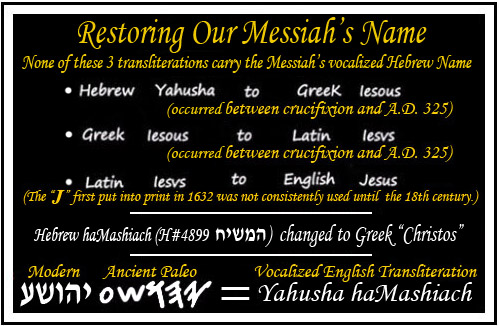
This renaming of the Messiah was not a neutral linguistic development nor a simple matter of translation. It reflected a deliberate refusal by Emperor Constantine and the Roman establishment to honor a Hebrew Yahudim (Jewish) Messiah or to preserve His Hebrew name. In its place, they introduced a name and title that the Messiah’s earliest followers would never have recognized as an acceptable substitute for YAHUSHA haMashiach. It was a name His mother never spoke, a name foreign to the covenantal language of Scripture, and one that marked a decisive shift away from the faith once delivered to the saints.
The Early Believers Were Neither Romans nor Christians
All references to the “early believers” in Scripture and early historical records point unmistakably to the true followers of Yahusha haMashiach, the Messiah. These believers were never participants in an institutional “church” as later defined by Roman Christianity. Rather, they remained faithful and obedient observers of the TORAH Law of Instruction, identifying themselves as part of Yasharal (Israel). They were the ecclesia, the “called-out ones,” a term that, in its Hebrew understanding, denotes people of the sacred assemblies, gathered according to the Creator’s appointed times rather than a man-made religious structure.
In stark contrast to the later Roman Catholic Christian worldview, every authentic reference to the early believers presents one unified community, distinguished by three defining attributes of great consequence:
-
They followed YAHUSHA haMashiach, the Messiah, walking as He walked and ordering their lives according to His teachings, example, and appointed times.
-
They held fast to the entire TANAKH (Old Testament), embracing the TORAH (Law of Instruction), the Nevi’im (Prophets), and the Ketuvim (Writings) as the authoritative foundation through which the Messiah was revealed and validated.
-
They remained faithful to the astro-luni-solar calendar embedded in the TORAH, beginning the year in spring at Rosh Hashanah (the first New Moon), counting fourteen days to locate PASSOVER, and from that anchor point discerning all other sacred appointments exactly as laid out in the Temple’s Sacrifice Schedule.
This final point is critical. The worship life of the early believers was not abstract or symbolic. It was anchored to the Temple’s daily, weekly, monthly, and annual sacrificial service, which functioned as Heaven’s visible time-grid on earth. The Temple Sacrifice Schedule provided the living calendar by which New Moons, lunar Sabbaths, and Feast Days were identified, ordered, and fulfilled. Every sacrifice, offering, and appointed service corresponded to a specific day of the lunar month, revealing a precise and divinely orchestrated rhythm of time and redemption.
The Temple’s Daily Sacrifice Schedule
The detailed daily sacrificial prescriptions recorded in Leviticus 23 and Numbers 28–29 function as what might be termed our Creator’s Rules of Engagement. In this light, the sacrificial calendar with its Menorah lunar ties (Leviticus 24) is established as the MASTER KEY of TIME and PROPHECY. As the Master Key, it unlocks both the measure of sacred time and the unfolding of prophecy by revealing the precise pattern of years, months, weeks, and days within the lunar‑appointed system upon which the Plan of Salvation is fulfilled step-by-step.
In the daily sacrifice schedule shown below, observe that every day of the year includes the continual offering of two lambs, one in the morning and one in the evening. On the Sabbath, two additional male lambs were presented, in addition to the regular morning and evening offerings. On the New Moon Day, the offerings were greater still: two bulls, one ram, seven lambs, and one goat, again together with the continual morning and evening sacrifices. Thus, no two days were identical, each being distinguished by the type and number of sacrifices appointed for it. In this way, no category of day could overlap with another. The New Moon Day remained uniquely set apart, never counted as a common workday nor as a seventh-day Sabbath. Each kind of day stood separate and distinct, preserving the sacred order and integrity of the lunar calendar established at creation and revealed in the heavens.
The lunar phases, together with the daily sacrifice schedule, correspond as a GPS to ensure the synchronization of worship on Earth with the heavenly courts above. As long as these rules are adhered to, the Creator’s correct holy days can be found and celebrated in accordance with His unique and ordained worship rhythm. Any variance, large or small, will never harmonize those seeking faithful, synchronized worship with their Messiah and Eternal Father.
The Feast Days, once obscured and altered through the passage of time, are now being graciously restored according to the sovereign will and perfect timing of Yahuah Alahim, after nearly two millennia of concealment. This restoration of the sacred calendar bears witness to the fulfillment of “the times of the Gentiles” (Luke 21:24). It reflects the holy pattern revealed in Exodus 12:1–3, when the Creator reestablished His calendar to guide Moses and the children of Israel before they departed from Egypt and, forty years later, their entrance into the Promised Land. In like manner, this same restoration of His divine timepiece is unfolding among the faithful today, preparing hearts and lives for entry into the everlasting Kingdom that has been promised.
The Fulfillment of the Sacrificial System
While the restoration of the Temple’s daily sacrificial schedule illuminates the original order of sacred time and reveals the divine structure upon which the Creator established His calendar, it must be clearly understood that these animal offerings were never intended to continue forever. They were prophetic shadows, instructional patterns, and sacred witnesses pointing forward to a greater and perfect reality yet to come.
From the beginning, the blood of bulls and goats could never remove sin in themselves. They served as living symbols, teaching humanity the cost of transgression, the necessity of atonement, and the promise of a coming Redeemer. Each morning and evening lamb testified silently of the One who would, in the fullness of appointed time, become the true and everlasting Lamb.
“But the Messiah came as High Priest… not with the blood of goats and calves, but with His own blood He entered the Most Holy Place once for all, having obtained eternal redemption.” Hebrews 9:11-12
That appointed moment was fulfilled when the Messiah laid down His life willingly for all mankind. In that sacred hour, the prophetic meaning embedded within the entire sacrificial system reached its divine completion. The veil was torn, the shadow met its substance, and the earthly pattern gave way to the heavenly reality. The continual offering found its fulfillment in the One whose sacrifice needs never to be repeated.
Therefore, although the understanding of the original daily sacrifice schedule is being restored to reveal the authentic calendar of the Creator and the prophetic framework of His Plan of Salvation, this restoration does not call for a return to animal sacrifices. The purpose of those offerings has already been accomplished in the perfect, once-for-all sacrifice of the Messiah, who bore the penalty of sin and opened the way of reconciliation for every soul.
“We have such a High Priest, who is seated at the right hand of the throne of the Majesty in the heavens, a Minister of the sanctuary and of the true tabernacle which Yahuah erected, and not man.” Hebrews 8:1–2
The restored knowledge of the daily sacrificial order now serves a different role. It functions as a divine testimony, confirming the precision of the Creator’s appointed times and magnifying the wisdom of His redemptive design. It points not backward to repeated offerings, but upward to the living High Priest who ministers in the heavenly sanctuary, whose atonement is complete, sufficient, and eternal.
Thus, the faithful are not called to rebuild the Temple or the altar of animal sacrifice, but to walk in the light of its fulfillment. The calendar, once veiled, is being restored to guide worship into harmony with the heavenly order, while the sacrifice, once repeated daily, stands forever fulfilled in the Messiah, the Lamb who was given for the life of the world.
“Seeing then that we have a great High Priest who has passed through the heavens, Yahusha the Son of Alahim, let us hold fast our confession.” Hebrews 4:14
In this restored understanding, the sacred rhythm of time and the completed work of redemption stand together, bearing unified witness to the wisdom, mercy, and sovereign purpose of the Eternal Creator.
When a promise-prophecy that requires participation reaches its full fulfillment, what purpose would there be in returning to the shadow for repeated practice? “It is finished” does not mean abolished, but confirmed, completed, and forever ratified.
The Scriptural Test for True Bridal Covenant Faithfulness
The faithful and obedient Yasharal (Israel) are succinctly defined in Scripture by a single, unyielding standard:
“To the Torah Law [containing commandments, judgments, statutes] and to the Testimony [the Tabernacle of the Testimony and the Feast Day prophecies of the Messiah]; if they speak not according to this word, it is because there is no light in them.” Isaiah (Yeshayahu) 8:20
This verse establishes a timeless measuring rod. Covenant faithfulness is not determined by popularity, institutional authority, or religious innovation, but by personal alignment with the TORAH Law (containing commandments, judgments, statutes, and testimonies), Deuteronomy 5:31-33; Deuteronomy 30:16; 1 Kings 2:3; 1 Kings 11:38; Jeremiah 7:23; Malachi 4:4; and Psalms 119. And the Testimony (the Tabernacles of the Testimony, containing the lunar-appointed Feast-day layout). This is the very framework through which the Messiah is revealed, and His redemptive work unfolded according to fixed lunar dates.
“And keep the charge of Yahuah your Alahim/Elohim, to walk in His ways, to keep 1) His statutes, and 2) His commandments, and 3) His judgments, and 4) His testimonies, as it is written in the TORAH LAW of Moses, that you may prosper in all that you do, and whither soever you turn yourself.” 1 Kings 2:3
The statutes specifically refer to the lunar appointed time as identified in the daily sacrifice schedule. Refer to the article: The Bridal Covenant of Promise, Assurance, and Restoration.
Roman Christianity and the Apostolic Faith
In direct opposition to this Scriptural standard, the Papacy (Roman Catholic Church) labored to convince the world that Rome’s newly constructed religion, called Christianity, represented the original followers of the Messiah after His resurrection. In truth, these two realities are separated by several centuries and are never synonymous. Roman Christianity did not preserve apostolic faith; it replaced it.
As Roman influence expanded, all regions under imperial authority were systematically fused into this new religious system. Those who refused to comply, who clung to the TORAH, the calendar of Scripture, and the original testimony of the Messiah, were branded as heretics and persecuted. Acceptance required submission to a new set of customs, beliefs, and mandates that were entirely absent from and often opposed to Scripture itself.
As one historian observed:
“In the year 325 A.D. was perpetrated one of the most colossal frauds and deceptions in the annals of history. This was the date of the Council of Nicaea, whose task it was to create a new religion that would be acceptable to Emperor Constantine…” The Historical Apollonius Versus the Mythical Jesus, Dr. R. W. Bernard, Ph.D.
Likewise, church historian Ben H. Swett writes:
“The Council of Nicaea was a pivotal event in the history of Christianity. The Messiah’s followers called themselves Natsarim but were known to the Romans as Quartodecimen. The term ‘Christians’ was the creation of Constantine in the 4th century A.D. The sudden adoption of a quasi-philosophic term to define the historic Jesus as equal to God was a major departure from Scripture and tradition. From A.D. 325 onward, Nicenes could, and did, proclaim other dogmas that have no basis in Scripture.” State Church of the Roman Empire, Ben H. Swett, 1998
Following this shift, mandatory creeds were drafted. Every citizen within the Roman Empire was required to swear allegiance, effectively renouncing the TORAH Law of the Bible. The first five books of the Old Testament, and abandoning the ancient Scriptural framework of worship. Such oaths included declarations like the following:
“I accept all customs, rites, legalism, and feasts of the Romans… the New Sabbath ‘Sol dei’ (day of the Sun, better known as Sunday)… In one word, I absolutely accept everything Roman, every new law, rite, and custom of Rome, and the New Roman Religion.” [This quote is attributed to a later published collection Assemani’s 1748 compilation.]
This was not merely a theological adjustment. It was a forced severing from the TORAH LAW of Scripture, the calendar of creation, and the Testimony of the Messiah, precisely the elements Scripture identifies as the source of true spiritual light and alignment with the Creator.
The Council of Laodicea
In A.D. 358, just thirty-three years after the formal establishment of Rome’s new Christian religion and its continuous seven-day planetary week, the Yahudim (Jews), under intense Roman pressure, finalized a sweeping overhaul of their own calendar system. This revision marked a decisive departure from the ancient Scriptural timekeeping model they had preserved as sacred for centuries.
Only seven years later, in A.D. 365, the Council of Laodicea, as recorded in the Roman canons, issued the following decree:
“Christians must not Judaize by resting on the [lunar] Sabbath , but must work on that day. Rather, honoring the Lord’s Day [new planetary Sunday]. But if any shall be found to be Judaizers, let them be anathema from Christ.” Council of Laodicea, Canon 29
If we were unaware of the documented evidence showing that the Yahudim (Jews) had just seven years earlier altered their calendar, including the adoption of Roman Saturday as their new Sabbath, we might reasonably assume, along with many today, that Saturday had always been the Jewish Sabbath. Under that assumption, this legislation could be read as a deliberate effort by Sunday-keeping Christians to distance themselves from Jews by forbidding rest on Saturday, which had become the new Jewish Sabbath.
However, the matter is far more complex. This canon may also be addressing the original lunar Sabbath, the Sabbath the Jews had faithfully observed since antiquity, one determined by the moon and counted from the New Moon, not anchored to Rome’s planetary week. In this light, the decree takes on an even more revealing significance.
Whichever interpretation one adopts, the cumulative weight of historical and Scriptural evidence leads to a single, unavoidable conclusion: both Rome and the Jewish leadership of that era altered the starting and stopping points of every unit of time: years, months, weeks, Sabbaths, and sacred days. As a result, neither system in use today faithfully reflects the TORAH Law’s statutes of time as revealed in the daily sacrifice schedule of the Temple, which contains the time-centric prophecies of the true Messiah, or the original principles of time-measuring designed to synchronize the Creator’s people with His authentic worship rhythm.
What was lost was not merely a calendar, but a divinely appointed framework of sacred time meant to unite heaven and earth in Bridal covenant faithfulness.
A Sobering Admission from Karaite Judaism
Most striking of all is the candid acknowledgment from Karaite Judaism itself, a movement often assumed to have preserved the most ancient biblical calendar. After centuries of warfare, dispersion, and imposed calendrical systems, they even admit that the original markers of sacred time have been obscured. These pragmatically honest Karaite Jews deserve accolades for the following admission:
“Through all the trials and tribulations that humanity has experienced over the past 5,000 years, we have no proof whatsoever that our current Saturday is the actual seven-day ‘anniversary’ of the original Shabbath of Creation.” https://www.karaiteinsights.com/article/shabbat.html
NEWS FLASH!!! If the Karaites, for which the Millerites and later the Seventh-day Adventist Church denomination has patterned its historic Day of Atonement (Yom Kippur) event of October 22, 1844, have concluded that “WE HAVE NO PROOF WHATSOEVER that SATURDAY is the ACTUAL SEVEN DAY ANNIVERSARY of the ORIGINAL SABBATH OF CREATION,” then it is time to sit up and TAKE NOTICE!!! SOUND THE ALARM!!!
The name Karaite means adhering to the Bible only (Sola Scriptura) and not to the Talmud and the Babylonian oral traditions or the Kabbalah. In the same way that the Protestant churches pride themselves on protesting and coming out of Catholicism, the Karaites pride themselves on coming out of Rabbinical Pharisaism, the Talmud, and all the oral traditions of Mystic Babylon. Yet, just as we have discovered that most of Protestantism has not yet come all the way out of the Roman Catholic Church and its errors, including solar time, neither did the Karaites regain all the truths that had been lost over the past 2,000 years, specifically with regard to the calendar, its Full New/Renewed Moon, lunar seventh-day Sabbaths, or the timing of its lunar appointed Feast dates.
What Sunday Keepers Have Known for Years
Few are aware that Sunday-keeping theologians and church leaders have openly acknowledged the original Scriptural Hebrew lunar Sabbath for well over a century. As early as 1916, this knowledge was not only recognized but carefully documented in ecclesiastical and scholarly literature. Yet despite this awareness, it produced no meaningful reform in worship practice among them. Why? Because obedience to the Torah Law among Sunday-keepers had already been declared unnecessary under the creed-based assumption that believers are “not under the Torah Law, but under grace.”
One striking example appears in the book Sunday the World’s Rest Day, a compilation of authors presented at the Fourteenth Congress of the Lord’s Day Alliance in 1916. This organization was formed explicitly to promote unity around Sunday observance as the only viable Christian day of worship. Notably, its leaders were fully aware that neither Saturday nor Sunday represented the original Sabbath of Scripture, a fact they candidly acknowledged among themselves.
What follows is NOT the testimony of lunar Sabbath advocates, but of committed Sunday proponents themselves:
The Sabbath which came down to the Jews from pre-historic [prior to Moses] times was the seventh-day of the lunar week. The lunar week and the lunar month gave the simplest form of time division to early man… Moon and month meant the same thing. The division of the month into four weeks of seven days… and the weekly division begun again at the time of the next new moon. The change from the lunar week to the seven-day week running continuously through the year, while a momentous change, was [purposely] unrecorded. The use of two styles of weeks seems to have existed together, and the more modern seven-day week slowly, but finally, supplanted its ancient…
competitor. The lunar week was simple and serviceable…When the continuous seven-day week was generally accepted, then it was linked with the past, as we now date events before Christ by a scale unknown to the people and historians of those times…The lunar Sabbath was succeeded by the seven-day weekly [Saturday] Sabbath without confusion, and the mention of the Sabbath in Exodus 31:13 and elsewhere, may be taken to refer to the lunar day.” Theodore Gilman, Sunday the World’s Rest Day, p. 479, 1916
Significantly, this illustrates that even biblical scholars with no vested interest in defending a Saturday Sabbath have acknowledged historical transitions in calendrical and weekly reckoning, lending independent weight to the recognition that a differing system of weekkeeping did, in fact, emerge and replace the sacred over time.
This admission alone is extraordinary, yet becomes exponential in its implications, for it not only affirms a single historical point but multiplies its weight. It confirms that the continuous seven-day week was not inherited from creation, but progressively supplanted the earlier lunar-based reckoning of time over generations without formal record or public acknowledgment, thereby reshaping the entire framework of sacred time.
Even more revealing is the recognition that this substitution occurred quietly, allowing the new system to appear ancient, familiar, and biblically rooted, while in reality being structurally disconnected from the full New Moon and the calendar established by the Creator.
Here lies the brilliance of the deception. Rome did not abolish the seven-day cycle altogether, which would have raised immediate alarm. Instead, it restored a seven-day week in appearance, while severing it from its lunar anchor. The result was a counterfeit that looked biblical, felt biblical, and functioned continuously, yet no longer reset by the lights appointed “for signs and for seasons.” Tradition was preserved, but truth was displaced.
The fact that Sunday-keeping advocates knew this, admitted it, and yet continued unchanged speaks volumes. It was not ignorance that preserved the Roman system, but a preference to ignore the Torah Law of YHUH (Yahuah). The question that remains is not whether the evidence exists, but whether truth is still valued above customs and traditions.
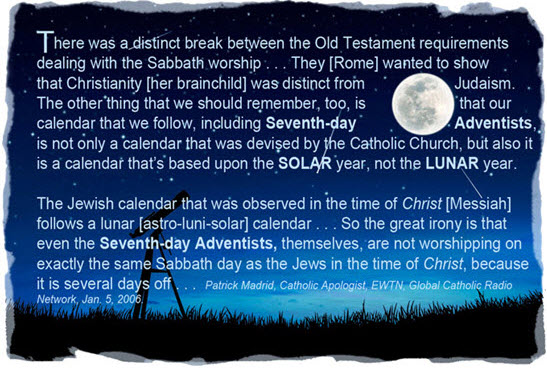
For more historical quotes, refer to The Lunar Sabbath’s Stunning Historical Evidence.
A Divine Warning: Appointed Times Must Remain Unaltered
Through the covenant established with Abraham, Yasharal (Israel) was entrusted with an extraordinary honor, the responsibility of safeguarding the oracles of the PLAN OF SALVATION, the divinely appointed REMEDY for sin. Embedded within this sacred trust was a precise, time-centric revelation of the Messiah’s redemptive ministry, expressed through the lunar-appointed Feast Days that marked His work step by step. Yet even greater than this responsibility was the privilege of bearing the seed of the long-promised Messiah Himself.
However, Scripture reveals that this covenantal honor came with a clear and solemn condition. Obedience was inseparably linked to a specific, predetermined system of time-measuring, one designed by the Creator to govern years, months, Sabbaths, and Feast Days. It is within this context that Yahuah Alahim issues a profound warning, tying Israel’s continued standing before Him to their faithfulness in preserving His set-time laws, declaring:
“If you (Yasharel – Israel) shall remove the prescribed SET-TIME LAWS, the oath of the covenant from before My face, declares Yahuah, then indeed (you) the children of Yasharal (Israel) shall cease from existence and being a nation before My face all the days (forever).” Jeremiah (YirmeYAHU) 31:36
Since the Eternal Yahuah Alahim knows the end from the beginning, is it not reasonable to ask whether He introduced this subject precisely because He foresaw that such a crisis would occur? Might this warning in Jeremiah have been given as a protective safeguard, a gracious alert to His beloved, set-apart people, urging them not to abandon His appointed times?
This leads us to the unavoidable question of our day: Has Yasharal (Israel) removed all or part of Yahuah Alahim’s prescribed set-time measuring model? The answer, though difficult, is clear, yes, yes, and yes. Every unit of sacred time has been altered. Not a single element remains fully intact according to the recorded Kodesh (sacred) standard entrusted to them.
This tragedy did not occur only once. It first unfolded in Jeremiah’s day, after which a measure of restoration was granted. Yet the same pattern reemerged with devastating permanence in the fourth century A.D. Unlike earlier periods, these calculated and willful calendar alterations were never reversed. To this day, the original time-measuring framework established at creation remains unrecovered and unrestored.
Thus, while this study began by examining Constantine and the Christian churches, which openly abolished the Torah’s truths, including the Creator’s calendar, it must also be acknowledged that the Jewish leadership likewise succumbed to altering the sacred things they were commissioned to guard. This sobering reality levels the field entirely. All have fallen short. All require restoration.
And yet, in this shared failure lies a shared invitation, an open call from a merciful Creator to return, to restore what was lost, and to once again walk in harmony with His sacred times and redemptive design.
“Under Roman domination, the authority of the patriarchate and the Sanhedrin was increasingly restricted. In the mid-4th century the proclamation of the New Moon and intercalation could no longer be carried out openly. Hillel II therefore publicized the principles of calendar calculation, enabling communities to determine festivals independently.” Encyclopaedia Judaica, 2nd ed., Vol. 9, pp. 506–507, s.v. “Hillel II”
In the middle of the fourth century, the fragile coexistence between Rome and the Jewish population collapsed ir jordan 11 bred game worn 1996 finals auctio into open conflict. During the years A.D. 351–352, Roman authority intensified its suppression of Jewish life, triggering a revolt that was swiftly and brutally put down. Numerous Jewish communities were devastated, local leadership structures were dismantled, and legal measures were enacted that sharply restricted Jewish religious and civil autonomy. In particular, the authority of the Sanhedrin and its head was severely reduced, signaling a decisive shift in Rome’s tolerance of independent Jewish governance.
This political upheaval struck at the heart of Jewish timekeeping. Under mounting Roman oversight, the long-standing practices of declaring the New Moon by observation, determining festival dates, and regulating intercalation could no longer be exercised freely or publicly. The pressure to bring Jewish time into alignment with Roman administrative norms had reached a breaking point. In response to these conditions, Hillel II moved to limit the Sanhedrin’s calendrical role and made public a new set of calculation methods that allowed communities to determine sacred dates without centralized proclamation, and no longer based upon the actual New Moon.
At the same time, the center of Jewish influence was shifting eastward. As Judea’s institutional authority waned, Jewish leadership in Babylon grew in prominence, and with it came a calendrical system shaped by Babylonian methods rather than Temple-based full moon observation. Although later tradition credits Hillel II with instituting the fixed Rabbinic calendar, the historical reality is more complex. What emerged was not a direct continuation of ancient practice, but the beginning of a new, calculated system born of necessity under Roman domination. This development marked a decisive turning point, setting in motion the gradual formation of the Rabbinical calendar as it exists today, based on calculation.
The continued use of the Roman continuous seven-day week by modern Yasharal (Israel), the unbroken week cycle from Sunday through Saturday, stands as clear evidence that the nation remains, in a very real sense, in Roman captivity. This captivity is no longer political or geographic, but embedded in the measurement of time itself, shaping worship rhythms in ways inherited from Rome and Babylon rather than from the Bible and its TORAH LAW Statutes.
In A.D. 358, under severe Roman pressure to abandon the Scriptural calendar, Jewish leadership adopted the dark conjunction lunar phase as their New Moon, as well as Rome’s new seven-day continuous weekly cycle, a system entirely divorced from the lunar phases. This replaced the original lunar-based week, which had always restarted after each New Moon and was anchored to lunar phases. Though external forms of observance were preserved, the foundational structure of sacred time was altered, leaving them with a calendar no longer synchronized with the Creator’s original design.
Dechiyos – Rules of Postponement
The forced union of these two incompatible time systems produced an entirely new problem for the Yahudim (Jews), utter calendrical chaos. In an effort to manage the resulting disorder, an additional synchronizing mechanism had to be invented. This solution became known as the dechiyos or Rules of Postponement, a construct devised solely to reconcile irreconcilable systems. Significantly, these rules did not exist before the calendar overhaul, nor were they necessary while the Scriptural time-measuring model remained intact and in harmony with itself.
What followed was, and remains to this day, a kind of calendar charade, the manipulation of time through artificial rules and calculations. How can this be demonstrated? Quite simply: for centuries, while the Creator’s original timekeeping system was faithfully observed, there was never a conflict between the Sabbath and the Feast Days. Both were derived from and harmonized by the same divinely appointed beacons of time, the sun, the moon, and the stars. When these celestial witnesses were properly employed, sacred time functioned with flawless unity.
In this way, the warning given through Jeremiah (YirmeYAHU), the voice of YAHUAH Alahim to Yasharal (Israel), has been fulfilled at least twice in history. First, during the Babylonian captivity in 605 B.C., brought on by disobedience, and again following the Roman captivity after A.D. 70, when the nation rejected the Messiah, the very benefactor of their promised eternal inheritance.
Yasharal Remains in Captivity Today
If Yasharal (Israel) has indeed removed the principles of Yahuah’s original time-measuring system without restoration, then where does that leave the nation today in light of Jeremiah (Yirmeyahu) 31:36? Scripture answers this sober question: It places them outside His divine protection and apart from the PROMISE to Abraham, Isaac, and Jacob, as manifested through Yahusha haMashiach, the Messiah, for their eternal future.
As difficult as this truth may be to receive, YAHUAH Alahim has clearly stated His case. Not a single soul will receive an eternal reward on that final GREAT DAY on the basis of genealogy alone. Salvation has never been inherited by bloodline. Rather, the opportunity for redemption is continually extended by our loving Eternal Father through the outstretched arms of the Messiah, calling all people to reformation and restoration. GRACE is freely offered to all, but SALVATION is granted only to those who respond to grace with obedience to His TORAH Law of Instruction. Grace was never intended to abolish obedience. It was given to empower it. The TORAH Law remains the Bridal Covenant, so to be received as His Bride, one must be found without spot or wrinkle.
The clearest evidence of a converted heart is revealed in trusting obedience to the MOST HIGH, particularly to His time-honored TORAH and its time-centric calendar model, designed to synchronize worship with YAHUAH Alahim and Yahusha haMashiach in Ruach and in Truth. This is the only pathway by which humanity may truly follow the Lamb wherever He goes (Revelation 14:4). From full New Moon to full New Moon, and from lunar Sabbath to lunar Sabbath, all Zadok (righteous) flesh shall come and worship before Yahuah Alahim (Isaiah 66:23). When these weekly rhythms are correctly joined with the prophetic Feast Day schematic, each counted from the full New Moon, the result is a complete, blood-stained roadmap provided by the Messiah alone leading unto Eternal Life.
Only those aligned with this divine framework will recognize that the promised Messiah came on time the first time and will return again at the prophetically lunar appointed time, exactly as foretold. Indeed, TIME, the Creator’s original astro-luni-solar calendar, and the EVENT of Yahusha haMashiach laying down His life for mankind are forever intertwined. Remove either one, and the whole collapses. United, they stand, and divided, they fall.
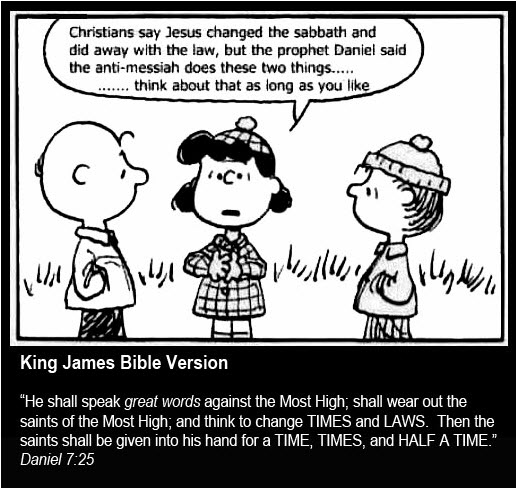
Evidence that Saturday “Sacredness” was Never Changed to Sunday!
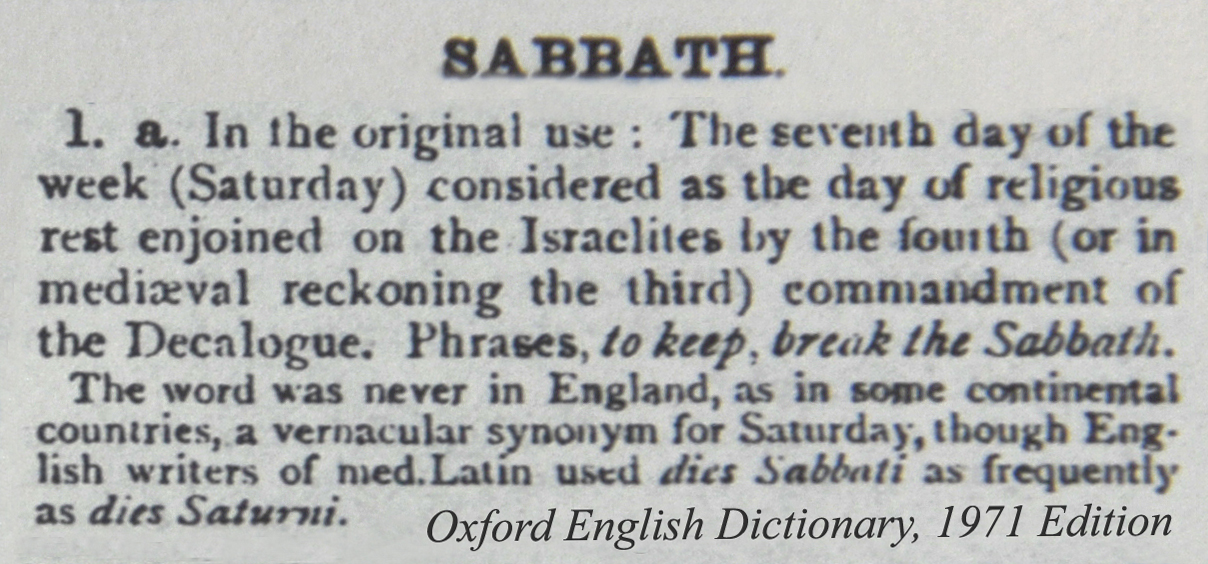
Does Your Church or Synagogue Carry the DNA Torch of the Roman Mother Church?
If truth holds genuine value for you, it is worth pausing to consider whether one or more of the following indicators may reveal that your Christian church or synagogue still carries the DNA of the Roman Catholic mother church, thereby remaining tethered, however subtly, to the Beast system and its Mark. This is not an accusation, but an invitation to thoughtful self-examination grounded in history, Scripture, and conscience.
History reminds us that institutional reform rarely comes from within. Just as Martin Luther ultimately discovered that he could not reform the Roman Catholic Church from the inside, so too no sincere seeker of truth should expect to effect systemic change within today’s religious institutions. Transformation does not occur through ecclesiastical structures, but through individual hearts awakened by truth. Real restoration begins one soul at a time, as knowledge replaces tradition and obedience is restored to its rightful place.
Indicators of Roman Mother Church DNA
A church or synagogue may still carry the imprint of Rome if it reflects one or more of the following characteristics:
-
Like Constantine, it worships Jesus Christ as the Son of God in place of YAHUSHA haMashiach, who came in the name of His Father YAHUAH Alahim, written in Hebrew more than 7,000 times in the Tanakh (Old Testament).
-
Like Constantine, its members identify themselves as Christians, even though this term did not exist in its imperial sense until Constantine institutionalized it in A.D. 325.
-
Like Constantine, it worships the Most High under the title the “Lord God” as a replacement for YAHUAH Alahim, the Eternal Father.
-
Like Constantine, it follows the rhythm of the pagan Roman solar calendar (Julian or Gregorian) for all worship occasions.
-
Like Constantine, it identifies either Saturday (Dies Saturnis) or Sunday (Dies Solis) as sacred days on a Roman continuous weekly cycle specifically designed to oppose the creation week revealed in the TORAH.
-
Like Constantine, it celebrates New Year’s Day on January 1st in winter, rather than Rosh Hashanah on the full New Moon of Abib 1 in spring, as prescribed in Scripture.
-
Like Constantine, it denounces the New Year in spring, New Moons, lunar Sabbaths, and the lunar-appointed Feast Days outlined in the TORAH.
-
Like Constantine, it follows a continuous seven-day week rather than the Scriptural week that is counted “from one New Moon to another.”
-
Like Constantine, its wall calendars display months and dates with no consistent synchronization to the Creator’s uniquely designated lunar phases.
-
Like Constantine, it teaches that believers are no longer under the TORAH Law, claiming it ended at the crucifixion, while asserting a covenant of Grace alone. Yet it was Constantine, not Yahusha haMashiach, who abolished Hebrew obedience in A.D. 325.
-
Like the mother church, it misapplies the phrase “the Law nailed to the cross” to mean the TORAH was abolished.
-
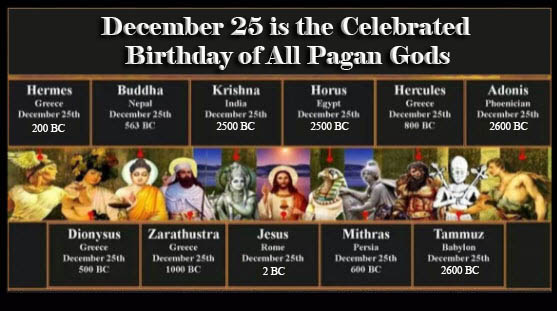
Like Constantine, it celebrates the birth of the anointed Messiah on Christmas, December 25, a date historically tied to pagan deities rather than the Messiah.
-
Like Constantine, it celebrates the death of Yahusha the Messiah on Good Friday instead of Passover, the 14th day counted from Rosh Hashanah (New Year’s Day) in spring.
-
Some Saturday keepers substitute Passover, the 14th day counted from the New Moon, with a quarterly communion service, despite all the biblical criteria for its precise placement, once a year in spring.
-
Like the Mother Roman Catholic Church, the Messiah’s resurrection is celebrated on Easter Sunday, deliberately severed from the three days and three nights that the Messiah lay in the tomb (the 14th through the 16th), rising just before sunrise on the 17th.
- Like the Mother Church, all or most of the Roman Holidays are honored, while none of the biblical lunar holy days are even considered.
-
Like the Mother Church, many teach that souls go immediately to heaven or hell at death, though Scripture teaches that all remain in the grave until the resurrection at the Messiah’s Second Coming.
-
Some promote prayer to saints, images, or Mary as an intercessor, teachings not found in Scripture.
-
Some acknowledge the Vatican as the Beast of Revelation, yet overlook evidence suggesting that Rabbinical Pharisee Judaism, through calendar alteration, has aligned with Rome in changing times and laws.
-
Nearly all churches believe the Mark of the Beast cannot affect them, assuming their denomination provides some form of immunity.
-
Many Saturday Sabbatarians believe Saturday observance prevents them from receiving the Mark of the Beast, while Sunday worshipers believe Grace exempts them entirely. Both positions arise from a lack of historical and calendrical understanding.
-
Like Constantine, churches generally fail to recognize that both the Roman calendar alteration and the Rabbinical Jewish calendar alteration produce the Mark of the Beast, which appears to be the abomination of desolation spoken of by the prophet Daniel. Both worldwide systems have departed from the Creator’s ordained rhythm of worship, which eliminates the Remedy for sin and the Plan of Salvation.
This is not an exhaustive list, nor is it written to condemn, but to awaken. The question before each of us is not what we have inherited, but what we are willing to examine, unlearn, and restore in obedience to the truth as it is written.

Historical Lunar Week and Sabbath Quotes
The widely held belief that the modern continuous weekly cycle has descended uninterrupted from Creation is not a conclusion shared by informed Jewish scholars who are well acquainted with their own history and with the immovable tenets of Torah Scripture. On the contrary, historical evidence strongly suggests that Jewish leadership between the second and fourth centuries, in concert with Roman authorities, played a significant role in the profound alterations to calendation, the system of sacred time-measuring now accepted by the world.
These changes did not occur through a minor adjustment, but through the deliberate setting aside of the Creator’s original calendar, the one beaconed by His ordained trinity of lights: the sun, the moon, and the stars. By disconnecting sacred time from these celestial witnesses, the original worship rhythm established at Creation was obscured, giving rise to the calendar confusion that persists to this day.
“In the years following Clement of Alexandria’s time (A.D. 150-215), an ominous change started to take place that was to radically change the Christian concept of the Sabbath.” This intimate connection between the week and the month was soon dissolved. It is certain that the week soon followed a development of its own, and it became the custom — without paying any regard to the days of the month (i.e. the luni-solar month) . . . so that the New Moon no longer coincided with the first day of the month. Then, on page 4179 of the same encyclopedia, we read: “The introduction . . . of the custom of celebrating the Sabbath every 7th day, irrespective of the relationship of the day to the moon’s phases, led to a complete separation from the ancient view of the Sabbath. . . Encyclopaedia Biblica, 1903 p. 5290.
“The invention of the continuous week was therefore one of the most significant breakthroughs in human beings’ attempts to break away from being prisoners of nature [time preordained by the Creator with the correct use of the sun, moon, and stars] and create a social world of their own.” The Seven Day Circle: The History and Meaning of the Week, Eviator Zerubavel, New York: The Free Press, 1985. p.11.
“Even after Constantine’s edict about Sunday [A.D. 321-324], it took another generation or two for the seven-day week to catch on throughout the empire. The 24-hour system took longer, having to wait until the invention of the mechanical clock in the Middle Ages by monks anxious to observe with precision their canonical hours. Before this, people marked the passage of time during the night by using the stars and during the day either by eyeballing the sun or by listening to public announcements of the time.” Calendar, David Ewing Duncan, p. 47, New York, Avon Books, 1998.
“The connection of the Sabbath with lunar phases, however, was (later) discarded by the Israelites…” The New Schaff-Herzog Religious Encyclopedia, p. 135-136.
“Most theologians and some scholars assume that mainstream Jewish society, at the time of Jesus…was practicing a fixed seven-day week, which was the same as the modern fixed [Roman planetary cycling] seven-day week. This is extremely doubtful. The change, from a lunar to a fixed week, was brought about by the power and influence of Rome. As long as the Nazarenes held power in Jerusalem, all Roman practices and customs, including that of the consecutive week, were held at bay.” Shawui Sabbath: Ancient Sabbath Observance
“The [early] Hebrews employed lunar seven-day weeks, which ended with special observances on the seventh day, but none the less were tied to the moon’s course.” Rest Days, Hutton nike revolution 7 Webster, p. 254-255
“He [Constantine] wished, almost the necessity, of so keeping Easter as to make the day of crucifixion Friday, and of the resurrection Sunday, caused differences of opinion that led to persecution and bloodshed.” Mazzaroth, The Constellations, Frances Rolleston, p. 133. Rivingtons, London, 1862.
“The Jewish festivals being regulated solely by the moon, may fall on any day of the [modern Roman] week.” Oxford English Dictionary, 1971 Edition, Vol. 2, “Pentecost.”
“The modern seven-day week came into use during the early imperial period, after the Julian calendar came into effect, apparently stimulated by immigration from the Roman East. For a while it coexisted alongside the old 8-day nundinal cycle, and fasti are known which show both cycles. It was finally given official status by Constantine in 321.” Roman Calendar Encyclopedia, Days of the Week.
“The Sabbath depending…upon the observation of the phases of the moon, it could not, accordingly be a fixed day [planetary day of the modern Roman cycling week]. The Jewish Encyclopedia: A Descriptive Record of the History. Edited by Isidore Singer, Cyrus Adler. Volume 10, p. 590.
“It is certain that the Jews celebrated the sheaf-waving on Nisan 16… without regard…to the day of the [modern Roman] week.” Oxford English Dictionary, 1971 Edition, Vol. 2, “Pentecost.”
“We shall be taken for Persians [Mithraists], perhaps… The reason for this, I suppose, is that it is known that we pray towards the east… Likewise, if we devote the day of the Sun to festivity (from a far different reason from Sun worship), we are in a second place from those who devote the day of Saturn, themselves also deviating by way of a Jewish custom of which they are ignorant.” Tertullian, Apologia.
The weeks do not continue in a regular cycle regardless of the moon. Each month has four weeks, their beginning with the New Moon. I have no doubt that this was the old Hebrew system. Babylonian Menologies and the Semitic Calendars, p. 89.
“It should be noted that the oldest dated Christian inscription to employ a planetary designation [Sunday – Saturday, unbroken cycle of weeks] belongs to the year 269 A.D.“ Inscriptiones Christianae Urbis Romae, ed. De Rossi, 1861, i, No. 1.
“The present Jewish calendar was fixed [to the Roman planetary continuous weekly cycle] in the fourth century.” Jewish Theological Seminary of America, Letter by Louis Finkelstein to Dr. Leroy E. Froom, Feb. 20, 1939.
“There was a distinct break between the Old Testament requirements… dealing with the Sabbath worship… They wanted to show that Christianity was distinct from Judaism… The other thing that we should remember, too, is that our calendar that we follow, including Seventh-day Adventists, is not only a calendar that was devised by the Catholic Church, but also it is a calendar that’s based upon the solar year, not the lunar year and the Jewish calendar that was observed in the time of Christ follows a lunar [lunisolar] calendar…So the great irony is that even the Seventh-day Adventists themselves are not worshiping on exactly the same Sabbath day as the Jews of the time of Christ.”Patrick Madrid, Catholic University Professor made the startling comment on EWTN, Global Catholic Radio Network on Jan 5, 2006 when answering a question about the Catholic Church changing the day of worship from Saturday to Sunday.
In all cases above emphasis has been supplied.
With a subtle yet decisive gesture, Constantine affixed Dies Solis (Sunday) to the Resurrection of our Messiah, thereby making his own calculated contribution to severing sacred time from the Yahudim (Jews). To the untrained eye, and to generations unfamiliar with the historical record, this maneuver created the powerful illusion that Scripture’s original seventh-day Sabbath had always been “Saturday.”
This illusion was sustained by a simple but effective mechanism: ensuring that Easter was observed every year on Sunday, the first day of Rome’s newly imposed planetary week. By extension, the day immediately preceding it, Dies Saturnis (Saturday), was made to appear as the seventh day of that same cycle. Yet according to Scripture and the ancient calendar of Creation, this alignment had never existed before.
“The long-term effect was that ‘Easter Sunday’ entered the Christian paradigm as ‘The Day of Christ’s Resurrection.’ The corollary to this realignment of time calculation was that the day preceding Easter Sunday, Saturday, became forever after ‘The True Bible Sabbath.’ This is the true significance of Constantine’s ‘Sunday law’ and it laid the foundation for the modern assumption that a continuous weekly cycle has always existed.” eLaine Vornholt & Laura Lee Vorholt-Jones, Calendar Fraud, “Biblical Calendar Outlawed.” Emphasis supplied.
Rethinking the Abomination that Makes Desolate
A closer reading of Daniel reveals that the abomination that makes desolate is inseparably linked to time itself, not merely to a political act or a future event. Daniel first introduces this concept in Daniel 11:31, where we are told that forces would arise to take away the daily sacrifice and set up the abomination that makes desolate. This language is not symbolic filler. It points directly to the Temple’s daily sacrifice schedule, which was governed by a precise, time-centric framework rooted in the Creator’s original worship calendar. To remove the daily sacrifice was to disrupt the very rhythm of sacred and prophetic time established by Yahuah Alahim, the Most High.
Daniel 12:11 deliberately repeats this same narrative, reinforcing its importance: “From the time that the daily sacrifice is taken away, and the abomination that makes desolate is set up…” What follows is not a vague warning, but a measurement of time: a thousand two hundred and ninety days. This repetition confirms that the abomination is not only an act of desecration, but a calculated alteration of appointed time, severing worship from the calendar that sustained it.
It is worth considering, then, whether this numerical period itself may have been obscured or manipulated to prevent recognition that the prophecy had already been fulfilled. Daniel 7:25 provides critical context, warning that this same power would “think to change times and laws.” The wording is precise. It does not merely say laws, but times and laws together, suggesting a coordinated effort to alter both divine instruction and the calendar by which it is kept. If sacred time was changed, then the prophetic clock tied to that time would necessarily be distorted as well.
Viewed through this lens, the abomination that makes desolate is no longer confined to a distant future expectation. It emerges as a historical reality rooted in the removal of the Temple’s daily, time-regulated sacrificial schedule and the substitution of a counterfeit system of time. This understanding not only harmonizes the testimony of Daniel’s visions but also explains why so many sincere believers have struggled to locate the fulfillment. When time itself is altered, recognition is delayed. Yet the prophecy remains accurate, waiting patiently for eyes willing to see and hearts willing to reconsider what has long been assumed.
Conclusion
Have we been mistaken for much of our lives in our sincere desire to be called “Christian,” Hebrew Roots, or Jews, while simultaneously dismissing the continued viability of the Torah, the Law of the Old Testament, and its original and authentic lunar appointed worship rhythm? Have we been conditioned to turn a blind eye to the original time-measuring model established at Creation, with its New Moons, lunar Sabbaths, and lunar-appointed Feast Days, simply because we were taught that we are now “saved by grace” and therefore no longer accountable to the Torah Law? In many cases, the honest answer is yes, not out of rebellion, but out of inherited ignorance. Yet every passing moment presents a fresh opportunity for correction, restoration, and a return to truth.
When viewed through this lens, the long-anticipated abomination of desolation comes into sharp and sobering focus. Scripture does not define this abomination merely as persecution, but as the removal of “the daily” and the setting up of a counterfeit system in its place. The daily sacrifice schedule of the Temple had functioned as the guardian of sacred time, regulating the calendar and preserving the prophetic rhythm through which redemption was revealed. When that daily was taken away, sacred time itself was disrupted. Many have assumed this abomination was destined solely for the end of time. Yet when Scripture defines the abomination as the removal of “the daily sacrifice” and the alteration of sacred time, the combined testimony of prophecy and history points decisively to its fulfillment in the fourth century A.D. It was then that the Temple’s time-keeping function was removed and replaced by the imperial Roman Julian calendar, along with a newly imposed worship rhythm foreign to the order established at Creation.
The historical record, including the Creed associated with Constantine and the Church of Constantinople, which became the doctrinal foundation upon which all later Christian churches were built, openly acknowledges that the Hebrews marked their months by the New Moon in accordance with the Torah. It was not Saturday of Rome’s sun-based calendar that Constantine sought to abolish, but Yahuah Alahim’s lunar Sabbath and the entire Temple-anchored lunar worship system tied to the daily sacrifice schedule.
Strikingly, the original seventh-day Sabbath of Scripture was not the same day later adopted by the Rabbinical Pharisee Jews under Roman coercion in A.D. 358. What they retained was the Roman Saturday, a planetary day shared with the pagan world. This distinction is difficult for many to accept, yet the evidence is unmistakable.
For those who have considered alternative calendar systems, such as the Enoch solar model or proposed future world calendars, the same historical clues offer clarity. The calendar practiced by the Hebrews before A.D. 325 was neither solar nor Roman in origin. It was lunar in its time-measuring foundation, governed by the moon as the primary beacon of sacred time. Psalms 104:19 puts it this way: “He ordained the moon for mo’edim…” Mo’edim are sacred lunar-appointed worship times.
Not every lunar phase qualified to commence the month, but the full moon alone functioned as the appointed signal for New Year’s, New Months, and the count toward all sacred days. This was the calendar safeguarded by the Temple’s daily service and the very system Constantine moved decisively to erase. For more on the New Moon, refer to: Treasury of Evidence the Full Moon Announces Lunar Months.
During Roman captivity, the Hebrews were compelled to relinquish the continued authority of Yahuah’s Torah, along with His New Moons, lunar Sabbaths, and the daily sacrifice framework that preserved the prophetic clock of redemption. To this day, that original time-keeping model, faithfully observed by the patriarchs and prophets for over four millennia, has not been fully restored. Consequently, both Rabbinical Judaism and the broader Christian world remain bound to Roman time-keeping. In this way, the abomination of desolation that began with the removal of the daily sacrifice schedule and the installation of a counterfeit calendar continues to cast its long shadow across the present. As history testifies, Rome stands as the successor of ancient Babylon, inheriting its authority and methods, and Scripture identifies this power as central to end-time deception.
And so we find ourselves standing at the threshold of the closing chapters of history. The realization that the abomination of desolation has already occurred does not lead to despair, but to accountability. It lifts the veil, removes the blinders, and calls a people to re-examine everything they have inherited. As Scripture speaks of the Beast power, formed in the mold of ancient Babylon, advanced through Roman authority, and formalized within its creedal structure, the urgency of our Messiah’s appeal echoes through His messengers, sounding forth with unmistakable clarity:
“BABYLON THE GREAT IS FALLEN, IS FALLEN . . .” Revelation (Hazon) 18:2
“. . . COME OUT OF HER, MY PEOPLE, LEST YOU SHARE IN HER SINS, AND LEST YOU RECEIVE OF HER PLAGUES.” Revelation (Hazon) 18:4
“My people are destroyed for lack of knowledge. WHY? Because you have rejected knowledge, I also will reject you from being Kohenim (Priests) for Me. Because you have forgotten THE TORAH (LAW) of your Alohim (God), I also will forget your children.” Hosea (HosaYAH) 4:6
“Our beliefs, right or wrong.
If right, to be kept right;
and if wrong, to be set right.”
May our conscience rise above politics and popularity as we come to understand that Constantine’s fourth-century Creed did not merely influence Christianity, but founded it upon a calendar, worship rhythm, and theological framework deliberately detached from the Temple’s prophetic timekeeping and the Torah Law itself. Most significantly, this alteration of sacred time severed the betrothed Bride from her Bridegroom, the Messiah, disconnecting the faithful from the very calendar through which He reveals Himself, fulfills His part of the covenant, and calls His people to walk in step with Him.
What was lost was not accidental, but deliberately removed from view. Yet the present moment stands as an open door. Now is the time to recover what was set aside and to return, with humility and courage, to obedience in all that Yahuah has lovingly prescribed.
May our gracious Father extend continued compassion to us all as we awaken from spiritual slumber and respond to His gentle yet urgent call to step away from man-made systems and into the full light of His truth. This preparation is not merely academic or historical in nature, but eternal in consequence, shaping how we align our lives, our worship, and our allegiance in view of His approaching judgment and the establishment of His everlasting Kingdom government. The call of Scripture remains clear and unrelenting: COME OUT from among them, and be separate, that we may stand faithful, prepared for His soon return and in harmony with our Creator when all things are finally made right.
Consider each of the following articles as they relate to this one:
- Constantine and the Week
- Constantine’s Creation of Jesus Christ
- Constantine’s Easter Controversy with the Messiah’s Quartodecimen
- Mo’edim and the Missing Key Puzzle Piece
- The Bridal Covenant of Promise, Hope, and Restoration
The following is a Christian’s challenge and a Rabbi’s rebuttal of the quote’s premise.
Hunting the Wild Quotation
Posted on May 17, 2010 by Roger Pearse
As I wander around the web, I come across supposed quotations that slap me in the face and shriek at me as “fake.” Today, I found this:
The following creed is that of a church at Constantinople around the time of the “Council of Nicea”:
“I renounce all customs, rites, legalisms, unleavened breads & sacrifices of lambs of the Hebrews, and all other feasts of the Hebrews, sacrifices, prayers, aspersions, purifications, sanctifications and propitiations and fasts, and new moons, and Sabbaths, and superstitions, and hymns and chants and observances and Synagogues, and the food and drink of the Hebrews; in one word, I renounce everything Jewish, every law, rite and custom and if afterwards I shall wish to deny and return to Jewish superstition, or shall be found eating with the Jews, or feasting with them, or secretly conversing and condemning the Christian religion instead of openly confuting them and condemning their vain faith, then let the trembling of Gehazi cleave to me, as well as the legal punishments to which I acknowledge myself liable. And may I be anathema in the world to come, and may my soul be set down with Satan and the devils.”
Do you think that this religion (Constantinianism) is what Yeshua wanted us to become entangled in?
This is a canon of Nicaea I. It sounds like a personal confession of faith. The poster, of course, gave no reference. But a Google search on I renounce all customs, rites, legalisms, unleavened bread & sacrifices of lambs of the Hebrews gave me this link at Fordham.edu, which said nothing about Nicaea and gave “From Assemani, Cod. Lit., 1, p. 105″ as the reference, and “from James Parkes: The Conflict of the Church and the Synagogue: A Study in the Origins of Antisemitism, (New York: JPS, 1934), 394-400.”
Assemani was an oriental scholar who published texts from Syriac in Rome in the 18th century, most of them medieval. So, this also is not in accord with the starting post.
Adding Assemani to the Google search brought up a slew of material such as this, headed Constantine’s and Rome’s Christian Creed, giving “Stefano Assemani, Acta Sanctorium Martyrum Orientalium at Occidentalium, Vol. 1, Rome 1748, page 105” as the reference for the very same paragraph.
We’re clearly in the realm of the polemical quote when we have two references for the same thing. Of course, “Sanctorium” is itself a typo, but suggestive of someone who has repeated, rather than checked, the data.
Is the book online? Not in Google Books or archive.org — not a good start.
What about the “Cod. Lit.” reference? This site tells us that J. A. Assemani published, inter alia:
“Codex Liturgicus ecclesiae Universae in XV libros distributus” (Rome, 1749-66). — This valuable work has become so rare that a bookseller in Paris recently issued a photographic impression of it.
So the “quote” has two references, neither readily accessible, both in Latin at best.
Volume 8 of the codex Liturgicus is here, and several others are accessible. Is volume 1, I wonder? After a lot of searching, I found it here. Page 105 is p.162 of the PDF. The renunciation starts at the top of p.106 and starts as per the quote.
But … it’s misleading. This is not the whole statement. A huge chunk has been omitted from the middle without being marked. For it should at least indicate the omission: “In one word, I renounce everything Jewish, every law, rite and custom … And if afterward I shall wish to deny”. In fact, the sentence before the break is truncated, and the one afterward starts before the ‘and.’
I renounce everything Jewish, legalism, custom, and rite; and above all, he who is expected by all the Jews in the shape and dress of Christ, I renounce Anti-Christ, and join myself to the true Christ and God. And I believe in the Father, the Son, and the Holy Spirit; the holy and consubstantial and individual Trinity; I profess the dispensation where one of the holy trinity, the Word of God, took flesh and became man; …
And later:
…if I pretend to be a Christian and then I wish to deny and return to Jewish superstition…
I don’t have time to translate the whole confession, but the extracts are more than a little misleading.
The other question, is this Nicene? Must be answered in the negative. There is no trace of such a statement in all this. No, this is a medieval Greek catechism for someone converting to Christianity from Judaism.
Quite why the Christians should not require a Jew professing conversion to be sincere, of course, we are not told by the original post.
Rebuttal by OvadYah
Thanks, Roger – I read your sobering critique against the hordes of posts on the internet that promote this ‘Constantine Creed.’ I admit that I found this particular Creed promotion too, ‘obviously’ stating the truths of history’s great anti-Semitism and hate against anything Jewish – except, of course, the very Bible that was authored mainly by Jews – including the ‘New Testament’!
True, in sober research, one often gets across (and should be wide awake against) this exuberance of most of modern day’s ‘Hebrew Roots Restorers’ seeking confirmation of their newfound ‘restored true Faith.’ This modern notion is so volatile these days that it could well point to a (mis)interpreted ‘anti-missionary’ onslaught by Jews – as suggested by one of your respondents, Kevin.
Kevin (receiving your agreement), in fact, confirmed my surmising while reading your sobering guidance Lakers Legend Magic Johnson Reacts to Michael Malone Firing of another danger inherent in the highlighting of the probable (mis)quotation by these exponents. Kevin’s views, in one swoop, cover up ALL the evidence of the GREAT Jew hatred of the Church from the time of its birth to this day (to various degrees, of course). Typically, as of the media apparatus with all they wish to sweep under the carpet, this treatment of the ‘uncovering of the (mis)quotes against Constantine’ places doubts on ALL the ‘evidence’ of history of the barbarous treatment of Jews simply for sticking to the faith of their ‘mamas and papas’ right up to Moses who was taught and enlightened by God. In fact, Kevin style, we could now even doubt the authenticity of Moses! Never mind the lion’s dens of Rome (NOT for Christians but for ‘Jewish style’ Messianics of the time!). Never mind Luther and Calvin’s venom and insult of Jews and everything Jewish! Never mind ….. ALL the awful hatred revealed by Christians against Jews and Judaism. Today, that hatred (SEE definition of hate!) is covered under a cloak of ‘love’ for Israel and Judaism – indeed a true love, infiltrated through by the bitter waters of centuries of Constantine Christianity. If you doubt these statements, which we are faced with daily in dealing with Hebraic Roots Restorers, then please ask the nearest Christian to you what he/she thinks of Rabbinic authority and the Oral Torah.
Irrespective of which of the libraries of ‘evidence’ of Christian hatred of Jesus’ own religion is (mis) quoted or not, ONE salient point of evidence stands unchallenged today: Millions of Christians are leaving the Constantine-originated institutions of Christianity and RETURNING to their ancient ROOTS of that hated Jewish ‘customs, rites, legalisms, unleavened bread & sacrifices of lambs of the Hebrews, and all other feasts of the Hebrews, sacrifices, prayers, aspersions, purifications, sanctifications and propitiations and fasts, and new moons, and Sabbaths, and superstitions, and hymns and chants and observances and Synagogues, and the food and drink of the Hebrews.”
I do not believe that casting doubts on the authenticity of “Constantine-like Decrees” can answer for the sound foundations (MUST BE!!!) of this ‘Turn Around’ by multi-millions of souls throughout the world to a Faith which they, the Returnees and Restorers themselves, have rejected before!
So, I commend your alertness – but please be aware that it does NOT sanctify the birth effects of Constantine’s Decrees and attitude, which poisoned the entire world against God’s One True Faith – Judaism. Interpret this approach as you wish, but do NOT lose sight of what the main message of Prophetic Scripture itself proclaims – as, in fact, confirmed by the authentic Jewish Torah principles hidden in the NT itself, which are, in fact, turning its truly seeking readers around to the very principles that Constantine and Christianity vehemently discarded.
Ref. http://www.kolhator.org.il and note the publication “Jewish Secrets Hidden in the NT” on display, written by an orthodox Rabbi.
OvadYah – co-founder KOL HATOR VISION for a restored Israel (of Jews and non-Jews who seek God’s True Way of Judaism.
Kerrie French’s final comments:
It was in response to the Jews rejecting the Messiah outright that the Good News of the Gospel was carried to the Gentiles. Yet, while they accepted the Messiah, they rejected the Torah Law of the Old Testament, causing the TRUTHS of SCRIPTURE to become defaced in the process. The Torah Law, which was recorded as the Promise and Purpose of the Prophetic and Time-centric coming of the Messiah, was thwarted and, in its place, a fraudulent focus and time system was established.
So, both sides, the Jews and Christians, rejected one of the two pillars of Scripture. The prophet Isaiah explains the standard this way:
“To the Torah Law and to the Testimony, if they speak not according to this word, it is because there is no light in them.” Isaiah 8:20