The Antikythera Mechanism
The Antikythera Mechanism
The 2,000-Year-Old Astro-Luni-Solar Computer
An Ancient Discovery That Challenged Modern Understanding
By Kerrie French
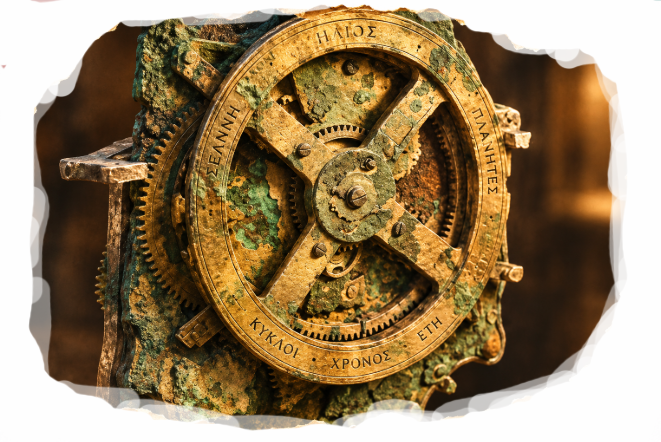
More than 2,100 years ago, Greek craftsmen constructed an extraordinary mechanical instrument capable of calculating and displaying the movements of the heavenly bodies. Today, this remarkable device is known as the Antikythera Mechanism, widely recognized as the earliest surviving example of an analog astronomical computer.Discovered among the remains of an ancient shipwreck near the Greek island of Antikythera, the mechanism has challenged conventional assumptions about the scientific and technological capabilities of the ancient world.
The shipwreck was discovered in 1900, and the mechanism was recovered in 1901. Based on archaeological evidence and subsequent scientific investigations, its construction is generally placed during the second century B.C., although its precise date and place of manufacture remain subjects of scholarly discussion.
What makes this discovery particularly remarkable is that no surviving mechanical instrument of comparable complexity is known from the following many centuries. The Antikythera Mechanism demonstrates that ancient civilizations possessed an astonishing understanding of celestial movements and their relationship to the measurement of time.
Unlocking the Secrets of an Ancient Computer
For decades, the corroded bronze fragments of the Antikythera Mechanism concealed their original purpose. However, through radiographic imaging, mathematical analysis, and mechanical reconstruction, researchers gradually uncovered the extraordinary sophistication of its internal workings. Among those who contributed significantly to this research was Michael Wright, a British museum curator and mechanical engineer who developed an influential working reconstruction of the instrument. There have been others who have followed.
 Wright’s work deserves particular recognition because he approached the mechanism not merely as an archaeological curiosity, but as a functioning astronomical instrument whose original design could be investigated through mechanical reconstruction.
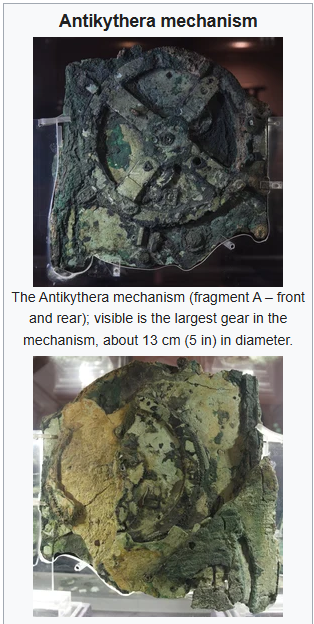
The original mechanism was approximately the size of a dictionary and contained an intricate arrangement of bronze gears. Modern reconstructions suggest that its complete design may have incorporated approximately 37 gears, although only a portion of the original mechanism survives. Operated by turning a handle, the interconnected gears moved pointers across carefully arranged astronomical and calendrical displays.
These displays represented several important celestial cycles, including the movements of the sun and moon, the changing phases of the moon, and the periodic recurrence of lunar and solar eclipses. Research has also identified a display associated with the scheduling of important Greek athletic festivals, including the Olympic Games on a four-year cycle.
Rather than functioning as a modern clock that measures hours, minutes, and seconds, this ancient instrument calculated time through the recurring movements of the heavenly bodies for years, months, and days. Its sophistication reveals that the Greeks understood something largely overlooked in modern civil timekeeping: the sun and moon operate in distinct but interconnected astronomical cycles.
The Heavens as an Instrument for Measuring Time
The Antikythera Mechanism was not merely an ingenious arrangement of gears. It was a mechanical representation of the orderly movements of the heavens. Its designers understood that celestial bodies move according to recurring mathematical relationships that can be observed, measured, and used to anticipate future astronomical events.
The mechanism incorporated a sophisticated representation of the moon’s changing apparent speed as it travels along its elliptical orbit. This feature is especially remarkable because it demonstrates an effort to reproduce the irregularities of celestial motion through mechanical means.
The instrument also included an eclipse-prediction system based on the Saros cycle, a period of approximately 223 lunar months, or 18 years and 11 days. Through this cycle, ancient astronomers could identify periods during which similar patterns of solar and lunar eclipses were likely to recur.
The mechanism therefore served as far more than a simple calendar. It was a mathematical model of astronomical time. Although some have suggested that instruments of this kind might also have served astrological interests, the surviving mechanism primarily demonstrates astronomical calculations and calendrical relationships.
Its most important contribution to our discussion is the unmistakable evidence that ancient timekeeping involved the coordinated observation of celestial cycles: the moon and stars for lunar years and months; the lunar phases for announcing each new month, the count of weeks, and days with its unique lunar phases; and the sun for solar years and hours.
The Remarkable 19-Year Lunar-Solar Cycle
One of the most significant features of the Antikythera Mechanism is its representation of the 19-year Metonic cycle. This astronomical cycle demonstrates the relationship between the lunar month and the solar year.
A regular lunar year consisting of twelve synodic months contains approximately 354 days, while the solar year contains approximately 365.24 days. Consequently, twelve lunar months fall approximately eleven days short of a solar year. If these differences were ignored, a calendar based exclusively on twelve lunar months would gradually drift through the seasons. But the lunar cycle is not held to strictly twelve months.
Ancient astronomers recognized that 235 lunar months correspond very closely to 19 solar years.
This relationship provided a mathematical foundation for coordinating lunar months with the annual progression of the sun. Within a 19-year lunisolar calendar, the moon automatically includes a thirteenth month that involves no human participation. These thirteen-month intervals help to maintain the relationship between the lunar months and the solar year. Although the correspondence is not absolutely exact, the difference is sufficiently small to make the cycle highly useful for long-term calendrical calculations.
The Antikythera Mechanism incorporated this 19-year relationship into its mechanical design, providing a striking demonstration of the astronomical knowledge available more than two millennia ago. Here we discover an important principle: the lunar month and solar year are not competing systems of timekeeping. They are complementary astronomical measurements.
The moon identifies the recurring monthly cycle, while the sun provides the seasonal framework within which those months occur. Together, they form the essential foundation of an astro-luni-solar calendar.
The Full Moon and the Beginning of the Lunar Month
Another fascinating feature of the Antikythera Mechanism is its ability to display the changing phases of the moon. The mechanism’s lunar display represented the illuminated and darkened portions of the moon as it progressed through its monthly cycle. This demonstrates that ancient astronomers understood the relationship between lunar phases and the passage of each day of the lunar month.
Yet the question of which lunar phase originally marked the beginning of the month at the time of Creation, the time of Noah, the time of Moses, the time of King David, and most importantly the time of Yahusha the Messiah, deserves particular attention.
Today, the New Moon is commonly identified with the dark conjunction, while certain religious calendars recognize the first visible crescent. However, the widespread acceptance of these conventions does not, by itself, establish which lunar phase was originally divinely ordained to begin the month by our Creator in the beginning. The history of calendation demonstrates that civilizations have adopted, modified, and occasionally replaced earlier methods of measuring time. Consequently, modern convention should not be treated as the final authority concerning ancient calendrical practices.
From the Scriptural perspective presented throughout the website TheCreatorsCalendar.com, the full moon is identified as the Scripture’s original New Moon, the visible heavenly marker from which the monthly count begins. This understanding places particular importance upon the moon’s complete illumination as a divinely appointed sign. In accordance with Genesis 1:14-16, the full moon is the only visible light that rules together with the stars as it rules the heavens along the east-west time continuum, in both the northern and southern hemispheres on the same 24-hour spin of the Earth.
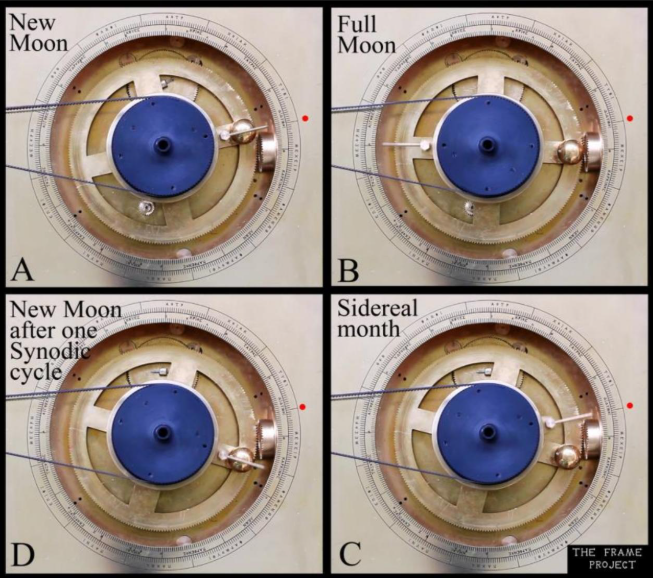
Michael Wright’s pioneering reconstruction of the Antikythera Mechanism is especially relevant to this discussion because it brought renewed attention to the instrument’s lunar display and the relationship between its astronomical and calendrical functions. At one point, in a video he produced, he declared that the mechanism’s time-measuring begins with the full moon. His statement may have been redacted and dismissed by the larger arena of scholars, as I can no longer find his video or any statement he made about the full moon. Yet it was stated. And while the masses may be in denial or have muted that detail for the sake of maintaining the status quo, here is one of the later models by someone else that clearly shows the start of the month is the full moon, the one in alignment, whereas the dark conjunction lunar phase that occurs before and after the full moon is out of alignment.
Where Scripture and the Measurement of Time Meet
Here is what Scripture says in Genesis 1:14, as it identifies the Creator’s principal instruments of time measurement. All of which were defined as lights in the heavens.
“And Alahim said, ‘Let there be lights in the firmament of the heaven to divide the day from the night; and let them be for signs, and for
seasons(mo’edim – lunar appointed time), and for days, and years: And let them be for lights in the firmament of the heaven to give light upon the earth:’ and it was so.” Genesis 1:14-15
But the evidence does not end with Genesis 1:14-15; now let’s read verse 16 as it is defined in Hebrew.
“And Alahim made two great lights; the greater light to rule the day, and the lesser light to rule the night together with the stars.” Genesis 1:16
This view of Genesis 1:16, identifying the lesser light of the moon was designed to rule together with the stars by night, is supported factually by two additional witnesses in Scripture, such as Psalms 136:7-9 and Jeremiah 31:35-36. But there are a few things that none of us were ever taught or realized are present in these three verses:
- When the greater light (sun) rules the daylight, it does so from east to west, when the stars are not present. This provides the parameters of the day.
- When the stars rule the night, they do so from east to west when the sun is not present. This provides the parameters of the night.
- When the lesser light (moon) rules together with the stars, it does so one night only, from east to west, when the sun is not present. This east-west time continuum principle defines which lunar phase is the New Moon.
Herein lies the extraordinary significance of these three Scriptural witnesses: Of all the moon’s changing phases, only the full moon rises in the east as the sun sets in the west, travels across the heavens throughout the night together with the stars, and sets in the west as the sun rises in the east. No other lunar phase fulfills this complete east-to-west pattern of ruling the night in the absence of the sun. This is the defining distinction upon which the full-moon New Moon interpretation rests. What has been overlooked for centuries is written across the heavens for all to witness. And Scripture provides a treasure trove of additional evidence supporting this conclusion. For a comprehensive examination, see Treasury of Evidence: The Full Moon Announces Lunar Months.
The question of whether the mechanism’s monthly calendar began with the full moon warrants careful investigation. The absence of widespread scholarly acceptance of such an interpretation does not, in itself, disprove it. At the same time, establishing the mechanism’s precise calendrical starting point requires examination of its surviving inscriptions, reconstructed gearing, and associated historical evidence.
The greater significance remains unmistakable: the moon was not an incidental feature of ancient timekeeping. Its recurring phases formed an essential part of the astronomical system represented by this extraordinary instrument. Without the moon’s divinely appointed role, the precise beginning points of years, months, weeks, and days, as established by the Creator, would be lost, leaving mankind without the orderly framework of His sacred calendar.
Any departure from the Creator’s original method of measuring time, whether by disregarding the altogether or substituting another lunar phase for the New Moon, would disrupt the divinely appointed sequence of sacred time. Consequently, the seventh-day Sabbaths would fall on incorrect dates, and the annual lunar-appointed Feast Days would no longer align with the ordained worship rhythm established by Yahuah Alahim, the Most High.
Astronomical Clocks and the Preservation of Celestial Time
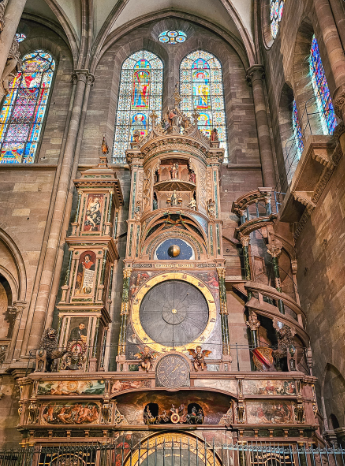 France’s Astronomical Clock of the Strasbourg Cathedral
The principles demonstrated by the Antikythera Mechanism did not disappear entirely from the history of mechanical timekeeping. Centuries later, elaborate astronomical clock/calendars appeared throughout Europe, displaying the movements of the sun and moon alongside conventional measurements of time. Among the best-known examples are the astronomical clocks associated with Strasbourg Cathedral in France.
If you look closely above the dark gray zodiac sphere, you will see the lunar mechanism showing gold on the right side and black on the left. Its current position illustrates that this photo was taken on the sixth or seventh day of the first week of that lunar month as counted from the full moon.
The Prague astronomical clock, dated 1410-1490.
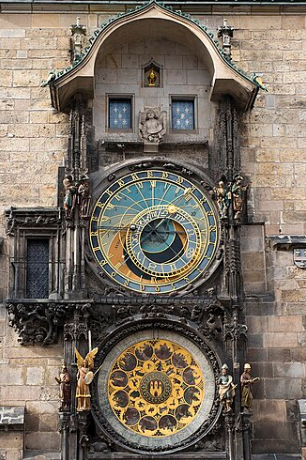
This extraordinary astronomical clock presents a remarkable narrative, one whose significance may be far greater than first meets the eye.
Yet what makes this ancient masterpiece particularly revealing is not merely what it displays, but the striking contrast between its two calendar faces.
The upper circular face illustrates the coordinated movements of the sun, moon, and stars, displaying the twelve constellations along the ecliptic in the heavens as the Creator ordained for lunar years, lunar months, weeks, and the count of days with each lunar phase.
What is particularly revealing, however, is that the lower face depicts the zodiac within a solar calendar framework alone. It entirely disregards the lunar components essential to determining lunar years, lunar months, and the sequential count of days established by the moon’s recurring phases.
This striking contrast can be understood as a rejection of the heavenly principles governing the beginning of each lunar month and its numbered days. Consequently, this single image illustrates the conflict between two time-measuring models and the blatant exchange of the Creator’s divinely established order of time for a calendar system shaped by human authority and manipulation. From this perspective, it reflects the historical consequences of imperial efforts to exercise authority over sacred time, recalling Daniel’s prophecy concerning the attempted alteration of “times and laws” (Daniel 7:25).
Thus, while the upper dial faithfully displays the Creator’s astronomical order for accurate time measuring with lunar years, lunar months, etc., the lower dial illustrates the consequences of mankind’s departure from the calendar written in the heavens. The result of abject denial of the Creator’s ordained principles that rule in the heavens is a calendar and time-measuring system that will never harmonize its adherents with the sacred worship rhythms of heaven, which include the New Moon Day, lunar Sabbaths, and lunar appointed Feast Days.
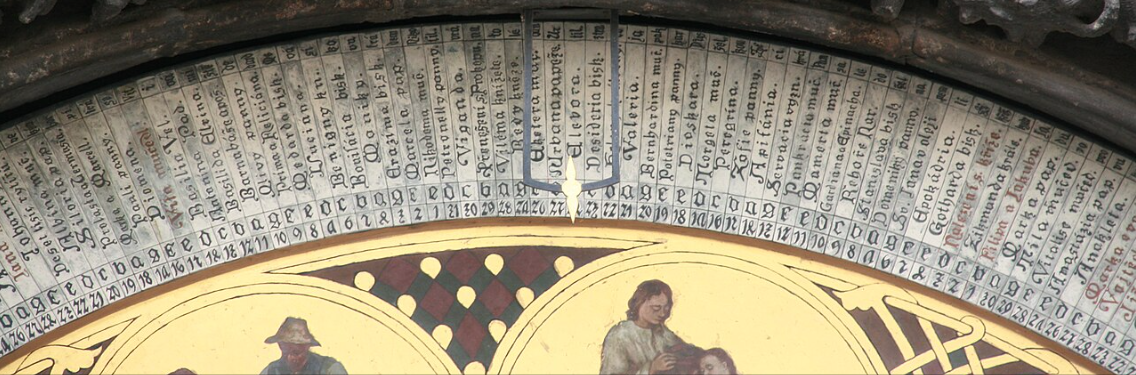
The evidence for this is found in the following image, which presents a close-up of the very top portion of the lower circular zodiac sphere. Here you can see with your own eyes that the days are numbered from 1 to 30 or 31, identifying a solar month, as lunar months are 29 or 30 days in length only.
Then notice that just above the numbered days of the solar months are the count from A-G (1-7), depicting the continuous weekly cycle of days that are never broken by the New Moon Day. As you may recall, it was Julius Caesar in 46 BC who first designed the continuous weekly cycle on an eight-day week. Four hundred years later, this was changed to a seven-day continuous weekly cycle and finally legislated by Emperor Constantine in A.D. 325. Before these changes were made and legislated, the whole world, including the Roman Empire, followed a lunar calendar.
Although constructed centuries after the original alteration of sacred time, this extraordinary clock stands as a visible witness to the transformation that had already taken place. Its two contrasting dials reveal what nearly 2,000 years of calendar history have obscured: the Creator’s heavenly order of time was displaced by a calendar established through human authority. What the heavens continue to proclaim, the calendar of mankind no longer reflects.
Astronomical Clock of St. Jean Cathedral in Lyon, France
Another noteworthy example is the astronomical clock of Saint-Jean Cathedral in Lyon, France, whose origins also extend to the fourteenth century. What makes this clock so extraordinary is that it exhibits the full moon as the New Moon, and the start of lunar months.
This first image shows the entire face. While you can see the Mazzeroth (zodiac), representing the stars along the ecliptic, the sun and moon are also well depicted as primary. The moon is illustrated in black and gold, with the gold depicting the reflected light of the sun.
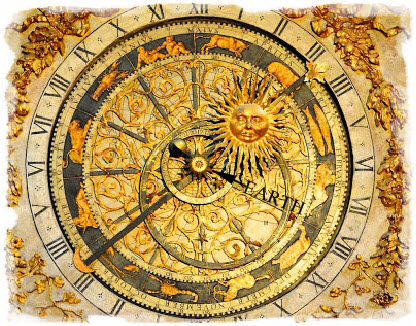
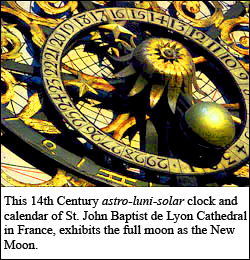 In the smaller image here to the right, you will find a close-up of the inner circle designed for the moon to number the days of each lunar month. This particular image captured the lunar apparatus depicting day one of the month with a full moon. This clock flies in the face of the Rabbinic Jews who, when in Roman captivity, exchanged their original full New Moon for the dark conjunction lunar phase. At the same time, they adopted the continuous weekly cycle promoted and legislated by Emperor Constantine.
Today, neither faction of Judaism has returned to what we understand to be the Creator’s original calendar, established at Creation and restored through Moses. Yet one of the most deeply entrenched assumptions in religious history is that the Jewish people, having been entrusted with Yahuah Alahim’s sacred oracles, could never have lost sight of the original seventh-day Sabbath. Consequently, both Saturday and Sunday observers have generally accepted the continuity of the modern seven-day weekly cycle, assuming that because the Jews observe Saturday as the seventh-day Sabbath, that same uninterrupted cycle must extend all the way back to Creation.
But this reasoning rests upon an assumption rather than demonstrated evidence. The preservation of a religious tradition does not, by itself, establish that the tradition has remained unchanged from its divine origin. The essential question is not whether the Jewish people have faithfully preserved their present Sabbath observance, but whether the weekly cycle they preserve today is the same one Yahuah established in the beginning.
Herein lies the extraordinary significance of the Antikythera Mechanism and the astronomical clocks that followed centuries later. Though separated by nearly two millennia, these remarkable instruments preserve a visible testimony to the celestial movements established by Yahuah Alahim at Creation.
While mankind has altered its calendars, redefined the beginning of months, and established a continuous weekly cycle independent of the moon, the heavenly luminaries have never departed from their appointed courses.
The Antikythera Mechanism stands as an ancient witness to the essential relationship between the sun, moon, and stars in measuring time, while the astronomical clocks of Europe preserve further evidence of mankind’s knowledge of these celestial relationships. The heavens have not changed. It is mankind’s calendar that has changed. The restoration of the Creator’s calendar, therefore, is not the invention of something new, but a return to the divine order of time established in the beginning, with the full New Moon, lunar Sabbaths, and appointed Feast Days restored to their rightful places in the sacred worship rhythms of Yahuah.
The Creator’s Calendar: The Sum of the Heavenly Luminaries
The discovery of the Antikythera Mechanism becomes especially meaningful when considered alongside the opening chapter of Genesis, as touched on earlier.
Scripture declares:
“And Alahim said, Let there be lights in the firmament of the heaven to divide the day from the night; and let them be for signs, and for seasons [mo’edim], and for days, and years.” Genesis 1:14
The Hebrew word translated as seasons is mo’edim, meaning appointed times, a term Scripture also uses for Yahuah’s sacred assemblies and appointed Feast Days. The significance of this passage is profound. From the beginning of Creation, the heavenly luminaries were appointed to serve as visible markers of time, including the sacred appointments between the Creator and His people.
This word, mo’edim, is further emphasized in Psalm 104:19:
“He appointed the moon for seasons (mo’edim): the sun knows his going down.” Psalm 104:19
Here again, the Hebrew term translated as seasons is mo’edim. But this time, Scripture specifically identifies the moon as appointed for the mo’edim. This connection is of extraordinary importance, for it establishes the moon’s divinely assigned role in the measurement of sacred time. The question is not simply how modern civilization has chosen to organize its calendar. Rather, it is how the Creator originally established the measurement of days, months, years, and His appointed times of worship.
The Lunar Month and the Weekly Sabbath
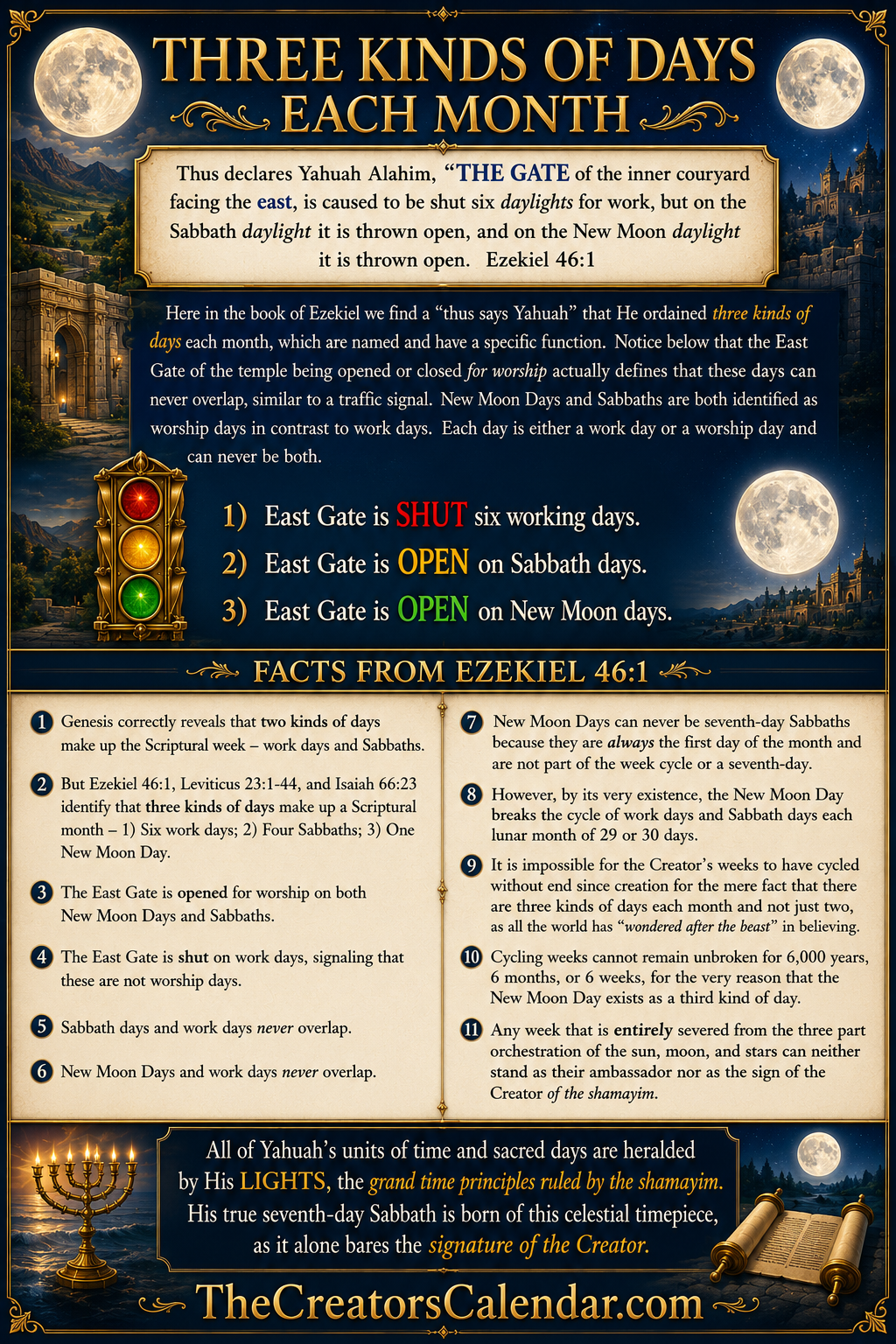
The moon’s divine appointment for the mo’edim extends beyond the annual Feast Days to the recurring seventh-day Sabbaths. The Creator’s original calendar recognizes three distinct kinds of days each lunar month: New Moon Day, the six working days, and the seventh-day Sabbath. Within this Scriptural framework, the four weekly Sabbaths fall on the 8th, 15th, 22nd, and 29th days of each lunar month.
Unlike the uninterrupted seven-day cycle of the modern civil calendar, the Creator’s weekly cycle is synchronized with the lunar month, beginning anew following each New Moon Day.
The Scriptural evidence for this recurring pattern is presented in greater detail in the article Three Months in a Row, which traces three consecutive lunar months through the Exodus from Egypt, the giving of manna, and Israel’s arrival at Mount Sinai. Together, these events provide the chronological foundation for understanding the relationship between the lunar month and the Creator’s seventh-day Sabbath.
The Crucifixion of Yahusha: The Heavens Bear Witness at Passover
Perhaps one of the most profound applications of the astronomical principles demonstrated by the Antikythera Mechanism concerns the crucifixion of Yahusha haMashiach on Passover, the 14th day of Abib, the first lunar month of spring.
Locating the precise year of the crucifixion remains a subject of historical and chronological investigation, with A.D. 30, 31, and 33 appearing in various proposed chronologies by different scholars and religious organizations. This study gives particular consideration to A.D. 31, while recognizing that the exact year must be established through careful examination of both Scriptural chronology and astronomical evidence.
According to the author of this article, as it has been demonstrated to be based on Genesis 1:14-16, the first month begins with the full moon as the New Moon. This fully illuminated moon marks New Moon Day, the first day of the lunar month. As the days progress, the moon gradually diminishes in illumination until it reaches its dark conjunction in the middle of the month, fourteen to fifteen days later, depending on whether the month is a 29 or 30-day month.
This places the appointed Passover, on the 14th day of Abib, on the day of the dark conjunction lunar phase, rather than the full moon. This is the only day of the month that a solar eclipse can occur.
Here, the astronomical principles demonstrated by the Antikythera Mechanism become especially significant. The mechanism was designed not only to coordinate lunar months with solar years but also to predict the recurring conditions under which solar and lunar eclipses could occur. Its eclipse-prediction system employed the Saros cycle of 223 lunar months, demonstrating that ancient astronomers understood the mathematical relationship between lunar phases and eclipses.
A solar eclipse can occur only when the Moon passes between the Earth and Sun near astronomical conjunction, by day. Conversely, a lunar eclipse can occur only near the full moon, when the Earth lies between the Sun and Moon, by night.
These astronomical relationships provide an intriguing setting for examining the extraordinary darkness recorded during Yahusha’s crucifixion.
Three Hours of Darkness at the Death of the Messiah
At the very hour Yahusha haMashiach offered His life as the appointed Passover Lamb, an extraordinary darkness descended upon the land, bearing solemn witness to the significance of His sacrifice. This remarkable event was recorded by three Gospel writers, each confirming the darkness that accompanied the Messiah’s final hours upon the stake.
The Gospel of Matthew records:
“Now from the sixth hour there was darkness over all the land unto the ninth hour.” Matthew 27:45
Mark 15:33 and Luke 23:44-45 confirm this extraordinary event.
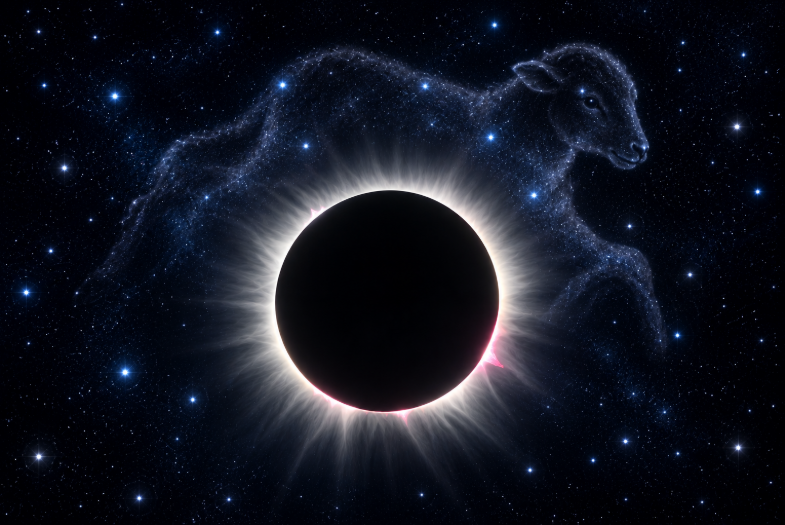 The sixth hour was reckoned from sunrise, according to the ancient practice of measuring daylight by the sun’s position and the movement of its shadow from 1-12 on a sundial. Yahusha Himself affirmed this principle in John 11:9, declaring, “Are there not twelve hours in the day?” His words establish the daylight period, beginning at sunrise, as the framework for counting the twelve hours during which the sun rules the daylight from east to west. Thus, the sixth hour corresponds approximately to noon, while the ninth hour corresponds to three o’clock in the afternoon. It was during these three hours, from the sixth to the ninth hour, that an extraordinary darkness covered the land while Yahusha suffered upon the stake.
Luke adds the significant detail that the sun itself was darkened.
“And it was about the sixth hour, and there was a darkness over all the earth until the ninth hour.
AndThe sun was darkened, and the veil of the temple was rent in the midst.” Luke 23:44-45
 The Greek wording of Luke 23:44-45 has received considerable scholarly attention because some ancient manuscripts employ a term associated with the failing of the sun’s light, a word also used in connection with eclipses.
Under normal astronomical conditions, the period of totality during a solar eclipse lasts only minutes, not three hours. Yet the relationship between the lunar phase and the appointed timing of Passover deserves careful consideration. Could the Creator, who established and maintains the movements of the heavenly luminaries to mark sacred time, have supernaturally extended this extraordinary darkness to bear witness to the greatest sacrifice in human history? Such a divine intervention would have transformed an astronomical time marker into a miraculous, larger-than-life testimony, emphasizing the profound significance of that appointed hour: the sacrificial death of Yahusha haMashiach, the only begotten Son of Yahuah Alahim, Creator of heaven and earth.
Within the full New Moon framework presented in this study, the 14th day falls on the lunar conjunction, precisely the phase during which a solar eclipse becomes astronomically possible.
This does not establish that an ordinary eclipse occurred at the crucifixion, but it highlights a remarkable relationship between the appointed Passover date and the celestial conditions associated with solar eclipses.
The Creator’s Appointed Time and the Passover Lamb
The significance of the crucifixion day extends far beyond the extraordinary darkness.
Yahusha did not die on an arbitrary day of the year. His sacrifice fulfilled the prophetic promise first revealed in the Garden of Eden, where the shedding of innocent blood is understood to have provided the skins with which Yahuah clothed Adam and Eve. This foreshadowed the ultimate sacrifice of the Lamb of Alahim, whose appointed time would later be established through the Passover ordinance recorded in Exodus 12.
“And you shall keep it [the Passover Lamb] up until the fourteenth day of the same month: and the whole assembly of the congregation of Israel shall kill it in the evening.” Exodus 12:6
The 14th day of Abib was therefore not merely a historical date. It was a divinely appointed time within the first lunar month of the sacred year. It was dedicated as a sacred, lunar-appointed Feast Day.
The Apostle Paul later declared:
“For even Messiah our passover is sacrificed for us.” 1 Corinthians 5:7
Within the chronology presented in TheCreatorsCalendar.com, the Passover sacrifice of Yahusha occurred according to the same heavenly order established at creation.
The sun marked the season of spring. The full New Moon established Rosh Hashanah (New Year’s Day), the first day of the first month lunar month. The lunar count identified the 14th day, at the dark conjunction, and the appointed Passover revealed the prophetic timing of the Messiah’s sacrifice.
Thus, the heavenly luminaries served not merely as measures of passing time, but as witnesses to the unfolding Plan of Salvation.
When the Heavens Declared the Fulfillment
The Antikythera Mechanism demonstrates that ancient astronomers possessed the mathematical knowledge necessary to calculate the recurring relationships between the sun, moon, and eclipses.
Yet no mechanical instrument could fully express the spiritual significance of the darkness that accompanied the death of Yahusha.
The Gospels testify that the sun’s light failed during the very hours in which the Messiah offered His life as the Passover Lamb. And from all ancient times, such a reality was caused by the conjunction lunar phase coming between the Earth and the Sun in what we call a total solar eclipse.
The significance of this heavenly testimony should not be overlooked.
The same Creator who appointed the sun, moon, and stars to measure time also established the lunar-appointed times of the year through which His Plan of Salvation would be revealed.
The Passover sacrifice was appointed in time, fulfilled in time, and witnessed beneath the very heavens that were established to accurately measure time.
The Antikythera Mechanism reminds us that the movements of the heavenly bodies follow an extraordinary mathematical order. Scripture reveals the greater purpose for which the Creator appointed those heavenly witnesses.
The heavens measure time, but the appointed events of redemption reveal its eternal significance.
An Astronomical Question That Challenges Established Calendars
One question remains worthy of serious consideration: Why has so little attention been given to applying the astronomical principles demonstrated by the Antikythera Mechanism to determine the precise date of Yahusha our Messiah’s crucifixion? By examining the spring full moon as New Moon Day, counting forward to the 14th day of Abib, and comparing the celestial conditions of A.D. 30, 31, and 33, could we not bring greater clarity and even confirmation to the appointed time of His sacrifice? Although modern astronomical calculations can reconstruct these lunar cycles without the ancient instrument, the underlying principles remain the same.
Might the limited attention given to this particular approach reflect something more than scholarly oversight? After all, identifying the full moon as the original New Moon would challenge the very calendrical foundations upon which Judaism and Christianity, including both Saturday and Sunday observers, have built their religious traditions. Such a revelation would call into question the continuous Roman-derived weekly cycle, the identification of the true seventh-day Sabbath, and the timing of Yahuah’s annual appointed Feast Days.
The implications are staggering. For nearly two thousand years, countless generations of sincere believers have placed their confidence in popes, pastors, rabbis, and perceived prophets, trusting them to faithfully interpret and preserve the truths of Scripture.
Meanwhile, Saturday Sabbath observers have confidently proclaimed that Saturday is the original seventh-day Sabbath established at Creation, while Sunday observers have likewise defended their traditional day of worship. Yet neither Saturday nor Sunday is identified by name in Scripture, and the modern continuous weekly cycle is not, by that fact alone, established as the weekly cycle ordained by Yahuah. The tragedy is that multitudes have accepted the authority of religious tradition as proof of Scriptural truth, never realizing that the very foundation of their worship calendar deserves to be examined against the heavenly order established by the Creator Himself.
Whether this reluctance or lack of sharing actual results arises from longstanding tradition, prevailing assumptions, or resistance to reconsidering established religious practices, the question deserves investigation. For if the Creator’s appointed times were established by the heavenly luminaries, no religious tradition, however ancient or widely accepted, can take precedence over the calendar He ordained at creation.
The Final Call: Come Out of Babylon and Prepare for the Bridegroom
The Creator’s Calendar has not been lost from the heavens. It has been lost from mankind’s understanding. The sun, moon, and stars continue to bear their appointed witness, calling mankind to recognize the sacred order established at creation. Yet restoration requires more than acknowledging the truth. It requires a willingness to forsake the traditions that have displaced the Creator’s commandments and return to His original and sacred appointed ways.
It is within this solemn context that the final call of Revelation 18:4 takes on profound significance:
“Come out of her, my people, that ye be not partakers of her sins, and that ye receive not of her plagues.” Revelation 18:4
This call to come out of Babylon is more than a summons to separate from religious confusion. It is an invitation to return to Yahuah in complete obedience, allowing His Word to restore what centuries of human tradition have obscured. Those who heed His call will seek to walk according to His commandments, honor His seventh-day Sabbaths, and observe His sacred appointed Feast Days at their divinely appointed lunar times. For the final restoration of His people must include the restoration of sacred time, just as Yahuah spent forty years schooling Israel in the wilderness, teaching them to walk in harmony with His divinely appointed calendar and the sacred times He established for His people to meet with Him.
The parable of the ten virgins in Matthew 25:1-13 reveals the importance of this preparation. All ten awaited the Bridegroom, yet only five were wise enough to carry extra oil for their lamps. When the Bridegroom delayed, all slumbered, but at midnight the long-awaited cry awakened them:
“Behold, the bridegroom cometh; go ye out to meet him.” Matthew 25:6
The five wise virgins were prepared. Their lamps were burning, their vessels contained the necessary oil, and they were ready to respond when the call came. So it must be with Yahuah’s faithful people in the closing hours of earth’s history. They must possess more than an outward profession of faith. Their lives must be filled with the oil of His Spirit, their hearts surrendered in obedience, and their understanding restored to the truth of His Word.
The Bridegroom will not arrive according to a timetable established by the traditions of men, but according to His sacred lunar-appointed time ordained by the Father. Those who have come out of Babylon and returned to the Creator’s ways will recognize the importance of His sacred appointments. Like the five wise virgins, they will have prepared their lamps, secured the extra oil, and made themselves ready to meet Yahusha haMashiach when the final call is heard.
For the ultimate purpose of restoring the Creator’s Calendar is not merely to recover the correct measurement of time, but to prepare a faithful people to meet their Bridegroom at His appointed time.
The heavens have never forgotten their appointed times. The sun continues its course, the full New Moon continues to mark the beginning of each lunar month, and the heavenly witnesses remain faithful to the order established at creation. Now the call goes forth for Yahuah’s people to remember, to come out of Babylon, her false customs of time measuring, holiday traditions, and to be restored to the everlasting covenant.
And when that final cry is heard, “Behold, the Bridegroom cometh; go ye out to meet Him,” may we be found among the five wise virgins, with our lamps burning brightly, our vessels filled with extra oil, and our hearts synchronized with the sacred worship rhythms of heaven, ready to enter with Yahusha into the Marriage Supper of the Lamb.
For those who are prepared, the appointed time will not be an hour of confusion, but the long-awaited glorious fulfillment of the promise:
“And they that were ready went in with him to the marriage: and the door was shut.” Matthew 25:10
The Creator appointed the time. The Messiah fulfilled the promise. And the faithful Bride will be ready when the Bridegroom comes at His lunar-appointed time.
Conclusion: Ancient Technology and the Measurement of Time
More than 2,300 years ago, the Antikythera Mechanism demonstrated that ancient mankind possessed an extraordinary understanding of the celestial movements governing time. Yet this remarkable instrument was merely a mechanical reflection of something infinitely greater. Long before its gears were fashioned, Yahuah Alahim had established the sun, moon, and stars as His heavenly witnesses, faithfully declaring the passage of years, months, weeks, and days and annual appointed times. What mankind once understood sufficiently to reproduce in intricate machinery has, in many respects, become obscured beneath centuries of religious tradition and calendrical change.
The astronomical clocks constructed centuries later provide additional and remarkable testimony. The Prague astronomical clock is particularly revealing because, within a single mechanical system, it displays two distinctly different approaches to measuring time. Its upper face portrays the coordinated movements of the sun, moon, and twelve zodiac constellations, while its lower calendar face presents the numbered days of solar months and the continuous weekly cycle. This extraordinary contrast illustrates the distinction between the heavenly movements that govern astronomical time and the civil calendar shaped by human authority. From the Scriptural perspective presented here, this departure reflects more than a change in calendrical practice. It represents the pride of earthly rulers, particularly the imperial powers of Rome, who presumed to exercise authority over sacred time, recalling the prophetic warning of Daniel 7:25 concerning the attempted alteration of “times and laws.” Within one magnificent instrument, the Creator’s celestial order remains visible above, while beneath it stands a calendar reflecting mankind’s determination to establish its own authority over time.
Equally remarkable is the astronomical clock of Saint-Jean Cathedral in Lyon, France. Its lunar display, as illustrated in this study, presents the fully illuminated moon in association with the beginning of the lunar count. Within the full New Moon interpretation presented here, this is an especially significant historical illustration of the principle that the full moon announces the beginning of the lunar month. Although the clock alone cannot establish which lunar phase began the month at Creation, its display invites renewed examination of a relationship between full moon illumination and calendrical reckoning that modern religious traditions have largely overlooked.
Taken together, these extraordinary instruments preserve a powerful visual testimony: mankind has long possessed the knowledge to measure time by the coordinated movements of the heavenly luminaries, even while civil and religious calendars have developed according to different principles. The heavens have not changed. It is mankind’s methods of reckoning sacred time that must be examined against the original order established by the Creator.
The significance of these discoveries reaches far beyond ancient astronomy. If the Creator established the heavenly luminaries to govern sacred time, then the calendar we follow is inseparable from the question of whose authority we recognize. The calendar is not merely a human convenience for organizing the passage of days. Within the Scriptural framework presented here, it is the divinely appointed means by which Yahuah identifies His New Moon Days, seventh-day Sabbaths, annual Feast Days, and sacred appointments with His people.
From the first Passover in Egypt to the sacrificial death of Yahusha haMashiach, the Creator’s appointed times reveal a remarkable continuity of purpose. The same heavenly order that marked Israel’s deliverance also provides the framework for understanding the appointed sacrifice of the true Passover Lamb. These events were not isolated occurrences scattered across history. They were unfolding revelations of the Plan of Salvation, established according to the wisdom and foreknowledge of Yahuah Alahim.
Perhaps the day will come when a scholar of sufficient courage and conviction will publicly investigate and announce what the astronomical evidence may reveal concerning the crucifixion of Yahusha haMashiach: that His sacrifice occurred on the 14th day of Abib, at the dark conjunction lunar phase, counted from the full New Moon of spring in the year AD 31. The Antikythera Mechanism demonstrates that the ancients possessed the mathematical knowledge to calculate the celestial relationships necessary for such an investigation.
With the precision of modern astronomical calculations, why should this question remain unexplored? If the Scriptural chronology and celestial evidence can be brought into agreement, the implications would reach far beyond the dating of a historical event. They would challenge longstanding assumptions concerning the beginning of lunar months, the identification of Yahuah’s seventh-day Sabbaths, and the calendar by which His appointed Feast Days are observed. Such a discovery would deserve to be proclaimed to the world, for it would concern not merely the measurement of time, but the appointed sacrifice of the Lamb of Alahim. Although I believe the evidence we already have in abundance is sufficient.
The greatest appointment still lies before us. The return of Yahusha, the gathering of His faithful people, and the Marriage Supper of the Lamb will bring the divine Plan of Salvation to its glorious fulfillment. The call to come out of Babylon is therefore not simply a warning against deception. It is a loving invitation to return to the Creator, recover His appointed ways, and prepare for the coming of the Bridegroom.
The Antikythera Mechanism may have lain forgotten beneath the sea for nearly two millennia, but the heavenly order it sought to represent has never ceased its appointed movements. Empires have fallen, civilizations have vanished, and religious calendars have changed. Nevertheless, the sun, moon, and stars continue their faithful testimony, just as they have since the beginning.
The heavens have not forgotten the Creator’s Calendar. The sacred appointments established by Yahuah remain written among the heavenly luminaries, awaiting recognition and restoration among His people.
For the ultimate purpose of sacred time is not simply to know the correct day, month, or year. It is to recognize the authority of the One who established them and to walk in obedience to His commandments. This includes honoring His New Moon Days, lunar Sabbaths, and lunar-appointed Feast Days. Above all, it is to be prepared for that final appointment when the Bridegroom calls His faithful people home.
May we therefore be numbered among the five wise virgins, whose lamps were burning and whose vessels were filled with extra oil. May we hear His call, recognize His appointed time, and enter joyfully into the everlasting Marriage Covenant with Yahusha haMashiach.
The Creator established the time. The Messiah fulfilled the promise. The heavens continue their witness. And the faithful Bride must now make herself ready.
Four Videos Exploring the Antikythera Mechanism
For a closer examination of this remarkable discovery, including working reconstructions and explanations of its astronomical functions, see the three videos presented in the original article:
- Animation 2: Gear-by-gear reconstruction
- Animation 2: Movement through the gears
- Animation 3: Exploded model assembling itself
Long Video Version by Tony Freeth: The Antikythera Mechanism Explained with Dr. Tony Freeth