October 22, 1844 and the Crescent Moon
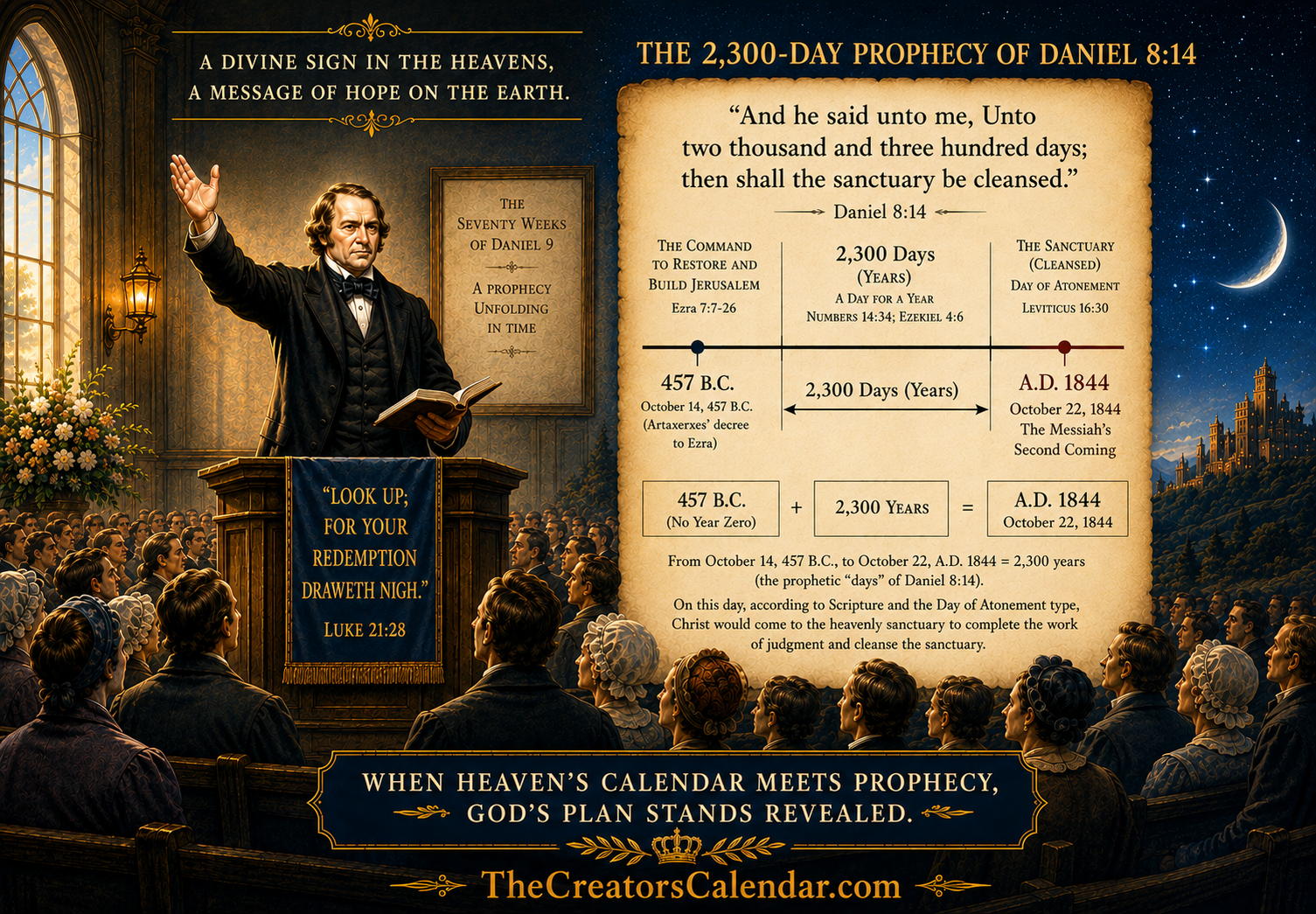
October 22, 1844
and the Crescent Moon
The Lunar Foundation of the Great Disappointment
and the Calendar Question Adventism Never Resolved
by Kerrie L. French
Table of Contents
Introduction |
A Call to Reexamine the Evidence |
Part One |
The Historical Foundation of 1844 |
Part Two |
Reexamining the Prophecy Behind the Date |
Part Three |
Restoring the Creator’s Original New Moon |
Part Four |
Restoring the Creator’s Original Seventh-day Sabbath |
Part Five |
The Sanctuary’s Master Key of Time |
Part Six |
Applying the Restored Calendar to 1844 |
Part Seven |
The Redemptive Meaning of the Appointed Times |
Part Eight |
Final Review and Invitation |
Introduction ~ A Call to Reexamine the Evidence
There are moments in every sincere search for truth when long-held conclusions deserve to be examined again, not because faith has failed, but because faithfulness requires that every belief remain answerable to Scripture. This study is offered in that spirit, with respect for those who came before us and with a willingness to follow the evidence wherever it leads.
Such examination can produce what is commonly called cognitive dissonance, the inner tension that arises when new information conflicts with something we have deeply trusted, practiced, or built into our identity. That tension can be uncomfortable, especially when the belief in question is tied to family, fellowship, rhythm of life, denominational history, or spiritual experience. Yet discomfort alone does not determine whether a teaching is true or false. It simply signals that two competing ideas are asking to be weighed carefully.
The purpose of this study is therefore not to diminish sincere conviction, but to invite a thoughtful reexamination of inherited understanding beside the written Word and the order established by the Creator Himself. Scripture repeatedly calls the faithful to examine, test, and “prove all things,” holding fast to that which is true. When cherished assumptions and newly discovered evidence seem to collide, the safest response is neither immediate rejection nor uncritical acceptance, but a humble return to Scripture, allowing truth itself to decide the matter.
“Prove all things, and hold fast to that which is good.”1 1 Thessalonians 5:21
An Unresolved Paradox
For nearly two centuries, October 22, 1844, has been revered as the prophetic high point of the Advent movement, marking what has long been understood as the beginning of the Antitypical Day of Atonement.2 Yet within this historic date lies a striking paradox. Its prophetic significance depends entirely upon a lunar calculation used to identify the Day of Atonement, while the denomination simultaneously upholds a Saturday Sabbath fixed to Rome’s solar calendar with its continuous planetary weekly cycle.
In effect, the denomination rests upon two opposing pillars of timekeeping that stand side by side but cannot form one coherent calendar framework. One relies upon a lunar month to locate an annual Feast Day, while the other follows an uninterrupted weekly cycle that operates independently of the moon and identifies Sunday as the first day and Saturday as the seventh. Because these systems arise from fundamentally different methods of measuring time, they cannot unite to establish one consistent rhythm of sacred worship.
This study brings that contradiction into clear focus by tracing the 1844 event back to its original lunar foundation. In doing so, it invites a careful reexamination of the New Moon, the seventh-day Sabbath, and the sacred Feast Days according to the Creator’s divinely prescribed principles of timekeeping. By revisiting these questions, we honor the faith of those who sincerely sought truth in the past while continuing the journey toward harmony with the Creator’s perfect cadence, through which He reveals the Plan of Salvation and the Messiah’s remedy for sin.
The Great Expectation
The 2,300-day prophecy, extensively studied by Sir Isaac Newton and others,³ gained significant attention and momentum in the early nineteenth century through the dedicated efforts of William Miller, Samuel Snow, and their growing community of followers. Miller’s calculations focused expectation upon the prophetic period in which the Messiah was believed to return, while Snow’s later seventh-month message narrowed that expectation to a specific lunar-appointed day.
The following account describes the dramatic arrival of the message at the Exeter camp meeting, where Samuel Snow presented the lunar calculation that would soon focus Millerite expectation upon October 22.
“So the battle went on until July 1844 as these Millerites sought to discover the exact day of the end of the 2,300 day prophecy and the Messiah’s physical return, when the greatest camp meeting that was ever held by Adventists [to that time], assembled in Exeter, New Hampshire. It was reported that there were three thousand in that encampment. It was held in the woods, in the open, no cloth pavilion for the camp services, but plenty of seats.
On Sunday forenoon Elder Joseph Bates was preaching, when a man came riding at full speed into the camp, placed his horse where they kept their stock, then came into the audience, and seated himself by the family of Elder John Couch, and with open Bible, in a whisper, explained to them the cause of their disappointment, and the midnight cry that was now due.
Brother Bates was using as an illustration of their course in patient waiting, his experience on nearing home on a sea voyage, after a long absence. The power of God came upon Sister Couch, as she arose, and beckoned to Brother Bates. He said, “Sister, what is it?” She replied, “What you are saying is all very good, but here is a man who has light on the midnight cry.”
“Well,” said Brother Bates, “then let him come up here on the platform, and give it to the people,” and he sat down. The minister who thus walked into the stand was Samuel S. Snow, who in a few sentences gave them the path of his midnight cry message. Elder James White was in that audience; I was not there, but got my light on the subject from those who were there.”4 Samuel S. Snow, The True Midnight Cry, Aug. 22, 1844, p. 1.
Part One
The Historical Foundation of October 22, 1844
The Lunar Calendar at the Heart of the 1844 Message
“In August, Samuel S. Snow issued a new paper entitled ‘The True Midnight Cry’ and in its first issue, dated August 22, 1844, set forth his case that Christ would return in the autumn of 1844. Snow focused on the celebration [of the lunar] feasts in the annual Jewish cycle as types of the saving work of Christ. He pointed out that Christ, the antitype, had fulfilled the springtime feast days at the very time of their occurrence in the Jewish calendar – Passover (crucifixion), First Fruits (ascension), and Pentecost (the outpouring of the Holy Spirit on the apostles). ‘God is an exact timekeeper,’ Snow declared. Thus, he reasoned that Christ would fulfill the work of the high priest on the Day of Atonement on the date of its occurrence in the Jewish [lunar] calendar, that is, in the autumn, on the “tenth day of the seventh month [a lunar designation for the solar month correlating with October] (Leviticus 16:29).5 Encyclopedia of Seventh-day Adventists, “Snow, Samuel Sheffield,” discussion of Snow’s August 1844 True Midnight Cry message; Samuel S. Snow, The True Midnight Cry, August 22, 1844, for his statement, “God is an exact timekeeper.
“To establish the year in which this would take place, Snow calculated that the [Artaxerxes] decree “to restore and build Jerusalem” (Daniel 9:25) that marked the beginning of the period of 2,300 days (symbolic years) given in Daniel 8:14 would have been issued in the latter part of the year 457 B.C. The 2,300-year period thus would end in late 1844, when the Day of Atonement (Yom Kippur) occurred that year. That is when the “cleansing of the sanctuary,” referred to in Daniel 8:14, was to take place. With Miller and the Advent movement in general, Snow believed that “the cleansing of the sanctuary” would be accomplished by the second coming of Christ, that is how Christ as the antitype would fulfill what the high priest’s work on the Day of Atonement typified. Based on the calendar of the Karaite Jews, Snow concluded that the Day of Atonement in 1844 would fall on October 22.”6 Encyclopedia of Seventh-day Adventists, “Snow, Samuel Sheffield,” discussion of Snow’s 1844 seventh-month calculation and use of the Karaite calendar; see also Samuel S. Snow, The True Midnight Cry, August 22, 1844.. (The emphasis is mine.)
The Feast Days Reveal the Plan of Salvation
One of Samuel Snow’s most significant insights was not merely the selection of a date, but his recognition that the biblical Feast Days reveal the Messiah’s redemptive work in an ordered sequence. Passover, Feast of Weeks, and the Day of Atonement were not isolated ceremonies, but lunar-appointed prophetic patterns pointing to specific stages in the Plan of Salvation. His reasoning therefore rested upon an essential principle: Yahuah is a precise timekeeper, and the Messiah fulfills each appointed type according to its divinely established order.7
Prophecy Must Follow a Consistent Calendar
“The year 1843 was, however, regarded as extending to the spring of 1844. The reason for this, briefly stated, is as follows: Anciently, the year did not commence in mid-winter, as now, but at the first New Moon after the Vernal Equinox. Therefore, as the period of 2,300 days was begun in a year reckoned by the ancient method, it was considered necessary to conform to that method to its close. Hence, 1843 was counted as ending in the spring, and not in the winter.”8 William Miller, as quoted in the 1888 ed. of E. G. White, The Great Controversy, Appendix Note 3; also Advent Herald (Boston), Mar. 1850.
With respect to Appendix Note 3 above, this narrative concerning William Miller was included in the 1888 edition of The Great Controversy by Ellen White, but was omitted from the 1911 edition and subsequent printings. Portions of this account were also published earlier in the Advent Herald (Boston, March 1850). For additional documentation concerning Appendix Note 3, refer to the article The Great Easter Controversy Cover-up.
Whatever the editorial reasons for its omission, Miller’s principle remains highly significant: if a prophecy begins within an ancient lunar method of reckoning time, consistency requires that the same method be followed to its conclusion. Once that principle is acknowledged, the question extends far beyond the beginning and ending of the biblical year. It naturally requires us to examine the calendar framework by which the New Moon, months, Feast Days, and seventh-day Sabbath themselves are identified.
This brings us directly to the calendar question at the heart of October 22, 1844. Miller and Snow recognized that the prophetic calculation required a return to ancient lunar reckoning, but which lunar phase actually marked the beginning of the month?
October 22, 1844, Established by the Crescent New Moon

Part Two
Reexamining the Prophecy Behind the Date
Where Do the 2,300 Evenings and Mornings Begin?
“Unto two thousand and three hundred evenings and mornings; then shall the sanctuary be cleansed.” Daniel 8:14
It was this verse that sparked an honest desire to prepare for the Messiah’s return. Before we can calculate the ending point, we must discover when this time prophecy begins. Yet, it does not state directly in the passage or the following verses a starting date as a calendar anchor.
- Daniel 8:13, “How long shall be the vision?” sets up the length question, not the beginning.
- Daniel 8:14, “Unto two thousand and three hundred evenings and mornings; then shall the sanctuary be cleansed.” This provides the ending event, not the start.
- Daniel 8:15-17, “Understand, O son of man: for at the time of the end shall be the vision.” Still, no start point is given.
- Daniel 8:18-19, “I will make known what shall be in the last end of the indignation…” This provides a general timeframe, not a specific date.
- Daniel 8:20-22 references the ram and the he-goat as Medo-Persia and Greece, providing historical actors, but again, no chronological starting marker.
- Daniel 8:23–26 continues the explanation of the vision and commands that it be sealed, but it still provides no explicit calendar date from which the 2,300 evenings and mornings are to be counted.
Because Daniel 8 itself supplies no explicit starting date, Miller and Snow looked to Daniel 9 and other historical markers to construct the chronology that led them to 1844.12 Building on other key markers, such as Artaxerxes’ decree and the Hebrew Day of Atonement on the tenth day of the Seventh Lunar Month, Miller and Snow believed the prophecy foretold the Messiah’s physical return on October 22, 1844. However, when the anticipated event failed to occur, those awaiting the Messiah’s return were profoundly disappointed. Some had made substantial personal and financial sacrifices in preparation for the expected event.13
This historic moment, remembered as The Great Disappointment, became a defining event for the Advent movement, profoundly shaping their understanding, faith, and foundational doctrine.
Nineteen years later, in 1863, the Seventh-day Adventist Church was formally organized, with James White, Ellen White, and the former sea captain Joseph Bates recognized among its principal cofounders.14 Under the guidance of Ellen White’s “apparent” prophetic gift, this fledgling body of Bible followers continued to believe that October 22, 1844, held significance in end-time prophecy.
Reexamining Daniel 8:14
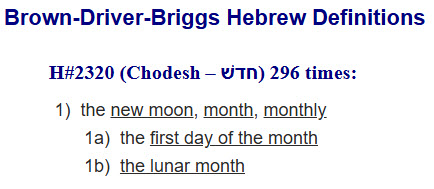

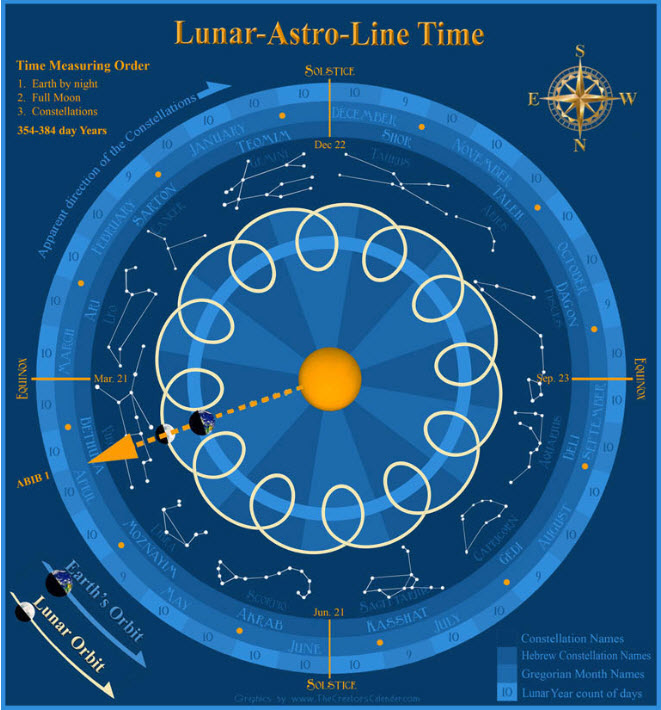
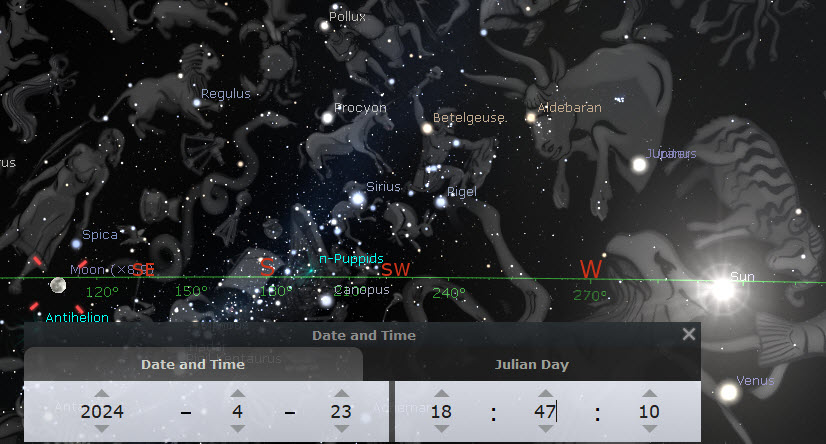
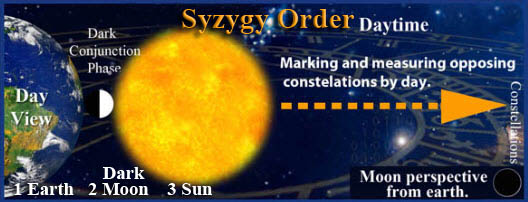
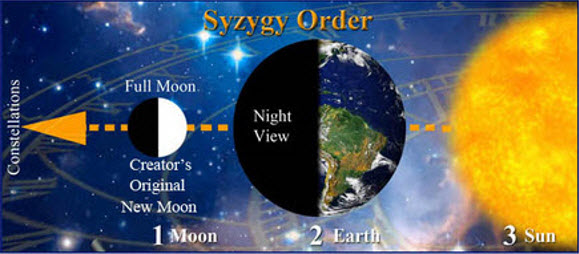
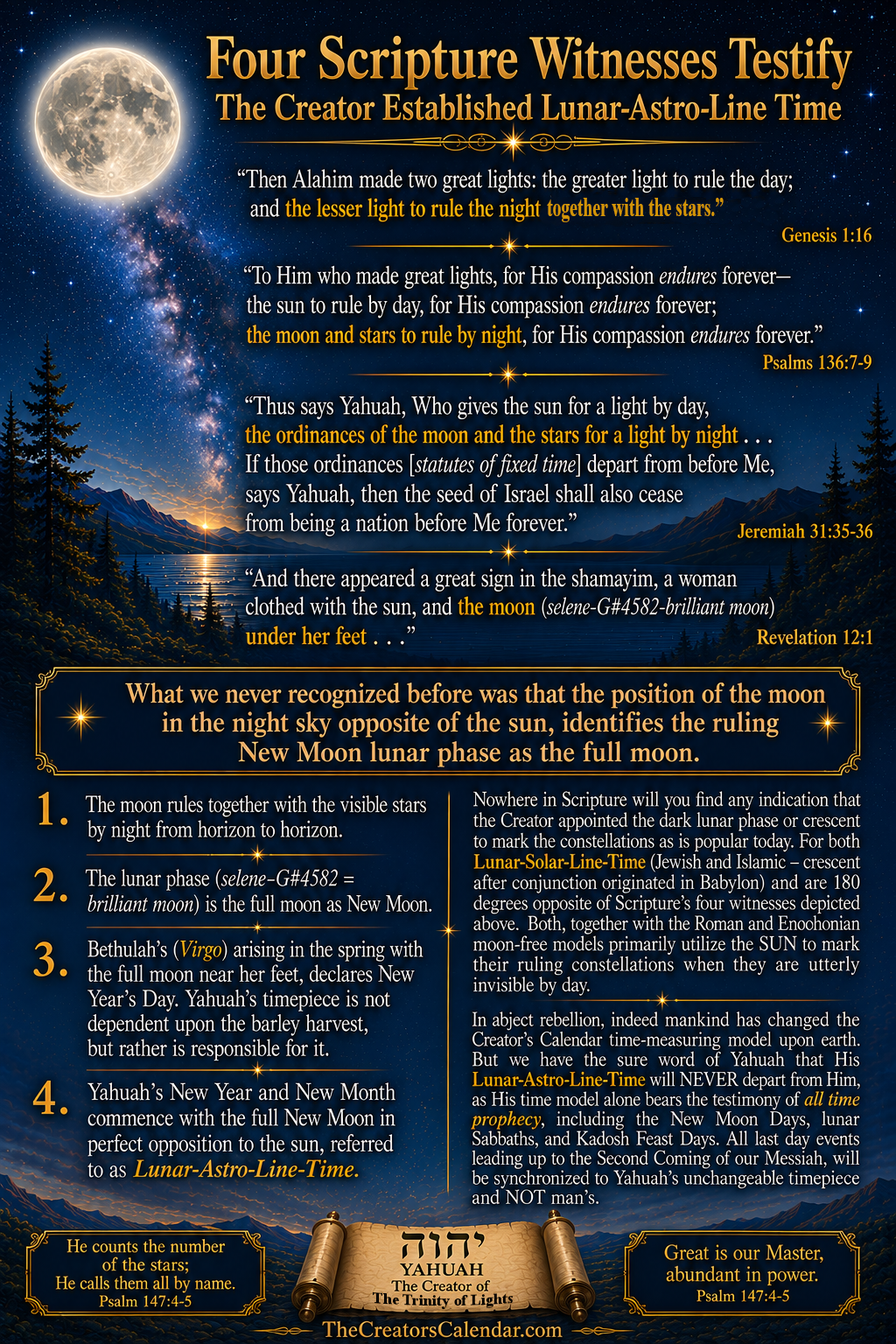 Our Creator, the Eternal Father, did not leave His people without a heavenly clock by which sacred time could be restored. Of the two syzygy alignments, only one lunar phase satisfies all four biblical criteria for announcing the New Year and each New Month. Together these illustrations show that the authentic New Moon lunar phase is the one where the moon rules with the visible stars by night, when the sun is nowhere in sight.
Part Four
Restoring the Creator’s Original
Seventh-day Sabbath
Called Out of Bondage and Restored to His Worship Rhythm
After identifying the full New Moon as the original starting point of the lunar month, an unavoidable question follows: What happens when we allow Scripture itself to count forward from that celestial marker? Remarkably, the answer is not confined to the identity of the seventh-day Sabbath alone, but to all units of TIME. The Exodus narrative opens a much larger window into the Creator’s entire framework of sacred TIME.
Across three consecutive lunar months, from the Exodus, to the manna, to Mount Sinai, Scripture preserves a remarkable sequence of dates, days, nights, journeys, worship, rest, and divinely appointed EVENTS. Together with a confirming witness forty years later, these chronological markers provide an unusual opportunity to examine how Scripture identifies the beginnings and boundaries of years, months, weeks, days, and the seventh-day Sabbath, not as disconnected measures of time, but as parts of one divinely ordered framework.
Let us therefore follow Yasharal out of Egypt, one date at a time, and allow three consecutive months of Scripture to reveal the Creator’s original order of TIME.
The First Month-in-a-Row – Calendar Restoration and Exodus
Yahuah’s declaration to Moses and Aaron concerning the beginning of the year was given while Yasharal was still “in the land of Egypt.” After generations of bondage, they had lived under the influence of Egypt’s religious traditions and systems of timekeeping. Their deliverance would therefore involve far more than leaving Egypt geographically. They were being called out of deeply ingrained traditions and an inherited orientation to TIME, and back into alignment with the Creator’s appointed order. Before they departed, Yahuah directed their attention to the very foundation by which sacred TIME would be measured:
“This month shall be your beginning of months; it shall be the first month of the year to you.” Exodus 12:2
The historical setting gives added significance to this command. Egypt possessed its own lunar reckoning. Egyptologist Richard A. Parker described the beginning of the Egyptian lunar month as occurring “on the morning when the old crescent could no longer be seen just before sunrise.” Within the framework examined in this book, Yahuah’s instruction to Moses and Aaron therefore represents a striking calendrical change. Yasharal was being called to recognize the Creator’s appointed beginning rather than simply continue according to the timekeeping system surrounding them.
This was a call to restoration. Yasharal was being restored to the Creator’s calendar, restored to worship according to His appointed TIMES, and restored to the covenant relationship for which He had called them. Yahuah was not merely leading a nation out of bondage; He was preparing a people to become His covenant Bride, aligned with the sacred order established by the Bridegroom. Calendar, worship, and covenant were therefore not separate concerns. To walk in covenant with Him meant learning once again to recognize His TIME, follow His sacred PATHWAY, and meet with Him according to His appointed order. They were being called to be a set-apart people, distinct from the worship and ways of the nations surrounding them.
Before they could count to the tenth day, sacrifice the Passover lamb on the fourteenth, or depart on the fifteenth, they first had to know where the count began. The issue was not merely how to count the days. The issue was which day began the count.

Once the beginning of the month was established, the appointed dates that followed could be counted in their proper order. Yahuah instructed each household to select its Passover lamb on the tenth day:
“On the tenth day of this month every man shall take for himself a lamb…” Exodus 12:3
The lamb was then kept until the fourteenth day:
“Then the whole assembly of the congregation of Israel shall kill it between the evenings on the fourteenth day of the same month.” Exodus 12:6
With the beginning of the lunar month established, the dates that followed could now be counted from that restored foundation. The tenth and fourteenth days simply carry that count forward, demonstrating why identifying the correct New Moon and beginning of the month had to come first. From this foundation, the Passover chronology continues to unfold in its appointed order.
The Departure From Egypt on the Fifteenth by Night
Although the Passover lamb was sacrificed on the fourteenth, Yasharal did not immediately depart from Egypt that night, as is often taught. Instead, they were specifically commanded to remain within their homes throughout the Passover night:
“And none of you shall go out of the door of his house until morning.” Exodus 12:22
Contrary to popular teachings within the Seventh-day Adventist Church, the story of the Exodus and the Manna indicates that the night follows the daylight in a day/night cycle from sunrise to sunrise. This will be illustrated more thoroughly within this Part Four section.
At midnight, judgment fell upon Egypt’s firstborn, while the blood of the Passover lamb protected the households of Yasharal. Pharaoh then summoned Moses and Aaron “by night” and commanded the people to leave. Yet the command to depart and the actual departure were not the same event. Yahuah had instructed His people to remain inside until morning.
Scripture provides two additional witnesses that identify both the date and the time of their actual departure.
Numbers records the date:
“They departed from Rameses in the first month, on the fifteenth day of the first month; on the day after the Passover the children of Israel went out with boldness in the sight of all the Egyptians.” Numbers 33:3
Deuteronomy records the time:
“Observe the
monthNew Moon of Abib, and keep the Passover to Yahuah your Alahim, for in the [lunar] month of Abib Yahuah your Alahim brought you out of Egypt by night.” Deuteronomy 16:1
Exodus 12:40-42 states:
“Now, the sojourn of the children of Israel who lived in Egypt was four hundred and thirty years. And it came to pass at the end of the four hundred and thirty years, on that very same day, it came to pass that all the armies of Yahuah went out from the land of Egypt. It is a night of solemn observance to Yahuah for bringing them out of the land of Egypt…” Exodus 12:40-42
Together, these witnesses establish the chronological sequence presented in this study: Passover occurred on the fourteenth between the evenings, at which time they killed the Passover lamb and placed its blood on their doorposts and lentils. After which they consumed all of it. Then at midnight all the firstborn males of Egypt were slain, both men and animals. Yasharal remained within their homes until morning, and their departure from Egypt occurred the next night.
Delivered by the Strong Arm of Yahuah
Yasharal’s departure from Egypt was only the beginning of their deliverance. They went out boldly under the mighty hand of Yahuah, leaving behind the land in which they had been held in bondage. Yahuah Himself went before them, leading His people by a pillar of cloud by day and a pillar of fire by night.
Within days, however, they found themselves facing what appeared to be an impossible situation. The Red Sea stood before them, while Pharaoh and his army pursued from behind. Fear swept through the camp as the people realized they appeared to be trapped between the sea and the advancing Egyptian army.
But Moses declared:
“Fear ye not, stand still, and see the salvation of Yahuah, which he will show to you today… Yahuah shall fight for you, and you shall hold your peace.” Exodus 14:13-14
Then Yahuah opened a pathway where no pathway had existed. The waters of the Red Sea divided, and Yasharal passed through on dry ground. When Pharaoh’s army followed after them, the waters returned, bringing the pursuing forces of Egypt to an end.
Yasharal had not merely walked out of Egypt. They had been brought out by the strong arm of Yahuah, led according to His TIME, protected by His presence, and carried through an impossible passage by His power. Egypt was now behind them, and the wilderness journey had begun.
Soon you will discover the remarkable reason why Yasharal was brought out of Egypt by night on the fifteenth and not first thing in the morning.
The Second Month-in-a-Row – Complaining of Hunger
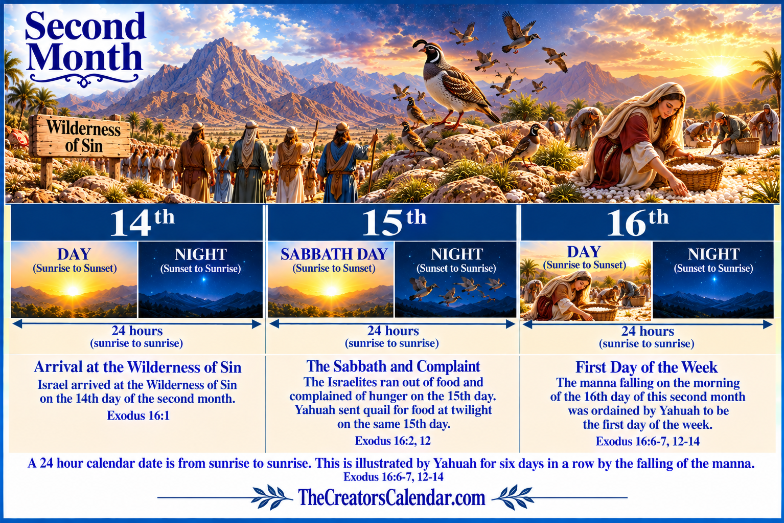
One lunar month after the Exodus, Yahuah provided another remarkable lesson in TIME. This time, He would rain down manna from heaven not only to feed His people, but to demonstrate the distinct relationship between the New Moon Days, working days, and His sacred seventh-day Sabbaths.
Remarkably, Scripture brings us once again to the fifteenth day of the lunar month, exactly one lunar month after Yasharal departed from Egypt on the fifteenth day of the First Month, to the very day. By this time their provisions had been exhausted, and the congregation murmured against Moses and Aaron because they had no bread to eat.
Resolving the Fifteenth of the Second Month Question
At first glance, the familiar English rendering of Exodus 16:1-2 appears to present a serious challenge to the chronology being examined here. The King James Version reads:
“And they took their journey from Elim, and all the congregation of the children of Israel came unto the wilderness of Sin, which is between Elim and Sinai, on the fifteenth day of the second month after their departing out of the land of Egypt. Then the whole congregation of the children of Israel murmured against Moses and Aaron in the wilderness.” Exodus 16:1-2, KJV
Read with this punctuation, the passage appears to say that Yasharal traveled and arrived at the Wilderness of Sin on the fifteenth day. If the fifteenth was the seventh-day Sabbath, as the manna sequence will indicate, an obvious question arises: Why would Yasharal have been traveling on the Sabbath? At first glance, this appears to contradict the very calendrical pattern we are examining.
However, punctuation was not part of the original Hebrew manuscripts. The commas and periods appearing in our English Bibles were supplied by translators and editors, and their placement will affect how a sentence is understood.
A familiar example of this very problem occurs in Yahusha’s words to the thief on the cross:
“Verily I say unto thee, To day shalt thou be with me in paradise.” Luke 23:43, KJV
Because the earliest Greek manuscripts did not contain the modern comma used in English translations, the punctuation determines how the statement is read. Compare:
“Verily I say unto thee, To day shalt thou be with me in paradise.”
with:
“Verily I say unto thee to day, Shalt thou be with me in paradise.”
The words remain essentially the same, but the placement of the punctuation changes the apparent timing of the promise. The example demonstrates why punctuation supplied by later translators should not automatically be treated as part of the inspired wording itself.
This becomes especially important in Exodus 16. The Septuagint preserves the passage with a different break in the sentence:
“And they departed from Elim, and all the congregation of the children of Israel came to the wilderness of Sin, which is between Elim and Sinai. And on the fifteenth day, in the second month, after their departure from the land of Egypt, all the congregation of the children of Israel murmured against Moses and Aaron.” Exodus 16:1-2, Septuagint
This rendering is particularly significant because it connects the fifteenth day of the Second Month with Yasharal’s murmuring and complaint of hunger, rather than necessarily identifying the fifteenth as the day upon which they arrived in the Wilderness of Sin. Within the chronology presented here, Yasharal had already arrived and was encamped before the daylight hours of the fifteenth began.
Notice the difference. In this rendering, Yasharal’s arrival is stated first and brought to a close. The fifteenth is then connected with their murmuring and complaint of hunger, rather than necessarily with the day upon which they arrived.
The point is not that the Septuagint must automatically be preferred over the Hebrew text or the King James Version. Rather, it demonstrates that the punctuation and sentence division can affect the apparent chronology. Within the chronology examined here, Yasharal could therefore have arrived and established their encampment before the daylight hours of the fifteenth, with their murmuring occurring on the fifteenth itself.
More importantly, the Septuagint rendering is the one that aligns with the larger chronological pattern presented in this study. It harmonizes the fifteenth of the Second Month with the fifteenth of the Exodus, the manna sequence that follows, and the additional calendrical witnesses still to come. Rather than standing as an isolated translation issue, it becomes part of a continuing pattern of TIME that can be tested against the events recorded in Scripture.
The Second Month-in-a-Row – The Quail and Manna
Yahuah heard their complaints and promised two distinct provisions to occur at two distinct TIMES: quail after sunset and bread from heaven the following morning. As the sequence unfolds, those two events will identify the night of the fifteenth and the morning of the 16th.
“At twilight you shall eat meat, and in the morning you shall be filled with bread. And you shall know that I am Yahuah, your Alahim.” Exodus 16:12
Accordingly, after sunset on the fifteenth, quail covered the camp. Then, when morning arrived, the manna appeared upon the ground for the very first time. Within the chronology presented here, that morning was the sixteenth day of the Second Month, and it would begin the six-day manna-gathering sequence that provides the key to identifying Yahuah’s seventh-day Sabbath.
The quail being sent after sundown on the 15th illustrates that the Sabbath ends at sunset. Add to this that the manna being provided first thing each morning identifies the day begins at sunrise. These are not stand-alone concepts. There is much to be discovered on the subject of when the day begins.
Refer to the article:
Six Days of Manna Reveal the Sabbath
Beginning with the first manna on the morning of the 16th, Yasharal gathered their daily portion for six consecutive working days. On the sixth day, Yahuah instructed them to gather twice as much:
“And it shall be on the sixth day that they shall prepare what they bring in, and it shall be twice as much as they gather daily.” Exodus 16:5
The Manna Was Teaching More Than the Sabbath
The manna was far more than Yahuah’s provision for a hungry people. It became a daily lesson in sacred TIME. Each morning a fresh portion appeared, and when some attempted to preserve the ordinary daily portion until the following morning, “it bred worms, and stank” (Exodus 16:20). The provision was therefore renewed from morning to morning, providing a recurring witness within this chronology to the sunrise beginning of each new day.
But the lesson extended beyond the daily cycle. For six mornings, Yasharal went out and gathered their food. On the sixth day, they gathered a double portion. Unlike the manna kept overnight on the other working days, this Sabbath portion was miraculously preserved until the following morning. Then, on the morning of the seventh-day Sabbath, no manna fell at all.
Through this simple but miraculous feeding schedule, Yahuah was teaching His people the rhythm of His sacred timepiece, His calendar: the morning beginning of the day, six working days, preparation on the sixth day, rest on the seventh-day Sabbath, and the recurring weekly count established within the lunar month. The manna did much more than satisfy their hunger. Day after day, it gently brought Yasharal into harmony with the very foundations of covenantal worship, obedience, and honor, teaching them to order their lives according to His TIME rather than the traditions they had acquired in Egypt.
Following the count forward from the morning of the 16th produces a remarkably precise sequence:
16th – First working day
17th – Second working day
18th – Third working day
19th – Fourth working day
20th – Fifth working day
21st – Sixth working day, double portion
22nd – Seventh-day Sabbath, no manna
Moses then declared:
“Six days you shall gather it, but on the seventh day, which is the Sabbath, there will be none.” Exodus 16:26

The manna therefore identifies the 22nd day of the Second Month as the seventh-day Sabbath. Counting backward seven days identifies the 15th as the preceding Sabbath, the very day upon which Yasharal complained of hunger, and Yahuah waited until after sunset to send the quail. Continuing the count backward and forward reveals the complete monthly pattern: the 8th, 15th, 22nd, and 29th are the seventh-day Sabbaths of the lunar month.
The Seventh Day of the Month – Never a Sabbath
But why does the first Sabbath fall on the 8th rather than the 7th? Because New Moon Day is the first day of the lunar month, yet it is neither a workday nor a seventh-day Sabbath. It stands alone as its own distinct class of sacred day, refreshing the count at the beginning of each lunar month. The six working days then follow on the 2nd through the 7th, making the 8th the seventh-day Sabbath.
This distinction is essential: the seventh day of the lunar month is not the Sabbath, although the Sabbath is always the seventh day of the week. The monthly date count and the weekly work count are related, but they do not begin on the same day. New Moon Day begins the month, while the six-day work count begins the following morning. Thus, the Sabbaths fall consistently on the 8th, 15th, 22nd, and 29th days of the lunar month.
Why Yasharal Departed Egypt by Night on the Fifteenth
Suddenly, the timing of the Exodus that occurred in the First Month takes on greater significance. Yasharal had been commanded to remain within their homes until morning following the Passover, yet they still did not depart Egypt during the daylight hours of the fifteenth. Instead, Scripture specifically records that Yahuah brought them out “by night.” Although Scripture does not explicitly identify that fifteenth day as the seventh-day Sabbath, Yahuah was gently unfolding His calendar one lesson at a time, allowing its divine order to be revealed progressively through the events He appointed.
Why?
Because the daylight hours of the 15th were Yahuah’s sacred seventh-day Sabbath, He did not lead His people out of Egypt during those sacred hours. Only after the Sabbath daylight had passed did their journey begin, precisely as Scripture records, “by night” on the fifteenth.
One lunar month later, to the very day, the same pattern appears again. On the fifteenth of the Second Month, Yasharal complained because their food had been exhausted. Yet Yahuah did not immediately send them out to gather food. He waited until after sunset, when the sacred daylight hours of the fifteenth had passed, and then sent the quail. The manna did not appear until the following morning, the 16th, beginning the first of six working days.
Thus, the Second Month provides the calendrical key that unlocks the First: the manna identifies the fifteenth as the seventh-day Sabbath and reveals why Yasharal’s departure from Egypt was delayed until the night of the fifteenth. We now have two months in a row bearing witness to the same Sabbath pattern, with the seventh-day Sabbaths falling on the 8th, 15th, 22nd, and 29th days of each lunar month.
The Third Month-in-a-Row: The Mountain
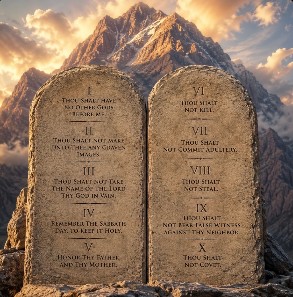
Two consecutive lunar months have already revealed the same pattern of sacred TIME. The First Month established the restored lunar foundation and recorded Yasharal’s departure from Egypt. The Second Month provided the manna, through which the New Moon Day placement, six working days, and seventh-day Sabbath became unmistakable. We also discovered that for two months in a row the day began in the morning at sunrise and not at sunset.
Now Scripture brings us into the Third Month, where Yasharal arrives at Mount Sinai. But rather than assuming that this month must follow the pattern already established, we will once again allow its own chronological witnesses to speak.
“In the third month, when the children of Israel were gone forth out of the land of Egypt, the same day came they into the wilderness of Sinai.” Exodus 19:1
Those two words, “the same day,” immediately draw our attention back to the Exodus and raise an intriguing question: What day was “the same day,” and will the Third Month independently confirm the pattern revealed in the first two months?

Testing the Third Month-in-a-Row
Here again, like the first month, Exodus 19, in describing Yasharal’s arrival at Mt. Sinai, does not explicitly state which dates were seventh-day Sabbaths. Therefore, we should not simply assume that the Third Month followed the same pattern already revealed in the First and Second Months.
Instead, we need another Scriptural TIME witness capable of testing the Third Month independently. Remarkably, such a witness exists in Yahuah’s Count to the Feast of Weeks, or Shabuoth.
Although the Feast of Weeks was not yet an active Sanctuary observance, as it was not established until the following year after Yasharal arrived at Mount Sinai, its later prescribed count provides a chronological overlay that can be followed backward across these earlier lunar months. In this way, Scripture provides another means of testing whether the 8th, 15th, 22nd, and 29th also emerge as the seventh-day Sabbaths of the Third Month.
The Count to Feast of Weeks (Shabuot)
Yahuah’s instructions for the Count to Shabuot are recorded in Leviticus 23:15-16. However, the count presented in this study differs significantly from the familiar fifty-consecutive-day interpretation. A detailed examination of the underlying Hebrew reveals a pattern built upon Sabbaths complete, preserving whole weekly units of six working days followed by the seventh-day Sabbath, while New Moon Days and 30th transition days remain outside the weekly count.
The complete Shabuot study demonstrates an extended count of seven Sabbaths complete, followed by an additional seven Sabbaths complete, plus one final day, producing a total of 99 counted days and terminating upon the full New Moon Day of the Fifth Month. That larger study is important in its own right, but for our present purpose we need only examine where the first seven Sabbaths complete carry us.
Beginning with the 16th of the First Month, those first seven complete Sabbath weeks extend across the First and Second Months and into the Third Month. The seventh Sabbath complete falls on the 8th day of the Third Month.
That is the chronological marker we need.
From the independently established Sabbath on the 8th, six working days lead to the 15th, followed by the 22nd and 29th, revealing the same Sabbath pattern already witnessed in the First and Second Months: 8th – 15th – 22nd – 29th.
This material is not evident in a cursory view of any modern English Bible version, but comes to life in the original Hebrew text. For the details on this subject and its word study, refer to The Count to Shabuot: A Fresh Look.
Three Months-in-a-Row – Arriving at Mt. Sinai
We have now followed Yasharal through three consecutive lunar months, allowing each month to contribute its own chronological witness.
In the First Month, Yahuah restored the beginning of the lunar month to Moses and Aaron before Yasharal departed from Egypt. Passover occurred on the 14th, and Yasharal departed by night on the 15th.
In the Second Month, the manna provided the weekly TIME witness. Beginning with the first manna on the 16th, six working days led directly to the Sabbath on the 22nd. Counting backward identified the 15th and 8th, while continuing forward identified the 29th.
In the Third Month, the Count to Shabuot provided another TIME witness, identifying the 8th as a Sabbath and consequently establishing the same recurring dates of the 8th, 15th, 22nd, and 29th. Then, on “the same day,” Yasharal came into the wilderness of Sinai.
Three months. Three distinct sets of EVENTS. Yet each unfolds within the same framework of sacred TIME.
But Yahuah was not finished providing witnesses. Forty years later, one final event would bring the pattern full circle.
Forty Years Later: Coming Full Circle
For forty years, the manna continued to teach Yasharal the same recurring lesson in sacred TIME: six working days of provision, a double portion on the sixth, and none upon the seventh-day Sabbath. Week after week, month after month, and year after year, the lesson continued.
Then Yasharal crossed the Jordan and entered the Promised Land. Once again, Scripture brings us to the First Month of Abib, and once again three consecutive dates are carefully preserved:
“So the children of Israel camped in Gilgal and kept the Passover on the fourteenth day of the month at twilight on the plains of Jericho. And they ate of the produce of the land on the day after the Passover [the 15th], unleavened bread and parched grain, on the very same day. Then the manna ceased on the day after [the 16th] they had eaten the produce of the land; and the children of Israel no longer had manna, but they ate the food of the land of Canaan that year.” Joshua 5:10-12 NKJV
Notice the sequence:
Abib 14 – Passover
Abib 15 – the day of Unleavened Bread
Abib 16 – the manna ceased
Within the calendar pattern established throughout these three months, those dates correspond precisely with:
14th – sixth working day and preparation day
15th – seventh-day Sabbath
16th – first working day of the following week
And here is where the evidence becomes particularly significant. No manna was expected to fall on the 15th because it was the Sabbath. Therefore, its absence on the 15th could not demonstrate that the forty-year miracle had ended. The meaningful test came with the following morning, the 16th, when manna would ordinarily have returned with the beginning of another working week.
But it did not return.
The manna had ceased.
The Manna Begins and Ends on the Sixteenth
The beginning and ending of the manna testimony provide two remarkable chronological bookends.
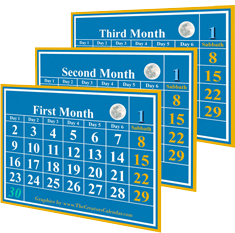 Second Month, 16th – the manna begins.
Forty years later, First Month, 16th – the manna ends.
When the manna first appeared in the wilderness, the 16th was the first working day following the Sabbath of the 15th. Forty years later, when the manna ceased, the 16th occupied that same position within the weekly cycle. Pasted text
For forty years, Yasharal had awakened after each Sabbath expecting the manna to return with the beginning of another working week. But on this particular 16th, it did not.
The miracle had lasted an entire generation, yet at its conclusion the weekly TIME pattern remained in the same position it had occupied when the manna began. Pasted text
The manna ceased, but the calendar pattern remained.
The Sanctuary Witness Continued When the Manna Ceased
The manna had completed its forty-year purpose, but Yahuah’s witness to sacred TIME did not end when the manna ceased. Another divinely appointed teaching system was already in place: the Wilderness Sanctuary.
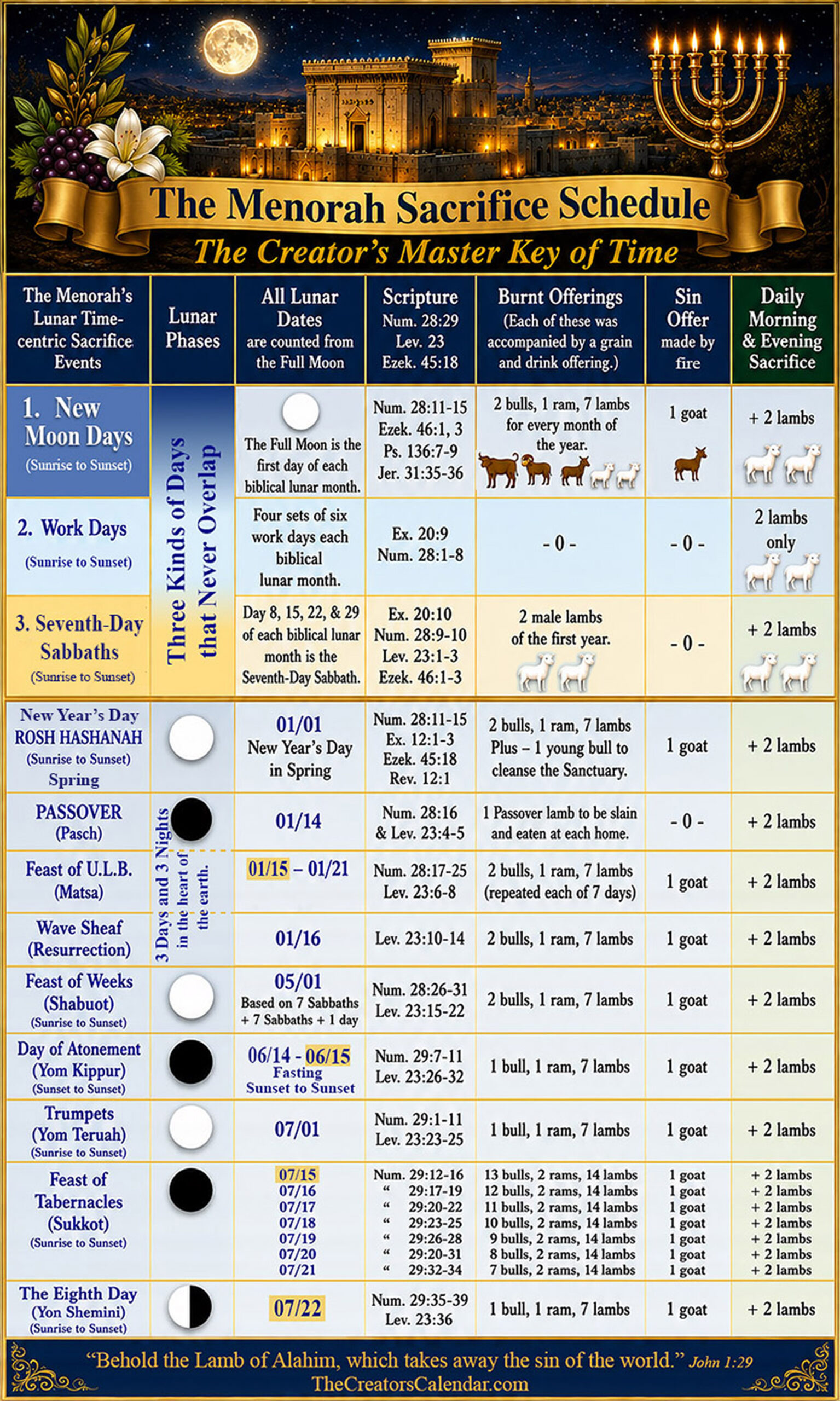
The manna and the Sanctuary were not operating according to two different systems of TIME. Both illustrated an earthly schedule ordered according to the heavenly pattern. The manna followed its prescribed feeding schedule, while the Sanctuary followed its prescribed schedule of sacrifices and worship. Together they testified that Yahuah’s appointed EVENTS were inseparably joined to His appointed TIME. One Creator, one cadence, one heavenly design.
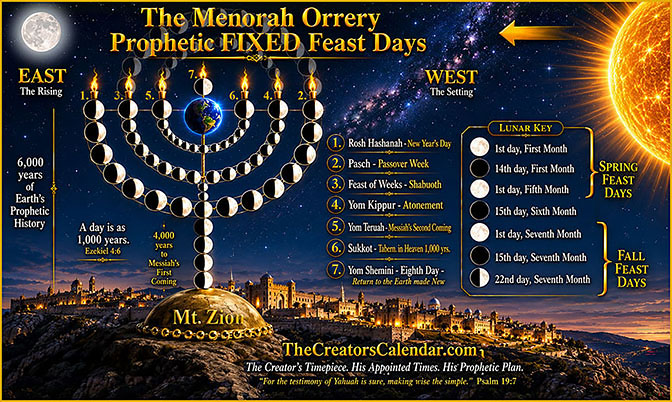
Within the framework presented in this study, that TIME was measured by the celestial witnesses Yahuah had established in the heavens. The sun governed the hours of daylight along the east-to-west continuum, while the full moon, together with the stars by night, marked the beginning of each new lunar year, lunar month, count of weeks, and the seven lunar appointed Feast Days.
The Sanctuary therefore required far more than a general awareness of passing time. Its worship system depended upon knowing exactly where Yasharal stood within Yahuah’s appointed order:
- Daily offerings followed the daily cycle established by the sun.
- Sabbath offerings followed the count of six working days and the seventh-day Sabbath as counted from each full New Moon Day.
- Full New Moon offerings marked the beginning of each lunar month.
- Annual Feast offerings occurred upon their prescribed dates within the lunar year.
Thus, the manna’s feeding schedule and the Sanctuary’s sacrifice schedule became two complementary witnesses to the same heavenly order. What Yahuah displayed above through the movement of the celestial lights, He taught below through the daily life and worship of His people.
The heavens established the TIME. The manna demonstrated its weekly rhythm. The Sanctuary, through its essential sacrificial system, joined each appointed TIME to its prescribed prophetic EVENT.
When the manna ceased on Abib 16 after forty years, Yahuah’s calendrical witness did not disappear. One forty-year teaching instrument had ended, but the Wilderness Sanctuary continued to preserve the larger heavenly pattern of lunar years, lunar months, lunar Sabbaths, days identified with their own unique lunar phase, and lunar-appointed Feast Days.

Part Six
Applying the Restored Calendar to 1844
The Displacement of the Original New Moon
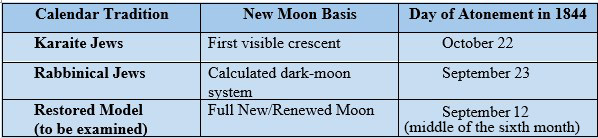
William Miller and Samuel Snow were sincere in their expectation of the Messiah’s return in 1844, yet their calculation depended upon New Moon traditions inherited from later Jewish systems.45 Neither the invisible conjunction nor the first visible crescent satisfies the Scriptural criteria presented in the preceding sections for identifying the authentic beginning of the lunar month.
Within the restored model, the full moon alone fulfills the appointed function of ruling the night together with the visible stars while the sun is absent. At the beginning of the year, it rises in the east against the constellation Bethulah, or Virgo, traverses the night sky, and sets in the west near sunrise. This celestial order identifies it as the Creator’s signal for the renewal of years and months.
The issue in 1844 was therefore not merely whether Miller and Snow used a lunar calendar, but whether they began their count from the correct lunar phase.
For the complete Scriptural evidence, refer to The Treasury of Evidence: The Full Moon Announces Lunar Months
Also: Uncovered: Lunar Secrets from Ancient Babylon.
The New Moon Signal was Misappropriated
Over time, the Creator’s signal for marking the start of years and months has been distorted, influenced by ancient Babylonian and Egyptian practices, and later adopted by gentile nations and even the Jews when in Roman captivity. Yet, Scripture is clear: the lesser light (the moon) was appointed to rule the night together with the stars, from east to west, throughout the entire night when the sun is absent.
Remarkably, the full moon is the only lunar phase that fulfills this role to commence the Year in spring. It rises in the east in the constellation of Bethulah (Virgo), ruling the night together with the visible stars, when the sun is not present. It then sets in the west, seamlessly transitioning into day by greeting the sun at sunrise. This harmony with the Scriptural criteria underscores its authenticity as the original signal for the start of lunar months. The Treasury of Evidence: The Full Moon Announces Lunar Months.
It may come as a surprise to many, yet the full moon alone emerges as the Creator’s original and authentic marker for the beginning of both years and months, the heavenly timepiece from which every day is rightly counted. From Genesis to Revelation, it stands unwavering as the only lunar phase that fulfills every Scriptural criterion with complete harmony and precision. Its consistent testimony through the ages confirms the divine order established at Creation, revealing that the full, radiant moon has always been heaven’s appointed signal for the renewal of time. For further insight, refer to “Uncovered: Lunar Secrets from Ancient Babylon.
As demonstrated in the “Four Scripture Witnesses Testify” illustration in Section 19, only the full-moon syzygy satisfies all four biblical criteria for the authentic New Moon.


Part Seven
The Redemptive Meaning of the Appointed Times
The Sabbath and the Feast Days: Their Distinct Roles
Did you know that the seventh-day Sabbath preexisted the creation of the earth and the fall in Eden?
The Sabbath and the Feast Days belong within the same divinely ordered calendar, yet they serve distinct purposes within the Creator’s government and the Plan of Salvation.
The seventh-day Sabbath stands as an enduring sign of Yahuah’s authority, sanctifying power, and sacred rhythm of worship:
“Moreover also I gave them My Sabbaths, to be a sign between Me and thee, that they might know that I am Yahuah that sanctified them.”62 Ezekiel 20:12; and Ezekiel 20:20.
These verses reveal that the Sabbath originates with Yahuah Himself: He calls them “My Sabbaths” and declares that He gave them to His people as a sign of His sanctifying authority. The Sabbath was therefore not a human institution or a later Jewish invention, but belongs to the divine order established by the Creator and revealed to humanity from Creation.
Enshrined within the fourth commandment, the Sabbath reflects an eternal principle of the Father’s righteous government. It identifies Him as Creator and calls His faithful people to rest, worship, and unity within His appointed rhythm. Yet while the Sabbath bears witness to the Creator’s authority and sanctifying power, it was not appointed to accomplish the redemptive work required by humanity’s fall.
That role belongs to Yahusha the Messiah alone. The lunar-appointed Feast Days were established as the prophetic framework through which His redemptive ministry would unfold. Beginning with Passover, they reveal the appointed events by which He would sacrifice His life, conquer death, minister on behalf of humanity, return for His faithful people, and ultimately restore them to the Father’s righteous standard.
The distinction may therefore be expressed simply:
- The Sabbath reveals the Creator’s authority, sanctifying power, and sacred rhythm.
- The Feast Days reveal the Messiah’s redemptive work and the appointed stages of the Plan of Salvation.
- Together, they function within one divinely ordered calendar, uniting worship, covenant, sacred time, and redemption.
Prophecies Fulfilled and Promises Yet to Come
Each Feast Day was prophetically assigned to a specific date within the lunar calendar, pointing forward to events that only Yahusha the Messiah could fulfill. During the appointed spring Feast sequence, He carried out the redemptive work foretold through Passover, Unleavened Bread, and the Wave Sheaf Offering, each in harmony with its designated time and purpose.63
This orderly fulfillment of the spring Feast Days stands as a powerful witness to the prophetic intent of the Creator’s appointed times. It also gives assurance that the remaining prophetic appointments will be fulfilled with the same divine precision at the Messiah’s Second Coming.
The appointed times therefore reach far beyond the study of ancient dates. They form a living testimony to the Messiah’s completed sacrifice, His continuing ministry, and the promises that remain to be fulfilled. By understanding and honoring their significance, the faithful Bride aligns herself with the redemptive work of the Bridegroom and prepares, in faith and expectancy, for the appointments yet to come.
To walk in the rhythm of these sacred times is to recognize the unfolding steps of the Plan of Salvation and to remain attentive to the Messiah’s promised return.
The Song of Moses and the Lamb
The cadence of the Creator’s sacred appointments can better be explained as a wedding dance in which the Bridegroom and His betrothed Bride move together in covenant harmony. Within this divine rhythm is a song of love, rescue, restoration, and final victory. As the Bride seeks to be in step and align her soul temple with the Messiah’s prophetic appointments, she learns to walk in step with His heart while preparing for the promised Wedding Supper of the Lamb.64
Each year, this sacred rehearsal begins with Rosh HaShanah and continues through the final appointed day following the Feast of Tabernacles, known as Yom Shemini, the Eighth Day. The annual cycle bears witness to the Messiah’s completed work, His continuing ministry, and the promises awaiting fulfillment. It will continue as a prophetic rehearsal until Yahusha returns and will thereafter remain an eternal memorial of the immeasurable love He demonstrated toward His faithful Bride.
Scripture identifies each Feast Day as a mo’edim (H#4150), a lunar appointed time, and as a miqra (H#4744), a sacred assembly or rehearsal.65 Each was assigned to a specific lunar date and given a defined duration. Whether lasting one day or several days, every appointment was designed to reveal a particular stage in the Messiah’s redemptive work and to be fulfilled according to its ordained time.
The spring Feast sequence provides a clear example:
- Passover, the fourteenth day: Yahusha fulfilled the appointed sacrifice by laying down His life as the Lamb for the sins of humanity.
- Unleavened Bread, the fifteenth day: The Messiah rested in the tomb on the appointed Sabbath.
- Wave Sheaf, the sixteenth day: Yahusha arose, triumphing over death and becoming the First Fruits of those who sleep.
These appointments were not fulfilled as indefinite prophetic eras, but as distinct events within their appointed sequence. Their precise fulfillment establishes the pattern by which the remaining Feast-Day prophecies may likewise be expected to unfold on a day-for-a-day basis.
The song and rhythm of the appointed times therefore unite remembrance with expectation. They call the faithful to honor what the Messiah has already accomplished, remain attentive to His present ministry, and prepare for the appointments that will culminate in the victory celebrated by Moses, the Lamb, and the redeemed.
Feast Day Memorials and Rehearsals
Part Eight
Final Review and Invitation
Conclusion
The evidence presented throughout this study returns us to the question with which we began:
Was October 22, 1844, established according to the complete and authentic calendar of Scripture?
The Millerites recognized that the biblical Day of Atonement belonged to a lunar calendar and that the prophetic year must be reckoned according to the ancient, spring-based method. Samuel Snow and William Miller made important contributions by restoring attention to the lunar foundation of the biblical year and to the principle that Yahuah Alahim fulfills prophecy according to precise appointed times.
Yet their calculation remained dependent upon the Karaite crescent New Moon. October 22 was therefore not established merely by Scripture, but by a particular interpretation of which lunar phase begins the month.83 That assumption was later joined, with the establishment of the Seventh-day Adventist Church, to the continuous Roman planetary week, a system that proceeds independently of the New Moon Day and the monthly lunar cycle.
This does not diminish the sincerity, courage, or devotion of the early Advent believers. Their willingness to search the Scriptures, sacrifice personal comfort, and proclaim the light they possessed deserves respect. Their work opened an important door by directing attention to the sanctuary, the Feast Days, and the precision of prophetic time.
But the opening of one door does not mean that every question beyond it was fully resolved.
The Great Disappointment should therefore be understood not merely as a failed prediction, but as evidence that the calendar foundation beneath the prediction had not been completely examined. The Millerites had restored the lunar year, but they had not yet restored the authentic New Moon, the lunar Sabbath sequence, or the full sanctuary rhythm of New Moon Days, workdays, lunar Sabbaths, and lunar appointed Feast Days.
When the full New Moon is restored, which announces the new month, the calculation changes. According to the framework presented in this study, the Day of Atonement in 1844 would correspond to September 12 (also restored to the 15th day of the Sixth Month) rather than October 22 (the 10th day of the Seventh Month). This alone requires a careful reconsideration of the prophetic claims subsequently built upon the later date.
The issue extends beyond a single date in Millerite and Adventist history. It asks whether sacred time is defined by the Creator’s celestial witnesses or by religious systems inherited from Rome, Babylon, and later Jewish tradition. It asks whether a lunar Day of Atonement can be joined consistently to a continuous planetary week and its Saturday Sabbath. Most importantly, it asks whether Scripture itself supports a Day of Atonement beginning in 1844 and continuing for more than 180 years.
The evidence presented here suggests that it does not.
Scripture places the definition of sacred time in the hands of Yahuah Alahim, the Creator and Most High. The sun, moon, and stars were appointed by Him for signs, seasons (mo’edim), days, and years. The sanctuary sacrifice schedule preserved the distinction between ordinary workdays, seventh-day Sabbaths, New Moon Days, and annual Feast Days. The Messiah then fulfilled the spring appointments according to their precise lunar dates, establishing the pattern by which the remaining prophetic appointments must also be understood.
The invitation is therefore not to reject all heritage, scholarship, or sincere religious experience. It is to allow Scripture to stand above every inherited interpretation. Where tradition and the written Word diverge, faithfulness requires that the Creator’s standard be restored, no matter how familiar the alternative may have become.
“Unfamiliar is no more wrong than familiar is right.”
~ Kerrie L. French~
Dear reader, the path forward requires courage and humility. It asks us to examine cherished beliefs as faithfully as the Bereans examined the teachings presented to them. It calls us not merely to exchange one calendar theory for another, but to deepen our relationship with the Father and His beloved Son, Yahusha haMashiach, by seeking to get it right.
The ultimate purpose of this calendar restoration is not simply to identify the correct New Moon, Sabbath, or Feast Day. It is to bring all worshipers into covenant harmony with the Bridegroom, to recognize the appointed rhythm of His redemptive work, and to prepare for the precise fulfillment of the promises that remain.
The measuring rules have been placed side by side. The evidence has been presented. The calendar question Adventism never fully resolved now rests before each reader.
Will we cling to the familiar measure, or will we allow the Creator’s unchanging standard to define sacred time?
May this journey of rediscovery lead us ever closer to the truth as revealed in Scripture. The Creator’s appointed times are not relics of a forgotten past, but living signposts along the pathway of redemption, continually pointing us to the faithfulness of Yahuah and the saving work of Yahusha haMashiach.
The Bridegroom is calling His faithful Bride to walk in harmony with His appointed rhythm today, preparing for the glorious fulfillment yet to come at the Marriage Supper of the Lamb.
May we hear His call, follow wherever He leads, and be found ready. HalleluYah!
Prayer of Restoration
O Sovereign Yahuah, Eternal Creator of time and truth, we praise
You for the light of Your Word and the brilliance of
Your heavenly design.
Thank You for preserving within the scrolls of Leviticus and Numbers
a sacred blueprint, a Master Key of Time, which unveils
the rhythm of Your appointed worship.
We are in awe that each sacrifice, feast, and lunar phase was divinely
appointed to guide our hearts into harmony with
the courts of heaven.
Forgive us, Father, for the years we walked in ignorance, aligned to
man-made calendars and traditions that obscured
Your holy rhythm.
Restore to us the joy of Your original design, as You did for Israel on the
eve of their exodus from Egypt, calling them to count from the
full moon as Your appointed New Moon.
Let us not be found outside the timing of Your deliverance, but instead
counted among the wise virgins who prepare by faith
to meet You in Your sacred time.
You have encoded Your truth in the very skies, and by Your Ruach
haKodesh, You are awakening hearts to
see and respond.
We thank You for the consistency of Your calendar, anchoring
Your true seventh-day Sabbaths and Feast Days to
the lights You placed in the firmament.
O Yahuah, teach us to number our days according to Your wisdom, and
to delight in Your ordained New Moons, Sabbaths, and
annual mo’edim as rehearsals of eternity.
Let the sacrifices that once testified through blood now echo in our hearts
through the blood of Yahusha, the Lamb
who fulfilled them all.
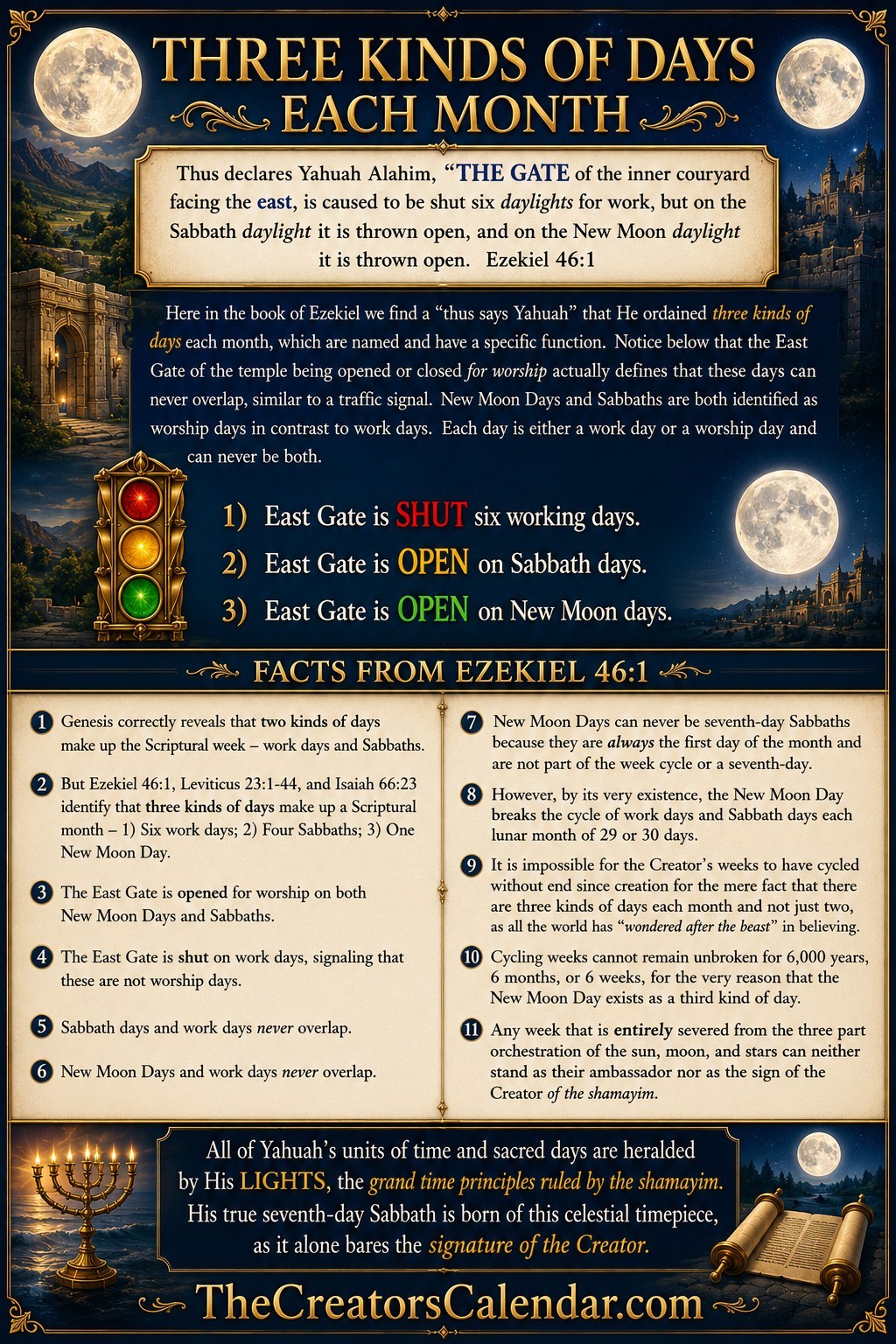
Help us discern between the three kinds of days You established,
New Moon Days, work days, and lunar Sabbaths, that
we may walk uprightly in Your appointed rhythm.
Raise up faithful messengers to declare the restoration of Your timepiece
and guide others into the light of Your
prophetic truth.
Cause the Menorah of time to shine once more upon Your people,
illuminating the path of redemption as You designed it
from Eden to the New Earth.
Let us be found watching and ready on the authentic Feast of Trumpets,
having been sealed on the Day of Atonement, and rejoicing
in the shelter of Tabernacles.
All praise to You, O Yahuah, for calling us back to Your appointed ways,
for in Your calendar we find not only time,
not only salvation, but YOU.
May Your Name be Praised in All the Earth!
HalleluYAH!!!
The New Moon and October 22, 1844
A Witness to the Faithful
In days of yore, a cry was heard,
A herald of hope, from holy word.
William Miller stood bold and true,
Proclaiming prophecies ancient and new.
October’s date, the twenty-two,
A fateful time, the saints held true.
With eyes uplifted, hearts ablaze,
They sought the end of Earth’s dark maze.
Yet the day came, the skies were still,
The Messiah’s return was not His will.
A Disappointment, great and vast,
Shaped a movement that should last.
But what of the time, the sacred sign?
Was it measured by Yah’s design?
The crescent moon or shadowed phase,
Could not fulfill His ancient ways.
For Scripture speaks of a brilliant light,
The full moon ruled the silent night.
From east to west, with stars, it reigns,
A beacon clear, its truth remains.
The appointed day and its lunation,
Was counted this way since creation.
Not bound by Rome’s calendar creed,
But by the rhythm, the heavens heed.
Atonement’s call, so wrongly timed,
October’s claim was misaligned.
For Yahuah’s time is not our own,
His timing carved with His lunar stone.
The Feasts were marked, each date decreed,
On Messiah’s path to meet our need.
Day by day, they foretell His plan,
The remedy for wayward man.
Passover’s cross, the tomb’s repose,
But three days later, He arose.
Each Feast fulfilled with perfect care,
On lunar time beyond compare.
Yet doctrines formed, traditions swayed,
And Torah’s truths were cast away.
A paradox within the creed,
To follow truth or with church concede.
October’s day, a lunar date,
Yet Saturday doesn’t correlate.
How can the truth of moon and sun,
Align with doctrines man has spun?
Day of Atonement, our lives to weigh,
Speaks not of years but a single day.
Its shadow points to a day to come,
When sins are cleansed and justice done.
O Saturday flock, arise, awake!
The ancient paths you must retake.
The full moon’s light, the sacred sign,
Reveals the truth of Yah’s design.
For feasts endure, their purpose clear,
To guide the faithful, year by year.
Until the final trumpet sounds,
And heaven’s joy eternal abounds.
Reject the fraud, the cunning snare,
Return to Yahuah’s loving care.
The moon, the stars, the sun’s embrace,
Declare His TIME, His saving grace.
So let the rhythms of heaven’s span,
Shape the walk of every man.
The Lamb leads on, His truth prevails,
In lunar light, His love unveils.
by Kerrie French
Kerrie French
www.TheCreatorsCalendar.com
The Sacrifice Schedule: the Master Key of Time
Mounting Evidence for the Lunar Sabbath
Restored Prophetic Feast Days of Yahusha the Messiah
The Menorah, The Gold Standard of Time
The Great Easter Controversy Cover-up
Scripture’s Test of a True Prophet
Footnotes for “October 22, 1844 and the Crescent New Moon”
1. 1 Thessalonians 5:21: “Prove all things; hold fast that which is good.” KJV.
2. Seventh-day Adventist teaching identifies 1844 with the beginning of the second and final phase of Messiah’s ministry in the heavenly sanctuary, typified by the ancient Day of Atonement and understood as the investigative judgment. See General Conference of Seventh-day Adventists, Fundamental Belief 24, “Christ’s Ministry in the Heavenly Sanctuary”; Ellen G. White, The Great Controversy (1911), pp. 399–400, 423–425.
3. Sir Isaac Newton, Observations upon the Prophecies of Daniel, and the Apocalypse of St. John (London: J. Darby and T. Browne, 1733). In his treatment of Daniel 8, Newton specifically addressed the sanctuary and the “2300 days,” interpreting prophetic days as years.
4. J. N. Loughborough, The Great Second Advent Movement: Its Rise and Progress (Washington, D.C.: Review and Herald Publishing Association, 1905), p. 522. Loughborough recounts the Exeter camp-meeting episode from reports of those who were present, noting that although James White was in the audience, Loughborough himself “was not there.”
5. Encyclopedia of Seventh-day Adventists, “Snow, Samuel Sheffield,” discussion of Snow’s August 1844 True Midnight Cry message; Samuel S. Snow, The True Midnight Cry, August 22, 1844, for his statement, “God is an exact timekeeper.
6. Encyclopedia of Seventh-day Adventists, “Snow, Samuel Sheffield,” discussion of Snow’s 1844 seventh-month calculation and use of the Karaite calendar; see also Samuel S. Snow, The True Midnight Cry, August 22, 1844.
7. Samuel S. Snow, The True Midnight Cry, August 22, 1844. Snow’s “seventh-month” argument connected the spring Feast fulfillments with the expectation that the Day of Atonement would likewise meet its antitypical fulfillment at the appointed time. See also “Snow, Samuel Sheffield (1806–1890),” Encyclopedia of Seventh-day Adventists.
8. Ellen G. White, The Great Controversy Between Christ and Satan (1888), Appendix Note 3. The note explains that the Millerite reckoning extended 1843 to the spring of 1844 because “anciently, the year did not commence in midwinter, as now, but at the first new moon after the vernal equinox,” and that the prophetic period was therefore considered according to the same ancient method at its conclusion. The same explanation was also published in the Advent Herald (Boston), March 1850.
9. The 1888 edition of The Great Controversy contained thirteen Appendix notes. In preparing the 1911 edition, those thirteen notes were replaced by thirty-one revised notes, principally designed to provide historical documentation and references. William C. White later described the preparation and changes made for the 1911 edition. See Ellen G. White Estate, “The 1911 Edition of The Great Controversy.”
10. Samuel S. Snow advanced the “seventh-month” message during the summer of 1844, identifying the tenth day of the seventh Jewish month with October 22, 1844, according to the Karaite reckoning. William Miller was initially hesitant but eventually accepted the October 22 date in early October 1844. See “Miller, William (1782–1849)” and “Snow, Samuel Sheffield (1806–1890),” Encyclopedia of Seventh-day Adventists.
11. In 1844, the fixed Rabbinic calendar placed the Day of Atonement on September 23, whereas the Millerites rejected that date and adopted October 22 on the basis of what they understood to be the biblical/Karaite reckoning of the Jewish year. See Biblical Research Institute, “When Did the 2300 Days of Daniel 8:14 Begin and End? Fresh Evidence from Scripture, Chronology, and Karaite History.”
12. William Miller and the Millerite movement connected Daniel 8:14 with Daniel 9, interpreting the 2,300 prophetic days according to the year-day principle and beginning the period with the decree associated with 457 B.C. This calculation was understood to terminate in 1844. See Seventh-day Adventist Biblical Research Institute, discussions of Daniel 8–9 and the year-day principle; see also Ron du Preez, “1844: Coincidence or Providence?” College and University Dialogue 18, no. 3 (2006), pp. 13–15, 31.
13. The Millerite expectation of October 22, 1844, culminated in what became known as the Great Disappointment. Some adherents committed substantial personal resources to the movement; Joseph Bates, for example, devoted his savings and other assets to the Second Advent cause. See Encyclopedia of Seventh-day Adventists, s.v. “Bates, Joseph (1792–1872)” and “Millerite Movement.”
14. The Seventh-day Adventist Church was formally organized in 1863. Ellen G. White, James White, and Joseph Bates are commonly identified as its three principal cofounders. See Encyclopedia of Seventh-day Adventists, “Denominational Organization, 1860–1863” and “FAQ About Adventists.”
15. Strong’s Hebrew H6153, עֶרֶב (ʿereb), “evening”; H1242, בֹּקֶר (boqer), “morning”; and H3117, יוֹם (yom), “day.” Daniel 8:14 literally employs the terms ʿereb and boqer, “evening” and “morning,” rather than the Hebrew noun yom. See Strong’s Exhaustive Concordance and the corresponding Hebrew lexicon entries.
16. Counts derived from a concordance examination of the Hebrew terminology in Daniel: Strong’s H3117, yom (“day”); H6153, ʿereb (“evening”); and H1242, boqer (“morning”). See Strong’s Exhaustive Concordance and Englishman’s Hebrew Concordance under the respective entries. The distinctive ʿereb-boqer construction occurs in Daniel 8:14 in connection with the 2,300 period.
17. Seventh-day Adventist historicist interpretation applies the year-day principle to the 2,300 “evenings and mornings” of Daniel 8:14, understanding the period as 2,300 years terminating in 1844. See Alberto R. Timm, “Miniature Symbolization and the Year-Day Principle,” Biblical Research Institute; and Seventh-day Adventist Fundamental Belief 24, “Christ’s Ministry in the Heavenly Sanctuary.”
18. Seventh-day Adventist Fundamental Belief 24 teaches that in 1844, at the conclusion of the 2,300-day prophetic period, Messiah entered the “second and last phase” of His heavenly ministry, typified by the work of the high priest on the ancient Day of Atonement and involving a work of investigative judgment. See General Conference of Seventh-day Adventists, Fundamental Belief 24, “Christ’s Ministry in the Heavenly Sanctuary.”
19. Seventh-day Adventist Biblical Research Institute, “Should Christians Observe the Israelite Festivals?” The article argues that the ceremonial system, including its festivals and Feast Days, was no longer obligatory for Christians under the New Covenant.
20. See Leviticus 23 and Numbers 28–29 for the prescribed dates and sacrifices associated with Passover, Unleavened Bread, the Feast of Weeks, Trumpets, the Day of Atonement, Tabernacles, the daily offerings, Sabbaths, and New Moons.
21. General Conference of Seventh-day Adventists, Fundamental Belief 24, “Christ’s Ministry in the Heavenly Sanctuary.” See also Ellen G. White, The Great Controversy (1911), chapters 23–24 and 28, for the historic Adventist interpretation of the heavenly sanctuary, the Day of Atonement typology, and the investigative judgment beginning in 1844.
22. Genesis 1:14. See Strong’s Hebrew H226, אוֹת (oth), “sign”; H4150, מוֹעֵד (moʿed), “appointed time, meeting, appointed feast”; H3117, יוֹם (yom), “day”; and H8141, שָׁנָה (shanah), “year.” The connection of moʿed with the heavenly lights is explicit in Genesis 1:14, while Psalm 104:19 specifically associates the moon with appointed times.
23. Psalm 104:19: “He appointed the moon for seasons [מוֹעֲדִים, moʿadim].” Compare Genesis 1:14, where the heavenly lights are appointed for signs, appointed times, days, and years.
24. The Julian calendar reform of 46–45 B.C. reorganized the Roman civil calendar around a solar year of approximately 365¼ days rather than maintaining the earlier Roman lunisolar structure. The reform became the basis of Roman civil timekeeping and, later, much of the Western calendar tradition.
25. The Hebrew noun חֹדֶשׁ (chodesh, Strong’s H2320) is used for both “new moon” and “month,” reflecting the relationship between the renewal of the moon and the monthly count. See, for example, Exodus 12:2; Numbers 28:11; 1 Samuel 20:5; and Isaiah 66:23.
26. The Universal Jewish Encyclopedia, s.v. “Calendar,” p. 631: “The months of the year were lunar, and began with the new moon.”
27. Exodus 12:1–3. The expanded rendering incorporates Hebrew lexical information, including H2320, חֹדֶשׁ (chodesh), “month/new moon”; H7218, רֹאשׁ (rosh), “head, beginning”; and H8141, שָׁנָה (shanah), “year.” The explanatory wording reflects the author’s Hebrew word study and is not intended as a verbatim rendering from a standard English Bible translation.
28. Richard A. Parker, The Calendars of Ancient Egypt, Studies in Ancient Oriental Civilization 26 (Chicago: University of Chicago Press, 1950), especially his opening discussion of the lunar day and month. Parker reconstructs the Egyptian lunar month as beginning on the first morning when the old waning crescent was no longer visible. The University of Chicago’s Oriental Institute describes Parker’s study as demonstrating that ancient Egypt possessed two lunar religious calendars in addition to its civil calendar.
29. Nehemiah 8:1–8. Ezra stood upon a wooden platform before the assembled people and publicly read from the Book of the Torah, while the Levites helped the people understand what was being read.
30. Exodus 12:1–6 and Leviticus 23:5 establish Passover on the fourteenth day of the first month. The identification of the first day of that month with the full New Moon is the calendrical conclusion developed in this study from the combined Scriptural and celestial evidence.
31. Astronomically, the full moon occurs when the moon is approximately opposite the sun as viewed from Earth. It therefore rises near sunset, remains visible through the night, and sets near sunrise. The identification of this spring full-moon arrangement with Bethulah (Virgo) and Revelation 12:1 is the celestial interpretation developed in this study.
32. A syzygy is an astronomical alignment in which the sun, Earth, and moon are arranged approximately in a straight line. Such alignments occur at both the astronomical new moon and the full moon.
33. James C. VanderKam, Calendars in the Dead Sea Scrolls: Measuring Time (London: Routledge, 1998), p. 110. VanderKam concludes that in the Qumran calendrical system under discussion, “the full moon…marks the inception of a new month.” See also pp. 79 and 85, where he discusses evidence from 4Q320 and related texts indicating that the full moon may have stood at the beginning of the lunar month.
34. See Numbers 28–29 and Leviticus 23. These passages prescribe the continual daily offerings, additional Sabbath offerings, New Moon offerings, and the sacrifices associated with the annual appointed Feast Days.
35. Numbers 28:3–8 prescribes two lambs daily, one in the morning and one in the evening. Numbers 28:9–10 adds two additional lambs on the Sabbath. Numbers 28:11–15 prescribes for each New Moon two young bulls, one ram, seven lambs, and one goat, in addition to the continual daily offering.
36. Jack Finegan, Handbook of Biblical Chronology, rev. ed. (Peabody, MA: Hendrickson, 1998), pp. 7–8. Finegan observes that in the Old Testament “the earlier practice seems to have been to consider that the day began in the morning,” citing passages such as Genesis 19:34.
37. Numbers 28:3–15 distinguishes the continual daily offerings from the additional Sabbath offerings and the substantially greater New Moon offerings. Ezekiel 46:1–3 likewise distinguishes the six working days from the Sabbath and the New Moon.
38. Scribner’s Dictionary of the Bible (1898), p. 521: “In the time of the earliest prophets, the New Moon stood in the same line with another lunar observance, the Sabbath.”
39. The Universal Jewish Encyclopedia, “Holidays,” vol. 5, p. 410: “The New Moon is still, and the Sabbath originally was, dependent upon the lunar cycle.” Your quote bank preserves this citation as well.
40. Exodus 12:1–6 and Leviticus 23:5 establish Passover on the fourteenth day of the first month. The identification of the first day of that month with the full New/Renewed Moon is the restored calendrical conclusion developed in this study.
41. This placement of the Feast of Weeks on the first day of the fifth lunar month represents the restored conclusion developed in the author’s study The Standard, the Covenant, and the Gift of Grace. The conventional fifty-day interpretation derives principally from Leviticus 23:15–16; the present study argues that the passage must be reconsidered within the larger sanctuary, sacrificial, and lunar framework. This point is not the focus of this presentation and may require further research.
42. This placement represents the restored Feast arrangement proposed in this study and differs from the received text of Leviticus 16:29 and Leviticus 23:27, which place the Day of Atonement on the tenth day of the seventh month. The author’s reconstruction is based upon the combined Menorah pattern, sanctuary sacrifice schedule, lunar phases, and prophetic sequence developed throughout this article. This point is also not the focus of this presentation and may require further research.
43. Revelation 8:1 records “silence in heaven about the space of half an hour.” John 11:9 identifies the daylight portion of a day as twelve hours. The interpretation of this “half hour” as the two-week interval between the restored Day of Atonement and the Feast of Trumpets is the prophetic application proposed in this study.
44. Leviticus 23:34–36 establishes the Feast of Tabernacles beginning on the fifteenth day of the seventh month and continuing for seven days, followed by an eighth-day sacred assembly. Counting inclusively places the seven-day Feast on days 15–21 and Yom Shemini, the Eighth Day, on day 22.
45. Samuel S. Snow’s seventh-month calculation relied upon a Karaite-based lunar reckoning rather than the fixed Rabbinic calendar in determining the Day of Atonement in 1844. This reckoning ultimately produced October 22 as the anticipated tenth day of the seventh month. See Samuel S. Snow, The True Midnight Cry, August 22, 1844; see also the historical discussion of the Millerite seventh-month movement and its reliance upon Karaite calendation.
46. The September 12, 1844 date is the restored calendrical conclusion developed in this study by beginning the month with the full New Moon and placing the Day of Atonement on the fifteenth day of the sixth lunar month within the reconstructed Feast arrangement. It therefore differs from the Millerite/Karaite calculation that produced October 22, 1844.
47. Leviticus 23:26–32 places the Day of Atonement within the seventh month, making its observance dependent upon the identification and counting of a lunar month. The Millerite date of October 22, 1844, likewise depended upon a lunar reckoning of that month.
48. Encyclopaedia Britannica, “Calendar: The Western Calendar and Calendar Reforms,” discussion of the Julian calendar. The article explains that Julius Caesar, advised by Sosigenes of Alexandria, replaced the earlier lunar basis of the Roman calendar with a solar system organized around a year of approximately 365.25 days.
49. Eviatar Zerubavel, The Seven Day Circle: The History and Meaning of the Week (Chicago: University of Chicago Press, 1985). Zerubavel discusses the spread of the planetary week in the Roman world and the historical association that developed between Saturn’s day and the Jewish Sabbath.
50. Register of the Grace Amadon Collection, Collection 154, Center for Adventist Research, James White Library, Andrews University. The collection register states that Grace Edith Amadon was invited by the General Conference of Seventh-day Adventists in January 1939 to join a specially formed research committee. Her surviving papers include extensive material on ancient Jewish calendation, Crucifixion/Passover chronology, Millerism, and the October 22, 1844 date.
51. Grace E. Amadon, “The ‘Wednesday’ Crucifixion Argument,” The Ministry, May 1942, and “The ‘Wednesday’ Crucifixion Argument (Concluded),” June 1942; Grace Amadon, “The Crucifixion Calendar,” Journal of Biblical Literature 63 (1944). Amadon defended a Friday, 14 Nisan Crucifixion while continuing to wrestle with the astronomical and calendrical evidence necessary to identify the appropriate historical year. Her surviving research collection contains extensive files devoted to “Crucifixion/Passover” and “The Crucifixion Date.”
52. Ellen G. White, The Desire of Ages (Oakland, CA: Pacific Press Publishing Association, 1898), p. 685: “The Passover moon, broad and full, shone from a cloudless sky.” The same wording also appears in her earlier The Spirit of Prophecy, vol. 3.
53. Eviatar Zerubavel, The Seven Day Circle: The History and Meaning of the Week (Chicago: University of Chicago Press, 1985), discusses the development and spread of the seven-day planetary week in the Roman world, in which the days were associated with the seven classical planetary deities. Saturn’s day became identified with the Jewish Sabbath by the first century. Zerubavel emphasizes that, unlike the day, month, and year, the continuous week does not correspond to a recurring astronomical cycle.
54. Amos 5:26 refers to Chiun (Hebrew Kiyyun), while Stephen’s quotation of the passage in Acts 7:43, following the Greek Septuagint tradition, gives the name Remphan or Rephan. These names have traditionally been identified by many interpreters with a deity associated with the planet Saturn, although the precise derivation of the names remains debated. See Amos 5:26; Acts 7:42–43.
55. Daniel 7:25. The Aramaic expression translated “times and laws” is commonly rendered from zimnin (“times,” appointed periods or seasons) and dath (“law”). In the context of this study, the passage is understood as relevant to changes affecting both sacred timekeeping and divine law; this application represents the interpretive conclusion developed here rather than a claim that the verse explicitly names the Roman planetary week.
56. Encyclopaedia Judaica, s.v. “Calendar,” subsection “Postponements (Dehiyyot).” The four dehiyyot regulate the beginning of Tishri and prevent certain festival dates from occurring on specified weekdays. Among their practical effects, Yom Kippur is prevented from falling immediately adjacent to the weekly Sabbath.
57. Encyclopaedia Judaica, s.v. “Calendar” and “Hillel II.” Jewish tradition commonly attributes the publication or formal establishment of the fixed calculated calendar to Hillel II in the fourth century C.E. The later Rabbinic calendar incorporates calculated lunar months together with rules of postponement, or dehiyyot.
58. Nachum Dershowitz and Edward M. Reingold, Calendrical Calculations, discussion of the Jewish calendar. The postponement rules, or dehiyyot, regulate the beginning of Tishri so that certain festivals do not fall on specified weekdays; among these restrictions, Yom Kippur is prevented from occurring on Friday or Sunday.
59. Samuel S. Snow’s “seventh-month” message calculated the expected Advent from the tenth day of the seventh Jewish month and identified that date as October 22, 1844. Contemporary and later Adventist accounts describe the Millerite calculation as following the Karaite Jewish calendar rather than the fixed Rabbinic calendar. See Samuel S. Snow, The True Midnight Cry, August 22, 1844; see also Arthur Whitefield Spalding, Origin and History of Seventh-day Adventists, vol. 1, discussion of the Karaite calendrical basis of the 1844 calculation.
60. Eviatar Zerubavel, The Seven Day Circle: The History and Meaning of the Week (Chicago: University of Chicago Press, 1985), discusses the continuous seven-day week as a social cycle that proceeds independently of the astronomical month. Unlike lunar months, the planetary week is not reset by the New Moon and therefore moves continuously through successive months and years.
61. Karaite Insights, “Shabbat.” The article states: “Through all the trials and tribulations that humanity has experienced over the past 5,000 years, we have no proof whatsoever that our current Saturday is the actual seven-day ‘anniversary’ of the original Shabbath of Creation.”
62. Ezekiel 20:12, 20. In both passages Yahuah identifies His Sabbaths as a covenant sign by which His people might know that He is the One who sanctifies them. Compare Exodus 31:13–17, where the Sabbath likewise functions as a sign between Yahuah and Israel and points back to His work as Creator.
63. See Exodus 12:1–14; Leviticus 23:4–14; Matthew 26:17–28; John 19:14–30; and 1 Corinthians 15:20–23. These passages establish the spring appointed times and identify Yahusha as the Passover sacrifice and the First Fruits of those who have fallen asleep. The precise calendrical placement of these events within the restored lunar sequence is the conclusion developed in this study.
64. Revelation 19:7–9 presents the marriage of the Lamb and the preparation of His Bride, culminating in the invitation to the marriage supper of the Lamb. Compare Revelation 15:2–3, where the redeemed stand in victory and sing “the song of Moses the servant of God, and the song of the Lamb.
65. Leviticus 23:2, 4. The Hebrew mo‘ed (H4150) denotes an appointed time, appointed place, or meeting, while miqra (H4744) denotes a convocation, assembly, or calling together. Within the calendrical framework developed in this study, these appointed convocations are understood as sacred rehearsals of the Messiah’s redemptive work.
66. See Exodus 12:14–17; Leviticus 23:4–14; Luke 22:14–20; and 1 Corinthians 15:20–23. These passages establish the memorial character of the spring appointments and identify Yahusha’s death and resurrection with the Passover and First Fruits themes.
67. Leviticus 23 repeatedly describes the appointed times as miqra’ei qodesh, sacred convocations. Within the prophetic framework developed in this study, the unfulfilled appointments are understood not merely as commemorations, but as rehearsals anticipating future redemptive events.
68. See Isaiah 53:4–6; Hebrews 9:11–15, 24–28; and 1 Peter 1:18–19. These passages identify redemption with the Messiah’s sacrificial blood and continuing heavenly ministry, rather than with human merit or ceremonial observance.
69. Revelation 14:4 describes the redeemed as those who “follow the Lamb whithersoever he goeth.” Within the covenant framework developed in this study, participation in the Creator’s appointed times is understood as an expression of faithfulness to the Messiah, not as a means of earning salvation.
70. See Exodus 12:1–14; Leviticus 23:5; John 1:29; John 19:14–30; and 1 Corinthians 5:7. These passages identify Passover with the fourteenth day of the first month and present Yahusha as the Passover Lamb whose sacrificial death provides redemption. The identification of the month’s beginning with the full New Moon is the restored calendrical conclusion developed in this study.
71. Revelation 14:12 describes the faithful as those who “keep the commandments of God, and the faith of Jesus.” Revelation 12:17 likewise identifies the remnant by their faithfulness to the commandments and the testimony of Yahusha. Within the framework of this study, these passages are understood as describing covenant allegiance to the Creator and His Messiah rather than dependence upon a calendar day considered apart from Him.
72. Matthew 25:1–13. In the parable of the ten virgins, all ten await the Bridegroom and carry lamps, but only the five wise virgins possess sufficient oil when the midnight cry is heard. The parable culminates in the call to watchfulness and readiness for the Bridegroom’s arrival.
73. Compare John 14:16–17, 26; John 16:13; and 1 Kings 19:11–12. These passages associate the Spirit of truth with guidance into truth and illustrate Yahuah’s quiet manner of communicating with His faithful servants.
74. See Deuteronomy 4:2; Proverbs 30:5–6; Isaiah 29:13; and Mark 7:6–13. These passages warn against adding to, diminishing from, or replacing the commandments of Yahuah with human tradition.
75. See Ephesians 2:8–10; Titus 3:4–7; Hebrews 9:11–15; and 1 Peter 1:18–19. Salvation and redemption are accomplished through the grace of Yahuah and the sacrificial work of Yahusha the Messiah, not through human works or ceremonial observance.
76. Compare Isaiah 66:22–23; Revelation 21:1–4; and Revelation 22:1–5. These passages portray the redeemed worshiping Yahuah in the restored creation and dwelling eternally in His presence. Within the framework of this study, the appointed times are understood to continue as memorials of the completed redemptive work of Yahusha the Messiah.
77. Compare 1 Corinthians 13:12; Philippians 2:8–11; and Revelation 15:2–4. These passages look forward to the redeemed seeing more fully, honoring the obedience and victory of the Messiah, and worshiping Yahuah for His righteous and faithful works.
78. See John 14:15; Ephesians 2:8–10; and 1 John 5:2–3. Salvation is the gift of Yahuah through the Messiah, while obedience is presented as the loving response of those who have received that gift. Within the framework of this study, honoring the Creator’s appointed times is understood as an expression of covenant faithfulness rather than a means of earning redemption.
79. Revelation 14:4 describes the faithful as those who “follow the Lamb whithersoever He goeth.” The expression is used here as a call to place loyalty to Yahusha and the written Word above inherited religious tradition.
80. See Isaiah 8:20; 1 Thessalonians 5:21; and 2 Timothy 3:16–17. Scripture repeatedly directs believers to test teachings and establishes the written Word as the standard for doctrine, correction, and instruction.
81. Acts 17:10–12. The Bereans were commended for receiving the message “with all readiness of mind” while searching the Scriptures daily to determine whether what they were hearing was true.
82. 1 Thessalonians 5:21: “Prove all things; hold fast that which is good.” Compare Acts 17:11, where the Bereans tested what they heard by searching the Scriptures daily.
83. Samuel S. Snow’s seventh-month calculation identified October 22, 1844, as the tenth day of the seventh month according to the Karaite-based lunar reckoning adopted by the Millerites. Thus, while the calculation was lunar, its result depended upon accepting the crescent as the marker from which the biblical month was counted. See Samuel S. Snow, The True Midnight Cry, August 22, 1844; see also the historical discussion of the Karaite calendrical basis of the Millerite seventh-month movement.
Clarification of Purpose and Intent
This article and the materials presented on this website are not directed at Jews, Romans, Seventh-day Adventists, or any other people or faith communities. Our purpose is not to single out individuals, question motives, or assign blame. People are not the issue.
What is examined here are doctrinal systems and inherited teachings, measured carefully against the testimony of Scripture. Where those teachings diverge from the biblical record, we believe it is both appropriate and necessary to name the discrepancy with clarity and respect.
Disagreement with doctrine is not an attack on persons. To question tradition is not to reject people. On the contrary, this work is offered in the spirit of informed choice, inviting readers to consider the sources of what they have been taught and to weigh those teachings thoughtfully against the Word of the Creator.
Each individual remains free to agree or disagree. Our role is not to persuade by pressure, but to inform with evidence, allowing conscience, prayer, and personal study to guide the outcome.
Truth can be examined without hostility, and conviction can be expressed without contempt. That is the standard we seek to uphold here.