Three Months in a Row – Forty Years Later – Part 4
Three Months-in-a-Row
Part Four
Forty Years Later
Introduction: The Promise to Abraham and the Purpose of the Wilderness
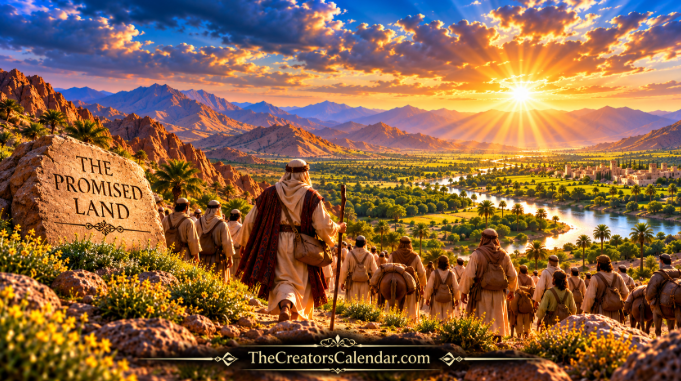
Long before Yasharal (Israel) became a nation enslaved in pagan Egypt, Yahuah had made an everlasting covenant with Abraham. He promised to multiply his descendants as the stars of heaven, establish Himself as their Alahim, and give them the land of Canaan, later known as Israel, as their inheritance. Yet the promise extended far beyond the possession of an earthly homeland. Through Abraham’s Seed, all nations of the earth would ultimately be blessed (Genesis 15:5; 17:7–8; 22:17–18).
At the heart of this covenant was a promise far greater than land or national prosperity. Yahuah was preparing a people through whom His divine instructions, covenant purposes, and Plan of Salvation would be revealed to the world. Yasharal’s journey from bondage to restoration was to become a prophetic pattern for future generations, especially the faithful covenant Bride living in the final days of earth’s history.
Just as ancient Yasharal emerged from generations of captivity surrounded by pagan worship, foreign customs, and corrupted systems of timekeeping, so the final generation must awaken from nearly 2,000 years of religious confusion, pagan influences, false calendars, and counterfeit forms of worship. The Covenant Bride must experience a complete restoration, leaving behind the traditions of spiritual captivity and returning to Yahuah’s original covenant, His divine instructions, His sacred lunar-appointed TIME, and the pure worship of her Creator. What Yahuah accomplished in preparing ancient Yasharal for the earthly Promised Land foreshadows the restoration He will accomplish in preparing His faithful Bride for the Eternal Promised Land.
The ultimate fulfillment of Abraham’s promised Seed would come through Yahusha haMashiach, through whom the blessing of redemption would extend to all who humbly confess their sins and seek restoration in Him (Galatians 3:16, 29).
The Wilderness: Restoring a Covenant People
Yet the descendants of Abraham who emerged from Egyptian bondage were far from prepared to fulfill their covenant calling. Generations under a pagan kingdom had exposed them to foreign gods, religious and dietary customs, and systems of timekeeping that stood in contrast to the divine order Yahuah intended to restore. Deliverance from Egypt was therefore only the beginning. Before they could enter their promised inheritance as a covenant nation, they needed to learn whose authority they would follow, whose instructions they would obey, and whose appointed TIME would govern their worship.
Yahuah had brought His people out of Egypt, but the influences of Egypt still had to be brought out of His people.
The wilderness became the place of that transformation. Far from being merely a difficult passage between bondage and inheritance, it became Yahuah’s divinely appointed classroom. There He would teach an entire nation to trust His provision, obey His commandments, recognize His sacred appointments, and walk in harmony with His covenant. Their preparation was not simply for life in a new land, but for a new relationship of faithfulness to the One who had delivered them.
Among the most remarkable instruments of this restoration was the daily miracle of manna. For six working days, Yahuah provided food from the heavens, with a double portion gathered on the sixth. Upon the seventh-day Sabbath, none fell. Through this repeated distinction between labor, preparation, and sacred rest, He taught His people to order their lives according to His appointed TIME rather than the customs of their former captivity.
Within the restored lunar calendar presented throughout this study, the full moon, as the original New Moon, announced the beginning of each month, followed by four complete weekly cycles whose Sabbaths fell on the 8th, 15th, 22nd, and 29th. The manna became a living demonstration of this sacred rhythm, reinforcing the relationship between the working days and the seventh-day Sabbath throughout the wilderness experience.
Yahuah was not merely feeding a nation. He was teaching a nation how to walk with Him.
The Sanctuary’s Second Witness
This instruction also prepared Yasharal for the Sanctuary’s appointed services, where sacred TIME would unite with prophetic EVENT to reveal the greater Plan of Salvation. The manna taught them when to work and when to rest; the Sanctuary would reveal the redemptive meaning and value of Yahuah’s sacred lunar appointed times. Together, these divine teaching instruments prepared His people to understand His covenant purposes that would ultimately find their fulfillment in Yahusha haMashiach.
For forty years, the manna continued its extraordinary testimony. But when Yasharal finally entered the Promised Land, its disappearance would reveal one final chronological witness, bringing the entire wilderness experience back to the sacred pattern established at its beginning.
Would the manna’s final morning confirm the same relationship between the lunar Sabbath and the first working day that had been established forty years earlier?
The Manna Begins and Ends on the 16th
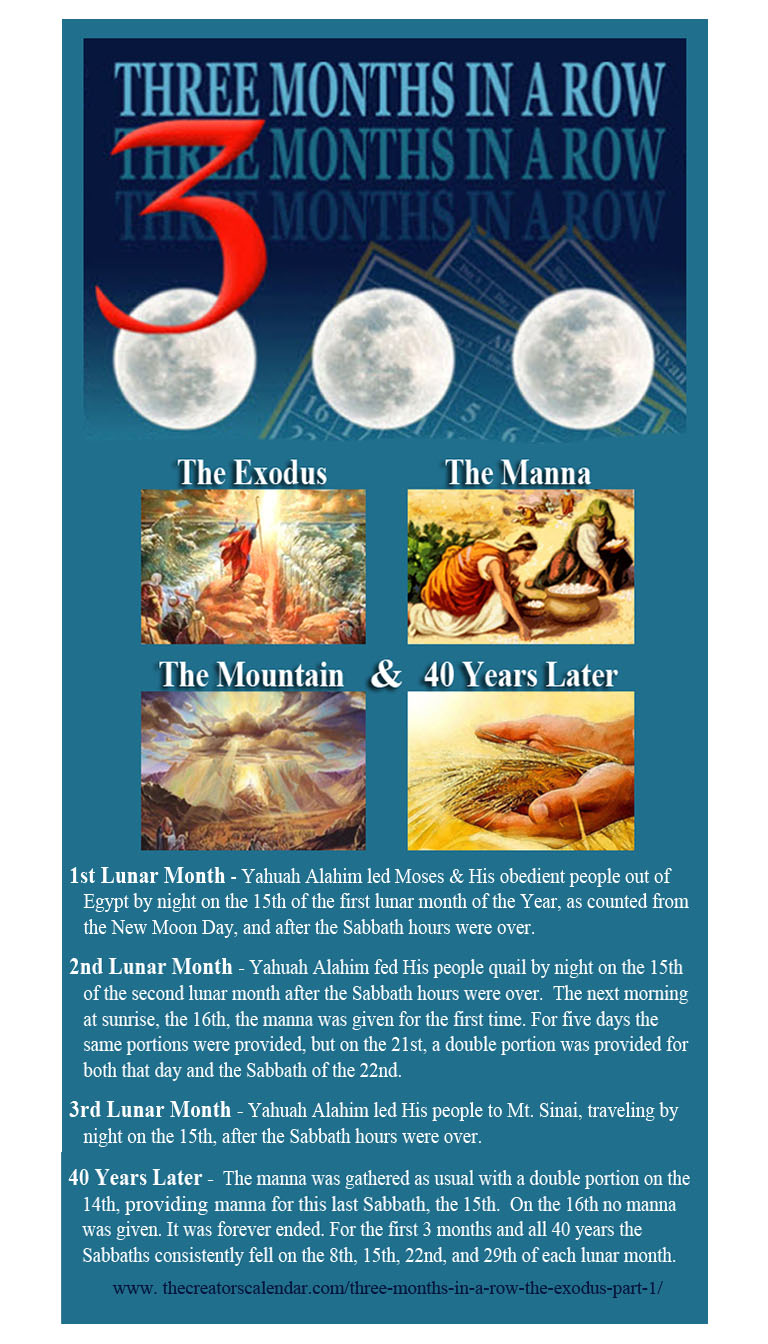
At the beginning of Yasharal’s wilderness experience, the manna first appeared on the morning of the 16th of the Second Lunar Month, as established in Part Two of this series. Within the calendar framework presented throughout this study, the 15th was the seventh-day Sabbath, and the 16th marked the first working day of the following week. Yet this testimony extended far beyond the three precise lunar months examined in this series. For forty years, spanning more than 480 lunar months, Yahuah’s sacred calendar maintained the same unbroken sequence. Each lunar month began with the full New Moon Day, followed by four complete weekly cycles, with seventh-day Sabbaths consistently falling on the 8th, 15th, 22nd, and 29th, without exception. Thus, the manna’s forty-year testimony is presented as evidence not merely of a pattern established during three months, but of the continuity of Yahuah’s appointed TIME throughout an entire generation.
At the conclusion of those forty years, Yasharal crossed the Jordan under the leadership of Yahusha (Joshua), whose name and mission foreshadowed Yahusha haMashiach, the One who would ultimately lead His END TIME faithful into the ETERNAL PROMISED LAND.
The parallel was remarkable. At the Exodus, Yahuah opened the Red Sea to deliver His people from bondage. Now He opened the Jordan River to bring them into their promised inheritance.
After entering Canaan, Yasharal encamped at Gilgal and observed Passover on the 14th of Abib. They ate the produce of the land following Passover, and Joshua 5:10–12 records the cessation of manna. Within the chronology presented throughout this study, these events followed the same weekly sequence established at the beginning of the wilderness journey:
- Abib 14: Sixth working day and preparation day.
- Abib 15: Seventh-day Sabbath and first day of Unleavened Bread.
- Abib 16: First working day of the following week.
The absence of manna on the 15th could not, by itself, signal the end of the miracle, for manna never fell upon the seventh-day Sabbath. The decisive morning was the 16th, when manna would ordinarily have returned.
But this time, it did not.
The chronological bookends of this forty-year testimony are extraordinary:
Second Lunar Month, 16th: The manna begins.
Forty years later, First Lunar Month, 16th: The manna ceases.

Within the lunar calendar interpretation developed throughout this series, both dates occupied the first working day following the Sabbath of the 15th. The miracle that began in the wilderness had fulfilled its purpose upon entering the Promised Land, while the sacred order of TIME it had demonstrated continued.
The manna ceased, but Yahuah’s appointed TIME remained.
Full Circle: One Creator, One Calendar, One Covenant
The ending of the manna testimony returns us to the very beginning of Yasharal’s restoration of sacred TIME.
Before the first Passover in Egypt, before manna fell in the wilderness, and before Yasharal stood at Mount Sinai, Yahuah first directed Moses and Aaron to recognize the full moon as His authentic and original New Moon, the beginning of His years and the lunar months. This was 180 degrees opposite of the dark lunar phase utilized by the Egyptians for beginning their lunar months.
Exodus 12:1–3 established the first month of the year and instructed Yasharal to select the Passover lamb on the 10th day. Before they could count to the 10th or the 14th, they first had to recognize the New Moon that established the beginning of the month.
At the Exodus, Yahuah restored His calendar. Through the manna, He taught the weekly rhythm of labor and rest. At Sinai, He called His people into covenant relationship, while the Sanctuary revealed the greater prophetic purpose of His appointed TIME.
Now, forty years later, the Passover at Gilgal and the cessation of manna completed this remarkable testimony.
Three months revealed the pattern. Forty years demonstrated its continuity.
Throughout this witness, the Creator’s Calendar remained anchored, within the interpretation presented here, to the full New Moon, which announced the beginning of each lunar month and established the count to New Moon Days, lunar seventh-day Sabbaths, and annual Feast Days.
This understanding challenges the long-held separation of lunar Feast Days from the continuous weekly Sabbath observed in traditional Judaism and Christianity.
Rabbinical Judaism determines its annual Feast Days through a calculated lunar calendar while observing Saturday as the seventh-day Sabbath upon an uninterrupted weekly cycle, independent of the New Moon. Its Rules of Postponement further regulate the placement of certain sacred dates. Likewise, most Christian traditions observe Saturday or Sunday upon a continuous seven-day cycle without using the New Moon to establish their weekly worship days.
In contrast, the restored calendar interpretation presented throughout this study maintains that Yahuah established one unified heavenly timekeeping system, in which the full New Moon governs the beginning of each month and the count to every weekly and annual sacred appointment.
The Manna Ceased, but the Sanctuary Witness Continued
The manna was not Yahuah’s only teaching instrument.
Throughout the wilderness journey, the Sanctuary provided another enduring and correlating witness to His appointed order. While the manna demonstrated the weekly rhythm of gathering and resting, the Sanctuary united sacred TIME with the prophetic EVENTS appointed for those days.
Its services included daily offerings, seventh-day Sabbath offerings, New Moon offerings, and annual Feast offerings. Each observance occupied its appointed place within the sacred calendar.
The distinction is foundational:
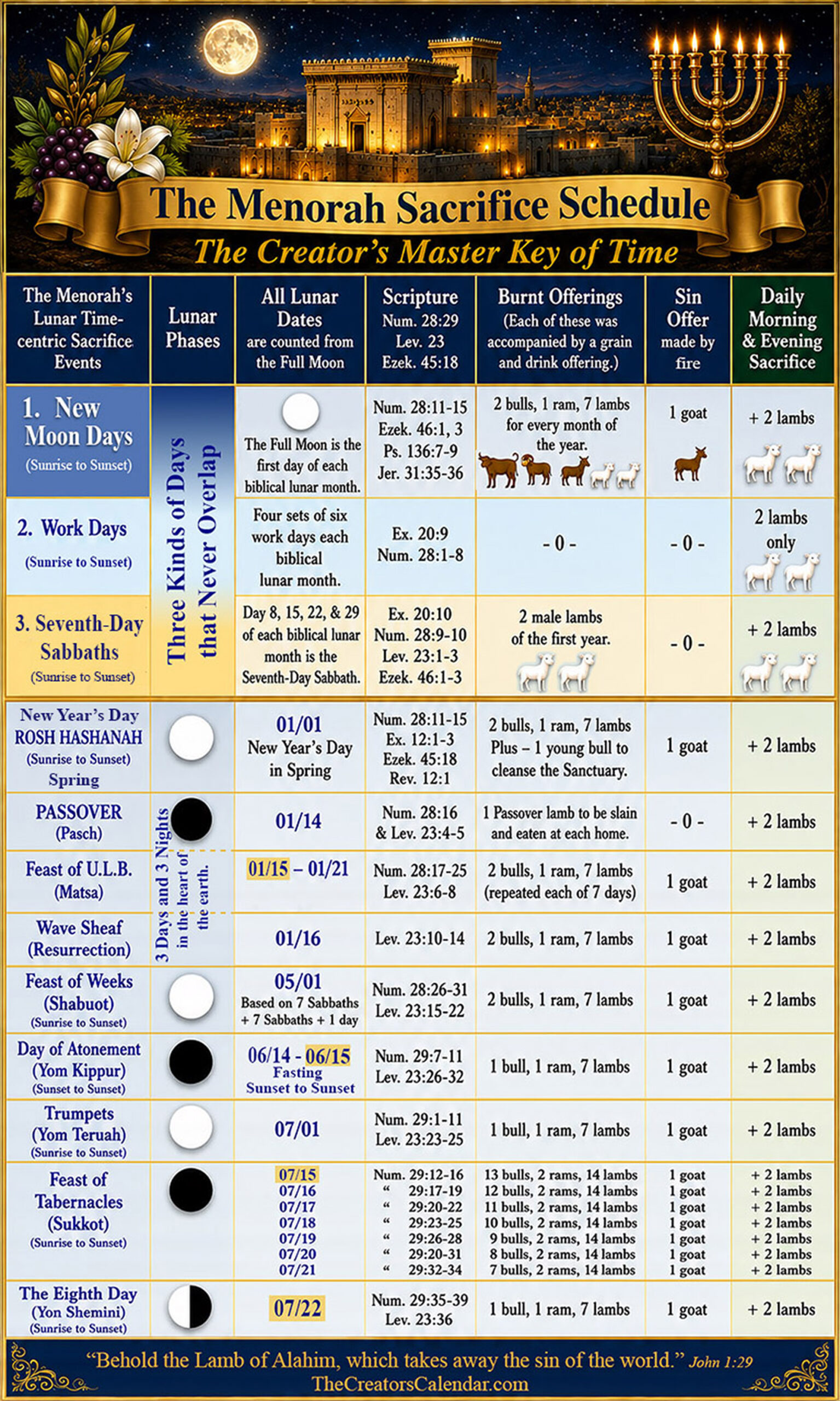
The Creator’s Calendar revealed by the manna and Sanctuary identified the appointed TIME. But the Sanctuary alone illustrated the prophetic EVENT in real time by way of the sacrificial system.
Together, they formed a divine teaching system pointing forward to Yahusha haMashiach and the fulfillment of Yahuah’s Plan of Salvation.
When the manna ceased on Abib 16, the Sanctuary continued to bear witness through its daily, weekly, monthly, and annual appointments.
The manna had completed its forty-year testimony, but the greater prophetic purpose of sacred TIME remained.
From Sacred TIME to Prophetic Fulfillment
At the heart of the Sanctuary’s prophetic system stood Passover.
The lamb sacrificed in Egypt foreshadowed Yahusha haMashiach, the promised Lamb who would deliver His people from the bondage of sin. What began as a memorial of deliverance became a prophetic witness to redemption.
“But when the fullness of the time was come, Alahim sent forth his Son, made of a woman, made under the TORAH LAW, to redeem them that were under the TORAH LAW, that we might receive the adoption of sons.” Galatians 4:4–5
The Sanctuary revealed Yahusha as LAMB, PRIEST, and KING. As the Lamb, He offered Himself for our redemption. As our High Priest, He ministers on behalf of His people. And as King, He will return to gather His faithful and establish His everlasting Kingdom.
The prophetic Feasts were therefore more than memorial ceremonies but rehearsals of these sacred future events. They illustrated the appointed TIME and EVENTS through which the identity, ministry, and redemptive work of the promised Messiah would be revealed.
This is why sacred TIME is inseparably connected with the Torah Law of Moses, the Bridal Covenant, and Yahuah’s eternal Plan of Salvation. He appointed the heavenly luminaries for signs and mo’edim, establishing the sacred times through which His covenant purposes would be revealed and fulfilled. The Torah is not separate from the Bridal Covenant; it reveals the divine instructions by which the Bride demonstrates her love, obedience, and faithfulness to her Bridegroom, Yahusha haMashiach. To reject these instructions is to disregard the covenant relationship He calls His people to honor, including their responsibility to respond faithfully to His gift of redemption. The Bride does not earn salvation through obedience, but her obedience bears witness to the transforming power of His grace. True Bridal faithfulness is revealed not merely in professing love for the Bridegroom, but in faithfully walking according to His appointed WAY.
- No Torah’s full New Moon, lunar Sabbaths and lunar appointed Feast Days,
- No Bridal Covenant,
- No Salvation.
The restoration of the Creator’s Calendar is not an end in itself. Its greater purpose is to bring the worshiper into harmony with Yahuah’s appointed TIME and into a deeper understanding of the Messiah whom the sacred lunar appointments reveal.
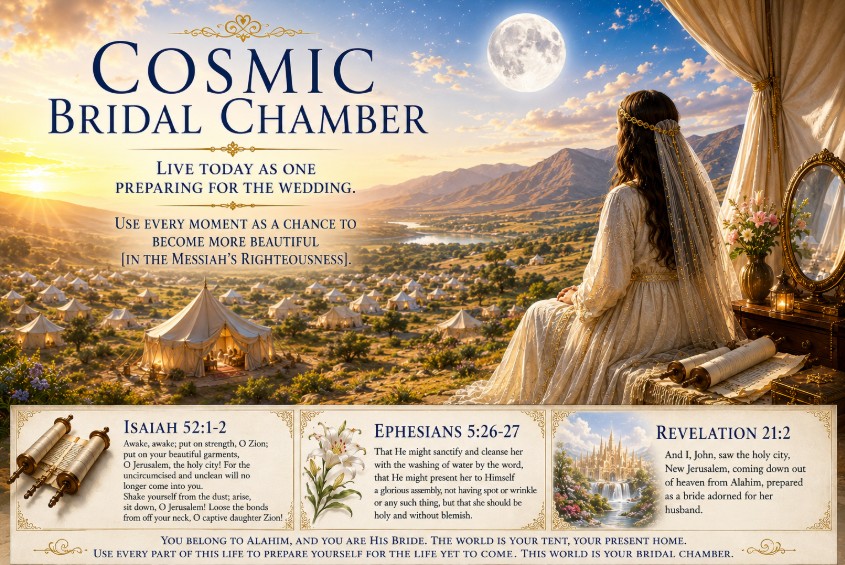
The ultimate purpose is not merely to know WHEN, but to recognize WHOM the appointed times reveal and prepare to meet Him.
Conclusion: Called Out of Bondage and into Eternity
The journey of Yasharal from Egypt to the Promised Land was far more than the deliverance of an enslaved nation. It was the fulfillment of Yahuah’s covenant promise to Abraham and a prophetic pattern of the greater restoration awaiting His faithful Covenant Bride. Just as ancient Yasharal had to leave behind the influences of pagan Egypt before entering their earthly inheritance, so the final Bride must awaken from centuries of spiritual captivity and return to the divine instructions, sacred appointed TIME, and covenant faithfulness established by her Creator.
The wilderness experience reveals that deliverance is only the beginning of restoration. Yahuah did not merely call His people out of bondage; He called them into a covenant relationship governed by His Torah, His appointed times, and His revealed WAY. The manna taught them obedience through the weekly rhythm of labor and Sabbath rest, while the Sanctuary revealed the prophetic EVENTS through which His eternal Plan of Salvation would unfold.
These were not isolated lessons intended for one generation. They formed a divine testimony extending from the Exodus to the final preparation of the Bride. The same Yahuah who called ancient Yasharal out of Egypt now calls His faithful people to separate from the religious confusion and counterfeit traditions of spiritual Babylon, returning to the pure worship of their Creator (Revelation 18:4).
At the Exodus, Yahuah declared:
“And it shall be for a sign unto thee upon thine hand, and for a memorial between thine eyes, that Yahuah’s law may be in thy mouth…” Exodus 13:9
His instructions were to govern the thoughts of the mind, the works of the hands, and the testimony of the mouth as His seal of the Bridal Covenant. Likewise, the seventh-day Sabbath was established as a sacred sign of the covenant relationship between Yahuah and His people (Exodus 31:13–14). True Bridal preparation therefore requires more than recognizing the correct calendar. It calls for repentance, obedience, and a heart fully surrendered to the Bridegroom.
Yahusha declared:
“My sheep hear My voice, and I know them, and they follow Me.” John 10:27
The Bride’s faithfulness is not the means by which she purchases redemption, but the living testimony of her love for the One who redeemed her. She is called to recognize His voice above the traditions of men, honor His covenant, and prepare for His appearing.
Even the manna carries this prophetic promise into eternity. In Revelation 2:17, Yahusha promises hidden manna to those who overcome. What sustained ancient Yasharal throughout their wilderness journey now points toward the eternal provision awaiting His faithful. And Isaiah 66:23 portrays New Moon and Sabbath worship in the restored creation, reminding us that Yahuah’s appointed worship is not merely a matter of ancient history, but remains steadfast for the past, present, and future.
The testimony of these four studies is therefore one continuous witness:
The First Month revealed the restoration of Yahuah’s calendar. The Second Month demonstrated His weekly order through the manna. The Third Month brought Yasharal to the Mountain and the covenant. Forty years later, the cessation of manna provided the final chronological witness to the sacred pattern presented throughout this series.
Three months revealed the pattern. Forty years demonstrated its continuity. Eternity will reveal its glorious fulfillment.
The promise to Abraham was never intended to end at the borders of earthly Canaan or Israel alone. Through Yahusha haMashiach, the promised Seed, the blessing of redemption reaches all who seek restoration to His Bridal Covenant: the small, the great, the rich, the poor, the free, the bond, male and female, and from every nation, who respond to His invitation and become heirs according to the promise (Galatians 3:29).
The same divine purpose that prepared ancient Yasharal for an earthly inheritance now calls the final Covenant Bride to prepare for the Eternal Promised Land. The journey that began with deliverance from Egypt will find its ultimate fulfillment when Yahusha gathers His faithful Bride into His everlasting Kingdom.
“And the Ruach and the bride say, Come. And let him that hears say, Come. And let him that is athirst come…” Revelation 22:17
May Yahuah awaken every sincere seeker, restore His appointed TIME in the hearts of His people, and prepare a faithful Bride who walks in His Torah, rejoices in His grace, and eagerly awaits the glorious appearing of Yahusha haMashiach.
The Bride is preparing for the Bridegroom.
HALLELUYAH!
“He who has an ear, let him hear what the Ruach (power, presence, and promise of YAHUAH) says to the
churchesecclesia (called out ones). To him who overcomes I will give some of the hidden manna to eat.” Revelation 2:17“‘From one New Moon to another, and from one Sabbath to another, all flesh shall come to worship before Me,’ says Yahuah.” Isaiah 66:23
“Surely My Sabbaths you shall keep, for it is a sign between Me and you throughout your generations, that you may know that I am Yahuah who sanctifies you.” Exodus 31:13-14
May Yahuah guide you as you seek the FATHER OF LIGHTS (James 1:17).