
Three Months in a Row – The Manna – Part 2
Three Months-in-a-Row
Part Two
The Manna
 Introduction
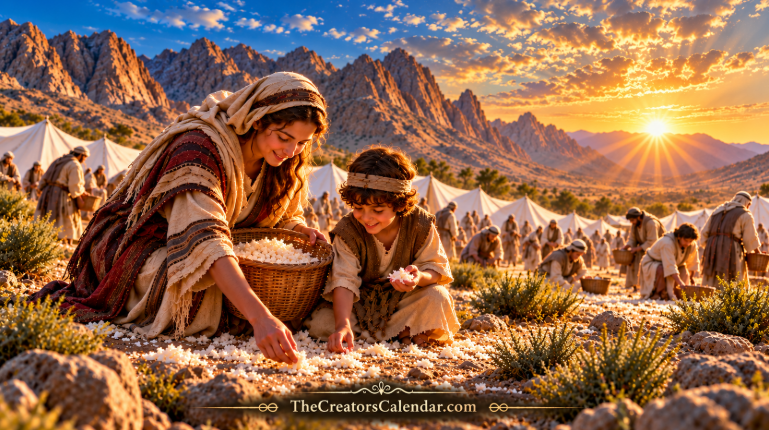
Within Three Months in a Row: The Manna, Part 2, our loving Eternal Father, Yahuah Alahim, continues the restoration of His original TIME-MEASURING calendar system. After generations of slavery under their pagan Egyptian masters, the Hebrew people had much to learn about their Creator and much to unlearn. Through the miraculous manna sent from heaven, Yahuah would teach them not only to depend upon His daily provision, but also to recognize and honor His sacred appointed times.
As established in The Exodus, Part 1, Yahuah restored to Moses and Israel the full New Moon as Rosh Hashanah, the beginning of the year in spring and the foundational marker of each lunar month. This was essential, for the correct beginning determines every appointed date that follows, including Passover on the 14th. Only one lunar month later, the manna would provide a second witness to that same divine calendar, revealing the relationship between New Moon Day, the six working days, and the sacred seventh-day Sabbath. Yahuah was not introducing a different system of TIME, but confirming the very order He had already restored.
Once again, TIME would become a test of faith and obedience. Just as Israel’s deliverance from Egypt depended upon observing Passover at its appointed TIME, their wilderness experience would teach them to gather, prepare, and rest according to Yahuah’s instructions. The manna would become a daily testimony that obedience involves not only WHAT Yahuah commands, but also WHEN He appoints it. How would you respond? Would you resist Yahuah’s appointed order of TIME because it differs from what you were taught, or would your heart’s greatest desire be to bring your soul temple into perfect harmony with His?
Exodus 16:1-36
Three Months in a Row – The Manna – Part 2And they journeyed from Elim, and all the congregation of the children of Israel came to the Wilderness of Sin, which is between Elim and Sinai, on the fifteenth day of the Second Month after they departed from the land of Egypt. 2 Then the whole congregation of the children of Israel complained against Moses and Aaron in the wilderness. 3 And the children of Israel said to them, “Oh, that we had died by the hand of Yahuah in the land of Egypt when we sat by the pots of meat and when we ate bread to the full! For you have brought us out into this wilderness to kill this whole assembly with hunger.”
4 Then Yahuah said to Moses, “Behold, I will rain bread from the shamayim (heavens) for you. And the people shall go out and gather a certain quota every day, that I may test them, whether they will walk in My law or not. 5 And it shall be on the sixth day that they shall prepare what they bring in, an
d it shall be twice as much as they gather daily.” 6 Then Moses and Aaron said to all the children of Israel, “At evening you shall know that Yahuah has brought you out of the land of Egypt. 7 And in the morning, you shall see the majesty of Yahuah, for He hears your complaints against Yahuah. But what are we that you complain against us?” 8 Also, Moses said, “This shall be seen when Yahuah gives you meat to eat in the evening [night of the 15th after the Sabbath daylight departed], and in the morning [the 16th] bread to the full; for Yahuah hears your complaints which you make against Him. And what are we? Your complaints are not against us but against Yahuah.”
9 Then Moses spoke to Aaron, ‘Say to all the congregation of the children of Israel, ‘Come near before Yahuah, for He has heard your complaints.’ 10 Now it came to pass, as Aaron spoke to the whole congregation of the children of Israel, that they looked toward the wilderness, and behold, the majesty of Yahuah appeared in the cloud. 11 And Yahuah spoke to Moses, saying, 12 “I have heard the complaints of the children of Israel. Speak to them, saying, ‘At twilight [sunset of the 15th], you shall eat meat, and in the morning [of the 16th], you shall be filled with bread. And you shall know that I am Yahuah, your Alahim.'”
13 So it was that quails came up at evening [sunset of the 15th] and covered the camp, and in the morning [the 16th], the dew lay all around the camp. 14 And when the layer of dew lifted, there, on the surface of the wilderness, was a small round
substance, as fine as frost on the ground. 15 So when the children of Israel saw it, they said to one another, “What is it?” For they did not know what it was. And Moses said to them, “This is the bread which Yahuah has given you to eat. 16 This is the thing which Yahuah has commanded: ‘Let every man gather it according to each one’s need, one omer for each person, according to the number of persons; let every man take for those who are in his tent.'” 17 And the children of Israel did so and gathered some more, some less. 18 So when they measured it by omers, he who gathered much had nothing over, and he who gathered little had no lack. Every man had gathered according to each one’s need. 19 And Moses said, “Let no one leave any of it till morning.” 20 Notwithstanding, they did not heed Moses. But some of them left part of it until morning, and it bred worms and stank. And Moses was angry with them. 21 So they gathered it every morning, every man according to his need. And when the sun became hot, it melted.
22 And so it was, on the sixth day [21st day of the lunar month], that they gathered twice as much bread, two omers for each one. And all the rulers of the congregation came and told Moses. 23 Then he said to them, “This is what Yahuah has said: ‘Tomorrow is a Sabbath rest, a sacred Sabbath to Yahuah. Bake what you will bake today, and boil what you will boil; and lay up for yourselves all that remains, to be kept until morning.'” 24 So they laid it up till the morning, as Moses commanded, and it did not stink, nor were there any worms in it. 25 Then Moses said, “Eat that today, for today is a Sabbath to Yahuah; today you will not find it in the field. 26 Six days you shall gather it, but on the seventh day, which is the Sabbath, there will be none.” 27 Now, it happened that some of the people went out on the seventh day to gather, but they found none. 28 And Yahuah said to Moses, “How long do you refuse to keep My commandments and My laws? 29 See! For Yahuah has given you the Sabbath; therefore, He gives you on the sixth day, bread for two days. Let every man remain in his place; let no man go out of his place on the seventh day.” 30 So the people rested on the seventh day. 31 And the house of Israel called its name Manna. And it was like white coriander seed, and the taste of it was like wafers made with honey.
32 Then Moses said, “This is the thing which Yahuah has commanded: ‘Fill an omer with it, to be kept for your generations, that they may see the bread with which I fed you in the wilderness when I brought you out of the land of Egypt.'” 33 And Moses said to Aaron, “Take a pot and put an omer of manna in it, and lay it up before Yahuah, to be kept for your generations.” 34 As Yahuah commanded Moses, so Aaron laid it up before the Testimony, to be kept. 35 And the children of Israel ate manna forty years until they came to an inhabited land; they ate manna until they came to the border of the land of Canaan. 36 Now, an omer is one-tenth of an ephah.
The Manna Was More Than Food
During the Second Month of the Exodus, Yahuah sent manna from heaven, providing the second detailed calendrical witness in a row. The First Month established the beginning of the lunar month and the dates surrounding Passover and the Exodus. Now, in the Second Month, the manna account provides additional chronological markers by which the relationship between the lunar month, the working days, and the seventh-day Sabbaths can be traced.
One detail in Exodus 16:1-2 is especially important. In the New King James Version, the punctuation makes it appear at first glance that Israel arrived at the Wilderness of Sin on the 15th day of the Second Month. Yet this creates a chronological difficulty within the sequence presented here, because the 15th is identified as a seventh-day Sabbath.
It is important to remember that punctuation was not part of the original Hebrew text but was supplied later by translators and editors. Consequently, punctuation can affect how the relationship between clauses is understood. A familiar example is Luke 23:43 in the account of Yahusha and the thief on the cross, where the placement of a comma affects the apparent meaning of the statement.
“And they took their journey from Elim, and all the congregation of the children of Israel came unto the wilderness of Sin, which is between Elim and Sinai, on the fifteenth day of the second month after their departing out of the land of Egypt. And the whole congregation of the children of Israel murmured against Moses and Aaron in the wilderness.” Exodus 16:1-2 KJV
Yahuah would never have required Yasharal to travel on His seventh-day Sabbath, for the placement of this sacred day lay at the heart of the calendrical lessons He was only now about to unfold to their understanding. This principle was recently illustrated in the First Month, when He led them out of Egypt by night on the 15th, only after the sacred Sabbath hours had passed. In like manner, their journey during the first portion of this Second Month would not have disrupted His Sabbath schedule of six workdays followed by the seventh-day Sabbath even though the lessons of the manna had not yet begun. The pattern remained intact: travel and labor occurred on the appointed workdays, while the Sabbath remained sacred and set apart for rest. How can we know?
It is my personal view that, considering the unusual length and construction of the complete sentence, a natural break in thought occurs following the word “Sinai.” A period at that point would clearly separate the statement describing Israel’s arrival in the Wilderness of Sin from the statement that follows concerning the murmuring that occurred on the fifteenth day of the Second Month. Read in this manner, the 15th identifies the day on which the congregation murmured against Moses and Aaron, rather than necessarily the day on which Israel arrived at the Wilderness of Sin.
The Septuagint provides an important alternative rendering of Exodus 16:1-2:
“And they departed from Elim, and all the congregation of the children of Israel came to the wilderness of Sin, which is between Elim and Sinai.** And on the fifteenth day, in the second month,** after their departure from the land of Egypt, all the congregation of the children of Israel murmured against Moses and Aaron.” Exodus 16:1-2, Septuagint
Notice what changes when the sentence is punctuated in this manner. The 15th day is connected with Yasharal’s complaint of hunger, rather than necessarily identifying the day upon which they arrived at the Wilderness of Sin. This distinction is important because the significance of the 15th in the Second Month is primarily calendrical and food-related, not geographical. It marks the Sabbath immediately preceding the beginning of the manna cycle, when Yahuah would begin providing bread from heaven, a provision that would continue throughout their forty years in the wilderness. Their precise location on the map is therefore secondary to the sacred TIME marker preserved specifically within the manna narrative.
The point is not to claim that the Septuagint is necessarily the most accurate version of Scripture. Rather, this rendering demonstrates how punctuation can alter the apparent chronology of the passage. Because the punctuation was supplied by translators rather than being part of the original Hebrew text, the grammatical relationship between Israel’s arrival and the date of the 15th deserves careful consideration.
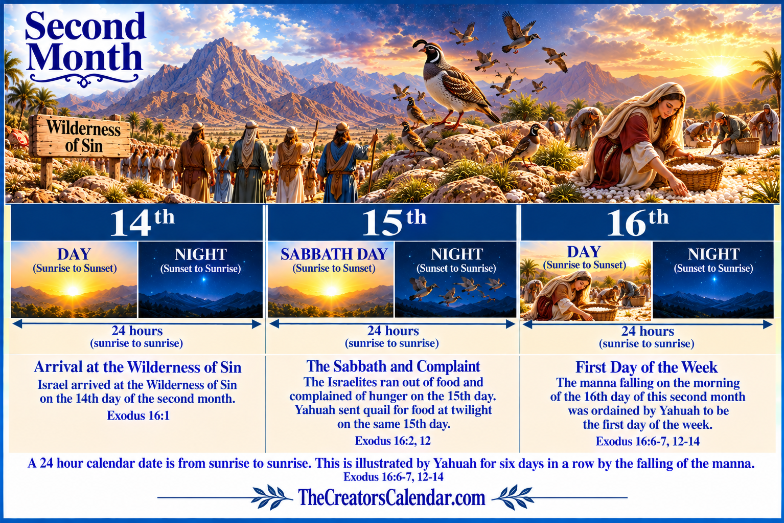
Within the chronology presented here, Israel had already arrived and was encamped before the daylight hours of the 15th day of the Second Month. On the 15th, the congregation murmured and complained of hunger. That day was the seventh-day Sabbath. Yahuah therefore waited until after sunset on the 15th, when the Sabbath daylight hours had ended, to send the quail to eat. Then, on the following morning, the 16th day of the lunar month, the first manna appeared.
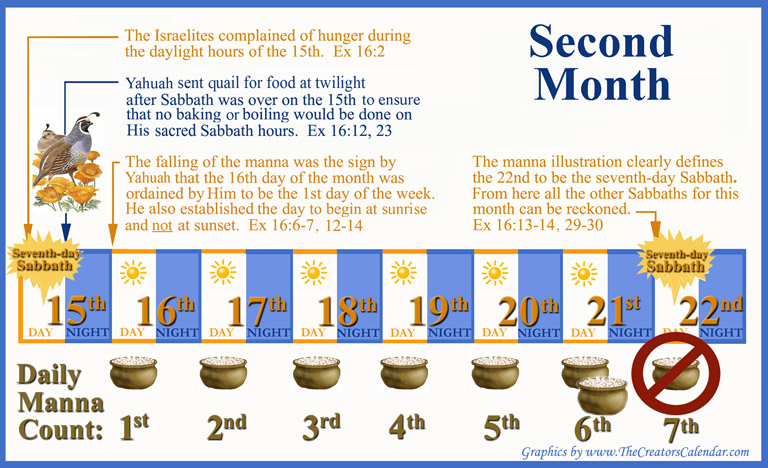
The date of the 15th, which is recorded in Scripture, along with the following morning of the 16th, which is not specifically dated in Scripture, together become the crucial chronological markers. Beginning with the morning of the 16th and following Yahuah’s six-day gathering schedule identifies the succeeding seventh-day Sabbath as the 22nd. Continuing the same pattern identifies the 29th as another seventh-day Sabbath. Counting backward according to that same weekly pattern identifies the 8th and the 15th of this second month as seventh-day Sabbaths as well.
Thus, the manna account provides an interconnected sequence:
- 15th — Was the Sabbath, and Israel ran out of food and complained.
- 15th — Night following the Sabbath hours, Yahuah provided quail.
- 16th — The next morning, manna was provided for this first workday.
- 21st — On the sixth workday, a double portion was provided for the Sabbath.
- 22nd — On the Seventh-day Sabbath, no manna was provided.
- 29th — The recurring pattern places the next Seventh-day Sabbath
The Second Month therefore does not stand alone. Its dates and events provide another witness to the calendrical pattern already established in the First Month, preparing us to examine the manna account step by step.
The Double Portion: A Miracle Within the Miracle
Among all the details surrounding the manna, the sixth-day double portion deserves special attention. Yahuah did not merely announce that the following day would be the Sabbath; He caused the manna itself to testify beforehand that a sacred day was approaching. On the sixth working day, the people discovered that they had gathered twice as much bread, two omers for each person. The rulers of the congregation recognized that something unusual had occurred and came to Moses concerning it. Exodus 16:22
Moses then explained the significance of the double portion:
“This is what Yahuah has said: ‘Tomorrow is a Sabbath rest, a sacred Sabbath to Yahuah. Bake what you will bake today, and boil what you will boil; and lay up for yourselves all that remains, to be kept until morning.’” Exodus 16:23
The importance of this instruction becomes even clearer when compared with what had happened on the preceding working days. Earlier, Moses had commanded the people not to leave any manna until morning. Some disregarded that instruction, and the manna they attempted to preserve bred worms and became offensive. Yet on the sixth day, Yahuah commanded them to do precisely what had previously resulted in spoilage: they were to keep the remaining manna overnight for the Sabbath. This time, “it did not stink, nor were there any worms in it.” Exodus 16:19-24
The difference was not the manna. The difference was Yahuah’s appointed TIME and His command concerning it.
Thus, the double portion contained a miracle within the miracle. Yahuah not only provided twice the ordinary amount before the Sabbath; He also preserved that portion in a manner contrary to what Israel had experienced during the ordinary working days.
The lunar Sabbath is therefore supported by three divine witnesses:
-
The sixth day testified through abundance and preparation.
-
The preserved portion testified through incorruption.
-
The seventh day testified through absence.
Together, these signs made the weekly pattern unmistakable. Yasharal did not have to depend upon human tradition to determine when the Sabbath arrived. Yahuah Himself identified the sequence through a recurring miracle witnessed and experienced by every household.
The double portion also revealed an important principle of obedience. Preserving manna overnight was wrong when Yahuah had forbidden it, yet the same action became right when He commanded it in preparation for His Sabbath. Faithfulness therefore required more than following a familiar rule; it required recognizing both His instruction and the appointed TIME to which it applied.
And then came the seventh day. No manna appeared. Anyone who went out searching discovered exactly what Yahuah had declared: “On the seventh day, which is the Sabbath, there will be none.” Exodus 16:26
Yet the empty wilderness revealed another beautiful truth. The absence of manna was not an absence of Yahuah’s provision, for He had already supplied everything necessary for His sacred Sabbath. What appeared to be an empty desert floor was actually evidence of a completed provision. Israel was learning to trust their loving Creator, not only when His blessings appeared before their eyes, but also when He called them to rest in what He had already provided.
Yahuah had marked His Sabbath from both sides. The double portion before it pointed forward to the sacred day, while the absence of manna upon it confirmed that the day had arrived. The miracle was not merely in the bread from heaven, but in the divine order of TIME governing its provision.
Twelve Calendrical Witnesses
1. Israel Murmured on the 15th Day of the Second Month
On the 15th day of the Second Month, Israel murmured and complained of hunger. As examined in the Septuagint discussion, the 15th identifies the day of their complaint rather than necessarily the day of their arrival in the Wilderness of Sin. Within the chronology presented here, Israel was already encamped before the Sabbath daylight hours began. Exodus 16:1-3
2. The Quail Came After Sunset, but the Manna Came the Following Morning
Yahuah declared, “At twilight you shall eat meat, and in the morning you shall be filled with bread” (Exodus 16:12). The quail came after sunset on the 15th, following the sacred Sabbath daylight hours, while the manna appeared the following morning on the 16th. This parallels the First Month, when Israel departed Egypt by night on the 15th, after the Sabbath daylight hours had ended. Exodus 16:6-13; Deuteronomy 16:1
3. The First Manna Identifies the 16th as the First Working Day
 The first manna appeared on the morning of the 16th, beginning six consecutive working days of gathering. This provides the chronological starting point for identifying the seventh-day Sabbaths throughout the Second Month. Exodus 16:4-5, 13-26
4. The Full New Moon Day Returns
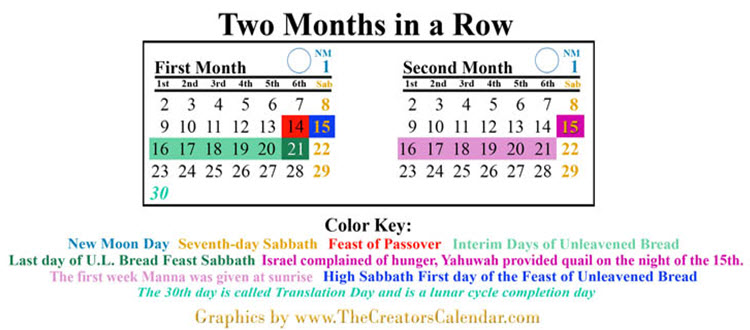
Counting backward from the Sabbaths of the 8th, 15th, 22nd, and 29th reveals a complete day at the beginning of the lunar month that stands apart from both the six working days and the seventh-day Sabbath. Within the restored calendar pattern, this is the full New Moon Day, occupying its distinct position at the head of the month, just as established in the First Month.
5. What About Manna on New Moon Day?
Scripture does not specifically describe the manna provision on New Moon Day. However, historical sources preserve references to New Moon observance and fasting. Jewish Family Celebrations, p. 35, states, “Each New Moon was celebrated with a fast.” Philo also mentions the sacred festival of the New Moon in connection with a day of fasting (Book 26, p. 159). While these references do not establish what occurred with the manna on New Moon Day, they invite further consideration of its distinct place within the monthly worship cycle.
6. Six Days of Gathering Identify the Sabbath as the 22nd
Beginning with the first manna on the 16th, Israel gathered its daily portion through the 20th. On the sixth working day, the 21st, Yahuah provided a double portion. No manna fell on the 22nd, identifying it as the seventh-day Sabbath. Continuing this weekly count identifies the 29th, while counting backward places the preceding Sabbaths on the 15th and 8th. Exodus 16:16-30
7. The Manna Appeared Each Morning, Not During the Night
The manna appeared in the morning after the dew lifted, marking the beginning of another working day. Within the sunrise-to-sunrise reckoning presented in this study, this recurring morning provision supports the pattern of daylight preceding the night that follows. Yahusha later declared, “Are there not twelve hours in the day?” John 11:9-10; Exodus 16:13-15, 21
8. Yesterday’s Manna Could Not Be Carried Into the Next Morning
Manna ordinarily spoiled when preserved until the following morning, but the sixth-day portion remained fresh for the Sabbath. This distinction reinforces the significance of the appointed morning and the special provision Yahuah established for His sacred day. Exodus 16:19-24
9. The Manna Was Yahuah’s Test of Obedience
Yahuah declared that the manna would test whether Israel would walk in His law (Exodus 16:4). Their obedience required gathering, preparing, preserving, and resting according to His instructions. The test concerned not only their willingness to obey, but their willingness to honor the TIME He appointed.
10. The Correct Sabbath Required the Correct Count From the New Moon
Within the calendrical framework presented in this study, the full New Moon establishes the beginning of each lunar month, from which the working days and Sabbaths are counted. The manna chronology identifies the recurring seventh-day Sabbaths as the 8th, 15th, 22nd, and 29th, confirming the same monthly pattern established during the Exodus.
11. The Same Test of Obedience Remains
The manna was more than a miraculous provision of food. It was a test of whether Yasharal (Israel) would honor Yahuah’s appointed TIME rather than follow its own understanding. That same principle remains relevant today. Within the calendar pattern presented in this study, recognizing the authentic seventh-day Sabbath requires first identifying the full New Moon and following the divine order established from it. The question remains: Will we arrange our worship according to Yahuah’s appointed times or according to the traditions we have inherited? Exodus 16:4-5, 27-30
12. The Same Creator, the Same Heavenly Calendar
For two months in a row, we have witnessed the same Yahuah Alahim who called all things into existence at Creation, appointing the sun, moon, and stars for signs, mo’edim, days, and years, restoring His sacred rhythm of worship to Moses and Israel. He did not establish a different sequence of TIME governed by different principles. Rather, He restored the original heavenly order, calling the hearts of mankind back into harmony with Himself. One Creator, one sacred cadence, one eternal heavenly design. It is within this divine rhythm of worship that our souls find their true rest. Genesis 1:14; Psalm 104:19
A Comparison of the First Two Months in a Row
Having examined the calendrical evidence of the Second Month, we can now compare it directly with the First. Although the events were entirely different, both months reveal the same divinely appointed order of TIME. The Exodus and the manna stand as two consecutive witnesses to Yahuah’s restored lunar calendar.
1. Both Months Follow the Same New Moon Day Beginning
In the First Month of Abib, Yahuah restored the full New Moon as the beginning of the year and the foundational marker from which the lunar dates were counted. The Second Month continued that same established order, rather than introducing a different system of TIME. Exodus 12:1-2; Exodus 16:1
2. The 15th Is a Seventh-Day Sabbath in Both Months
In the First Month, Israel remained in Egypt through the sacred Sabbath daylight hours of the 15th and departed by night. In the Second Month, Israel murmured on the 15th, followed by quail after sunset and manna the following morning. Within the chronology established in this study, both accounts identify the 15th as the seventh-day Sabbath. Numbers 33:3; Deuteronomy 16:1; Exodus 16:1-13
3. In Both Months, Significant Activity Followed the Sabbath Daylight Hours
The parallel is remarkable. During the First Month, Yahuah led Israel out of Egypt by night on the 15th. During the Second Month, He provided quail after sunset on the 15th. In both accounts, these events followed the sacred daylight hours of the Sabbath, preserving the same order of TIME.
4. The Second Month Confirms the Weekly Pattern
The manna schedule provides the additional evidence needed to trace the weekly count. Beginning with the first manna on the 16th, six working days culminated in the double portion on the 21st, followed by the Sabbath on the 22nd. Continuing this pattern identifies the 29th, while counting backward identifies the 8th and 15th.
Thus, the recurring Sabbath dates remain:
8th, 15th, 22nd, and 29th.
5. Two Months Testify to One Divine Calendar
The First Month revealed the calendar through Passover and the Exodus. The Second Month confirmed its recurring weekly rhythm through the manna. Different events, different miracles, and different circumstances, yet both testify to the same heavenly order.
First Month: Passover and the Exodus.

Second Month: Manna from the Shamayim.

Two months in a row now stand together as witnesses to one Creator, one calendar, and one sacred rhythm of worship.
A Lesson That Would Continue for Forty Years
The manna account of the Second Month records the beginning of a lesson that would extend far beyond these first few days in the Wilderness of Sin. Scripture tells us that the children of Yasharal continued to eat manna for forty years, until they came to the border of the land they were to inhabit. Exodus 16:35
For forty years, Yahuah provided the bread from heaven. What began in the Second Month became part of the continuing wilderness experience of Yasharal, teaching them that their lives depended upon His provision and His WORD.
But the manna carried another lesson as well. From its beginning, Yahuah connected its provision with a recurring pattern of labor, preparation, and Sabbath rest. The manna therefore did more than sustain Israel physically; it taught them to order their lives according to Yahuah’s appointed TIME.
This makes the manna particularly significant within the larger story of Three Months in a Row. The Second Month gives us the beginning of the manna testimony, but Scripture allows us to follow that testimony all the way to the borders of the Promised Land.
And when the manna finally ceased forty years later, the timing of that event would provide one final opportunity to examine the calendar pattern that began here. That evidence will be considered fully in Part 4: Forty Years Later.
For now, the important point is simple: the manna lesson did not end after one week or month. What began upon the wilderness desert sand became a forty-year testimony to Yahuah’s provision, His instruction, and His restored appointed TIME.
Second Month Conclusion
The manna account of the Second Month provides a remarkable second witness to Yahuah’s restored calendar. What began with the full New Moon and the Passover chronology of the First Month was now confirmed through a miraculous provision governed by the same divine order of TIME. The first manna appeared on the morning of the 16th, followed by six working days, the double portion on the 21st, and the sacred seventh-day Sabbath on the 22nd. Continuing this pattern identifies the 29th, while counting backward establishes the 8th and 15th as Sabbaths within the same lunar month.
The significance reaches beyond the dates themselves. Through the manna, Yahuah demonstrated that His appointed times were not merely instructions to be remembered, but a sacred rhythm to be lived. Every household became a witness to His provision, and every Sabbath testified that the Creator who established TIME at Creation remained faithful to the order He had ordained.
Two consecutive months now stand together in testimony. The First Month revealed the calendar through Passover and the Exodus. The Second Month confirmed its weekly rhythm through the manna. Different events and different miracles, yet the same heavenly design, with the full New Moon establishing the beginning of each month and the seventh-day Sabbaths recurring on the 8th, 15th, 22nd, and 29th.
Yahuah had now provided two consecutive monthly witnesses to His appointed order of TIME. Yet the testimony was not complete.
The First Month established it.
The Second Month confirmed it.
And the Third Month would provide yet another witness.
“He who has an ear, let him hear what the Ruach (Spirit) says to the ecclesia (churches). To him who overcomes I will give some of the hidden manna to eat . . .” Revelation 2:17
 Supporting Evidence for When the Day Begins

Sunrise or Sunset, When Does the Day Begin
A Day in Genesis – (Genesis 1:1-5)
Which Came First, the Chicken or the Egg?
Visible Stars Define the Parameters of Day and Night