Restoring the Creator’s Calendar – Exodus 12:1-3
Restoring the Creator’s Calendar
In Preparation for the Exodus
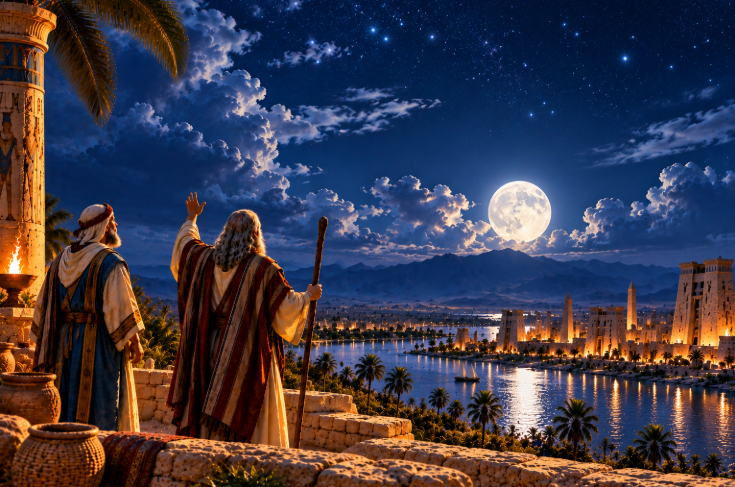 Exodus 12:1-3
Introduction
Exodus 12 records far more than the institution of Passover. Before Yahuah delivered Israel from Egypt, and before He instructed them concerning the lamb, the blood, or their departure, He first addressed TIME.
Speaking to Moses and Aaron while they were still in Egypt, Yahuah identified the beginning of the lunar months and established which month was to stand first in the revolution of the year. Only after establishing this foundation did He instruct Israel to count forward to the tenth and fourteenth days for the events surrounding Passover.
Why was the calendar addressed before the Exodus? Why did the correct reckoning of the month matter to a people preparing to leave Egypt? And what did Moses and Aaron see in the heavens that night that identified the beginning of Yahuah’s year?
This interlinear study of Shemot (Exodus) 12:1-3 examines those questions and the evidence that Yahuah was not introducing a new calendar, but restoring His original astro-luni-solar system of TIME to a people preparing to leave Egyptian bondage.
The implications extend far beyond ancient Israel. If Yahuah restored His calendar before the first Exodus, we must consider whether the restoration of His appointed TIME will again accompany His call to come out of the calendar traditions all these years later for the final Exodus and journey to the Promised Land.
Word Study Introduction
Before drawing conclusions about what Yahuah was establishing in Exodus 12:1-3, it is important to examine the words of the passage more closely. Much of the time-centered meaning contained in these verses can be easily overlooked when the original Hebrew terms are rendered simply as month, beginning, or year.
The following interlinear word study examines these key Hebrew terms using Strong’s Concordance and the Brown-Driver-Briggs Hebrew Lexicon. Our purpose is to allow the language of the passage to reveal the framework Yahuah was establishing for Moses, Aaron, and Israel as they prepared for the Exodus. What did Yahuah establish first, and what did He expect Israel to understand about the measurement of His months and years?

Revealing Yahuah’s Heavenly Time Model
Before Israel could leave Egypt, Yahuah Alahim began restoring His people to His ordained TIME. Exodus 12 reveals that the calendar was not a peripheral matter, for the timing of Passover and Israel’s deliverance depended upon correctly identifying the beginning of the month and counting forward to the appointed day.
Egypt was not merely the nation in which Israel had been enslaved. It also possessed its own religious practices and methods of reckoning time. After generations of bondage, Israel had lived under this Egyptian system and its surrounding culture. Therefore, before Yahuah called His people out of Egypt, He first re-established the standard by which they were to identify His appointed TIME.
Historical evidence provides an important clue concerning the lunar reckoning known in ancient Egypt:
“on the morning when the old crescent could no longer be seen just before sunrise.”
Richard A. Parker, “The Beginning of the Lunar Month in Ancient Egypt,” Journal of Near Eastern Studies, Vol. 29, No. 4 (1970), pp. 217-220.
This places the beginning of the Egyptian lunar month at the moon’s period of invisibility, immediately following the disappearance of the waning crescent. This historical evidence provides an important backdrop for understanding why Yahuah’s declaration concerning the beginning of the month in Exodus 12 was so significant.
The contrast between these two systems becomes especially significant when we examine which lunar phase marks the beginning of Egypt’s lunar month. The following illustration depicts a lunar-solar model in which the month begins with the dark conjunction, when the moon is aligned between the Earth and Sun and is not visible from the Earth.
Click on the image to view it larger.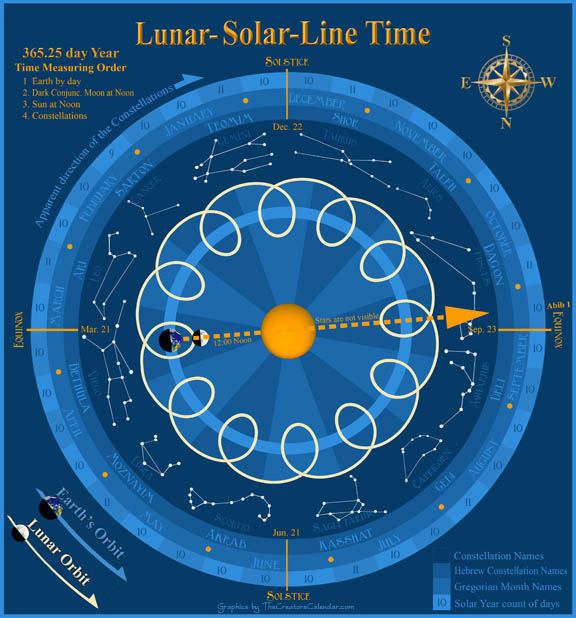
The image above illustrates a lunar-solar method of time reckoning in which the dark lunar phase is aligned between the Earth and Sun. At conjunction, the moon is invisible from Earth because its illuminated side faces away from us and because it is in proximity to the Sun. The Sun and the starry constellation beyond it are likewise not viewed together, either by day or by night.
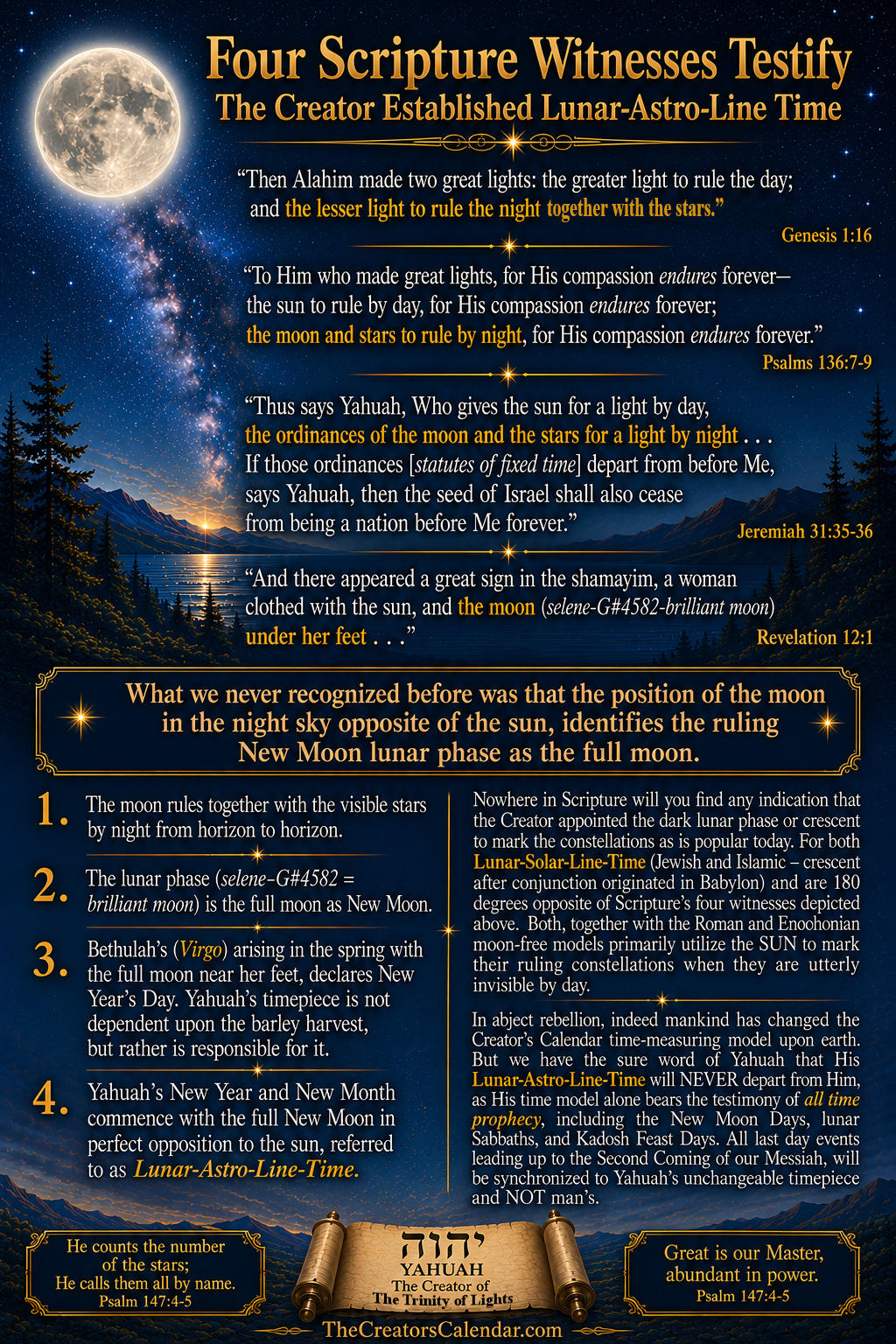
This creates an important contrast with the time model presented in this study. Genesis 1:16 establishes that the greater light, the Sun, was designed to rule the day alone from east to west, while the lesser light, the moon, was designed to rule the night together with the stars from east to west. The stars are also appointed as part of the celestial order, even though this relationship is not always clearly expressed in translation. Therefore, rather than looking toward a dark invisible moon in conjunction with the Sun, we are looking for a brilliant lunar witness that can rule together with the stars by night, from sunset to sunrise.
The difference between these two models is approximately 180 degrees. During the daylight, one looks toward the Sun and an invisible dark moon; but it is during the night that one looks in the opposite direction toward the brilliant full moon and the visible stars of the eastern night sky. On the night of the full moon, these visible witnesses rise in the east and move together across the night sky toward the west.
The following illustration clarifies that the stars were designed to rule together with the moon by night, even though this relationship has been obscured in the translation of Genesis 1:14. The additional Scripture witnesses below further verify this celestial relationship presented throughout this study.
Verse by Verse
“And declared Yahuah (H#3068 – יהוה – YHUH) unto Moses and unto Aaron, while in the land of Egypt, commanding that:” Shemot (Exodus) 12:1
Right from the start, Verse 1 of Exodus 12 begins with Yahuah declaring to both Moses and Aaron just 15 days before the Exodus that His shamayim (heavenly) time system was of pivotal importance. He was now about to detail how it worked and what great sign to look for in the NIGHT SKY for the start of His ordained YEAR. This TIME MODEL, as it related to the PASSOVER (Pasch) event, was His first test of obedience for keeping Passover at the correct time and a paramount step in Israel’s recovery and ultimate restoration to the Promised Land. Thus, a descriptive revelation of the Creator’s Calendar was given to prepare an obedient Israel for success so that they may be saved during this last and most horrific plague of Egypt, the death of all firstborn males.
Here is an example of YHUH’s authentic lunar-astro time-measuring, which is always viewed after sunset in the spring, when the full moon rises in the east and rules together with the stars by night, both remaining visible as they travel from horizon to horizon. (Click on the image to enlarge it.)
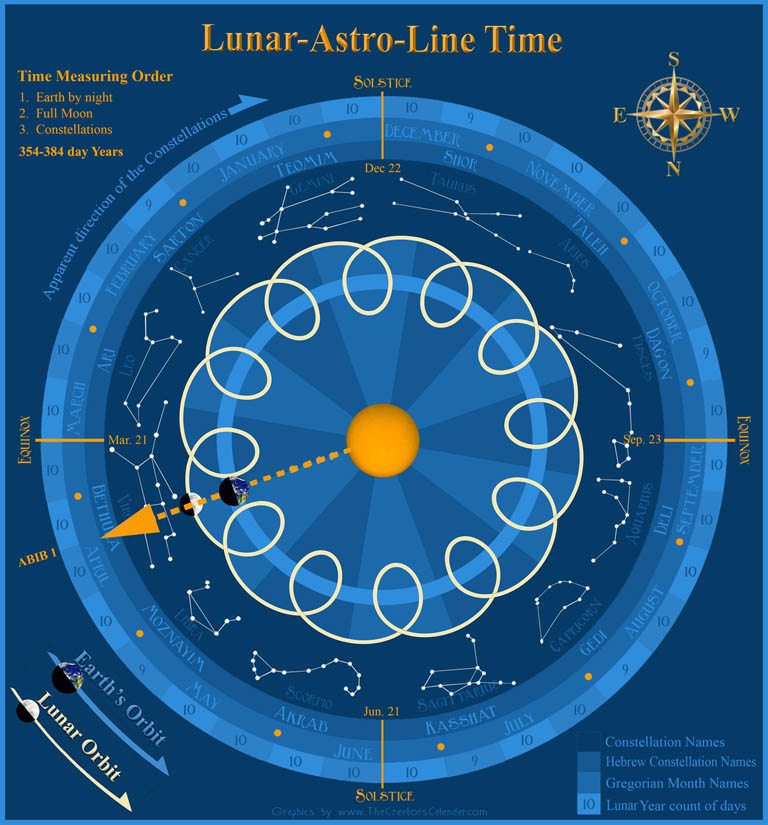
The pre-Passover plague of death involving the firstborn males was therefore tied directly to Yahuah’s ordained time-measuring mechanism, not to the calendar system of Egypt. Israel had to know when the month began in order to correctly identify the 14th day appointed for Passover. This required trust and obedience as they adjusted their reckoning of TIME from Egypt’s dark lunar starting point to the brilliant full moon presented in this study as Yahuah’s true New Moon.
The calendar question was therefore not merely theoretical. Getting the TIME right was essential to getting the EVENT right. If Israel began the month from the wrong lunar phase, they would arrive at the wrong 14th day, fail to observe Passover at its appointed time, and lose their firstborn right along with the Egyptians.
The calendar question was therefore not merely theoretical. Getting the TIME right was essential to getting the EVENT right. If Israel began the month from the wrong lunar phase, they would arrive at the wrong 14th day, fail to observe Passover at its appointed time, and lose their firstborn right along with the Egyptians.
Clues for Restoring the Creator’s Calendar
Having established in Verse 1 that Yahuah spoke directly to Moses and Aaron while they were still in Egypt, we now come to Verse 2, where He begins revealing the TIME framework they were to follow. His first instruction concerns the beginning of the lunar months and the month that was to stand first in the revolution of the year:
“The New Moon, this self-same one, is HEAD (ROSH) of the lunar months, which is FIRST in PLACE as the New Moon for measuring the revolution of a year (HASHANAH).” Shemot (Exodus) 12:2
Referring back to our word study, Verse 2 provides the pivotal instructions for identifying the beginning of Yahuah’s lunar months and the first month of His year. The expression “this self-same one” points Moses and Aaron to the lunar marker being identified as the HEAD (ROSH) of the months.
Having already contrasted this with Egypt’s dark lunar starting point, we are now left with two visible lunar phases to consider for the beginning of the month: the first visible crescent and the brilliant full moon. Which one fits the celestial TIME model being restored to Moses and Aaron? Four important clues help us answer that question.
1. The first clue: “This self-same one.”
The expression “this self-same one” points to the lunar marker Moses and Aaron were being instructed to recognize. Within the framework presented in this study, the invisible dark lunar phase has already been ruled out, leaving two visible possibilities for consideration: the first visible crescent and the full moon. Which of these visible lunar phases fulfills the remaining clues?
2. The second clue: Midnight on Passover.
Shemot (Exodus) 12:29 identifies midnight as the time when Yahuah passed through Egypt and struck the firstborn. This raises an important question concerning the lunar phase on that Passover night. Would the 14th day correspond with the brilliant full moon at its brightest, or with the dark portion of the lunar cycle, when the moon is no longer ruling the night sky?
Within the chronology presented here, the Passover occurred approximately fourteen days after the New Moon. If the 14th brought Israel to the dark lunar phase, then counting backward through the lunar cycle brings us to the full moon at the beginning of the month.
The importance of correctly identifying that beginning cannot be overstated. Israel had to count from Yahuah’s appointed lunar marker to the 10th day to select the lamb and then to the 14th day to sacrifice it. Getting the beginning of the month wrong meant getting Passover wrong. Their obedience to Yahuah’s TIME instructions was inseparably connected with their obedience to the Passover EVENT.
3. The third clue: ROSH, meaning “HEAD.”
The Hebrew word ROSH (H#7218) literally means head or chief. Might the use of HEAD contain another celestial clue?
In the shamayim model presented in this study, the full moon rises in the east together with the constellation Bethulah (Virgo) in the spring. Her head arises first on the eastern horizon as she begins her journey across the night sky. The brilliant full moon can remain visible through the night as the stars travel from east to west, something the early crescent cannot do.
The crescent is observed low in the western sky for a comparatively short period before setting. Therefore, it cannot travel from the eastern horizon to the western horizon together with Bethulah throughout the night. The full moon, however, provides the brilliant lunar witness capable of ruling together with the stars from east to west.
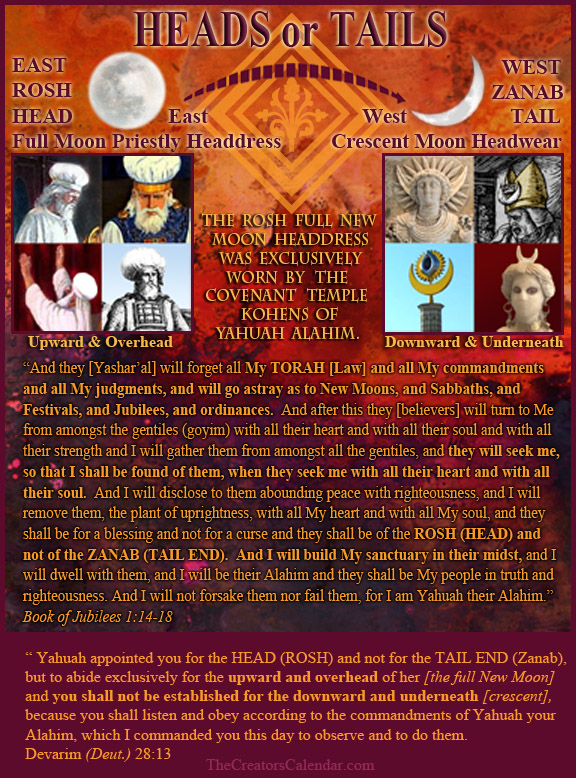
This celestial relationship also provides the foundation for the imagery presented in Hazon (Revelation) 12:1-2, where the woman, Sun, moon, and stars appear together as heavenly signs.
4. The fourth clue: The Messiah’s Passover and the darkened Sun.
The fourth clue comes approximately 1,500 years after the Exodus, yet again on Passover, the 14th day of the first lunar month. Yahusha, Yahuah’s firstborn Son, laid down His life as the promised Passover Lamb for the sins of mankind.
Luke records that during the crucifixion the Sun was darkened from the sixth to the ninth hour. This extraordinary daytime darkness presents another important celestial question. If the darkening of the Sun is understood within the astronomical TIME model being examined in this study, what lunar phase would necessarily be positioned between the Earth and Sun?
That position belongs to the dark conjunction phase, the only lunar alignment capable of producing a solar eclipse. Within the chronology presented here, this places the dark lunar phase around the middle of the month, at Passover. Counting backward approximately fourteen days through the lunar cycle again brings us to the opposite lunar phase, the full moon, at the beginning of the month.
Thus, the Exodus Passover and the Messiah’s Passover become two powerful TIME witnesses separated by approximately 1,500 years. Both are presented in this study as pointing to the same lunar order: the brilliant full moon at the beginning of the month and the dark conjunction phase approximately halfway through the lunar cycle.
For a fuller examination of the crucifixion darkness and its astronomical implications, see “From the Sixth to the Ninth Hour.”
As a result of these four clues, together with the additional Scriptural evidence that follows, we find a consistent pattern pointing to the full moon as the authentic and original New Moon, the beginning of the lunar month established at Creation. Egypt’s lunar reckoning was therefore approximately 180 degrees opposite the TIME model presented here. The contrast could hardly be greater: darkness and LIGHT, the invisible and the visible, Egypt’s reckoning and the Creator’s appointed TIME.
Three Additional Witnesses
Beyond these four clues, Scripture provides three remarkable witnesses spanning from Abraham to the final scenes portrayed in Revelation. Viewed in their historical order, each contributes another piece of evidence supporting the full moon as the original New Moon:
1. The Abrahamic Covenant, 430 Years Before the Exodus
The first witness takes us back 430 years before Israel departed Egypt, to the night Yahuah established His covenant with Abraham. Genesis 15 describes a night of unusual darkness, while Exodus declares that Israel came out of Egypt “at the end of the four hundred and thirty years, even the selfsame day.” Within the lunar chronology presented in this study, the darkness of Abraham’s covenant night provides an earlier witness to the lunar phase associated with this same appointed date. If the 14th occurred during the dark portion of the lunar cycle, then the full moon stood approximately fourteen days earlier at the beginning of the month.
For a fuller examination of this witness, see “The Night Was Dark.”
2. The Messiah’s Passover, Approximately 1,500 Years After the Exodus
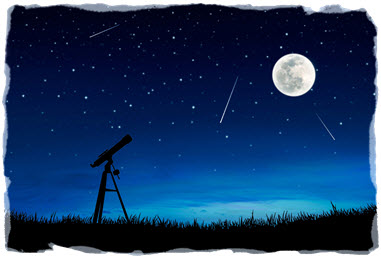
The second witness carries us forward approximately 1,500 years to Yahusha’s fulfillment of the Passover on Abib 14. As examined in the fourth clue above, the extraordinary darkening of the Sun recorded by the Gospel writers provides another witness, within the astronomical interpretation presented in this study, to the dark conjunction phase occurring near the middle of the lunar cycle.
For the detailed evidence surrounding this event, see “The Sun Was Darkened from the Sixth to the Ninth Hour.”
3. The Great Sign of Revelation 12
The third witness carries us forward to the prophetic imagery of Hazon (Revelation) 12:1, where a great sign appears in the shamayim: a woman clothed with the Sun, the moon associated with her feet, and a crown of twelve stars upon her head.
Within the celestial model presented in this study, the woman represents the constellation Bethulah (Virgo), while the brilliant full moon provides the lunar witness associated with her in the spring night sky. This relationship again points to the full moon working together with the stars and marking the beginning of the astro-luni-solar year.
For a fuller examination of this celestial sign, see A Great Sign Appeared in the Shamayim.
Together, these three witnesses form a remarkable progression through sacred history: the covenant with Abraham, the Passover fulfillment of Yahusha, and the prophetic sign of Revelation. Each surrounds the Exodus witness from a different point in the Scriptural record, while pointing back to the same central question: Which lunar phase truly marks the beginning of Yahuah’s month?
• Worship at the East Gate.
• New Moon by New Moon.
• New Moon Changed by Formal Decree.
• He Ordained the Full Moon for Appointed Times
• The Full Moon is the First Lunar Phase.
• The True New Moon Rules from Sea to Sea.
• Twelve Gates are Twelve Full New Moons.
• Amos Prophesied a Solar Eclipse.
The Lunar Phase that is First in Order
Having identified the lunar phase that marks the HEAD (ROSH) of the months, we now return to another important expression in Verse 2. Yahuah declares that this same New Moon is also “FIRST in PLACE” for measuring the revolution of the year:
“The New Moon, this self-same one, is HEAD (ROSH) of the lunar months, which is FIRST in PLACE as the New Moon for measuring the revolution of a year (HASHANAH).” Shemot (Exodus) 12:2
Referring back to our word study, Verse 2 establishes both order and position. This New Moon is not merely the beginning of another lunar month. It marks the first lunar month of the year, from which the remaining months are reckoned in their proper sequence.
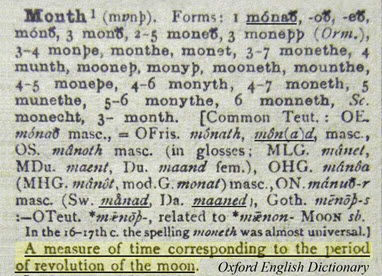
This distinction becomes especially important in an astro-luni-solar calendar, where a year may contain twelve or thirteen lunar months. Within the TIME model presented in this study, the first full moon of the year is identified in relation to the constellation Bethulah (Virgo) in the spring. This provides a consistent celestial starting point from which the succeeding lunar months can be measured. Without a fixed starting point, the calendar becomes like a rubber ruler, capable of stretching or contracting according to whatever standard is applied.
Scripture also speaks of the “turn of the year” (tekufah, H#8622). Second Chronicles 24:23 uses the expression in connection with the springtime, while Shemot (Exodus) 34:22 uses it in connection with the autumn harvest season. Together they demonstrate recurring turning points within the annual cycle.
Yet Exodus 12:1-2 establishes which of these seasonal turning points stands first in Yahuah’s yearly order. The month of the Exodus was to be “the first month of the year.” Therefore, within the calendar framework presented here, Rosh Hashanah, the head or beginning of the year, belongs in the spring rather than the fall.
This is visibly manifested because, from the perspective of Earth at night in the spring, the rising full moon highlights the constellation Bethulah as it rises on the eastern horizon at sunset, as shown above. While the full moon returns each lunar month, the stars complete their visible annual circuit and return to the same seasonal position only once each year. From Hazon (Revelation) 12:1, we discover that Bethulah (Virgo) is the constellation that works together with the full moon by night, marking the first lunar month of the astro-luni-solar year.
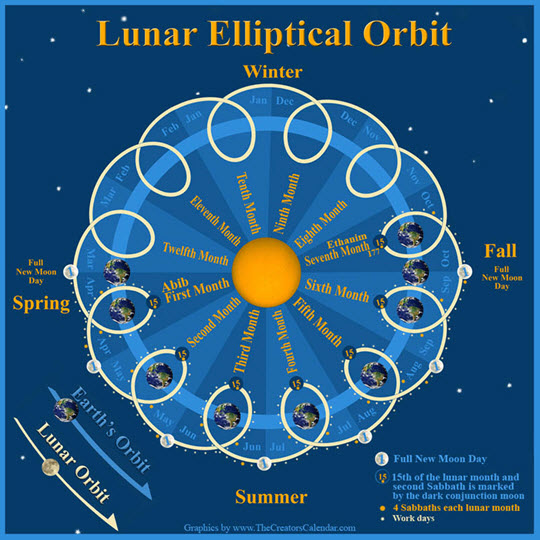 Note: This illustration depicts the astro-luni-solar calendar within a heliocentric model. Whether the universe is ultimately understood from a heliocentric or geocentric perspective does not alter the observable relationship of the Sun, Moon, and Stars from Earth for the measurement of TIME.
The Shadows of the Earthly Temple
The TIME principles Yahuah restored to Moses and Aaron in Egypt were established before the instructions for the earthly Sanctuary were given. This chronological order is significant. Yahuah first restored the framework of His months and appointed times, and only later instructed Moses to build the Sanctuary according to the shamayim (heavenly) pattern.
This demonstrates an important distinction: the Creator’s calendar did not originate with the earthly Sanctuary. Rather, the earthly Sanctuary operated according to the Creator’s already established celestial TIME.
Approximately three months after the calendar instructions of Exodus 12, Israel arrived at Sinai. It was only afterward that Yahuah instructed Moses:
“And let them make me a sanctuary; that I may dwell among them.” Shemot (Exodus) 25:8
The Sanctuary services that followed were therefore placed within a TIME framework already established by Yahuah. Its daily offerings, seventh-day Sabbaths, New Moons, and annual Feast Days were appointed according to that greater celestial order.
This becomes especially important when we consider the Messiah. Approximately 1,500 years after the Exodus, Yahusha fulfilled the Passover type by laying down His life on Abib 14 as the promised Lamb. The earthly types and shadows pointed forward to Him, but the celestial TIME system upon which those shadows had operated did not thereby cease.
The earthly Sanctuary could come to an end without bringing Yahuah’s TIME to an end, because the Sanctuary depended upon the Creator’s celestial timepiece, not the other way around.
Yahusha’s ministry as Lamb, Kohen (Priest), and King therefore continues within the greater shamayim reality to which the earthly Sanctuary pointed. What began with the Creator’s TIME at Creation, was restored to Israel before the Exodus, and later governed the Sanctuary services remains part of the same unbroken celestial order.
This helps us understand why Yahuah addressed TIME before Israel ever reached Sinai. He was not introducing a calendar that depended upon the Levitical system. He was restoring Israel to a TIME system that preceded it.
Yahuah brought Israel out of Egypt so they might walk again according to His Torah and preserve His sacred oracles of truth. In time they would receive detailed instructions concerning His New Moons, seventh-day Sabbaths, and annual Feast Days. Yet the foundation had already been laid in Egypt.
From Creation forward, Yahuah’s appointed times were designed to bring His people into harmony with His heavenly order. Isaiah carries that principle forward into the restored creation:
“From one new moon to another, and from one Sabbath to another…” Isaiah 66:23
The earthly Sanctuary was the shadow. The heavenly (shamayim) pattern was the reality. And the Creator’s appointed TIME provided the framework in which His redemptive plan would unfold.
How to Count from the New Moon
Having established the HEAD of the lunar month in Verse 2, Yahuah now gives Israel a practical demonstration of how His calendar is to be counted. Verse 3 begins the count from that established New Moon, directing Israel forward to the tenth day in preparation for Passover.
You shall keep and teach this to all the congregation of Israel saying, “in the tenth of the lunar month, do the following: And you shall reserve and keep every man a lamb for each household of the father, a lamb for each house.” Shemot (Exodus) 12:3
Verse 3 demonstrates how Israel was to count from that beginning. On the tenth lunar calendar date, counting from and including the New Moon Day of the New Year, each household was instructed to select and reserve a lamb for the approaching Passover.
This is significant because the command requires a clearly identifiable starting point. Israel could not arrive at the correct 10th or 14th day unless they first knew which celestial marker constituted the beginning of the month. The appointed EVENT depended upon correctly identifying the appointed TIME.
The full New Moon Day is presented in this study as the first day of each Scriptural month. The month and its New Moon cannot be separated, because the beginning of the month is intrinsically connected with the moon and its recurring cycle of lunar phases. Just as a rope must have a beginning from which its length can be measured, the lunar month must have an identifiable beginning from which its calendar dates can be counted.
Verse 3 therefore moves the discussion from identifying the New Moon to actually using it as the starting point of the calendar count. Beginning with the New Moon, Israel counted forward to the 10th day to select the lamb and then to the 14th day for Passover.
This raises another important question. If the year is divided into lunar months, might the lunar month itself also contain visible divisions established by the moon? The recurring lunar phases provide natural markers throughout its 29- or 30-day cycle. Within the calendar model presented in this study, these divisions also provide the framework from which the lunar weeks and seventh-day Sabbaths are reckoned.
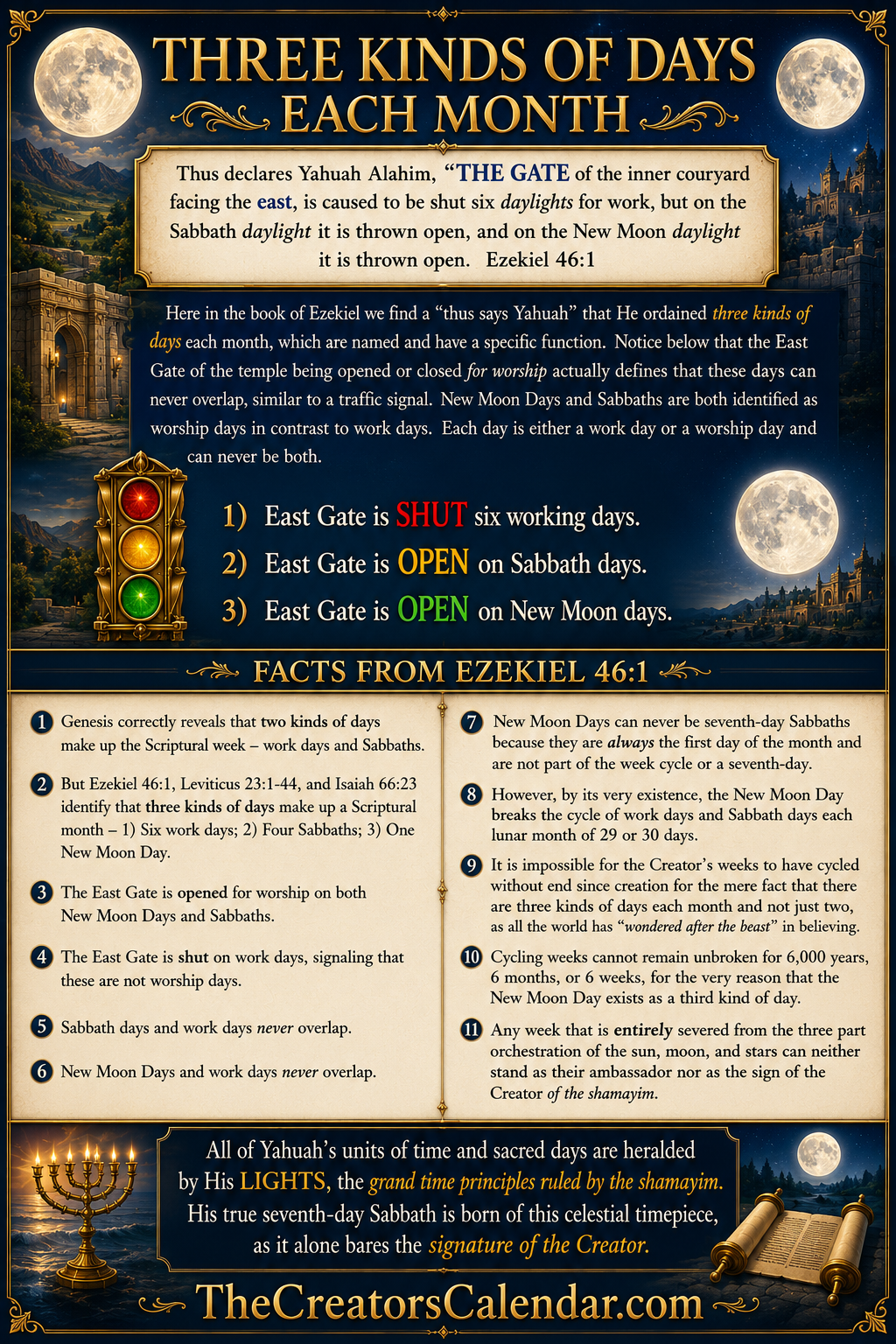
As illustrated above, the lunar month contains three distinct kinds of days: New Moon Day, six working days, and the seventh-day Sabbath. New Moon Day establishes the beginning of the monthly count, while the six working days and seventh-day Sabbath form the recurring weekly pattern that follows. Within this restored calendar model, these three kinds of days work together within one lunar month rather than belonging to separate systems of time.
Why would the Creator establish the Sun, moon, and stars as His great celestial timepiece, and then establish the week and Sabbath upon an entirely unrelated system? Rather, the week itself belongs within the same shamayim order. The months, weeks, Sabbaths, and annual appointed times form parts of one unified celestial TIME system.
Among the lunar phases, only one represents visible wholeness and completeness: the full moon. Before something can be divided into smaller portions, there must first be a whole from which those portions are measured. A simple illustration is a whole round loaf or pizza divided into individual portions. The whole exists first, and the divisions proceed from it. Within the TIME model presented here, the full moon provides that complete lunar starting point.
Scripture also uses the imagery of increasing LIGHT:
“But the path of the just is as the shining LIGHT, that shines more and more unto the perfect day. The way of the wicked is as darkness: they know not at what they stumble.” Mashali (Proverbs) 4:18
The imagery is striking. LIGHT increases until it reaches fullness, while darkness stands in contrast. Within the celestial framework of this study, this provides another illustration of the full moon as the lunar phase of completeness.
Exodus 12:2-3 therefore gives us both the beginning and the count. Verse 2 identifies the HEAD of the lunar months, while Verse 3 demonstrates that Israel was expected to count forward from that established beginning to the appointed dates of Passover.
First identify Yahuah’s New Moon. Then count. The TIME establishes the date, and the date identifies the EVENT.
Who are the Remnant?
Having traced Yahuah’s appointed TIME from Creation, through the Exodus, and into the ministry of Yahusha, an important personal question remains: Who are the people who continue to walk in harmony with their Messiah and His heavenly order?
Scripture identifies those who belong to Messiah as the spiritual seed of Abraham and heirs of the promise:
“If you are Messiah’s, then you are Abraham’s seed, and heirs according to the promise.” Galatians 3:29
Those who are Messiah’s are therefore joined to the same covenant promise that reaches back through Abraham and continues through Yahuah’s unfolding Plan of Salvation. Within the framework presented in this study, that redemptive plan continues to unfold according to Yahuah’s appointed Feast Day pattern upon astro-luni-solar TIME.
The death of Yahusha did not bring Yahuah’s redemptive order to an end. Rather, His sacrifice brought the earthly system of types and shadows to its fulfillment and opened the way for the greater ministry to which those shadows had always pointed. The Levitical priesthood, animal sacrifices, and earthly Sanctuary made with hands gave way to the ministry of the true Lamb and Kohen in the shamayim.
“But now He has obtained a more excellent ministry, inasmuch as He is also Mediator of a better covenant, which was established on better promises.” Hebrews 8:6
His redemptive ministry did not end at the stake. Yahusha continues as both Lamb and Kohen, ministering on behalf of those who come before Yahuah in repentance and confession. The earthly Sanctuary was temporary, but the heavenly reality to which it pointed continues in the shamayim.
What a beautiful depiction of Yahuah’s love for mankind. Throughout the Sanctuary pattern, two realities continually meet: the confessed sins of the repentant sinner and the shed blood of Yahusha, the Lamb. His blood provides the means of forgiveness, while His priestly ministry represents the continuing work of reconciliation between Yahuah and His people.
Yet Scripture also points toward a time when that work reaches its conclusion. Hazon (Revelation) portrays a solemn moment when every case has been decided, and the distinction between the righteous and the unrighteous has become permanent:
“He who is unjust, let him be unjust still; he who is filthy, let him be filthy still; he who is righteous, let him be righteous still; he who is kadosh (sacred), let him be kadosh still.
And behold, I am coming quickly, and My reward is with Me, to give to every one according to his work. I am the Alpha and the Omega (Aleph and Tav), the Beginning and the End, the First and the Last.”
Sanctified are those who do His commandments that they may have the right to the tree of life, and may enter through the gates into the city.
But outside are dogs and sorcerers and sexually immoral and murderers and idolaters, and whoever loves and practices a lie.” Hazon (Revelation) 22:11-16 NKJV
The remnant are therefore not merely people who possess information about Yahuah’s calendar. They are those who belong to Messiah, walk according to His truth, and remain faithful to Yahuah as His redemptive purpose moves toward its completion.
The Great Test of TIME
The calendar question ultimately reaches beyond the measurement of days, weeks, months, and years. At its heart is the question of worship and authority. Which system of TIME will we recognize, and whose authority will govern the appointed times by which we worship?
Throughout this study, we have traced Yahuah’s TIME from the celestial witnesses established at Creation, through the instructions given to Moses and Aaron in Egypt, and forward into the redemptive ministry of Yahusha. Within this framework, the calendar becomes far more than a means of marking dates. It identifies the appointed rhythm by which Yahuah calls His people to meet with Him.
Daniel foretold of a power that would seek to alter this sacred order:
“And he shall speak great words against the most High, and shall wear out the saints of the most High, and think to change times and laws…” Daniel 7:25
The contrast is therefore significant. Will we follow the familiar Roman paper wall calendar, with its continuously cycling planetary week and annual holidays, or will we return to the Creator’s astro-luni-solar TIME system, established in the shamayim and revealed through His celestial witnesses?
This is why the restoration of Yahuah’s calendar cannot be dismissed as merely an interesting study of ancient timekeeping. TIME and worship are inseparably connected. If Yahuah establishes His appointed times, then identifying those times correctly becomes part of recognizing His authority.
The Exodus provides a powerful example. Before Yahuah brought Israel out of Egypt, He first restored the beginning of His months and instructed His people how to count to Passover. Their deliverance required more than leaving Egypt geographically. They were also being called out of Egypt’s system of TIME and restored to the calendar of their Creator.
The same question confronts the remnant today. Will we remain within inherited systems simply because they are familiar, or will we examine the celestial and Scriptural evidence for ourselves and follow wherever Yahuah’s truth leads?
The great test of TIME is ultimately a test of worship: Whose TIME will we honor, and whose authority will we obey?
“And behold, I am coming quickly, and My reward is with Me, to give to every one according to his work [trust and obedience].” Hazon Revelation 22:12
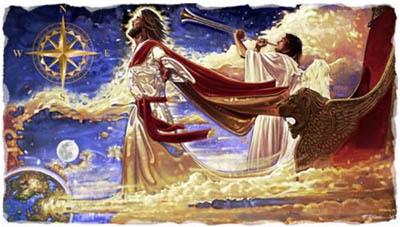
Song… The Signature of Yah is Still Written There
Further Study
The Sun was Darkened From the Sixth to the Ninth Hour
Evidence the Full Moon Announces Lunar Months